
Advanced Rolling Techniques
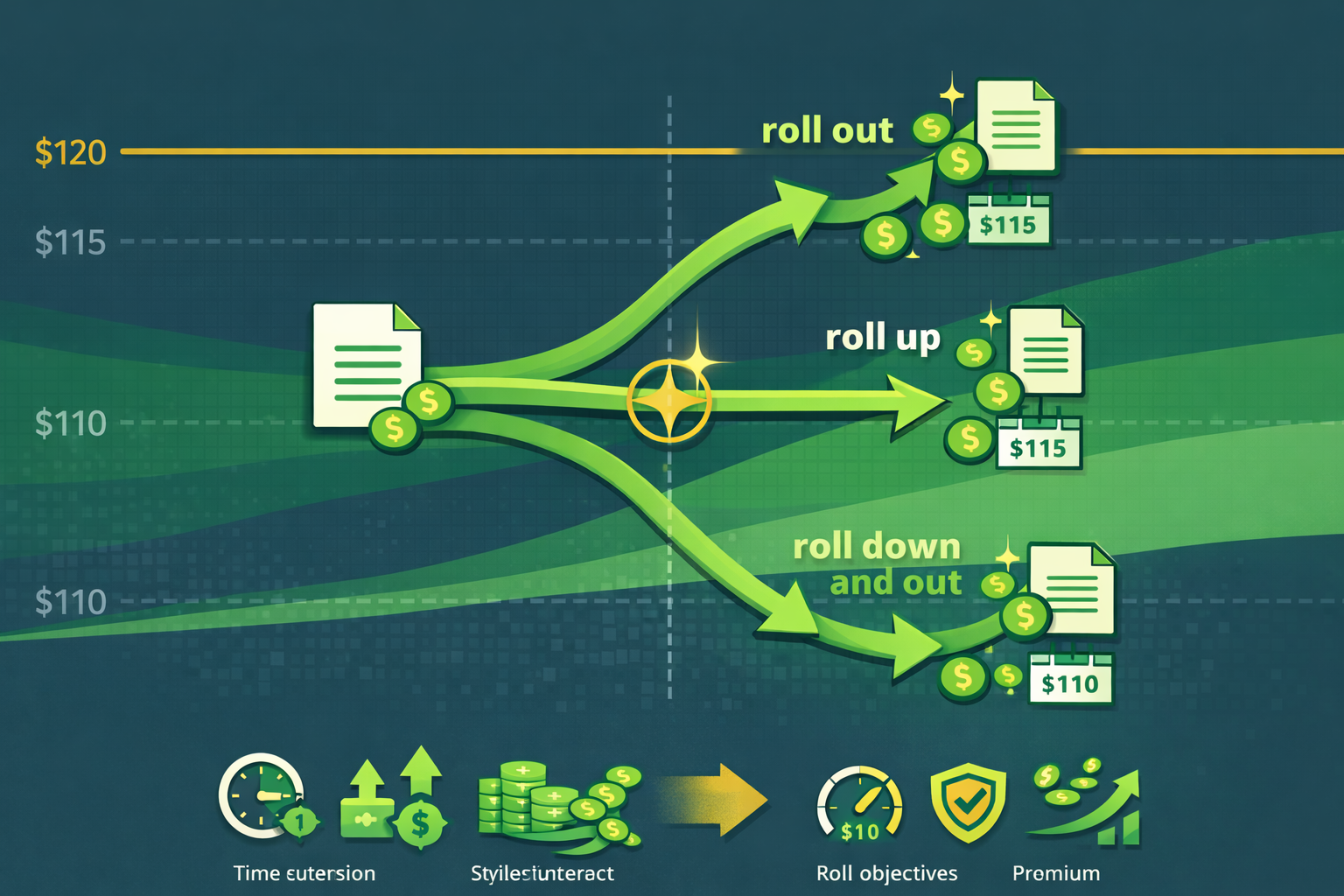
Rolling an option means closing your current position and opening a new one with a different strike, expiration, or both. Basic rolling is straightforward: roll a covered call out in time to avoid assignment. Advanced rolling is strategic: you use rolls to lower cost basis, adjust to valuation changes, and extract more premium while staying disciplined. Here's how to roll with precision.
TL;DR
- Rolling isn't avoiding mistakes: It's adjusting positions to match changing valuation or market conditions
- Three dimensions to roll: Time (later expiration), strike (higher or lower), or both, each serves a different purpose
- Roll covered calls up and out: When the stock rises near fair value, extend time and raise strikes to capture more upside
- Roll puts down and out: When a stock you want to own drops further, lower the strike and extend time to improve entry
- Always net a credit: Rolling should collect more premium or reduce cost basis, never add capital without clear benefit
The Three Types of Rolls
Every roll adjusts one or more of three variables: strike price, expiration date, and premium collected. Understanding which to change and when separates basic rolling from advanced technique.
Rolling out (time only): You keep the same strike but push expiration further. Example: You sold a $110 covered call on "QualityCo" (stock at $105) expiring in 7 days. The stock hasn't moved much. You roll the $110 call from 7 days to 37 days, collecting $1.50 extra credit. Same strike, more time, more premium. Use this when your valuation thesis hasn't changed but you need more time for the trade to work.
Rolling up (strike only): You raise the strike without changing expiration. Rare, but useful when the stock jumps faster than expected. Example: QualityCo jumps from $105 to $112 overnight (earnings beat). Your $110 call (7 days left) is deep in-the-money. You roll to a $115 call (same expiration) for a $2 debit. Now you capture $5 more upside if assigned, worth the small cost. Use this when the stock moves above your fair value target and you want to keep exposure.
Rolling down (strike only): You lower the strike, usually on puts. Example: You sold a $95 put on QualityCo (stock at $100). The stock drops to $90, and your put is in-the-money. You roll down to a $90 put (same expiration) for a $3 credit. Now you own shares at $90 instead of $95 if assigned, a better entry. Use this when the stock becomes more attractive at a lower price.
Rolling out and up: Extend time and raise strikes (covered calls). Example: Your $110 call (7 days, stock at $108) is close to assignment. You roll to a $115 call (37 days) for $2 credit. More time, higher strike, more premium. Use this when you want to delay assignment and keep income flowing.
Rolling out and down: Extend time and lower strikes (puts). Example: Your $95 put (7 days, stock at $88) is in-the-money. You roll to a $90 put (37 days) for $2 credit. Better entry price, more time, more premium. Use this when you still want the stock but at a better price.
Rolling Covered Calls: Up and Out
Covered calls generate income, but assignment caps upside. Advanced rolling delays assignment while extracting more premium and raising your exit price.
Let's say you own QualityCo at $100, sold a $108 covered call (30 days), and collected $3 ($300 premium). The stock rises to $107 with 7 days left. Your call is worth $2 (intrinsic value $0, extrinsic $2). If assigned, you sell at $108, locking in $8 per share profit plus $3 premium = $11 total ($1,100).
But what if fair value is $120, and you want more upside? Roll the call.
Step 1: Buy back the $108 call for $2 (cost $200). Step 2: Sell a new $112 call (37 days) for $4 (collect $400). Net credit: $200 ($400 collected - $200 spent). New position: $112 strike, 37 days out, $2 more premium collected.
Now if the stock rises to $112, you sell at $112 (not $108), gaining $4 more per share ($400 extra). Total profit: $12 (stock gain) + $5 (original $3 + rolled $2 credit) = $17 per share ($1,700 vs. $1,100 without rolling). You delayed assignment, collected more premium, and increased upside.
When to roll up and out:
- Stock approaches your short strike with more than 5 days to expiration
- Fair value is still 10%+ above current price
- You can collect net credit (or spend less than 20% of the premium you'd lose by closing)
- Implied volatility is stable or rising (better premiums on new calls)
When NOT to roll:
- Stock is at or above fair value. Let assignment happen, take profits, redeploy capital
- You're spending a debit to roll and the new strike doesn't improve your outcome meaningfully
- Rolling becomes a habit to avoid taking profits. Sometimes selling is the right move
Rolling Cash-Secured Puts: Down and Out
Puts are limit orders with income. You want to buy QualityCo at $95, so you sell a $95 put for $3. The stock drops to $88, and your put is in-the-money. You have two choices: take assignment and own shares at $95, or roll the put lower to improve your entry.
Rolling down and out works when your valuation thesis improves (the stock is more attractive at $88 than $95) or when you want to give the stock more time to recover before taking ownership.
Example: QualityCo drops from $100 to $88. Your $95 put (7 days left) is worth $8 ($7 intrinsic + $1 extrinsic). Fair value is $110, so owning at $88 is even better than $95.
Step 1: Buy back the $95 put for $8 (cost $800). Step 2: Sell a new $90 put (37 days) for $5 (collect $500). Net debit: $300 ($800 spent - $500 collected). New position: $90 strike, 37 days out, $5 new premium.
Now if assigned, you own shares at $90, not $95, saving $5 per share ($500). Your total cost basis: $90 (strike) - $3 (original premium) - $5 (rolled premium) + $3 (net debit from rolling) = $85 effective cost. Without rolling, your cost basis would be $92 ($95 strike - $3 premium).
When to roll down and out:
- Stock drops but your valuation thesis is intact or improved
- You still want to own shares, just at a better price
- You can collect enough premium on the new put to offset most or all of the rollover cost
- Implied volatility is elevated (better premiums on new puts)
When NOT to roll:
- The stock drops because the business fundamentals deteriorated. Don't roll into a value trap
- You're paying a large debit to roll and the new strike doesn't offer a meaningful improvement
- You no longer want the stock. Close the put, take the loss, move on
Rolling LEAPs for Long-Term Holding
LEAPs (long-dated calls) give leveraged exposure to wonderful companies. As expiration approaches, theta accelerates (time decay speeds up). Rolling the LEAP extends your exposure and resets the theta clock.
Let's say you own a $90 LEAP on QualityCo (18 months to expiration, bought at $15 per share, $1,500 total). The stock is at $105, and your LEAP is worth $20 (10 months left). You've gained $500 ($2,000 current value - $1,500 cost). Fair value is $130, and you want to hold longer.
Option 1: Close the LEAP, take the $500 profit. Taxable event, and you lose exposure. Option 2: Roll the LEAP to a new expiration.
Step 1: Sell the current $90 LEAP (10 months left) for $20 (collect $2,000). Step 2: Buy a new $90 LEAP (24 months out) for $22 (cost $2,200). Net debit: $200 ($2,200 cost - $2,000 received). New position: $90 strike, 24 months out, fresh theta clock.
Now you have 24 more months for QualityCo to reach $130. Your cost basis is $1,700 ($1,500 original + $200 roll cost). If the stock rises to $130 over the next year, your LEAP could be worth $40+ ($4,000), a $2,300 gain on $1,700 invested (135% return). Without rolling, you'd have closed at $500 profit (33% return).
When to roll LEAPs:
- 6-9 months before expiration, when theta accelerates
- Stock hasn't reached fair value and your thesis is intact
- You can roll for a reasonable debit (less than 20% of current LEAP value)
- Implied volatility on new LEAPs is similar or lower than current contract
When NOT to roll:
- Stock is at or above fair value. Take profits and redeploy
- Theta decay exceeds the premium you're collecting from covered calls (if using poor man's covered call strategy)
- You're rolling to avoid admitting the trade didn't work. Be honest about results
Preserving Valuation Discipline While Rolling
Rolling is a tool, not a goal. Every roll should align with your valuation thesis. If you're rolling just to avoid assignment or defer losses, you're trading, not investing.
Valuation checkpoint before rolling:
- What's the company's current intrinsic value? (use Wall St Yardie app or your preferred model)
- Where's the stock trading relative to fair value?
- If assigned (calls) or if you take ownership (puts), does it still fit your portfolio?
- Is rolling adding to your position in a wonderful company, or delaying exit from a mediocre one?
Example: Covered call on overvalued stock. You own QualityCo at $80, sold a $100 call, and the stock is at $105 (fair value $95). The call is deep in-the-money. Rolling up to $110 would collect premium, but you'd be holding an overvalued stock. Better move: let assignment happen. Take profits. Find a new opportunity.
Example: Put on deteriorating business. You sold a $50 put on "FadingCo" when it seemed undervalued. The stock drops to $40, and you discover earnings are collapsing. Rolling down to a $45 put just locks you into a bad business. Better move: close the put, take the loss, preserve capital.
Rolling is powerful when combined with discipline. It's dangerous when used to avoid reality.
What Could Go Wrong?
- Rolling to avoid admitting mistakes: If the business deteriorated, rolling doesn't fix it, it just delays the loss while adding cost
- Death by a thousand rolls: Rolling repeatedly on the same position can pile up small debits that erase your gains
- Ignoring valuation: Rolling a covered call on an overvalued stock caps your exit at an even worse price
- Transaction costs add up: Every roll involves two trades (close old, open new), and commissions plus spreads can cost $20-50 per roll
- Emotional attachment: Rolling because you "don't want to let go" of a stock leads to poor decisions and missed opportunities
Mitigation: Set rules before entering a trade. Example: "I'll roll covered calls only if the stock is still 10%+ below fair value." Or: "I'll roll puts only if the valuation thesis improves." Journal every roll and track whether it improved your outcome. If more than 30% of your rolls hurt results, stop rolling and reassess.
Next Steps
- Master when to use advanced strategies before rolling frequently
- Understand poor man's covered call rolling dynamics
- Learn layering calls to reduce rolling frequency
- Review covered call basics before rolling
- Explore valuation principles to guide rolling decisions
Rolling is one of the most powerful advanced techniques. It gives you flexibility to adjust to changing conditions, extract more premium, and improve entries or exits. But it only works when guided by valuation and discipline. Roll with a plan, not emotion. Track results, and be honest when rolling makes things worse, not better.
*Disclaimer: This content is for educational purposes only and does not constitute financial advice. Past performance does not guarantee future results. Always conduct your own research before investing.*