
Layering Covered Calls Over Time
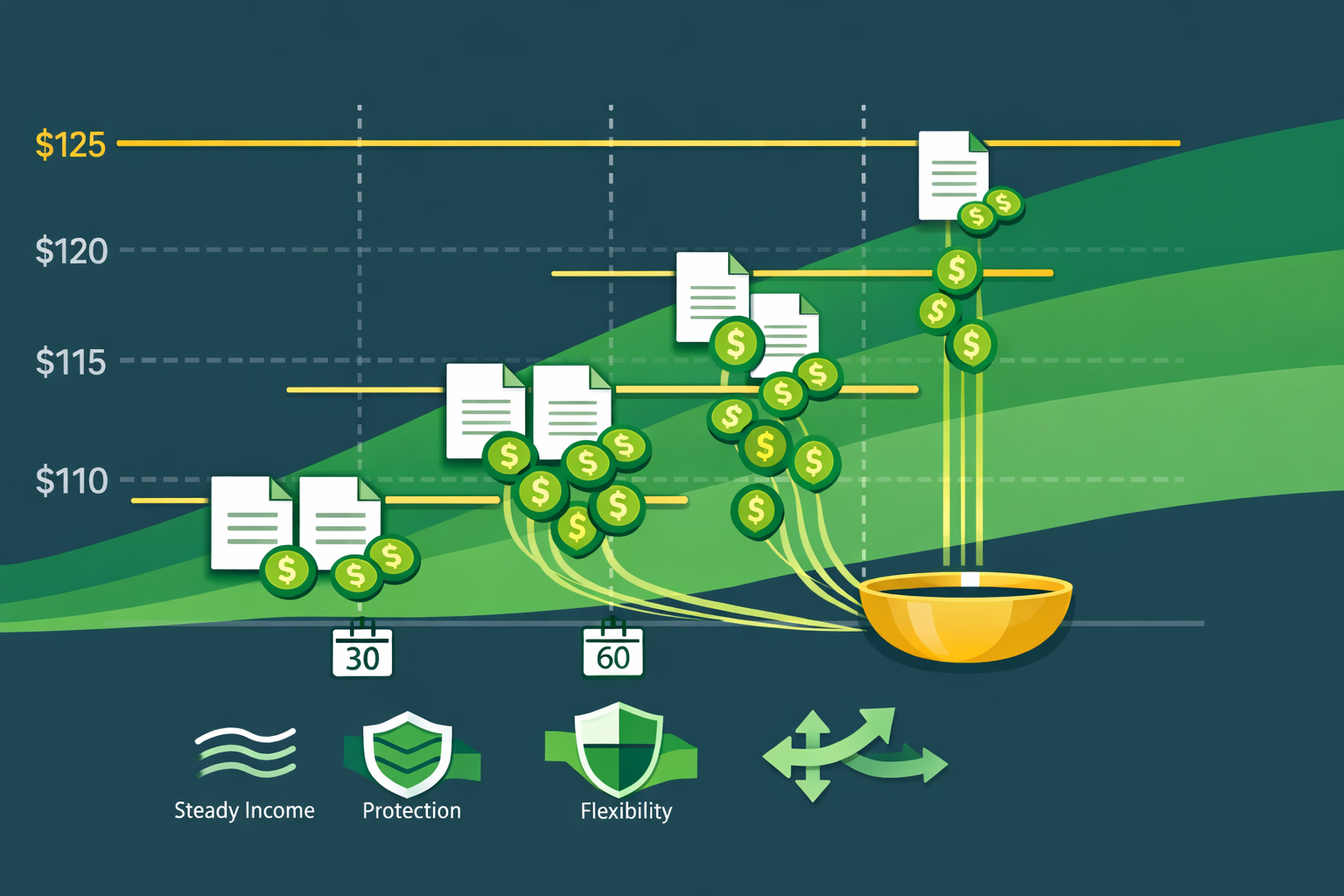
Selling one covered call per month works, but it creates lumpy income and binary assignment risk. If the stock jumps on one expiration day, you lose all your upside at once. Layering covered calls across multiple expirations smooths income, reduces volatility, and gives you more control over when and how shares get called away. Here's how to layer strategically.
TL;DR
- Spread contracts across time: Instead of selling one 30-day call, sell three calls across 30, 60, and 90 days to smooth income
- Reduce binary assignment risk: If the stock spikes, only one contract gets assigned, not all your shares at once
- Match strikes to valuation: Layer strikes around your fair value estimate so calls closer to expiration are tighter, further out are higher
- Requires more contracts: Layering works best with at least 300 shares (three contracts minimum), less than that adds complexity without benefit
- Track carefully: Managing multiple expirations requires discipline and journaling to avoid confusion
The Problem with Single-Expiration Covered Calls
Traditional covered call strategy: you own 500 shares of "QualityCo" at $100 (trading at $105), and you sell five $110 calls expiring in 30 days for $2.50 each ($1,250 total premium). Simple, consistent income.
But what happens if QualityCo jumps to $115 on day 29? All five contracts get assigned. You sell 500 shares at $110, locking in $10 per share gain ($5,000) plus $1,250 premium. Total profit: $6,250. Not bad.
The problem: you wanted to hold QualityCo longer because fair value is $125. That $5 per share you missed ($115 to $120, let's be conservative) costs you $2,500 in upside. And now you have $55,000 in cash to redeploy, creating a taxable event and timing pressure.
Secondary problem: If the stock stays at $106 on day 30, all five calls expire worthless. You keep the premium, but you made zero capital gains. Your income was $1,250 for the month. Next month, if the stock drops to $102, premiums shrink and you collect less. Income becomes unpredictable.
Layering fixes both problems.
How Layering Works
Instead of selling all five contracts at the same expiration, you stagger them across multiple dates. Example: Sell two calls at 30 days, two at 60 days, one at 90 days. Now your income and assignment risk are spread over time.
Let's use QualityCo at $105, fair value $125. You own 500 shares. Here's how to layer:
Layer 1 (30 days, 2 contracts): Sell two $110 calls for $2.50 each ($500 premium). Layer 2 (60 days, 2 contracts): Sell two $115 calls for $3.00 each ($600 premium). Layer 3 (90 days, 1 contract): Sell one $120 call for $3.50 ($350 premium).
Total premium collected upfront: $1,450 (vs. $1,250 with single expiration). Strikes: Staggered from $110 to $120, aligned with valuation. Expirations: 30, 60, 90 days out.
Now what happens if QualityCo jumps to $115 in week 3?
Result: The two 30-day calls ($110 strike) get assigned. You sell 200 shares at $110. The two 60-day calls ($115 strike) are at-the-money, you can roll them up and out or let them ride. The one 90-day call ($120 strike) is still out-of-the-money, untouched. You keep 300 shares with upside to $120, and you collected $1,450 in premium across all layers.
Compare that to the single-expiration approach: all 500 shares gone at $110, upside capped entirely.
Benefits of Layering
Smoother income: Instead of collecting $1,250 once per month, you collect $500 (30-day), $600 (60-day), and $350 (90-day) in rolling intervals. Some contracts expire, others get assigned, others get rolled. Income becomes more predictable over time.
Reduced assignment shock: If the stock spikes, you only lose part of your position, not all of it. You can adjust the remaining calls (roll up, close, or let expire) while keeping exposure.
Better alignment with valuation: Layering lets you match strikes to time. Shorter-term calls can be tighter to current price (collect more premium), longer-term calls can be higher (capture upside if the stock re-rates toward fair value). Single-expiration forces you to pick one strike for all contracts, less precise.
More flexibility to adjust: With three expirations, you can roll one layer without touching the others. Example: The 30-day calls are in-the-money, so you roll them up and out to 60 days. The 60-day and 90-day calls stay untouched. Less work than rolling five contracts at once.
How to Structure Layers
The key is balancing strikes, expirations, and position size to match your valuation thesis and risk tolerance.
Step 1: Define your fair value range. Let's say QualityCo trades at $105, fair value is $125, and you're comfortable selling shares between $115 and $125. That's your target band for strikes.
Step 2: Allocate contracts across time. Divide your position (500 shares = 5 contracts) into three layers: 40% (2 contracts) short-term, 40% (2 contracts) medium-term, 20% (1 contract) long-term. Why this ratio? You want most income from near-term contracts (higher theta, faster decay), but keep some exposure long-term (capture re-rating if valuation improves).
Step 3: Set strikes progressively higher. Short-term (30 days): $110 strike (closer to current price, higher premium). Medium-term (60 days): $115 strike (midpoint of valuation band). Long-term (90 days): $120 strike (closer to fair value, lower premium but more upside).
Step 4: Adjust as contracts expire or approach assignment. When the 30-day calls expire worthless, sell new 30-day calls at updated strikes. When they get assigned, either let shares go or roll up and out. The medium and long-term layers stay in place, providing continuity.
Example: 3-Month Layering Strategy
QualityCo at $105, fair value $125. You own 500 shares at $100 (cost basis).
Month 1 setup:
- Sell 2x $110 calls (30 days) for $2.50 = $500
- Sell 2x $115 calls (60 days) for $3.00 = $600
- Sell 1x $120 call (90 days) for $3.50 = $350
- Total premium: $1,450
Month 1 outcome: Stock stays at $107. The 2x $110 calls expire worthless. You keep $500. The 60-day and 90-day calls remain open. You now sell 2 new 30-day calls at $110 for $2.50 ($500 more). Total income for Month 1: $500 (expired calls).
Month 2 outcome: Stock rises to $114. The new 2x $110 calls (30 days) are in-the-money, assigned. You sell 200 shares at $110 for $10 per share profit ($2,000) plus $500 premium. The 2x $115 calls (now 30 days left) are at-the-money. You roll them to $118 (60 days) for $1 credit ($200). The 1x $120 call (30 days left) is still out-of-the-money. Total income for Month 2: $2,500 (profit + premium from assigned calls) + $200 (roll credit).
Month 3 outcome: Stock reaches $122. The rolled 2x $118 calls (now 30 days) get assigned. You sell 200 more shares at $118 for $18 per share profit ($3,600). The 1x $120 call gets assigned. You sell the last 100 shares at $120 for $20 profit ($2,000). All shares sold. Total income for Month 3: $5,600 (profit from assignments).
3-month summary: Collected $1,450 (initial premiums) + $500 (Month 1) + $2,500 (Month 2 assignments) + $200 (roll credit) + $5,600 (Month 3 assignments) = $10,250 total. Average monthly income: $3,417.
Compare to single-expiration: If you'd sold all 5 contracts at $110 (30 days) in Month 1, you'd have been assigned immediately when the stock hit $114 in Month 2. You'd have sold all 500 shares at $110, total profit $10 per share ($5,000) plus $1,250 premium = $6,250. Layering captured $4,000 more by staggering exits.
When Layering Makes Sense
Layering isn't for everyone. It adds complexity, requires tracking multiple positions, and works best with larger holdings.
Use layering when:
- You own at least 300 shares (3+ contracts). Less than that, the effort outweighs the benefit
- The stock is volatile and assignment timing is uncertain. Layering spreads risk
- Fair value is significantly higher than current price (20%+ upside). You want to capture re-rating over time, not all at once
- You're committed to holding the stock long-term and want to generate income without giving up all your position quickly
- You can monitor positions weekly and adjust as needed. Layering requires active management
Don't use layering when:
- You own fewer than 300 shares. Just sell one or two calls per month, keep it simple
- The stock is at or above fair value. Let assignment happen, take profits, move on
- You're new to covered calls. Master single-expiration strategies for a year before layering
- You don't have time to track multiple expirations. Missed adjustments can cost you
Managing Layered Positions
Track each layer separately. Use a spreadsheet or journal. Columns: Expiration date, Strike, Contracts, Premium collected, Status (open/closed/assigned). Update weekly.
Roll expiring layers first. Focus on contracts expiring soonest. If they're in-the-money, decide: roll up and out, let assignment happen, or close and take profit. Don't touch longer-dated layers unless they're deep in-the-money.
Adjust strikes as valuation changes. If fair value drops (company reports weaker earnings), lower strikes on new layers. If fair value rises (business accelerates), raise strikes. Layering gives you flexibility to adapt without disrupting the entire position.
Avoid over-layering. More than three expirations gets messy. Stick to 30, 60, 90 days. Beyond that, tracking becomes a job.
What Could Go Wrong?
- Complexity overwhelms you: Managing three expirations plus rolling means more decisions, more tracking, more stress. If it's not improving results by 20%+, simplify
- Transaction costs pile up: Every roll or adjustment costs commissions plus bid-ask spread. On small positions, this eats gains
- Missed adjustments lose money: If you forget to roll an expiring layer, you might get assigned when you didn't want to, or miss premium collection
- Overconfidence in upside: Layering tempts you to hold longer and set higher strikes. If fair value is wrong, you cap income and delay profitable exits
- Tax complexity: Multiple assignments over time create more taxable events to track. Consult a tax advisor if you're trading large positions
Mitigation: Start simple. Layer just two expirations (30 and 60 days) before adding a third. Track everything in a spreadsheet. Set calendar reminders for expiration weeks. Review results monthly. If layering doesn't beat single-expiration by at least 15-20% after six months, go back to basics.
Next Steps
- Understand advanced rolling to manage layered calls
- Learn when to use advanced strategies like layering
- Review covered call strike selection basics
- Master covered call management
- Explore portfolio construction with multiple strategies
Layering covered calls is a powerful technique for smoothing income and reducing binary assignment risk. It works best with larger positions, patient investors, and disciplined tracking. When done right, layering captures more upside, generates consistent cash flow, and keeps you in control of your exits. When overdone, it creates stress and complexity without improving results. Start simple, track everything, and scale up only when the benefits are clear.
*Disclaimer: This content is for educational purposes only and does not constitute financial advice. Past performance does not guarantee future results. Always conduct your own research before investing.*