
When to Use Advanced Strategies
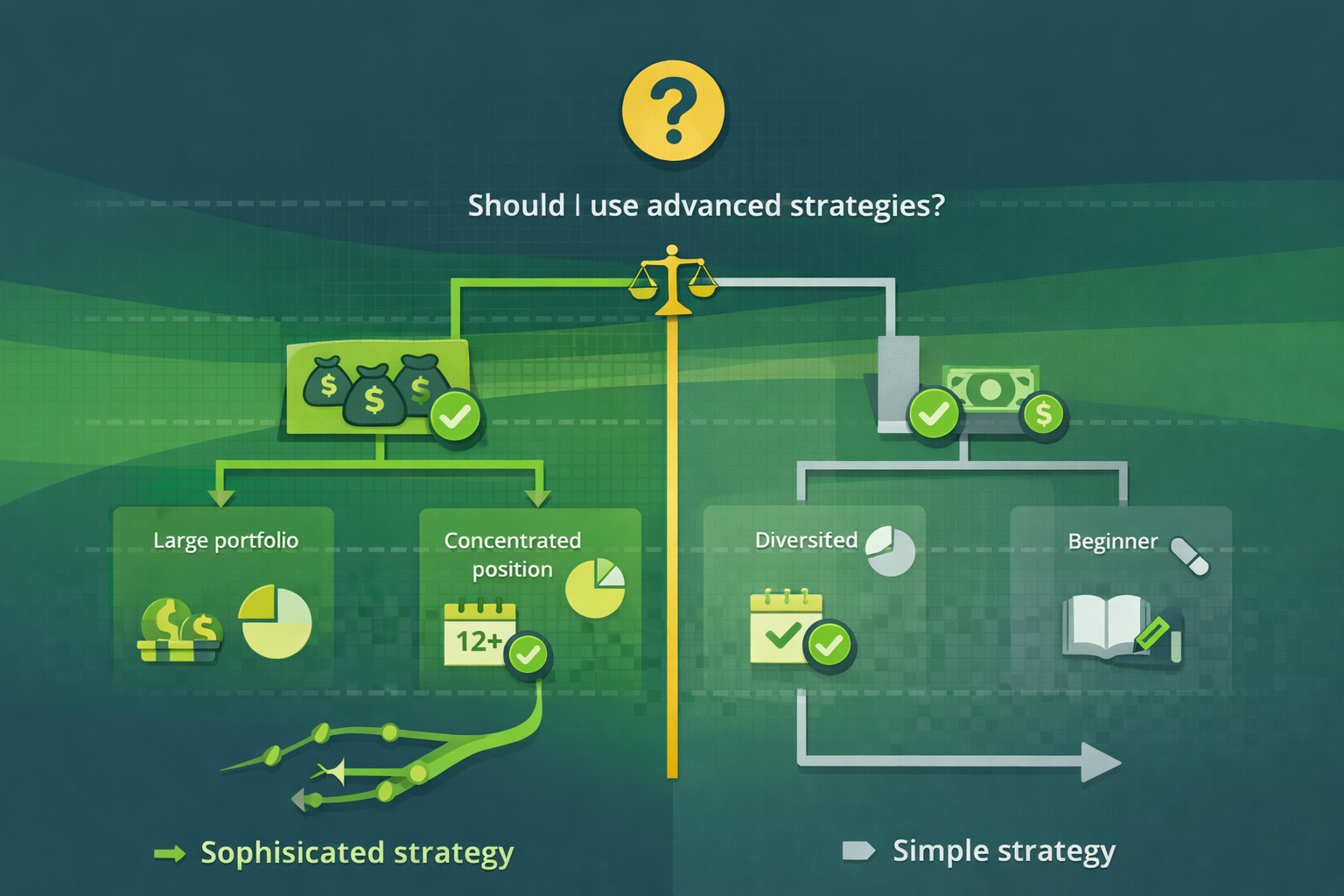
Advanced strategies aren't for every investor or every situation. Using them at the wrong time adds risk without reward. The right time? When they solve a specific problem that simpler tools can't fix, and when you have the experience to execute without stress. Here's how to know when advanced makes sense.
TL;DR
- Portfolio size matters: Advanced strategies work best with at least $100,000 in capital, smaller accounts benefit more from simplicity
- Concentrated positions need precision: If you hold more than 20% in a single stock, advanced tools help manage risk better
- Experience is non-negotiable: You should master basic covered calls and puts for at least a year before going advanced
- Specific problems require specific tools: Use advanced strategies to solve clear issues like cost basis reduction, scaling entries, or hedging concentrated risk
- Simplicity wins if outcomes are equal: If a basic strategy gets you 90% of the result, don't add complexity for the extra 10%
When Portfolio Size Justifies Complexity
Advanced strategies require enough capital to spread risk and absorb transaction costs. With a small portfolio, the benefits disappear under commissions and bid-ask spreads.
Let's say you have $20,000 invested in two stocks. You own 100 shares of "QualityCo" at $100. A simple covered call generates $200 monthly ($2 premium). Layering three different expirations might add $30-50 per month, but now you're managing three positions, paying three commissions, and spending hours tracking. That extra $400-600 annually isn't worth the complexity.
Now imagine you have $150,000 across five positions. You own 500 shares of QualityCo (five contracts). Layering expirations generates meaningful extra income, maybe $2,000-3,000 annually, and the transaction costs are proportionally smaller. Suddenly the effort makes sense.
Threshold rule: Don't use advanced strategies unless they improve your return by at least 3-5% annually AND you have enough capital that transaction costs stay under 0.5% of the strategy's income or savings.
When Concentrated Positions Need Precision
If you hold 20% or more of your portfolio in a single stock, basic strategies might not give you enough control. Advanced tools let you manage risk with precision.
Example: You own 1,000 shares of QualityCo at $90 (50% of your $180,000 portfolio). The stock trades at $110, above your fair value estimate of $105. You want to trim exposure but avoid triggering a big tax bill or selling too fast.
Basic approach: Sell 200 shares, or sell two covered calls at $115. Works, but crude. If the stock drops to $95, you wish you'd kept more. If it jumps to $125, you regret not capping more upside.
Advanced approach: Layer covered calls across three strikes and three expirations. Sell three calls at $110 (30 days), three at $115 (60 days), and two at $120 (90 days). Now you trim exposure gradually, generate $4,000-5,000 in premium over three months, and keep flexibility to adjust if valuation changes. If the stock drops, roll down. If it runs, you lock gains at different levels. Precision.
This kind of control matters when the position is large enough that mistakes hurt. For a $10,000 position (5% of portfolio), basic tools are fine. For a $90,000 position (50%), advanced is justified.
When Experience Makes Execution Automatic
Advanced strategies require split-second decisions, rolling positions, managing Greeks, and staying calm during volatility. If you're still learning, that stress kills results.
Experience threshold: You should have at least one year of consistent, profitable results with covered calls, cash-secured puts, and basic LEAPs before trying advanced tactics. Why? Because advanced strategies amplify both skill and mistakes.
Let's say you're new and try a poor man's covered call (LEAP + short call). The underlying stock drops 15% in two weeks. You panic. Do you roll the short call? Close the LEAP? Buy a protective put? Without experience, you freeze or make the wrong move. An experienced investor knows: check the valuation, if the business is still wonderful and the drop is noise, roll the short call down and out, collect more premium, and wait.
Experience turns complexity into routine. If managing a basic covered call still feels stressful, don't go advanced.
When You're Solving a Specific Problem
Advanced strategies are tools, not goals. Use them to solve clear problems that simpler methods can't fix.
Problem 1: High cost basis. You bought QualityCo at $120, it trades at $100. Selling covered calls at $105 generates income but doesn't lower your cost basis fast enough.
Advanced solution: Sell multiple covered calls at different strikes and expirations. Layer $102, $105, $108 strikes across 30, 60, 90 days. Collect $6-8 per share over three months instead of $2-3 in one month. Lower cost basis faster without capping upside too tightly.
Problem 2: Scaling into a position. You want to buy 500 shares of QualityCo at $95, but you don't want to deploy $47,500 all at once. Selling one put at $95 helps, but it's binary, you either get 100 shares or none.
Advanced solution: Sell five puts at different strikes, $93, $94, $95, $96, $97, with staggered expirations. Collect $2-3 per contract. Now you scale in gradually, own shares at different prices, and generate income along the way. More control, same discipline.
Problem 3: Concentrated risk in a volatile stock. You own 800 shares of QualityCo (40% of portfolio). You believe in the business long-term but worry about a 20-30% correction.
Advanced solution: Buy protective puts at $95 (insurance), fund them by selling covered calls at $115 (income). Net cost might be $1 per share ($800 total). Now you cap downside to 14% (if the stock drops to $95) while still participating in gains up to $115. Without this, a 30% drop costs you $33,000 in paper losses.
Notice the pattern: each advanced strategy solves a specific, measurable problem. If you can't name the problem clearly, stay simple.
When Simplicity Would Leave Money on the Table
The flip side: don't use advanced strategies if the simple version gets you 90% of the way there. Sophistication for sophistication's sake is waste.
Example: You own QualityCo at $100, it trades at $110, fair value $115. You want income. A single covered call at $115 generates $3 per share, $300 monthly. Layering three expirations might add $50-100 more. Is that worth the extra tracking, commissions, and mental load? Probably not unless you have five or ten contracts.
Decision rule: Only use advanced if it improves your outcome by at least 20% compared to the simple version, after accounting for costs and effort. If a basic covered call gives you $300/month and advanced gives you $330, stick with basic. If advanced gives you $400, it's worth considering.
Signals That You're Ready
Here's a quick checklist:
- You've been trading options profitably for at least 12 months
- You understand how delta, theta, and implied volatility affect pricing without looking them up
- You can explain your strategy in one sentence to a non-investor
- You have at least $100,000 in investable assets
- You hold at least one concentrated position (20%+ of portfolio) that needs precision risk management
- You have a specific problem (cost basis, scaling, hedging) that simple strategies can't solve
- You track every trade in a journal and review results monthly
- Managing basic strategies (covered calls, cash-secured puts) feels routine, not stressful
If you check all of those, you're ready to explore advanced tools. If you check fewer than five, stay with the basics.
What Could Go Wrong?
- Using advanced too early costs money: New investors often lose more from execution mistakes than they gain from sophistication
- Overestimating your skill: What looks easy in theory becomes stressful in real time, especially during volatility
- Adding complexity without solving a problem: If you can't name the specific issue you're fixing, the strategy is probably unnecessary
- Transaction costs eat gains: Advanced strategies mean more trades, and commissions plus spreads can erase the extra income
- Distraction from fundamentals: Focusing on execution can pull you away from valuation and business quality, the real drivers of returns
Mitigation: Start with paper trading. Test the advanced version for three months alongside your simple version. Compare results honestly. If the advanced version improves outcomes by 20% or more after costs, adopt it. If not, stay simple.
Next Steps
- Understand what makes a strategy truly advanced
- Learn the poor man's covered call for capital efficiency
- Master rolling techniques before layering positions
- Review basic covered call discipline
- Check if you understand protective puts well enough
Advanced strategies are power tools. In the right hands, they make investing safer and more efficient. In the wrong hands, they create expensive mistakes. Know when you're ready, know what problem you're solving, and stay honest about results. When in doubt, simple wins.
*Disclaimer: This content is for educational purposes only and does not constitute financial advice. Past performance does not guarantee future results. Always conduct your own research before investing.*