
Managing Covered Calls
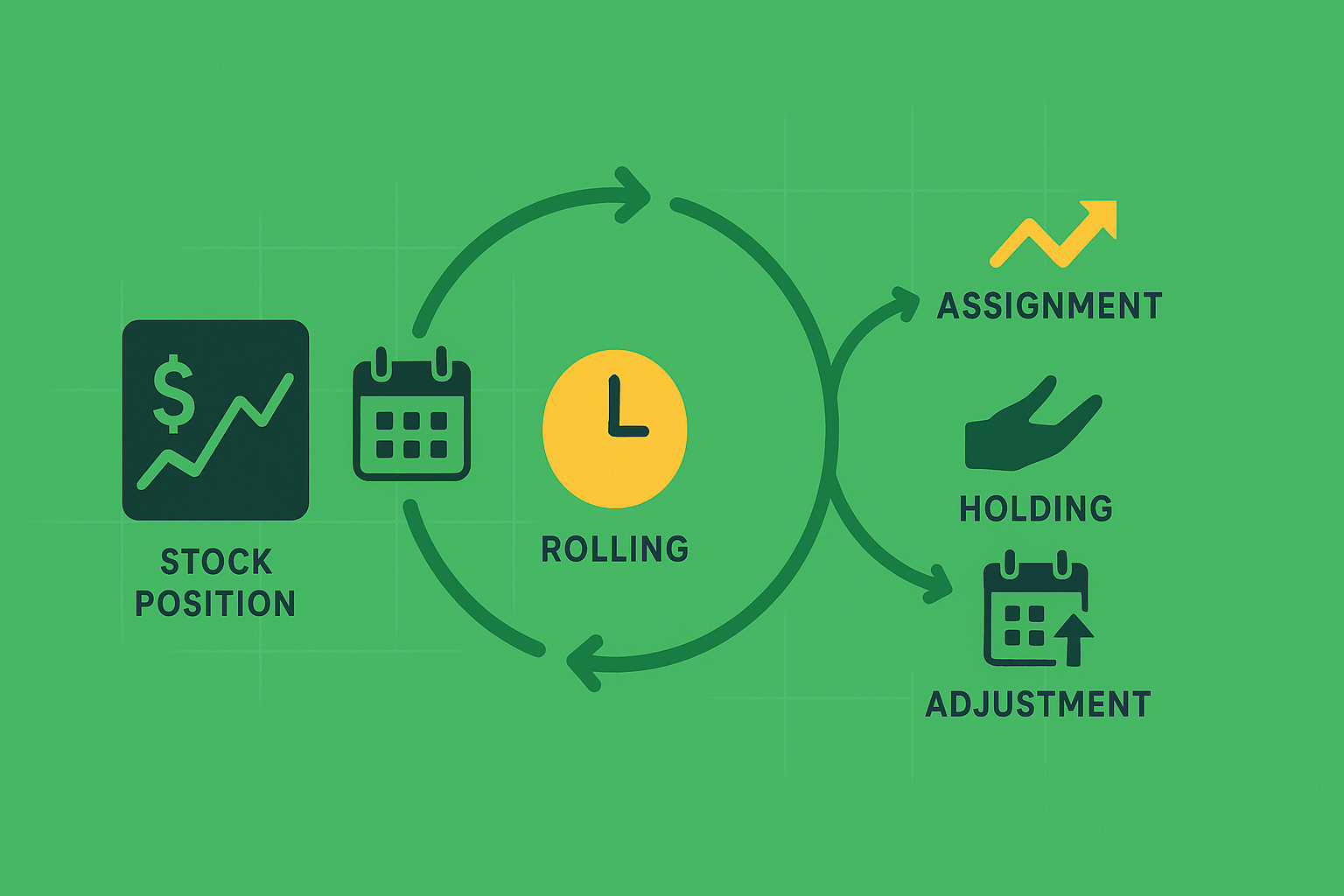
Selling a covered call is the easy part. Managing what happens next separates beginners from consistent income generators. When the stock drops, surges, or sits still, you need a plan. Rolling, adjusting, and handling assignments aren't complicated, but they require discipline.
TL;DR
- Let winners go: Accept assignment as success when your stock hits the strike at a profit
- Roll up and out: If the stock surges and you want to keep it, buy back the call and sell a higher strike further out
- Close early: If the call loses 80-90% of its value, buy it back and sell a new one
- Don't chase losses: If the stock drops hard, stop selling calls and reassess the business fundamentals
- Track dividends: Buy back calls before ex-dividend dates if time value is low to keep the dividend
When to Do Nothing
This is the most important rule: most of the time, you should do nothing.
You sold a $50 call on stock you bought at $45. If expiration arrives and the stock is at $48, the call expires worthless. You keep your shares, you keep the premium, you're ready to sell another call. Perfect trade, zero management required.
The "do nothing" zone:
- Stock stays below the strike price
- No major news affecting the company
- Dividends aren't approaching
- You're still happy to own the stock long-term
When the trade works as planned, don't mess with it. New traders over-manage positions, creating unnecessary costs and complexity. If it ain't broke, don't touch it.
Rolling Up and Out (Stock Surges)
Your stock rockets past your strike price. You sold $50 calls with 30 days to go, and now the stock is at $56 with two weeks until expiration. You'll get assigned soon, but you don't want to sell because you think fair value is $65.
The roll:
- Buy back the $50 call (might cost $650, it's now in-the-money)
- Sell a $58 call expiring 30-45 days later (collect $300)
- Net cost: $350 ($650 paid - $300 collected)
Now you've reset your position. You spent $350 to keep the stock and move your exit point from $50 to $58, giving you more upside potential.
When rolling makes sense:
- Stock is still undervalued by your analysis
- You collected enough premium on the original call to offset the roll up cost
- The new strike still represents a profit you're happy with
- Company fundamentals remain strong
When rolling doesn't make sense:
- You're chasing the stock higher every month, paying commissions and widening spreads
- The stock is at or above fair value (just let it go, assignment is success)
- You're trying to "rescue" a losing position by rolling to avoid assignment
- You've rolled three times already, accept defeat and move on
Closing Early (When Time Value Decays)
A covered call you sold for $200 is now worth $20 with two weeks until expiration. You've captured 90% of the premium. Should you wait for expiration or close now?
Close it and sell a new one.
Here's the math:
- Original premium: $200
- Current value: $20
- Buy it back for $20, capturing $180 profit
- Sell a new call for next month at $180
- Total premium over two periods: $360 instead of $200
By closing early and recycling your position, you're capturing more premium per month than waiting for expiration. This is called "premium harvesting."
The guideline: When your short call loses 80-90% of its value and there's more than a week until expiration, consider buying it back and selling a new one for the next month.
Watch out for:
- Commission costs eating your gains (need at least $30-40 profit after costs)
- Stocks that are in strong bull market with momentum. The stock will continue to hit your strike
- Selling a strike below the price you bought the stock. This will lock in a loss.
Handling Assignments
Assignment is not failure. Assignment means your stock reached your target price and you made money. Accept it and move on.
When you get assigned:
- Shares are automatically sold from your account at the strike price
- Cash appears in your account (strike × 100 shares per contract)
- You keep all premiums collected from the call
- You realize capital gains (or losses) based on your original purchase price
Example:
- Bought 100 shares at $45 = $4,500
- Sold $52 call, collected $200 premium
- Assigned at $52 = receive $5,200
- Total profit: $700 capital gain + $200 premium = $900 (20% return)
That's success. You made 20% on capital deployed. Now find your next opportunity.
Don't:
- Chase the stock after assignment by buying it back at a higher price
- Feel like you "lost" because the stock kept rising (you made your target return)
- Try to predict where the stock goes next (that's speculation, not value investing)
Managing Around Dividends
This is where mistakes get expensive. You sell a $50 call on a stock paying a $1.00 quarterly dividend. Stock trades at $51, call is worth $150, ex-dividend is in three days.
If you don't act, you might get assigned before ex-dividend date. You lose the $100 dividend ($1 × 100 shares) to save $150 in call buyback cost. But you also lose the stock position entirely.
Decision tree:
If call is in-the-money (ITM) before ex-dividend:
- Calculate: Call time value vs. dividend value
- Time value = call price - intrinsic value
- If time value < dividend, expect early assignment
- Consider buying back the call to keep the dividend
Example:
- Stock at $51, strike at $50, call worth $140
- Intrinsic value: $100 ($51 - $50)
- Time value: $40 ($140 - $100)
- Dividend: $100
- Math: Pay $40 time value to keep $100 dividend = $60 net gain
- Action: Buy back the call before ex-dividend
If call is out-of-the-money (OTM) before ex-dividend:
- No early assignment risk (nobody exercises OTM calls)
- Keep the call, collect the dividend, no action needed
When the Stock Drops
Your stock bought at $45 drops to $38. You sold a $50 call for $200 that's now worth $10. You have a $700 loss on the stock, partially offset by $190 premium gain. What now?
First, reassess the business:
- Why did it drop? Temporary news or fundamental deterioration?
- Is fair value still $60, or has something changed?
- Would you buy more at $38 if you had cash?
If fundamentals are intact:
- Let the call expire worthless, keep the premium
- Sell another call at a lower strike ($45) to collect more premium, get at least 10% annual return
- Keep reducing your cost basis until the stock recovers or you exit at break-even
If fundamentals have deteriorated:
- Let the call expire worthless
- Stop selling calls
- Exit the position at $38, take the loss
- Move capital to a better opportunity
Don't:
- Keep selling calls to "get back to even" on a fundamentally broken company
- Roll calls down to lower strikes just to collect premium on a declining stock
- Convince yourself premiums compensate for business quality decline
What Could Go Wrong?
Rolling addiction: You roll positions three, four, five times to avoid assignment, paying commissions each time. Total costs exceed the original premium.
Mitigation: Set a rule: maximum two rolls per position. After that, accept assignment and move on. Don't chase the stock indefinitely.
Dividend assignment: You forget to check ex-dividend dates, get assigned, and lose a $200 quarterly dividend to save $50 in call buyback cost.
Mitigation: Set calendar alerts for ex-dividend dates on all stocks where you sell calls. Review positions 5-7 days before ex-dividend to decide whether to close.
Over-managing in choppy markets: Stock bounces between $48 and $52 weekly. You keep closing and reopening positions, paying commissions and spreads that eat all your premium.
Mitigation: In choppy markets, sell calls further out (60-90 days) and wider strikes (15-20% OTM) to reduce management needs. Accept lower premium for less stress.
Next Steps: Your Management Checklist
- Set calendar alerts for ex-dividend dates on all stocks where you sell calls
- Create a rule: maximum two rolls per position before accepting assignment
- When calls lose 80-90% value with 7+ days left, consider closing early and reselling
- Accept assignment as success when it happens at a profit above your cost basis
- Review business fundamentals when stocks drop, don't just chase premiums
- Track total costs (commissions + spreads) to ensure they're under 10% of premiums collected
- Use WSY app to verify fair value before rolling decisions
- Review related topics: covered call risks and volatility management
Managing covered calls is about discipline, not complexity. Let winners go, don't chase losers, harvest premium when it makes sense, and respect dividends. That's the whole game. Keep the riddim steady.
*Disclaimer: This content is for educational purposes only and does not constitute financial advice. Past performance does not guarantee future results. Always conduct your own research before investing.*