
When NOT to Use Options
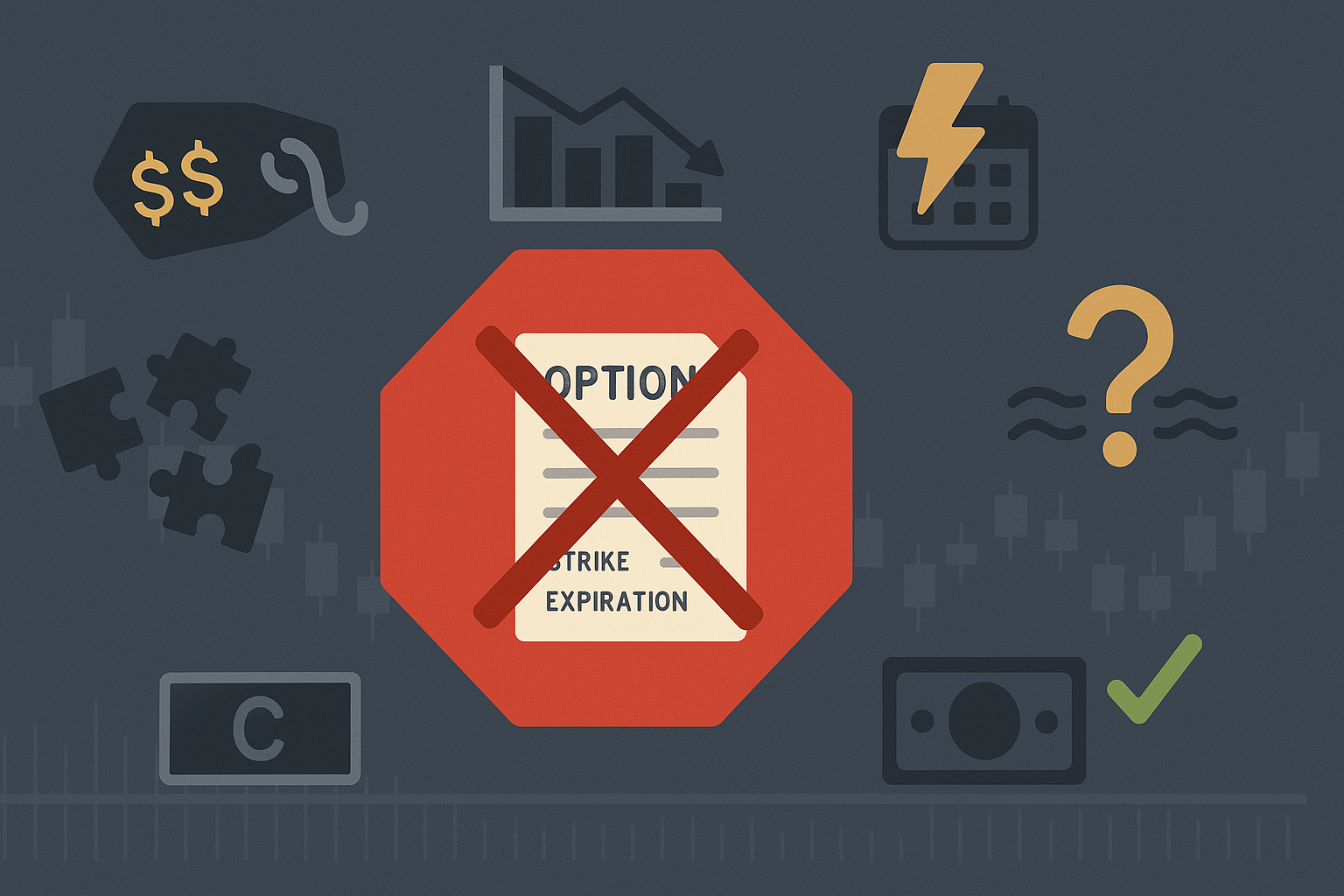
Options are powerful tools, but power used in the wrong context creates disaster. Selling puts on speculative stocks, using LEAPs on overvalued companies, or hedging a diversified portfolio with excessive premiums all violate the principles of value investing. Knowing when to skip options entirely is as important as knowing when to use them.
TL;DR
- Avoid options on bad businesses: no premium is worth owning declining companies, even "cheap" ones trading below book value
- Skip options during earnings or major news: implied volatility spikes make premiums expensive and outcomes unpredictable
- Don't use options when you lack conviction: if you wouldn't buy the stock outright, don't sell puts. If you wouldn't hold for years, don't use LEAPs
- Over-diversified portfolios don't need hedging: if no single stock is more than 5-10% of your portfolio, protective puts cost more than they save
- When in doubt, hold cash: dry powder beats forced trades. Sitting out is a valid strategy when valuations are stretched or opportunities are scarce
When the Business Is Broken
Options magnify outcomes, good or bad. If you sell puts on a deteriorating business, you're not getting paid to wait for value to emerge, you're catching a falling knife for pennies.
Example: Selling puts on a declining company
"RetailCo" is trading at $20, down from $40 two years ago. Revenue has fallen 15% annually, margins are shrinking, and debt is rising. The stock looks "cheap" at 8x earnings, and the $18 put pays $2 in premium (11% yield).
You sell the put, thinking "even if assigned, I'm buying at $16 effective price ($18 strike - $2 premium). That's 6x earnings, a bargain!"
Six months later, earnings miss again, the stock drops to $12, and you're assigned at $18. You now own a declining business at $16 effective cost, a 25% paper loss. The $2 premium feels meaningless when the company might be worth $10 or less in two years.
Why it fails: cheap doesn't mean undervalued. A stock at 6x earnings is only attractive if earnings are stable or growing. If earnings are falling 20% per year, that 6x P/E becomes 10x forward earnings in 18 months. You've overpaid for a melting ice cube.
The rule: only use options on wonderful companies with durable competitive advantages, predictable earnings, and clean balance sheets. No amount of premium income justifies owning junk. If the business model is broken, walk away.
When Implied Volatility Is Too High
High implied volatility makes options expensive. Selling puts or calls might generate 5-8% monthly premiums, but that's because the market expects the stock to move 20-30% in either direction. You're not getting paid for patience, you're taking on extreme uncertainty.
Example: Selling puts before earnings
"TechGrowth" reports earnings in two days. The stock is at $100, and the $95 put (5% out of the money, expiring in one week) pays $4 (4% yield for one week). You think "even if it drops, I'm buying at $91 effective price. That's a great entry."
Earnings miss, the stock opens at $82, and you're assigned at $95. You lose $13 per share ($1,300 on 100 shares) in one day, far exceeding the $4 premium you collected. Worse, the stock stays depressed for months as guidance is slashed and analysts downgrade.
Why it fails: high premiums reflect real risk. The market isn't giving you free money, it's pricing in the probability of a large adverse move. You're selling insurance right before a hurricane, and the payout exceeds the premium.
The rule: avoid selling options within 1-2 weeks of earnings announcements, FDA decisions, legal rulings, or other binary events. The premium looks attractive, but the tail risk is asymmetric. If you must trade around events, buy options (limited downside) instead of selling them (unlimited downside).
When You Lack Conviction
Options require conviction in both direction and timing. If you're unsure whether a stock is undervalued, selling puts or buying LEAPs is gambling, not investing.
Example: Selling puts on a "maybe" stock
You see "UtilityCo" trading at $50, yielding 4% in dividends. It's not exciting, but the $48 put pays $1.50. You think "I don't love this stock, but $46.50 effective price ($48 strike - $1.50 premium) is decent. I'll take the income."
The stock drops to $45 due to rising interest rates (utilities are rate-sensitive). You're assigned at $48, owning a stock you never wanted at a price that's no longer attractive. The $1.50 premium doesn't offset your buyer's remorse or the opportunity cost of capital tied up in a mediocre business.
Why it fails: selling puts should reflect a genuine desire to own the stock at the strike price. If you're selling puts just for income, without conviction about the business, you're setting yourself up for regret. Assignment should feel like a win (buying something you want at a discount), not a burden.
The rule: only sell puts on stocks you'd happily buy today at the strike price or higher. Only buy LEAPs on stocks you believe will compound at 15%+ annually. If you lack conviction, hold cash or buy the stock outright (so you control timing).
When You're Over-Diversified
Diversification is your primary risk control. If you own 20 stocks, each representing 5% of your portfolio, the failure of any single stock costs you 5%. Hedging every position with protective puts costs 2-3% annually (40-60% of portfolio yield), reducing returns without meaningful risk reduction.
Example: Hedging a broad portfolio
You own 15 stocks worth $150,000 total ($10,000 each). You buy protective puts on all 15, spending $3,000 per year (2% of portfolio). Over 10 years, that's $30,000 in premiums.
If one stock drops 50% during that decade, you lose $5,000 (3.3% of portfolio). The puts might save $2,000-3,000 of that loss, netting you $1,000-2,000 in benefit. But you've spent $30,000 in premiums to save $2,000. That's a terrible trade.
Why it fails: diversification already limits single-stock risk to tolerable levels. Over-hedging a diversified portfolio is paying twice for the same protection. The math doesn't work unless you own concentrated positions or face systemic risk (entire market crashing).
The rule: only hedge positions that represent more than 10-15% of your portfolio or when you anticipate market-wide crashes (e.g., 2008, 2020). For diversified portfolios, accept 5-10% volatility as normal and save the premium costs for better opportunities.
When Valuations Are Stretched
Options on overvalued stocks are dangerous because any short-term gains are offset by long-term mean reversion. Selling puts on stocks at 40x earnings or using LEAPs on momentum darlings sets you up for permanent losses when the bubble pops.
Example: Selling puts on an overvalued stock
"MomentumStock" trades at $200, 60x earnings, driven by hype around a new product. The $190 put pays $8 (4% yield for one month). You sell it, thinking "if assigned, I'm buying at $182 effective price. That's still 55x earnings, but the growth justifies it."
Three months later, the product launch disappoints, growth slows, and the stock falls to $120 (20x earnings, fair value). You're assigned at $190 and sitting on a 37% loss ($7,000 on 100 shares). The $8 premium is irrelevant when the stock was never worth $200 in the first place.
Why it fails: selling puts on overvalued stocks assumes the market will stay irrational longer than your position can tolerate. It might, but value investing is about buying undervalued businesses, not speculating on momentum continuations.
The rule: only use options on stocks trading below intrinsic value with at least a 20% margin of safety. If a stock is fairly valued or overvalued, skip the trade. No premium or leverage justifies overpaying for a business.
When You Don't Understand the Strategy
Complexity is the enemy of execution. If you can't explain an options strategy in three sentences, you shouldn't use it. Advanced strategies (iron condors, butterfly spreads, ratio spreads) introduce multiple risks, confusing payoffs, and high transaction costs.
Example: Overlaying exotic strategies
You read about a "collar" strategy (sell a covered call, buy a protective put) and decide to implement it on five stocks. Each position requires monitoring two contracts, rolling both when they expire, and balancing strike prices to maintain profitability.
After six months, you've spent 20 hours managing the positions, paid $500 in commissions, and netted $800 in premiums. That's $40 per hour of your time, and you've capped upside on all five stocks while paying for downside protection you didn't need (because the market went up).
Why it fails: complexity creates decision fatigue and transaction drag. Simple strategies (covered calls, cash-secured puts, protective puts, LEAPs) are easier to execute, monitor, and adjust. Exotic strategies sound smart but rarely outperform simple, disciplined approaches.
The rule: stick to strategies you can explain to a 12-year-old. If you need a spreadsheet to calculate payoffs or can't visualize the risk-reward profile, skip it. Master the basics first.
When Opportunity Cost Is Too High
Every dollar spent on options premiums (buying puts) or tied up in cash-secured puts is a dollar not invested in compounding businesses. If you have better opportunities (undervalued stocks with 20%+ expected returns), deploying capital into options might cost you more in forgone gains than you save in risk reduction.
Example: Buying puts instead of stocks
You have $10,000 to deploy. You could buy 100 shares of "ValueCo" at $100 per share (intrinsic value $140, 40% upside). Or you could spend $2,000 on protective puts for your existing portfolio.
You choose the puts. Over the next two years, "ValueCo" rises to $140 (40% gain = $4,000 profit if you'd bought it). Your puts expire worthless, costing you $2,000, and your existing portfolio rises 10% ($10,000 gain on $100,000 portfolio).
Net result: you missed $4,000 in gains from "ValueCo" and spent $2,000 on unused puts. That's $6,000 in opportunity cost compared to simply buying the undervalued stock.
Why it fails: hedging is a cost, not an investment. If you have high-conviction opportunities with large margins of safety, allocating capital to those stocks generates better risk-adjusted returns than buying insurance.
The rule: only hedge when you lack better opportunities, face concentrated risk, or anticipate market turmoil. Otherwise, deploy capital into undervalued businesses and accept normal volatility.
What Could Go Wrong?
Ignoring the "when not" list: you recognize these scenarios but convince yourself "this time is different." You sell puts on a weak business because the premium is too good to pass up, or you hedge a diversified portfolio because it "feels safer."
Mitigation: create a pre-trade checklist that includes "is the business wonderful?" and "am I hedging out of fear or logic?" Review the checklist before every trade to prevent emotional override.
Overcomplicating decisions: you spend hours analyzing whether to hedge, which strikes to use, and how much to allocate. The analysis paralysis prevents you from acting on simple, high-probability opportunities.
Mitigation: default to simplicity. If a trade requires more than 15 minutes to evaluate, it's probably too complex or marginal. Focus on obvious mispricings (stocks at 50% of intrinsic value) and skip borderline cases.
FOMO (fear of missing out): you see others making money with options during a bull market and feel pressure to participate, even when valuations are stretched or strategies don't fit your goals.
Mitigation: measure success by long-term compounding, not short-term premiums. Sitting in cash earning 4-5% risk-free while waiting for undervalued opportunities is a valid strategy, even when others are chasing 10% yields on overvalued stocks.
Next Steps
- Review past trades: identify 3-5 trades where you used options inappropriately (bad businesses, high IV, lack of conviction). Calculate the cost (losses, premiums, opportunity cost)
- Build a "skip list": write down specific conditions where you will not use options (e.g., "no puts on stocks with declining revenue," "no LEAPs on P/E > 30")
- Practice saying no: for every 10 potential options trades, deliberately skip 7-8. Force yourself to be selective, focusing only on highest-quality opportunities
- Track opportunity cost: for every dollar spent on options, calculate what you could have earned in undervalued stocks. This data reveals whether your options usage is additive or destructive
- Read Building a Risk Management Plan to create guardrails that prevent inappropriate options usage
- Explore Balancing Risk and Reward for frameworks on when income or protection strategies make sense
*Disclaimer: This content is for educational purposes only and does not constitute financial advice. Past performance does not guarantee future results. Always conduct your own research before investing.*