
Building a Risk Management Plan
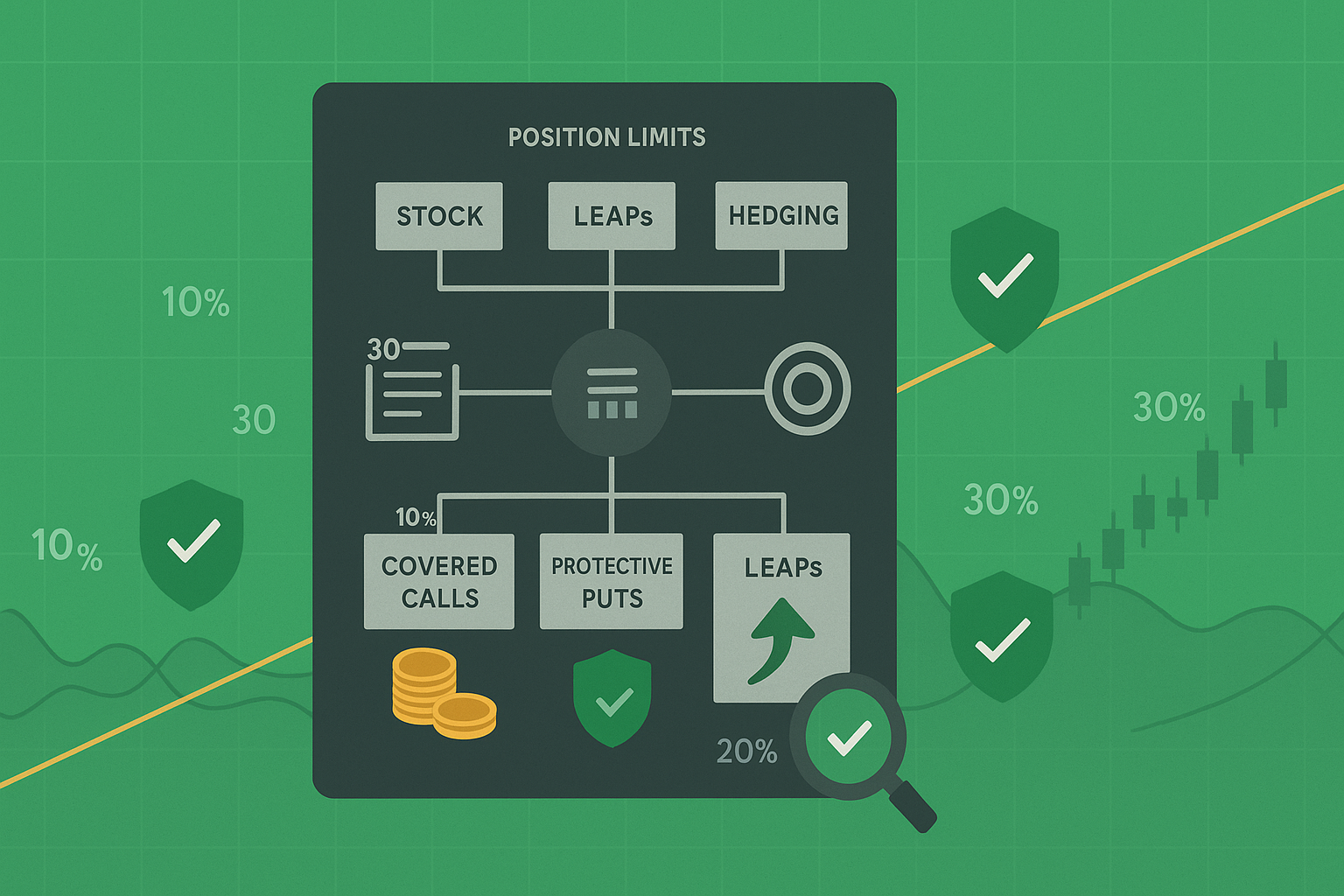
Options give you control over risk, but only if you have a plan. A 70% stock, 20% cash, 10% options allocation means nothing if those options are overleveraged LEAPs on speculative stocks. A risk management plan defines position limits, hedge timing, income targets, and decision rules before emotions take over. Plans beat reactions every time.
TL;DR
- Define position limits: never more than 10% per stock, 30% in LEAPs, 20% in unhedged concentrated positions
- Set hedge triggers: buy protective puts when a single stock exceeds 15% of portfolio or when market-wide valuations reach extreme levels
- Establish income goals: target 5-10% annual premium income from covered calls and puts, allocated to positions where assignment risk is acceptable
- Document decision rules: write down conditions for selling calls, buying puts, or using LEAPs before entering trades (prevents emotional override)
- Review quarterly: assess whether hedging costs, income gains, and leverage usage align with long-term compounding goals
Step 1: Inventory Your Current Risk
Before building a plan, understand your current exposure. List every position, calculate its percentage of portfolio, and identify where risk is concentrated.
Example inventory:
- "MoatCo" (20% of portfolio, $40,000 at $80/share, intrinsic value $120)
- "StableCo" (15% of portfolio, $30,000 at $50/share, intrinsic value $55)
- "GrowthCo" (10% of portfolio, $20,000 at $100/share, intrinsic value $140)
- Seven other stocks (5% each, $10,000 per position)
- Cash (10%, $20,000)
Risk assessment:
- "MoatCo" is overweight at 20%, if it drops 30%, you lose 6% of total portfolio. That's uncomfortable.
- "StableCo" at 15% is borderline, a 20% drop costs 3% of portfolio, manageable but notable.
- The other positions (10% and below) are diversified enough that individual losses are tolerable.
Risk management priorities:
- Hedge or trim "MoatCo" (20% position is too concentrated)
- Consider income strategies on "StableCo" (fairly valued, stable earnings)
- Let smaller positions run unhedged (diversification is sufficient)
Step 2: Set Position Limits
Position limits prevent overconcentration and overleveraging. Here's a framework for a $200,000 portfolio:
Stock positions:
- No single stock more than 10% of portfolio ($20,000 max per position) unless hedged with protective puts
- Exception: one "conviction stock" can be 15-20% if intrinsic value exceeds price by 40%+ and you're willing to hedge
Options positions:
- LEAPs leverage: no more than 30% of portfolio at risk in LEAP premiums ($60,000 max)
- Covered calls: can cover up to 50% of stock positions, but only on fairly valued or overvalued stocks
- Cash-secured puts: no more than 40% of cash tied up in put obligations at any time ($8,000 if you hold $20,000 cash)
- Protective puts: allocate 1-2% of portfolio annually to hedging concentrated positions ($2,000-4,000 per year)
Why these limits work: they prevent any single strategy or position from causing catastrophic losses. If LEAPs are limited to 30% of portfolio and one LEAP goes to zero, you lose 10% (assuming three positions). That's painful but recoverable. If you allocated 60% to LEAPs, a similar loss wipes out 20-30% of wealth, hard to bounce back from.
Step 3: Define Hedge Triggers
Don't hedge based on emotion or market predictions. Use objective triggers that signal when protection is justified.
Trigger 1: Position size exceeds 15% of portfolio
If any stock grows (through appreciation or concentration) to 15%+ of portfolio, buy protective puts or trim the position. This prevents single-stock risk from dominating your wealth.
Example: "MoatCo" rises from $80 to $120, and your 500 shares go from $40,000 (20% of portfolio) to $60,000 (30% of a now $200,000 portfolio). You buy a $110 put for $5 per share ($2,500 total) to cap downside at 8% from current price. Or you sell 200 shares, reducing position to $36,000 (18%), and redeploy $24,000 into new opportunities.
Trigger 2: Market-wide valuations reach extremes
When the S&P 500 Shiller P/E exceeds 30 (historically top 10% of valuations), allocate 2-3% of portfolio to broad-market protective puts (SPY or QQQ puts). This hedges against systemic risk without trying to time the exact top.
Example: In January 2022, Shiller P/E was 38, top 5% historically. Buying a 6-month SPY put for 2% of portfolio would have offset 20-30% of the March-October decline. Cost: $4,000 on a $200,000 portfolio. Benefit: saved $8,000-12,000 during the 25% S&P correction.
Trigger 3: Binary events on concentrated holdings
If you own 10-15% of your portfolio in a single stock and it faces a binary event (earnings, FDA approval, legal ruling), buy a 1-2 month protective put. High implied volatility makes the put expensive, but the tail risk justifies the cost.
Example: You own 15% of your portfolio in "BioTech," awaiting FDA approval in 30 days. Stock is at $100, intrinsic value if approved is $150. You buy a $90 put for $6. If approval is denied and the stock crashes to $60, the put gains $24, saving you $2,400 per 100 shares. If approved, you lose the $600 premium but gain $5,000 in stock appreciation (net +$4,400).
Step 4: Set Income Targets
Income strategies (covered calls, cash-secured puts) should generate 5-10% annual yield without excessive assignment risk or opportunity cost.
Covered call allocation:
Sell calls on 30-40% of your stock holdings, targeting positions that are fairly valued or slightly overvalued. Avoid selling calls on undervalued stocks with strong catalysts.
Example: Your portfolio has 10 stocks. Three are undervalued with 30-50% upside ("MoatCo," "GrowthCo," "ValueCo"). Four are fairly valued with 5-10% upside ("StableCo," "UtilityCo," "ConsumerCo," "HealthCo"). Three are overvalued or dead money ("MatureIndustry," "CyclicalCo," "SlowGrower").
Sell covered calls on the seven fairly valued or overvalued stocks. Leave the three undervalued winners alone. This generates income on 70% of holdings without capping your best opportunities.
Target yield: 2% per quarter (8% annualized) on the 70% of holdings where calls are sold. On a $140,000 allocation (70% of $200,000), that's $2,800 per quarter or $11,200 annually.
Cash-secured put allocation:
Use 20-30% of your cash reserves to sell puts on stocks you'd love to own at a discount. This generates 5-8% quarterly yields while building positions.
Example: You hold $20,000 cash. Sell puts on 2-3 stocks for $4,000-6,000 in total obligation (strike prices × number of contracts). Collect $400-600 per quarter in premiums (8-12% annualized yield on the cash secured).
If assigned, you're buying wonderful companies at discounted prices. If not assigned, you're earning 8-12% on idle cash, far better than 4-5% money market rates.
Step 5: Document Decision Rules
Write down specific conditions for entering and exiting trades. This prevents emotional decision-making during volatility or euphoria.
Covered call rules:
- Only sell calls on stocks trading within 10% of intrinsic value (fairly valued)
- Strike price must be at least 5% above current price (never cap upside too tightly)
- Expiration: 30-60 days (balance premium vs. flexibility)
- If stock drops 15% from entry, stop selling calls and reassess valuation
- If assigned, accept the profit and redeploy capital into new opportunities
Cash-secured put rules:
- Only sell puts on stocks with intrinsic value 30%+ above strike price (margin of safety)
- Strike price should represent a "dream entry" where you'd buy aggressively
- Expiration: 30-60 days (shorter = lower capital tie-up)
- Avoid selling puts within 2 weeks of earnings (high IV, uncertain outcomes)
- If assigned, review the business immediately. If fundamentals have changed, sell the stock and move on
LEAP rules:
- Only buy LEAPs on stocks with intrinsic value 40%+ above current price (deep undervaluation)
- Strike price: in-the-money (0.70-0.80 delta) to reduce time decay risk
- Expiration: 18-24 months (enough time for value realization)
- Never allocate more than 10% of portfolio to a single LEAP position
- Review every 6 months. If intrinsic value converges to price (within 20%), sell the LEAP and lock in gains
Protective put rules:
- Buy puts on any position exceeding 15% of portfolio
- Strike price: 10-15% below current price (balance cost vs. protection)
- Expiration: 3-6 months (enough time for volatility to subside)
- Roll puts if they expire and position remains concentrated
- Skip hedging if position falls below 12% of portfolio (natural diversification takes over)
Step 6: Build a Quarterly Review Process
Risk management isn't set-and-forget. Review your plan every 90 days to ensure it aligns with portfolio changes, market conditions, and personal goals.
Review checklist:
- Position sizes: Are any stocks now above 15% of portfolio? If yes, hedge or trim.
- Hedge effectiveness: Did protective puts save more than they cost? If no, reduce hedging frequency.
- Income performance: Did covered calls and puts generate 5-10% annual yield? If no, adjust strikes or expiration targets.
- Leverage usage: Are LEAPs performing as expected (15%+ annual returns)? If no, reduce allocation or improve stock selection.
- Cash levels: Is cash between 10-20% of portfolio? If too low, sell some winners or collect put premiums. If too high, deploy into undervalued stocks or LEAPs.
- Emotional discipline: Did you follow your decision rules, or override them due to fear/greed? Log any violations and adjust rules if necessary.
Example review (quarter 2, 2024):
- "MoatCo" grew to 22% of portfolio (up from 20%). Bought protective puts, cost $3,000 (1.5% of portfolio).
- Covered calls generated $3,200 in premiums (1.6% of portfolio, on track for 6.4% annual).
- One LEAP position on "GrowthCo" underperformed (down 10% despite stock rising 5%). Time decay exceeded gains. Decided to reduce LEAP allocation from 30% to 20% of portfolio.
- Cash reserves at 8%, below 10% target. Sold 100 shares of "StableCo" (position had grown to 18%), raised $5,000 cash, now at 11%.
- Violated decision rule once: sold a covered call on "ValueCo" despite it being undervalued (intrinsic value 35% above price). Got assigned and missed a 25% rally. Cost: $2,500 in opportunity cost. Lesson learned, will follow rules more strictly next quarter.
Step 7: Integrate Income, Protection, and Leverage
A complete risk management plan balances all three components: income generation, downside protection, and smart leverage.
Balanced portfolio example ($200,000):
- Core stock holdings (60%, $120,000): 10 stocks, diversified, no single position above 10%. No hedging needed due to diversification.
- Income sleeve (20%, $40,000): 3-4 stocks where covered calls are sold, generating $800-1,200 per quarter ($3,200-4,800 annually, 8-12% yield on this sleeve).
- Protection sleeve (5%, $10,000): Protective puts on 1-2 concentrated positions or broad-market hedges if valuations are extreme. Costs $2,000-3,000 annually (1-1.5% of total portfolio).
- Leverage sleeve (10%, $20,000): 1-2 LEAP positions on deeply undervalued stocks, targeting 30-50% returns over 18-24 months.
- Cash reserves (5%, $10,000): Dry powder for opportunities, plus capital for selling cash-secured puts (generating $800-1,200 annually on idle cash).
Net result: the portfolio generates 8-12% income from options, spends 1-1.5% on protection, and allocates 10% to leverage for amplified returns. Core holdings compound at 10-12% annually (value investing baseline), and the options overlay adds 5-8% net (income + leverage - hedging costs). Total expected return: 15-20% annually with controlled downside risk.
What Could Go Wrong?
Over-engineering the plan: you create 20 rules for every scenario, then spend hours debating whether to execute trades. Complexity breeds paralysis.
Mitigation: keep rules simple. Five core rules per strategy (covered calls, puts, LEAPs, hedging) is enough. If a rule requires a flowchart, it's too complex.
Ignoring the plan during stress: the market crashes 15%, and you panic-buy protective puts on everything, violating your hedge triggers and blowing 5% of portfolio on expensive insurance.
Mitigation: write down your rules and post them where you see them before every trade. Commit to following them for at least one year before adjusting. Discipline beats improvisation.
Failing to adapt: your plan assumes 10% annual income from covered calls, but after two years of getting assigned early, your realized yield is only 4%. You keep following the same strategy instead of adjusting.
Mitigation: review quarterly. If a strategy underperforms for 3-4 consecutive quarters, investigate why and adjust (different strikes, expirations, or stock selection).
Chasing perfection: you try to optimize every aspect (max income, minimal hedging cost, perfect leverage), leading to constant tinkering and transaction costs.
Mitigation: good enough is good enough. If your plan generates 15% annual returns with 20% max drawdowns, that's excellent. Don't sacrifice consistency for marginal optimization.
Next Steps
- Draft your position limits: write down max allocation per stock, LEAPs, and hedging. Post it where you make trades
- Set three hedge triggers: choose specific conditions (position size, valuation, events) that require protective action. Commit to executing when triggered
- Define income targets: decide how much premium income you want annually (5-10%) and which positions will generate it
- Schedule quarterly reviews: block 2 hours every 90 days to audit your plan's performance and adherence
- Start a trade journal: log every option trade with rationale, outcome, and lessons learned. This data feeds future plan improvements
- Read Balancing Risk and Reward for deeper insights on income vs. protection trade-offs
- Explore Managing Position Sizing with Options for detailed position limit frameworks
*Disclaimer: This content is for educational purposes only and does not constitute financial advice. Past performance does not guarantee future results. Always conduct your own research before investing.*