
Balancing Risk and Reward
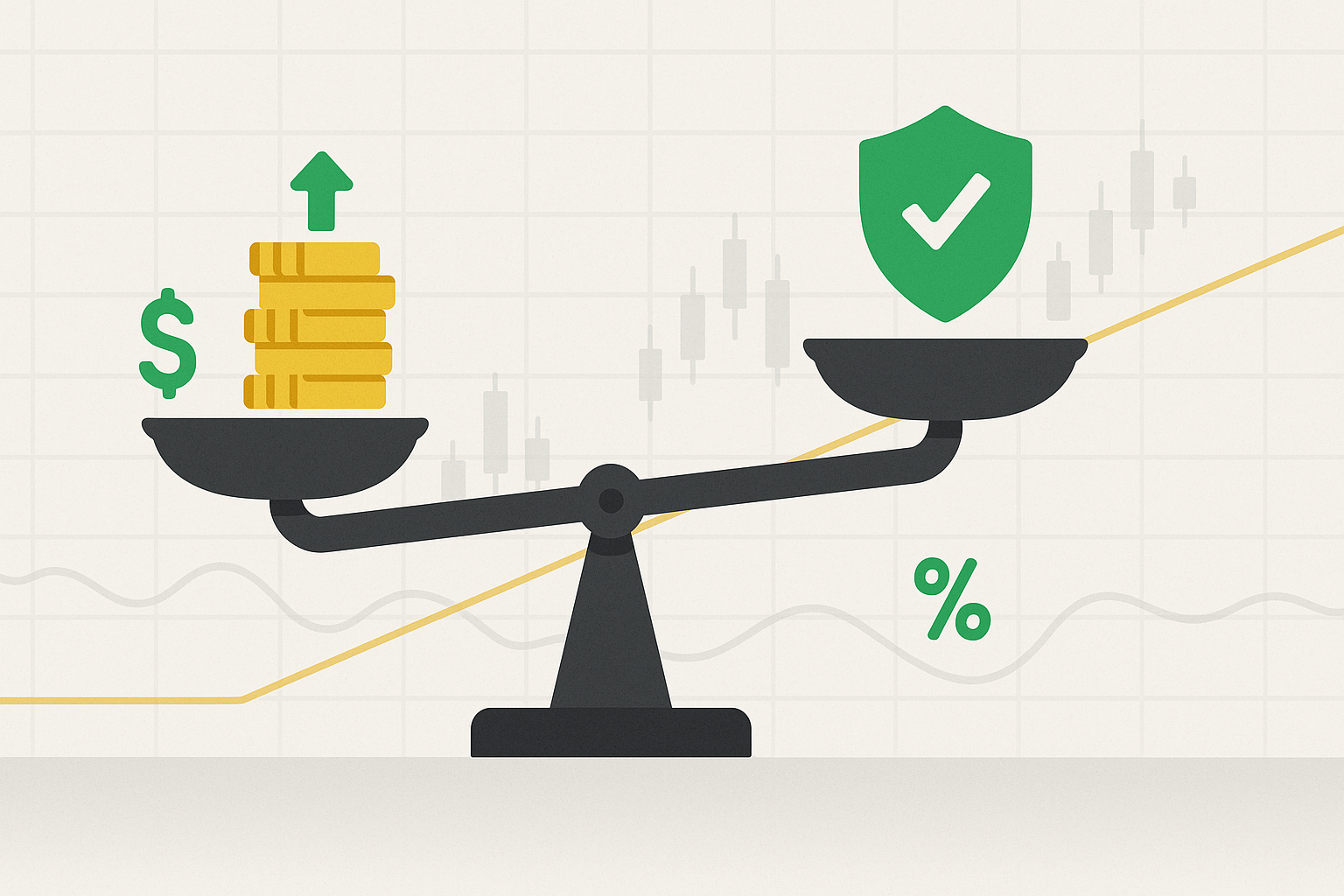
Every option trade offers a deal: collect income now or pay for protection later. Covered calls bring in premiums but cap upside. Protective puts cost money but limit losses. The mistake isn't choosing one over the other, it's failing to match the trade to your actual risk tolerance and portfolio goals.
TL;DR
- Income strategies (covered calls, cash-secured puts): maximize yield but limit upside or tie up capital. Best when you want cash flow from undervalued stocks
- Protection strategies (protective puts): preserve capital but cost money upfront. Best when you need downside insurance on concentrated positions
- Balance both: use income to fund protection, or rotate strategies based on market conditions and valuation levels
- Risk-first mindset: always know your max loss, opportunity cost, and break-even before entering any trade
- Position sizing matters more: proper sizing reduces the need for extreme hedging or aggressive premium chasing
The Core Trade-Off
Options force you to choose between collecting premiums and paying for safety. You can't do both at the same time with the same dollars. Here's the basic decision tree:
Scenario 1: You own 200 shares of QualityCo at $100, currently trading at intrinsic value.
- Covered call (income): Sell the $105 call for $3 per share ($600 total). You pocket $600 now but cap your upside at $105. If the stock rises to $120, you miss $3,000 in gains (200 shares × $15 opportunity cost).
- Protective put (protection): Buy the $95 put for $3 per share ($600 total). You spend $600 now to limit losses to $5 per share. If the stock drops to $80, you save $3,000 (avoided loss from $95 floor vs. $80 price).
Same $600, opposite outcomes. The question isn't "which is better?" It's "what do I need right now?"
When to Prioritize Income
Income strategies make sense when you're confident in your valuation and don't expect significant short-term volatility. You're willing to trade upside for cash flow because:
You believe the stock is fairly valued or slightly undervalued: covered calls work best when a stock trades near intrinsic value and you expect moderate, steady growth (5-10% annually). If you think QualityCo will compound at 8% per year, selling calls at $105 (5% above current price) lets you collect premiums while still capturing reasonable upside.
You need cash flow: maybe you're building income to supplement salary, fund living expenses, or reinvest into new positions. Premium income is liquid, predictable, and doesn't require selling shares.
You're comfortable with assignment: if the stock rises and your calls get exercised, you're happy to sell at a profit. Assignment isn't failure, it's a planned exit at a price you chose (plus the premium you collected).
Example: You own "StableCo" at $50, which has an intrinsic value of $55. It's growing earnings at 7% per year and pays a 2% dividend. You sell the $52 call (4% above current price) for $1.50, collecting a 3% yield. If assigned, you exit at $52 + $1.50 = $53.50 (7% total return in one quarter). If not assigned, you keep the premium and sell another call next month.
Over 12 months, you might collect $6-8 per share in premiums (12-16% yield) while holding a stock that compounds at 7% intrinsically. That's a 19-23% total return, far better than the dividend alone.
When to Prioritize Protection
Protection strategies make sense when you face concentrated risk, uncertain market conditions, or need to hold a stock through volatility. You're willing to pay for insurance because:
You have a large position in one stock: if 30% of your portfolio is in "TechGrowth," a 20% drop wipes out 6% of your total wealth. A protective put that costs 2% of the position saves 18% if the stock crashes. The math is simple: hedging cost < potential loss.
You're holding through uncertainty: earnings announcements, regulatory decisions, or macro events (rate hikes, recessions) create tail risk. A protective put lets you stay invested without panicking if volatility spikes.
You can't afford to sell at a loss: maybe you bought at $100, the stock dropped to $80, and you're confident it will recover to $110 within 18 months. But you can't stomach another 20% drop. A protective put at $75 costs $3 but ensures you don't capitulate at $60 during a panic.
Example: You own 500 shares of "CycleStock" at $80 (intrinsic value $100). Earnings are in two weeks, and the stock has been volatile lately. You buy a $75 put for $2 per share ($1,000 total). If earnings disappoint and the stock drops to $65, your put gains $10 per share ($5,000), offsetting most of the paper loss. If earnings beat and the stock rises to $90, you lose the $1,000 premium but gain $5,000 in stock appreciation (net +$4,000).
That's the trade-off: you gave up 2.5% of upside ($2 per $80 share) to cap downside at 6.25% ($75 floor from $80 entry). For a concentrated position or volatile stock, that's a reasonable price for peace of mind.
Blending Both: Using Income to Fund Protection
The smartest approach is to use premium income from one strategy to pay for protection in another. This creates a self-funding risk management system:
Strategy 1: Sell covered calls on core holdings to generate premium income. Let's say you own 5 stocks, each worth $10,000. You sell covered calls on 3 of them (the most stable, fairly valued names), collecting $300-500 per quarter per stock ($900-1,500 total).
Strategy 2: Use that premium income to buy protective puts on your highest-risk holding. Maybe you have one high-conviction stock that's volatile or concentrated. You allocate $500 per quarter to buy puts, funded entirely by covered call premiums.
Net result: you've added downside protection without reducing overall returns. The covered calls cap upside on 60% of your portfolio, but the protective puts preserve capital on the 20% that matters most. The remaining 20% stays unhedged, allowing full upside participation.
Position Sizing: The Ultimate Risk-Reward Tool
Before worrying about income vs. protection, get position sizing right. If you never risk more than 5-10% of your portfolio in any single stock, you can afford to skip protective puts entirely. The cost of hedging small positions often exceeds the benefit.
Oversized position + no hedging = disaster: 40% of portfolio in one stock, no protection, stock drops 30% = 12% portfolio loss. That's hard to recover from.
Oversized position + hedging = expensive insurance: 40% of portfolio in one stock, protective puts cost 2-3% annually = you're paying $800-1,200 per year per $10,000 invested. Over 5 years, that's $4,000-6,000 in premiums (40-60% of gains).
Proper position sizing + selective hedging = efficient risk control: 5-10% per stock, hedge only the highest-risk names during uncertain periods. Most positions are small enough that natural diversification handles risk. You save hedging costs for the few concentrated bets that need it.
Market Conditions Matter
The right balance shifts based on valuation and volatility:
Bull markets (low volatility, rising prices): prioritize income strategies. Covered calls generate steady premiums, and protective puts are expensive (high premiums, low probability of use). Focus on cash flow and let winners run.
Bear markets (high volatility, falling prices): prioritize protection. Protective puts are cheaper (low stock prices, high IV makes puts attractive), and covered calls risk assignment at depressed levels. Protect capital first, generate income later.
Sideways markets (moderate volatility, range-bound): blend both. Sell covered calls on stocks near the top of their range, buy protective puts on stocks near the bottom. This captures premium from mean reversion while limiting downside risk.
What Could Go Wrong?
Chasing income without considering opportunity cost: you sell covered calls every month for 3% premium, but the stock rises 50% in a year. You miss $5,000 in gains to collect $3,600 in premiums. Net loss: -$1,400 vs. holding unhedged.
Mitigation: Only sell covered calls on fairly valued stocks where you'd be happy to exit at the strike price. If you believe a stock can double, don't cap it with calls.
Over-hedging with protective puts: you spend 3-4% annually on puts "just in case," but the stock never crashes. Over 5 years, you've paid 15-20% of your position in premiums for protection you didn't need.
Mitigation: Hedge selectively. Only buy puts on concentrated positions, during high-uncertainty periods, or when implied volatility is low (cheap premiums). Don't hedge 100% of your portfolio.
Ignoring assignment risk: you sell covered calls assuming you'll keep the stock, then get assigned and lose your position right before a big move.
Mitigation: Accept that assignment is part of the strategy. If you can't afford to sell the stock, don't sell calls. Consider rolling up and out if you want to keep the position.
Paying for protection that expires worthless: you buy a protective put, the stock rises, and the put expires. You "wasted" the premium.
Mitigation: Insurance is a cost, not an investment. If you wouldn't buy fire insurance on your house and then complain it didn't burn down, don't regret unused puts. The goal is protection, not profit.
Next Steps
- Audit your portfolio: identify which stocks are candidates for income (stable, fairly valued) vs. protection (volatile, concentrated)
- Calculate your risk: for each position, determine max loss if the stock drops 20-30%. If that's unacceptable, buy protection. If it's tolerable, consider income strategies
- Track trade-offs: log every covered call and protective put. After 6-12 months, review whether you're collecting more premium than you're spending on protection
- Read Managing Position Sizing with Options for guidelines on how much capital to allocate per trade
- Explore Covered Calls as Risk-Adjusted Income for tactics on generating cash flow without excessive risk
- Check out Building a Risk Management Plan to integrate income and protection into a cohesive strategy
*Disclaimer: This content is for educational purposes only and does not constitute financial advice. Past performance does not guarantee future results. Always conduct your own research before investing.*