
Options Premiums as Yield Alternatives
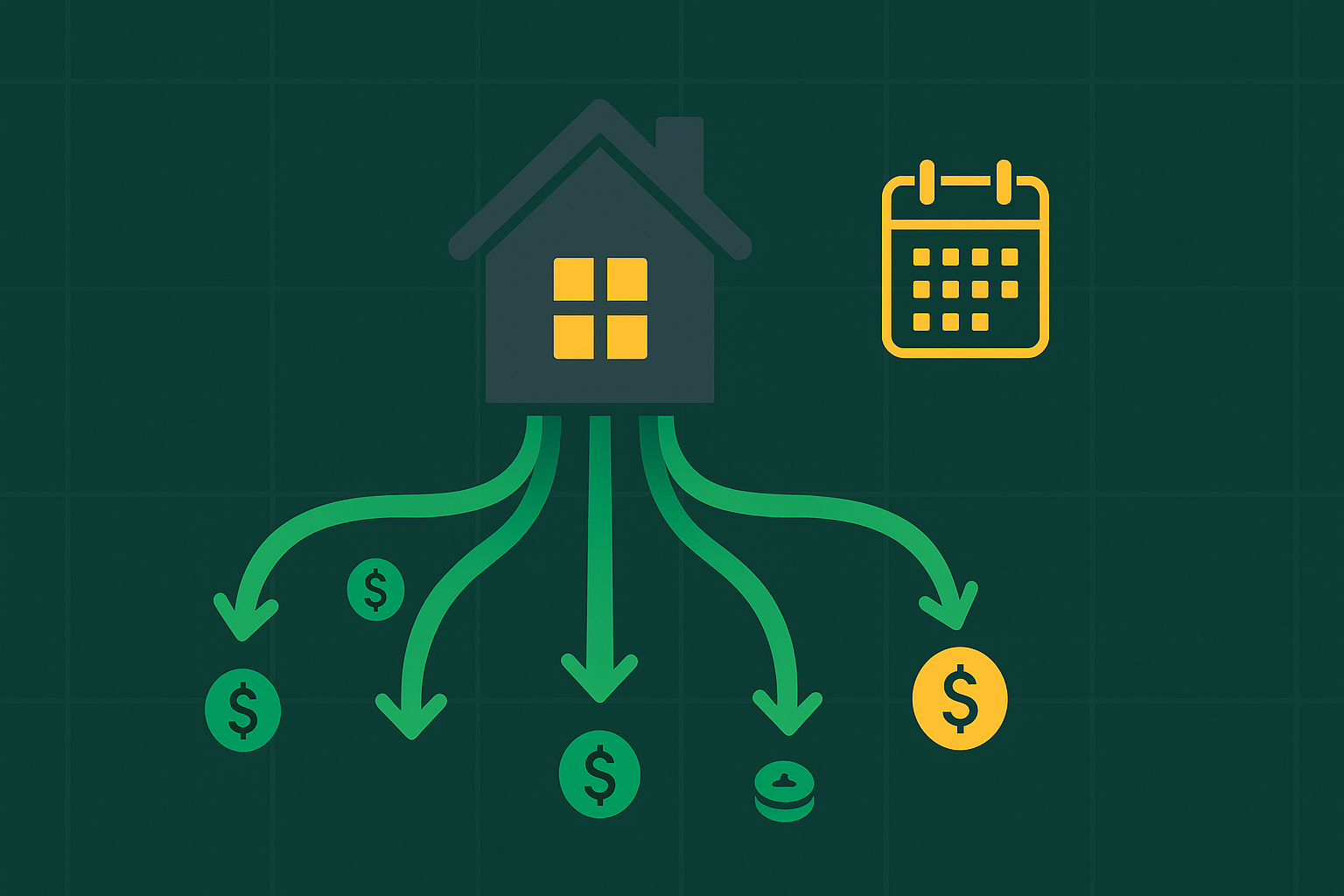
Most investors think yield means dividends. But there's another way to generate cash flow from stocks you own or want to own, premiums collected from selling options. Think of it as getting paid rent while you wait for value to show up.
TL;DR
- Premiums = synthetic dividends: Options income can outperform traditional dividend yields, often by 2-5x
- Two sides to the coin: Collect premiums by selling covered calls (on stocks you own) or cash-secured puts (on stocks you want)
- Flexible and repeatable: Unlike quarterly dividends, you control when and how much income to generate
- Works best on quality: Combine premium income with fundamental value analysis for sustainable returns
- Risk trade-off: You cap upside (calls) or commit to buying (puts) in exchange for income
The Rent Analogy
Imagine owning a house worth $300,000 that you think will eventually sell for $400,000. While you wait for the market to catch up, you rent it out for $1,500 per month. The house might appreciate slowly, but the rent keeps coming in.
That's exactly how options premiums work. You own a stock trading at $50 that you believe is worth $70. Instead of just sitting on it hoping for appreciation, you sell someone the right to buy it from you at $60 for 30 days. They pay you $200 upfront (the premium). If the stock stays below $60, you keep the shares and the cash. If it rises above $60, you sell at your target and still pocket the premium.
Either way, you collect "rent" while waiting for value.
Premium Income vs. Dividend Income
Here's how the two compare on "ABC Manufacturing" trading at $50 per share:
Traditional dividend approach:
- Annual dividend: $2 per share (4% yield)
- Quarterly payments: $0.50 per quarter
- Predictable but fixed
Options premium approach (covered calls):
- Sell $55 call monthly for $150 premium
- Annualized: $150 × 12 = $1,800 per 100 shares ($18 per share)
- Effective yield: 36% on your $5,000 position
- Flexible timing and strike selection
The difference? Premium income lets you target 8-12% monthly returns on stable value stocks, compared to 3-5% annual dividend yields. You're actively generating cash flow instead of waiting for quarterly checks.
How Premium Collection Works
Scenario 1: Selling covered calls (you own the stock)
You buy 100 shares of "Steady Corp" at $40 per share ($4,000 investment). Fair value based on earnings is $55. You sell a $50 call expiring in 45 days for $180 premium.
- Stock stays below $50: Keep shares + $180. New cost basis: $38.20. Repeat monthly.
- Stock rises above $50: Sell at $50, realize $1,000 gain + $180 premium = $1,180 total profit (29.5% return).
Annual income potential (if stock stays range-bound): $180 × 8 (45-day cycles) = $1,440 premium income (36% yield).
Scenario 2: Selling cash-secured puts (you want to buy)
"Quality Industries" trades at $60, but you think it's only fairly valued at $50. Instead of placing a limit order, you sell a $50 put expiring in 30 days for $200 premium.
- Stock stays above $50: Keep the $200, no purchase. Repeat and collect more premiums while waiting.
- Stock drops below $50: Shares assigned at $50, effective cost $48 after premium ($50 - $2). You wanted to buy anyway, just got paid to wait.
This is like getting paid $200 to place a limit order. Compare that to earning zero while hoping for a dip.
Why This Works for Value Investors
Value investing is about buying wonderful companies below intrinsic value. Options premiums fit this framework perfectly:
Built-in margin of safety: When you sell puts below fair value or calls above it, you create price buffers. You're not speculating, you're collecting income within your margin of safety.
Earnings yield amplification: A stock with 10% earnings yield can generate 20-30% total returns when you layer premium income on top. Check fair value quickly using Wall St Yardie app.
Forced discipline: Selling calls above fair value means you take profits systematically instead of holding forever hoping for more. Selling puts below fair value means you only buy when price justifies it.
Time works for you: Unlike buying options where time decay hurts you, selling options means theta decay puts money in your pocket every day.
Real Numbers Example
Let's walk through a 12-month strategy on "Wonderful Co." trading at $45:
Your analysis:
- Fair value: $60 per share
- Strong cash flow, economic moat
- Low debt, predictable earnings
Month 1-3: Sell $50 calls monthly
- Premium collected: $200 + $180 + $190 = $570
- Stock stays $45-$48 range
- Cost basis reduced to $39.30
Month 4: Stock jumps to $52, shares called away
- Capital gain: $700 ($52 - $45 on 100 shares)
- Total premiums collected: $570
- Total profit: $1,270 on $4,500 investment = 28.2% return in 4 months
Month 5-12: Start selling $42 puts monthly to re-enter
- Premium per month: $150 average
- Stock stays above $42, collect $150 × 8 = $1,200 more
- Never bought back in, but generated 26.7% return on reserved cash
Total 12-month return: $1,270 + $1,200 = $2,470 (54.9% on $4,500 capital). All while staying disciplined about valuation.
What Could Go Wrong?
Opportunity cost on calls: Your stock might rocket to $75, but you sold it at $52. You missed $23 per share of upside.
Mitigation: Only sell calls above your fair value estimate. If Wonderful Co. is truly worth $60, selling $52 calls captures most rational upside. Use conservative fair value estimates, see app for guidance.
Forced buying on puts: Market crashes 30%, your $42 put gets assigned, stock drops to $30. You own shares down 29% from your entry.
Mitigation: Only sell puts on companies you genuinely want to own long-term. If the business is solid and you calculated intrinsic value correctly, the market will eventually recover. Don't sell puts on value traps just for juicy premiums.
Premium addiction: High premiums become addictive. You start targeting yield over quality, selling options on sketchy companies.
Mitigation: Stick to wonderful companies first, options second. Never compromise on business quality for extra premium. Quality over quantity, always.
Market volatility changes: Premiums collapse in low volatility environments. Your $200 monthly calls now fetch $50.
Mitigation: View premiums as bonus income, not core strategy. When premiums shrink, just hold the stock. Don't chase yield by going further out-of-the-money or shortening durations excessively.
Tax complications: Premium income is usually taxed as short-term gains. Frequent options activity creates tax reporting complexity.
Mitigation: Track every trade carefully. Consider holding positions in tax-advantaged accounts where appropriate. Consult tax professionals for your situation.
Next Steps: Building Your Premium Income System
- Start with covered calls: Only on stocks you already own and have analyzed thoroughly
- Calculate fair value first: Use intrinsic value tools before considering premiums
- Set yield targets: Aim for 2-4% monthly returns initially, scale as you gain experience
- Choose quality over yield: Better to collect $100 on Wonderful Co. than $300 on a value trap
- Track your results: Journal every trade, note what works and what doesn't
- Learn the mechanics: Study how covered calls and cash-secured puts operate in detail
- Manage time decay: Understand how theta works in your favor when selling
- Build income streams: Explore systematic income generation strategies
Think of options premiums as getting paid twice, once when you collect the premium, and again when the stock reaches fair value. The key is patience. You're not day trading for quick hits. You're systematically harvesting income from positions you'd hold anyway.
The best part? Unlike dividends that require you to wait for board approval, you control when and how much premium income to generate. That flexibility, combined with value principles, creates a powerful wealth-building system. Keep the riddim steady, collect your rent, and let the market eventually pay you fair value on top of it. That's Wall St. Yardie style premium income.
*Disclaimer: This content is for educational purposes only and does not constitute financial advice. Past performance does not guarantee future results. Always conduct your own research before investing.*