
Intrinsic Value: What It Means
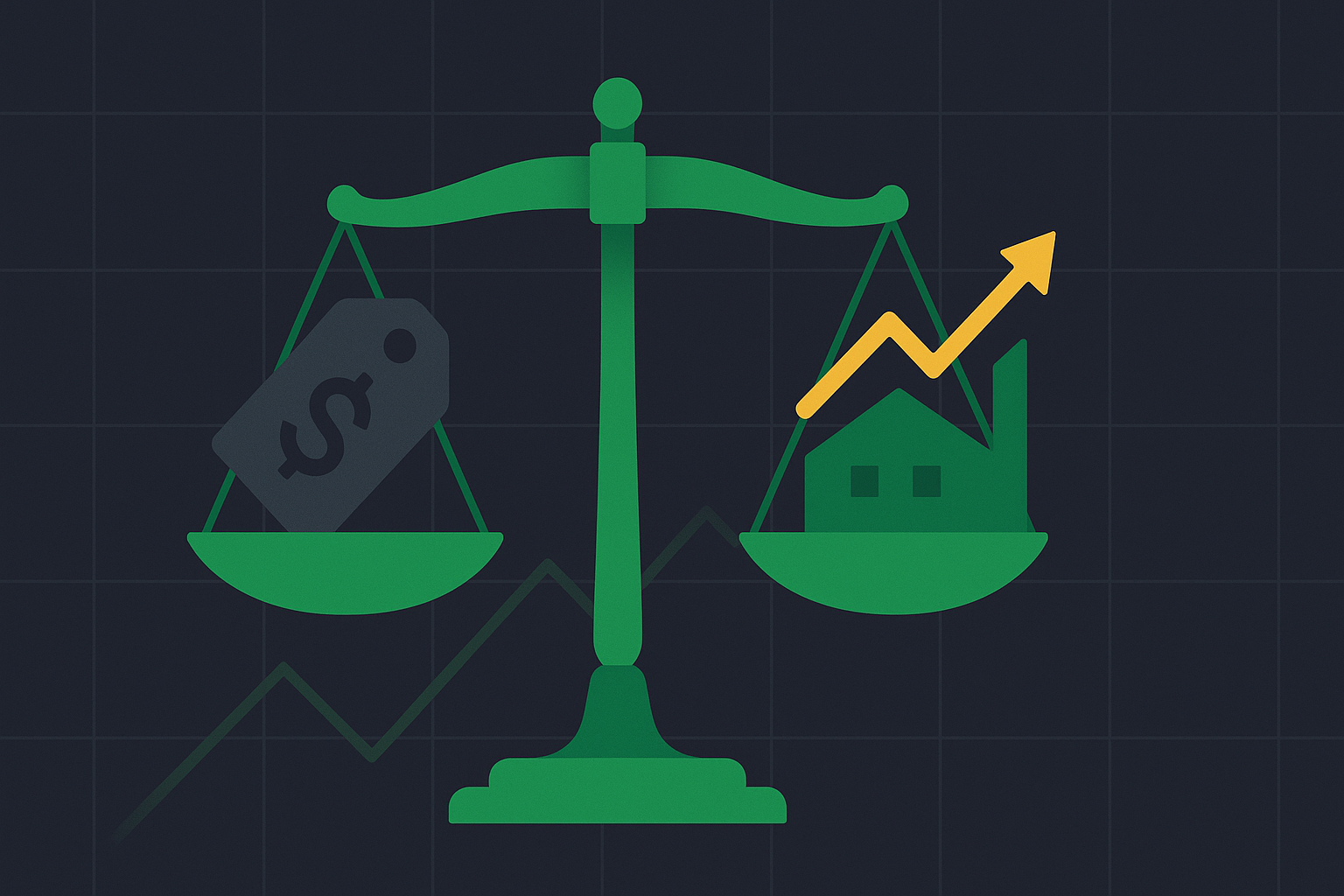
Your neighbor offers to sell you their car for $5,000. Good deal or bad deal? You can't answer that without knowing what the car is actually worth—its make, model, condition, mileage. That "true worth" is its intrinsic value. In investing, intrinsic value is the same concept: what is this business really worth, independent of what Mr. Market says today?
TL;DR
- Intrinsic value = present value of all future cash flows: What you'd rationally pay for the entire business
- Different from market price: The stock price is what others will pay today; intrinsic value is what it's truly worth
- Multiple methods to calculate: DCF, earnings multiples, asset-based—each gives different perspectives
- Requires estimates and judgment: It's an educated guess, not a precise number, so use ranges
- The foundation for value investing: Buy when market price is below intrinsic value, sell when it exceeds it
The Core Concept
Intrinsic value is what a rational, well-informed buyer would pay for an entire company if it weren't publicly traded. Imagine you're considering buying your local profitable bakery. What matters?
The bakery's value comes from the cash it generates: profits after all expenses, reinvestment needs, and growth potential. You'd calculate how much cash the business will throw off over its lifetime, then discount those future dollars back to today's value using your required return rate.
That's intrinsic value in a nutshell. For public companies, the process is the same—just bigger numbers and more variables.
Benjamin Graham called intrinsic value "that value which is justified by the facts." It's not hope, hype, or momentum. It's cold, rational analysis of what the business can actually earn for its owners over time.
Why Intrinsic Value Matters
The gap between market price and intrinsic value is where value investors make money. Warren Buffett's famous quote says it all: "Price is what you pay, value is what you get."
Consider three scenarios:
Scenario 1 - Market price > intrinsic value: Stock trading at $80, intrinsic value is $60. Don't buy. Even a "good" company is a bad investment at the wrong price.
Scenario 2 - Market price = intrinsic value: Stock trading at $60, intrinsic value is $60. Pass. No margin of safety, no reason to risk your capital.
Scenario 3 - Market price < intrinsic value: Stock trading at $40, intrinsic value is $60. Interesting. You're buying $1 of value for $0.67. This 33% discount gives you upside potential plus protection if you're slightly wrong.
The beauty? Intrinsic value grows over time as good companies reinvest profits and compound. A company worth $60 today might be worth $70 in three years—and if you bought at $40, you're capturing both the discount and the growth.
A Real Numbers Example
Let's value "Tech Services Inc." using a simplified discounted cash flow (DCF) approach:
Company fundamentals:
- Current free cash flow: $200 million
- Growth rate (next 5 years): 8% annually
- Growth rate (years 6-10): 5% annually
- Terminal growth: 3% forever
- Your required return (discount rate): 10%
- Shares outstanding: 50 million
Year-by-year cash flows:
- Year 1: $200M × 1.08 = $216M
- Year 2: $216M × 1.08 = $233M
- Year 3: $233M × 1.08 = $252M
- Year 4: $252M × 1.08 = $272M
- Year 5: $272M × 1.08 = $294M
- Years 6-10: Continue at 5% growth
- Terminal value at year 10: $368M × (1.03) ÷ (0.10 - 0.03) = $5,413M
Present value calculations: Discount each year's cash flow back to today using your 10% rate. After running the numbers:
- PV of years 1-10: approximately $1,850M
- PV of terminal value: approximately $2,087M
- Total intrinsic value: $3,937M
Per-share intrinsic value: $3,937M ÷ 50M shares = $78.74 per share
Current market price: $55
Your margin of safety: ($78.74 - $55) ÷ $78.74 = 30%
With a 30% margin of safety on a business you understand, this could be a compelling buy. Check out our valuation models guide for more detailed approaches.
Different Approaches to Intrinsic Value
Smart investors use multiple methods to triangulate value:
Discounted cash flow (DCF): The gold standard. Project future cash flows and discount to present value. Most theoretically sound but requires many assumptions.
Earnings multiples: Compare P/E ratios to peers and historical averages. Simpler but less precise. Works well for stable, mature companies.
Asset-based valuation: Add up all assets (property, equipment, inventory) minus liabilities. Conservative floor value, especially useful for asset-heavy businesses or liquidation scenarios.
Owner earnings: Buffett's approach—take net income, add back non-cash charges (depreciation), subtract capital expenditures needed to maintain the business. This is the cash an owner could actually take out.
No single method is perfect. Using 2-3 approaches and looking for convergence builds confidence. If DCF says $80, earnings multiples suggest $75, and asset value provides a $50 floor, you've got a reasonable range of $75-$80 with downside protection.
The Art and Science
Here's the challenging truth: calculating intrinsic value requires judgment. You're forecasting the future, and the future is uncertain.
Two skilled analysts can reach different intrinsic values for the same company. One might estimate 8% growth, another 6%. One uses a 10% discount rate, another 12%. These seemingly small differences compound into significantly different valuations.
This is why successful value investors:
- Use conservative assumptions
- Think in ranges, not single numbers ($70-$85 instead of $77.50)
- Demand wider margins of safety for uncertain businesses
- Update estimates as new information emerges
Your intrinsic value estimate for a company might be $75 ± $10. That's okay. It tells you: definitely buy below $55 (30% margin from the low end), definitely don't buy above $95 (above the high end), and use judgment in between based on business quality and market conditions.
What Could Go Wrong?
Garbage in, garbage out: If your growth rate assumptions are too optimistic or you underestimate competition, your intrinsic value will be inflated. You'll think you're getting a bargain when you're actually overpaying.
Mitigation: Stress-test your assumptions. What if growth is half what you expect? What if margins compress by 2%? Rerun your models with pessimistic inputs. If the company still looks cheap in bad scenarios, you've found something special.
Changing circumstances: The intrinsic value you calculate today might be obsolete in 6 months if the business deteriorates, industry dynamics shift, or management makes poor capital allocation decisions.
Mitigation: Reassess intrinsic value quarterly or when major news hits. Value investing isn't "buy and forget"—it's "buy and monitor." Be willing to sell if your thesis breaks.
Overconfidence in precision: Treating intrinsic value like a fact rather than an estimate leads to inadequate margins of safety. A $0.25 difference between price and your exact value estimate isn't compelling.
Mitigation: Always use ranges. Build in humility. Remember that even the best investors are wrong 30-40% of the time. For more on protecting yourself, see margin of safety explained.
Ignoring qualitative factors: You can perfectly model cash flows but miss that the industry is being disrupted, management is mediocre, or the moat is eroding.
Mitigation: Intrinsic value is 60% math and 40% judgment. Study the business, read annual reports, understand competitive dynamics. The numbers tell you what to calculate; the qualitative tells you if the numbers will hold up.
Next Steps
- Pick one company you own or want to own and calculate its intrinsic value using at least two methods
- Document your assumptions (growth rates, discount rate, terminal value) and explain why they're reasonable
- Create a spreadsheet template for DCF calculations you can reuse
- Compare your intrinsic value estimate to current market price—is there a sufficient margin of safety?
- Set a calendar reminder to revisit your valuation in 90 days and update based on new financial results
- Read the company's last 3 annual reports to improve your qualitative understanding of the business
Remember: Intrinsic value isn't about precision—it's about being approximately right rather than precisely wrong. A reasonable estimate with a margin of safety beats perfect calculations with zero room for error every single time.
*Disclaimer: This content is for educational purposes only and does not constitute financial advice. Past performance does not guarantee future results. Always conduct your own research before investing.*