
Buying vs. Selling Options
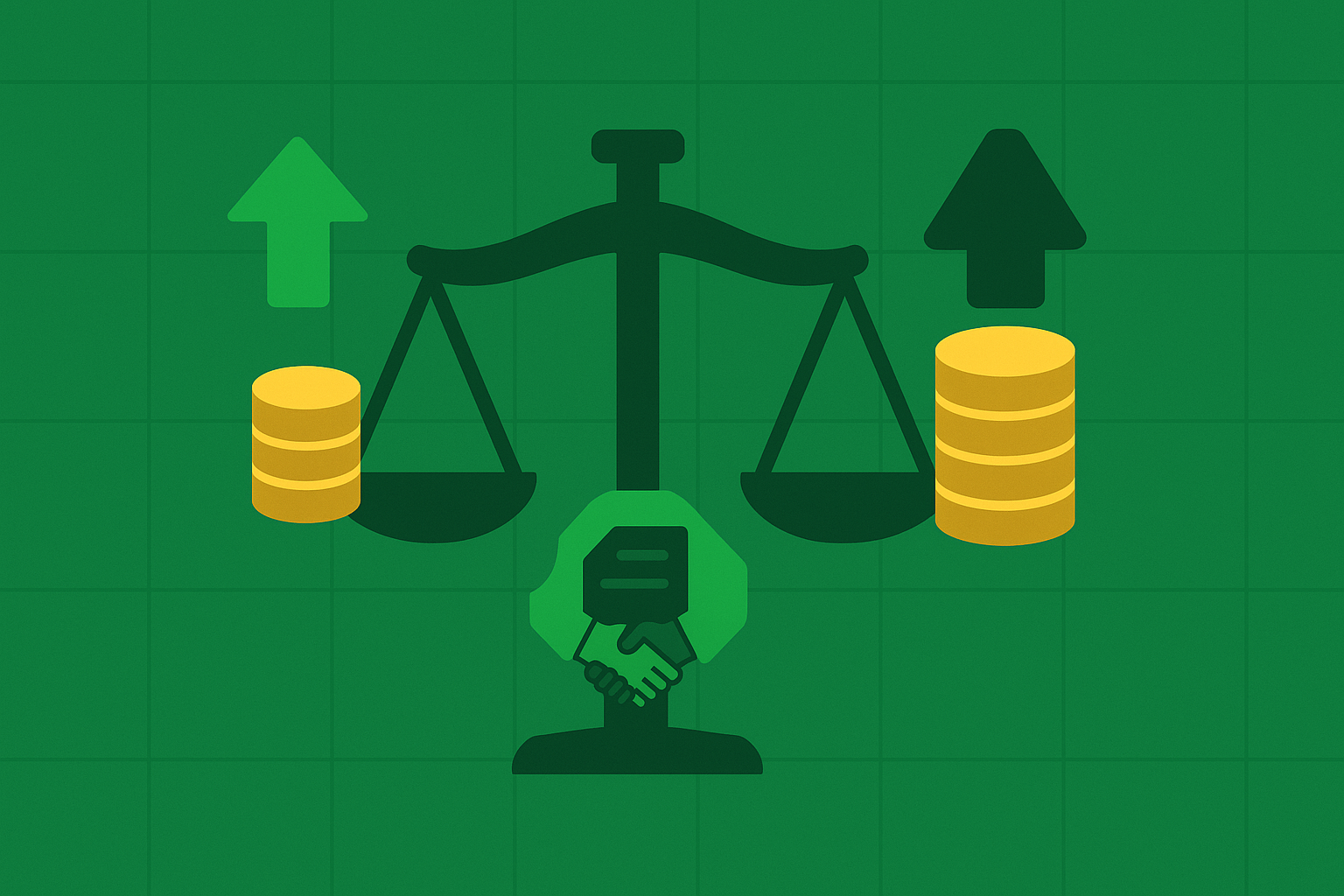
Most investors think options are just another way to bet on stock direction. They're half right. The real power is in choosing which side of the trade to take. Buyers and sellers play completely different games with opposite risk profiles, and understanding the difference determines whether you build wealth or blow up your account.
TL;DR
- Buyers pay premium, sellers collect it: One side pays for rights, the other gets paid to take on obligations
- Buyers have limited risk, sellers have limited profit: Maximum loss for buyers is the premium paid, maximum gain for sellers is the premium collected
- Time decay helps sellers, hurts buyers: Every passing day erodes the buyer's position and improves the seller's edge
- Probability favors sellers: Most options expire worthless, meaning sellers win more often but with smaller individual gains
- Value investors prefer selling: Collecting premium aligns with buying undervalued stocks and generating income while waiting
The Fundamental Difference
When you buy an option, you purchase the right to do something, buy or sell stock at a specific price. You pay a premium upfront. You control the decision. You can exercise, sell, or let it expire. Your risk is capped at the premium paid. Your profit potential depends on how far the stock moves in your favor.
When you sell an option, you collect premium upfront in exchange for taking on an obligation. You don't control when the option gets exercised. The buyer decides. Your maximum profit is the premium collected, no matter how far the stock moves. Your risk ranges from substantial to unlimited depending on whether the position is covered.
Think of it like insurance. Buyers are policyholders paying premiums for protection or opportunity. Sellers are insurance companies collecting premiums and hoping the policy never pays out.
Buying Options: Rights and Limited Risk
Option buyers are the optimists. They believe the stock will move big, fast. They pay a small premium to control a large position. If they're right, the leverage amplifies returns. If they're wrong, they lose only the premium.
Long call example: You buy a $50 call for $2 premium ($200 total). The stock needs to rise above $52 to break even. If it jumps to $60, you make $800 profit ($10 gain × 100 shares minus $200 premium). If it stays flat or drops, you lose $200. That's it. No margin calls. No assignment surprises.
Long put example: You buy a $50 put for $2 premium ($200 total). The stock needs to fall below $48 to break even. If it crashes to $40, you make $800 profit. If it rises or stays flat, you lose $200 maximum.
Buyers love the defined risk. They know their maximum loss before entering the trade. But here's the catch: options are decaying assets. Every day that passes without the stock moving erodes the premium. You can be right about direction but wrong about timing and still lose money.
Value investors rarely buy options unless they're using long-dated LEAPs to gain leveraged exposure to undervalued companies or buying protective puts for portfolio insurance.
Selling Options: Obligations and Limited Profit
Option sellers are the realists. They know most options expire worthless. They collect premium upfront and bet on the stock staying in a range or moving slowly. Their edge comes from time decay and probability, not big directional moves.
Short call example (covered): You own 100 shares of stock at $48 and sell a $50 call for $2 premium ($200 collected). If the stock stays below $50, you keep the stock and the premium. If it rises above $50, your shares get called away at $50. Your maximum profit is $400 ($2 gain on stock plus $200 premium). Your risk is unlimited if the stock soars, but owning the stock "covers" this risk by capping loss to opportunity cost.
Short put example (cash-secured): You sell a $50 put for $2 premium ($200 collected). You set aside $5,000 cash in case you're assigned the stock. If the stock stays above $50, you keep the premium. If it falls below $50, you buy the stock at $50 (but your effective cost is $48 after the premium). Your maximum profit is $200. Your maximum loss is $4,800 if the stock goes to zero (minus the $200 premium collected).
Sellers win more often (most options expire worthless), but they win small. Buyers lose more often, but when they win, they win big. The seller's edge comes from collecting premium repeatedly over time, turning occasional small wins into steady income.
This is why value investors love covered calls and cash-secured puts. Both strategies let you collect premium while staying aligned with value principles: owning quality companies at fair prices.
Time Decay: The Seller's Secret Weapon
Options lose value as expiration approaches. This phenomenon, called theta decay, works like a silent tax on buyers and a quiet subsidy for sellers.
Let's say you buy a $50 call with 30 days until expiration for $2 premium. The stock sits at $49 the whole time. After 15 days, the premium drops to $1.20 even though the stock barely moved. After 25 days, it's worth $0.40. On expiration day, it expires at $0.05. You lost $195 not because you were wrong about the stock, but because time ran out.
Now flip it. You sell that same $50 call for $2 premium. The stock sits at $49 the whole time. After 15 days, your obligation shrinks to $1.20. After 25 days, it's $0.40. On expiration day, you keep the full $200 because the option expired worthless. You won without the stock moving in your direction.
Time decay accelerates in the final 30 days of an option's life. This is why sellers prefer short-dated options (30-45 days) and buyers prefer long-dated options (6-12 months or LEAPs).
Probability and Win Rate
Statistics favor sellers. Roughly 70-80% of options expire worthless, meaning sellers collect premium without assignment. But this doesn't guarantee profit. The 20-30% of trades where sellers lose can wipe out months of small wins if risk isn't managed.
Seller mindset: Win small, win often, avoid catastrophic loss. A seller might collect $200 premium eight times, then lose $1,000 once. Net result: +$600 across nine trades. The key is never letting one bad trade destroy the account.
Buyer mindset: Lose small, lose often, hit a home run occasionally. A buyer might lose $200 on eight trades, then make $2,000 on one. Net result: +$400 across nine trades. The key is sizing positions so you can afford to be wrong repeatedly while waiting for the big win.
Value investors lean toward selling because it aligns with steady compounding, not home run chasing. You collect premium on undervalued stocks you want to own anyway, turning patience into cash flow.
Assignment: The Hidden Dynamic
Assignment happens when the option buyer exercises their right. For sellers, this removes control. You don't get to choose when it happens.
Short call assignment: You sell a $50 call on stock you own at $48. The stock jumps to $55. The buyer exercises. Your shares get called away at $50. You made $2 per share ($50 - $48) plus the premium collected, but you miss out on the move from $50 to $55. This is opportunity cost, not a loss.
Short put assignment: You sell a $50 put. The stock drops to $45. The buyer exercises. You're forced to buy the stock at $50. Your effective cost is lower after the premium collected, but you own a stock that's underwater on paper. If your valuation said fair value was $60, this is still a win. You got the stock cheaper than market price before the drop.
Value investors view assignment as a feature, not a bug. Covered calls get you out of positions near fair value. Cash-secured puts get you into positions below fair value. Both align with the strategy of buying wonderful companies at discounts and selling them when fairly valued.
What Could Go Wrong?
Sellers face larger absolute losses when wrong: Collecting $200 premium feels good until you lose $2,000 on a bad trade. Capping upside means the risk/reward can be lopsided without proper stock selection.
Buyers face frequent small losses that add up: Losing $200 eight times feels like death by a thousand cuts. Most retail buyers overtrade, turning small losses into portfolio destruction.
Naked selling is catastrophic: Selling options without owning the stock (naked calls) or holding cash (naked puts) can lead to unlimited losses. This violates every value investing principle. Never sell naked.
Chasing premium without valuation invites disaster: Selling options on bad companies just because the premium is high is the fastest way to own stocks you don't want or lose money on volatile swings. Always start with quality business fundamentals.
Ignoring assignment risk around earnings creates surprises: Stocks can gap 20% overnight on earnings. Sellers wake up assigned at terrible prices. Buyers wake up with worthless contracts. Avoid selling options into earnings unless you want the stock at the strike price.
Next Steps
- Decide which side aligns with your goals: buying for leverage or directional bets, selling for income and probability
- If selling, only use covered calls (own the stock) or cash-secured puts (hold the cash), never sell naked options
- If buying, focus on long-dated options (6+ months) to reduce time decay impact and align with value investing time horizons
- Understand payoff diagrams to visualize the risk/reward differences between buying and selling
- Track win rate and average win/loss size for both buying and selling to see which strategy fits your temperament and discipline
Buyers rent opportunity. Sellers rent out their patience. Value investors lean toward selling because it turns time and stability into income, which compounds better than gambling on big moves. Choose the side that matches your strategy, not your emotions.
*Disclaimer: This content is for educational purposes only and does not constitute financial advice. Past performance does not guarantee future results. Always conduct your own research before investing.*