
Options 101 Real Estate Investor Guide
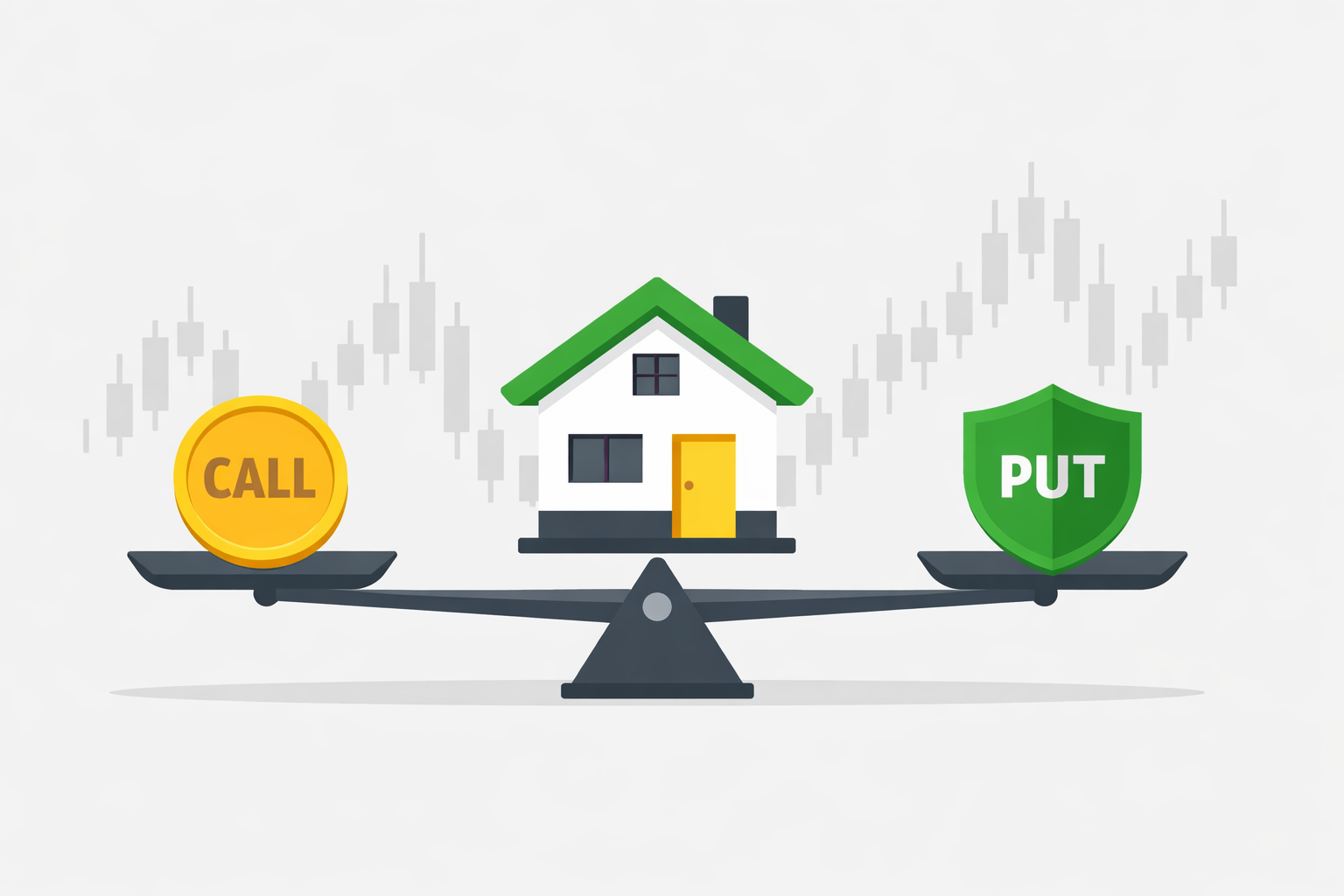
If you’ve ever made an offer on a house, you already understand options, you just didn’t know it yet. Every deposit, every "lock it in before prices (rates) move," every deal to protect your sale value - those are the same ideas Wall Street traders use every day.
This guide breaks down stock options through the world of real estate so you can finally see how simple the game really is.
TL;DR
Stock options are just contracts - rights to buy or sell, not obligations.
Call options lock in your buy price (like a deposit on a house).
Put options lock in your sell price (like home insurance).
Manage Your entry or Exit - You can make or protect money depending on how the market moves.
The goal isn’t gambling - it’s learning how to use options the way real estate investors use good deals and solid protection.
Options 101: The Real Estate Investor's Guide
Stock options can sound intimidating because people explain them like you need a suit, a finance dictionary, and an uncle on Wall Street to translate.
We are not doing that.
We are going to use real estate, because everybody understands a house, a price, and a handshake deal.
The one sentence definition
A stock option is a contract that gives someone the right (not the obligation) to buy or sell 100 shares of stock at a set price, by a set date.
That is it.
- The set price is called the strike price.
- The set date is called the expiration date.
- The fee paid for the contract is the premium.
There are two kinds of options:
- Call option: the right to buy.
- Put option: the right to sell.
And there are two roles you can play:
- Buyer: you pay the premium for the right.
- Seller: you collect the premium and take the obligation.
In this strategy, we are primarily sellers.
The Call option: locking in your purchase price
Imagine you find a house you love listed for $300,000.
You are not ready to buy today. Maybe you are waiting on your lender, maybe you are waiting on your bonus, maybe you just need two weeks to get your life together. The problem is that the market is hot and you think prices are going up.
So you make a deal with the homeowner:
- You pay them $5,000 as a non-refundable fee.
- In exchange, they give you the right to buy the house for $300,000 any time in the next 90 days.
That $5,000 is like the premium price for the stock option. The $300,000 is the strike price. The 90 days is the expiration date.
Now let's see what could happen.
Scenario A: the house jumps to $340,000
- Your contract lets you still buy it for $300,000. It is your right.
- You exercise your right, and you win, because you locked in and paid the lower price of $300,000 for a $340,000 house.
Scenario B: the house drops to $280,000
- You do not have to buy it for $300,000.
- You walk away and only lose the $5,000 fee.
That is a call option. The right to buy, without the obligation.
The Put option: guaranteeing your sale price
Alright, we already talked about call options being like putting a deposit on a house to lock in a great price. Now, let's talk about put options, and this time, let's stay in the real estate world.
You now own a house that you paid $300,000 for, and everything has been going great. In fact, your house is now worth $350,000 given the recent hot market. But lately, you've been hearing two pieces of bad news:
Your company is thinking about relocating to another city. If that happens, you'll have no choice but to move and sell your house whether the market is good or bad.
The housing market is starting to look shaky, due to the rumors of the company moving, prices in your area are showing signs of dropping, and you're worried that if you do have to sell, you could end up selling and losing that $50,000 in equity.
So now you are not trying to lock in a purchase price. You are trying to protect the profit you already made.
That is where a put option comes in.
You're not sure what's going to happen, but just in case, you make a deal:
- You found an investor that loves the area and pay them a small fee, let's say $5,000.
- In exchange, they agree that, if you decide to sell, they will buy your house from you for $350,000 anytime within the next 90 days.
- This means you have the right, but not the obligation, to sell your house at $350,000 price, no matter what happens in the market.
Now, let's see what can happen:
Scenario A: Prices Go Up, and You Still Have to Move
- The market rallies, and now your home is worth $365,000.
- Your company does decide to relocate you, meaning you have to sell your house.
- But since the market price is higher than your contract price ($350,000), you simply sell your home on the open market for $365,000 instead.
- Your put option expires unused, and the only thing you lose is the $5,000 fee you paid for protection.
- No regrets. It was insurance for a worst-case scenario, but thankfully, you didn't need it.
Scenario B: The Market Crashes, and You Have to Move
- Your company does relocate, meaning you have to move and sell your house.
- The housing market crashes due to the news of the move, and suddenly your home is only worth $300,000 again.
- No worries. Since you decide to sell, that investor still has to buy your house for $350,000 so you just saved yourself a $50,000 loss.
- That's using a put option as protection, just like insurance.
That is a put option. The right to sell, without the obligation.
Next Steps
Lock in the basics: Read What is an Option Contract? to reinforce the “right, not obligation” idea with another everyday example.
Understand why the price of the contract moves: Learn the simple breakdown in How Options Are Priced , what’s “real value” vs “time value.”
Turn patience into income: When you’re ready to apply the real estate mindset to a real strategy, read Getting Paid to Wait
Pick the right tool for your situation: Compare the two workhorse moves in Covered Calls vs. Cash-Secured Puts so you know when you need shares vs when you just need cash set aside.
Keep it grounded in value: Before you touch any contract, build the habit of pricing the business first with Intrinsic Value as a Starting Point
Final summary
Stock Options get way less scary when you stop treating them like casino chips and start treating them like real estate paperwork. A call is you locking in a buy price, a put is you protecting a sell price, and the premium is the small fee that makes the deal real. Keep it simple, practice first, and always make the stock choice with the same care you’d use before putting money down on a property.
*Disclaimer: This content is for educational purposes only and does not constitute financial advice. Past performance does not guarantee future results. Always conduct your own research before investing.*