
How to Buy Stock Shares for Free
TL;DR
We wanted Ethereum exposure, but we respected crypto volatility and did not want to guess the perfect dip.
So we used ETH4U as our brokerage-friendly Ethereum proxy and ran a simple monthly loop.
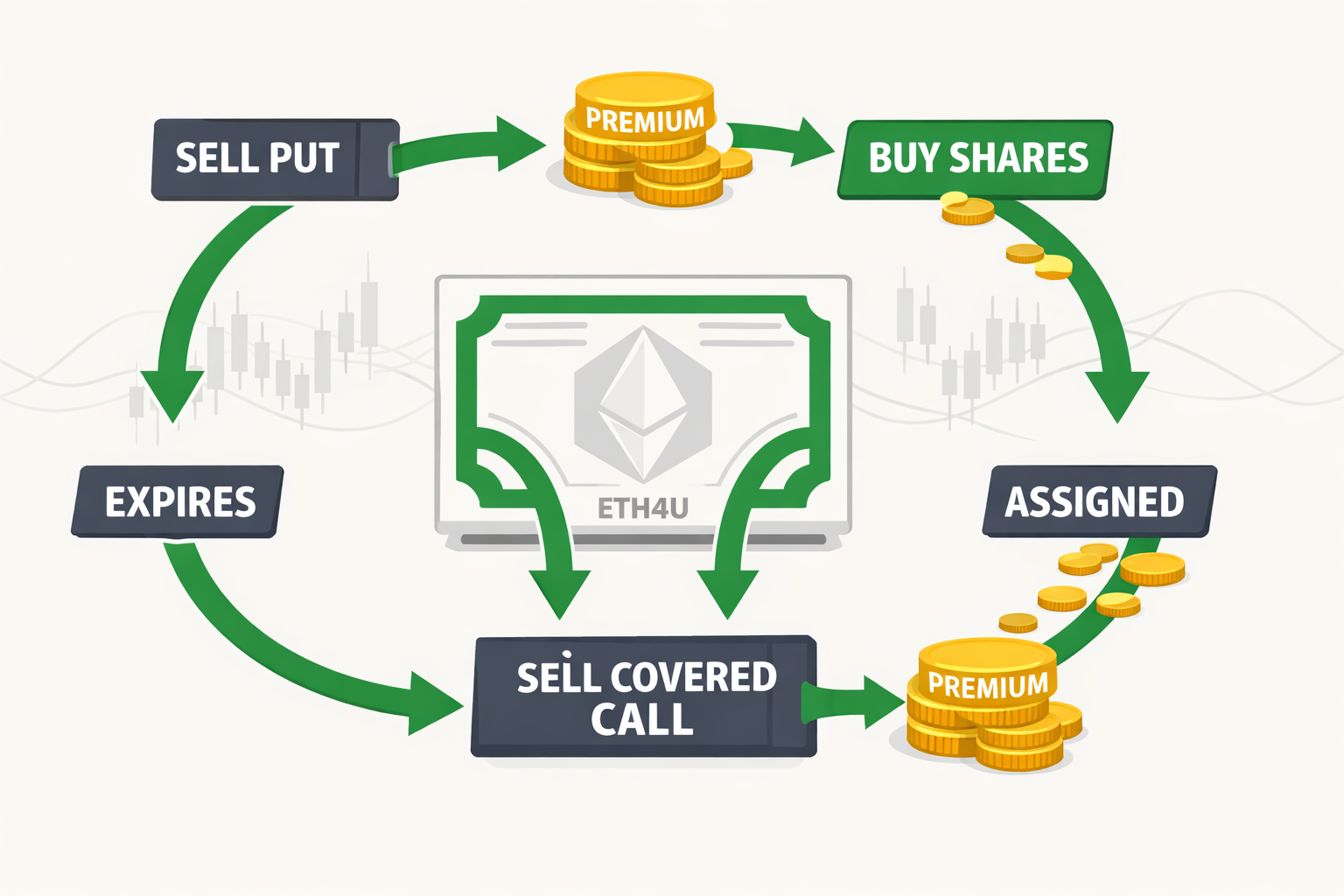
- Sell a cash secured put to collect premium.
- Use that premium to buy shares right away.
- At expiration, either the put expires worthless and we repeat, or we get assigned and switch to covered calls to collect more premium while waiting for shares to get called away.
The goal is to build a position steadily while using option premium to lower our effective cost, not to hit home runs or predict short-term price moves.
Disclaimer & Ticker note: ETH4U is a fictional symbol used for education. The trade log below is a real-world style example, but this article is not financial advice.
The Idea
Imagine you want to buy/acquire Ethereum, you have been reading, learning, and you believe the long-term crypto story for Ethereum is a real opportunity.
But you also realize the truth about crypto, it is volatile.
- It can move up 20% like it is nothing.
- Then it can humble you on a random Tuesday with a big 30% drop.
- Also trying to set up wallets, keys, and all the extra setup, buying ETH directly doesn't see that practical for you.
- You learned about ETH4U, a Ethereum Treasury company that allows you to get exposure to Ethereum and get compounded returns on that Ethereum.
So you decided, ETH4U is a stock you see as a clean way to get Ethereum-style exposure without all the extra crypto account setup. Same excitement, same volatility risk, but packaged inside a normal brokerage (trading) account, which you already have.
Because of your knowledge of crypto and it's volatility you need a way to buy that will help reduce your risk when it takes those nasty dips, while allowing you to acquire shares over time. So, instead of trying to time the perfect buy price, we use the Wheel strategy as a way to build the position slowly while using the market's money to do so.
That is the whole vibe, get paid and use the money you collected from the market to build the position. Essentially "free shares", with calculated risk.
The Simple Strategy (step by step)
We run a simple loop:
- Sell cash secured puts (SPO) to collect premium each month.
- Use that premium to buy shares.
- Two outcomes for Step 1:
If assigned shares,
- switch hats and sell covered calls (SCO) to collect more premium.
- Use call premium to buy more shares.
If NOT assigned,
- Repeat Step 1 & 2, Sell cash secured puts buy more shares.
- Repeat monthly.
The strategy is not magic, it is mechanics:
- Premium collected lowers the effective cost of building the position.
- If the stock drops, you are still exposed, but you are also collecting premium that can soften the landing.
- The slow share buys keep you engaged without going all-in at a single price.
Important reality check: “free shares” is a catchy phrase, but nothing is truly free. You are taking short term risk in exchange for premium. Once that risk expires then the shares become "free", the stock can still go to 0 but you won't have any of your invested capital at risk.
Why this approach is/can be beginner friendly
Options sound like witchcraft (obeah) until you stop treating them like witchcraft. Let's simplify things and get a basic understanding of the trade, the risks, and why this is simple (not easy, easy implies emotion, and emotions can get tricky).
Most people have only every heard of buying options (calls and puts). Buying options can be tricky and is speculation (aka Gambling). The thing you must realize upfront if you are new to options is that the market allows you to Sell options as well. You essentially become the other side of the trade for someone wanting to Buy that same option. We are just on the other side of the trade. Since most options expire worthless, this puts us in a high probability position to win, that is investing.
See the Wall St Yardie Options 101 article if you need more details: Options 101 Real Estate Investor Guide | Wall St Yardie
1) Selling Puts is like getting paid to wait
A cash secured put is basically:
- “I want to own ETH4U, but I do not want to sit on the sidelines waiting for the perfect dip.”
- “So I pick a price I would be happy to buy at (like $50, $40, or $38), and I collect premium today for being willing to buy there.”
Here is the key mindset shift.
We are not using this to delay owning the stock. We are using it to take action now without pretending we can predict the short-term price action.
So, we do two things at once:
- Sell the put to collect premium (this is the “getting paid to wait” part). Money gets deposited to our account right away.
- Buy some shares right away with the premium we just collected so we are in the game today, at today's price!
Lastly, we wait for the option to expire and make the next decision, which is where Step 2A (assignment/Sell Calls) and Step 2B (sell another Put) come in.
We are not guessing the dip, we are building position while the clock runs.
2) What next, Two outcomes after you sell the put
After Step 1 (selling the cash secured put), only two things can happen at expiration (we take no action till then).
Outcome A: ETH4U drops and you get assigned (shares delivered).
This is not a surprise, it is part of the plan. Assignment is simply the buyer executing their right to sell the stock to you at the strike price. Since we wanted to buy this stock anyway that is cool. We are now paying a price we chose, and got a discount (the premium we collected) to do so. Or strategy however is to get the market to give us the shares "free" so we have a little work to do in this scenario, but we will get paid for our work, again!
After assignment, you now have the shares, our plan was not to just buy the shares but use the market's money to do it. We need to now get the market to pay use to take these shares that we just paid for back, this way the cost basis for the shares we acquired in step 1 above become truly "risk-free". What we do now is switch hats and sell calls, these calls we sell are called covered calls because we have the shares to cover when the call buyer exercises their right to buy.
Covered calls are basically:
- “If you want my shares at $38, pay me for that right.”
If the stock stays below $38, you keep the premium and keep the shares, then you can sell another call next month, collect more premium, buy more shares, etc. If the stock rallies above $38, you may get the stock shares called away, which is fine because our strategy is built around acquiring shares using the market premiums we have collected.
Outcome B: The put expires worthless (no assignment).
In this scenario you keep the premium, we already used the premium to buy shares so if we have enough shares for the position we want we can stop here, and have no more risk, the put expired worthless and we are not obligated to do anything at this point. However, if we still want more shares we sell a new put and buy more shares just as we did in step 1. We can rinse and repeat this as many times as we like given we want to acquire more shares and have the cash in our account to sell the put.
You task now is simply:
- Sell a new cash secured put (next month, new strike).
- Use the premium to buy shares at the latest price so you keep building the position in real time.
The risk: because the market does not care about our vibes
This strategy is not a cheat code. It is a structured way to take risk.
- The stock can keep falling. Premium helps, but it cannot stop gravity. If this happens we can stop the cycle and re-evaluation our investment position to determine if we want to continue the cycle to acquire shares.
- You can get over-allocated. Assignment can stack quickly if you sell multiple contracts. That is why position sizing matters. One thing we need to determine upfront is how much of this stock we would be willing to hold based on the size of our account. Remember options contracts trade in 100 share lots. So if we only want to allocate $5000 to the position we need to ensure we are not selling puts that would over commit us. For Example, if the strike price we sell is $40 then we will need $4000 per contract, in our account for 1 contract. We are still below our $5000 allocation, so we can sell 1 contract. If we can allocate $10000 we can then sell 2 contracts. This keeps our position sized appropriately. Think of the dollar amount you are willing to commit to buying the stock, and sell contracts in accordance with this amount.
What I would tell a beginner doing this for the first time
- Only wheel what you would gladly own. If you are not proud to own it, do not sell puts on it. Quality companies ONLY . Do your research. Ensure the fundamentals of the company matches you investment goals. Don't ever sell puts on a company you are not willing to hold forever!
- Keep your contract count boring. Overconfidence is how people turn a strategy into a crisis. Stick to the sizing guidance from the second bullet in the Risk section above.
- Think in cycles. Each month is one decision. At expiration day you can decide to continue the investment or stop. The choice is yours. Once you reach your desired number of shares feel free to stop and find another opportunity with another company.
- Track your effective cost basis. Premium collected is real. Log it like a grown-up. Keep track of the number of shares bought with the premium and at what price. Also, how much premium was collected in each trade.
- Know your “stop caring” level. If the thesis breaks, do not keep trading out of pride or thinking you know better than the market. Sell your shares and move on.
Example with Real Numbers (Sep 2025 to Jan 2026)
Below is what an actual trade sequence looks like, with some numbers to make it real:
September 2025: Start the position and get paid to wait
18-Sep
- Stock Price: $61.38
- Sell 2 cash secured puts: Oct $50 Put, collected $3.11 premium
- Buy stock: 10 shares at $61.38
With the stock trading at $61.38 we sold the $50 Strike Price, Put, Expiring in October (1 month away). We collected $3.11/share in premium. Since we sold 2 contracts (200 shares) we collected $622 (3.11 * 200) total and committed $10,000 until October expiration (29 days away). We used the $622 to by 10 shares of the stock the same day @ $61.38. Notice we sold the put that was $11 lower than the current price, we want to give ourselves room for a dip and purchase the shares at a lower level if assignment happens. You might want to sell the put option that is at the 20 Delta, which tends to be a sweet spot.
October 2025: Close, roll down, add shares
17-Oct
- Stock Price: $50.95
- Buy to close: Oct $50 Put for $0.05 (basically pennies)
- Sell 2 cash secured puts: Nov $40 Put, collected $2.25 premium
- Buy stock: 9 shares at $50.95
In this case we did not wait for expiration since the stock price on expiration day was close to our strike we closed the October 50 Put, for $0.05 (5 cents/share). The stock dropped almost $11 and we still exited with a profit (now we are investing!). This is okay and we will factor this cost in the next round of selling puts. This allows us however to sell a new put for November at a much lower strike, freeing up some capital in our account, so this was a little risk management here on expiration day, not before! This is the rhythm you want. When the put decays, you can close it cheap and reset for the next month.
We then sold 2 more Puts for the November Expiration at the $40 Strike price. Now we are only committing $8000 for the next month. We collected a little less premium this month but that is okay because we are now have a strike price that is $10 lower. This round we collected $2.25/share ($450 total). We then buy 9 shares with this cash. Notice we bought 10 shares at $61.38, we are now buying another 9 shares for $50.95. We have lowered our break-even price using dollar cost averaging and used the market's money to do it! Our average share price is now $60.70, lower that when we started at $61.38!
November 2025: The stock drops, premium gets spicy
13-Nov
- Stock Price: $36.57
- Buy to close: Nov $40 Put for $3.63 (pain, but controlled)
- Sell 2 cash secured puts: Dec $38 Put, collected $5.13 premium
- Net Premium: $1.50
When the stock moves down toward your strike, the put gets more expensive to buy back. You can take the loss, then re-sell puts at a lower strike with richer premium while rolling out to the next month. This is not “winning,” this is repositioning, since the stock price was dropping we waited a bit to use this premium to buy more shares. About 2 weeks later the price stopped dropping and we used the $300 we collected (200 * 1.50) to buy 15 shares at $32.55/share. Notice that for December our Strike actually dropped again to $38, so now we only have $7600 committed, even in a situation where things are "going bad" we are coming out on top and reducing risk as we go.
December 2025: More puts, more shares, then assignment
2-Dec
- Sell 3 cash secured puts: Jan $25 Put, collected about $1.61 premium
- Buy stock: 15 shares at $32.55
We saw and opportunity to take advantage of the stock price, things started turning around and then we decided to sell 3 puts for Jan expiration knowing we had about 2 weeks for the December to expire, this was a calculated risk that once you get comfortable with the trade you can take. But know that we have now committed more capital on top of what was going for the December expiration.
December we have the $38 Puts for 2 contracts which means we needed to commit $7600 in capital ($38 * 200). When we sold the Jan early we did 3 contracts at $25 Strike Price, committing another ($7500 in capital). This is trader's choice and you should manage your position size accordingly. If you were not okay having $15,100 in play for the next 2 weeks (December 2 to Dec 19, December expiration date) then you should wait and add once the December situation is settled.
Then the big moment.
19-Dec
- Assigned stock: 2 lots of 100 shares at $38 (two assignments, total 200 shares)
- Sell 1 covered call: Jan $38 Call, collected about $1.47 premium
- Buy stock: 5 shares at $31.37
- Buy stock: 10 shares at $31.25
The stock closed below $38 on December 19. Our $7600 we had reserved was used to buy shares at $38, we got assigned. Assignment sounds scary until you remember what you signed up for.
If you sell a cash secured put, you are saying:
“I am willing to buy 100 shares at this strike price.”
So when ETH4U slid and the puts finished in the money (closed below $38), we got the shares.
Now we flip the script, we sell calls. The volatility on ETH4U allows us to sell calls at the $38 strike price and collect a nice premium. This means when the stock gets above $38 again the market will take the shares from our account. But in the meantime, we collect the premium from the calls and buy another 10 shares at $31.25, dollar cost averaging down even more!
Late December 2025: Keep the rent coming
22-Dec
- Sell 1 covered call: Jan $38 Call, collected about $1.70 premium
- Buy stock: 5 shares at $32.50
Covered calls are the “rent check” phase. You own shares now. You sell someone else the right to buy them from you at a set price, which happens to be the same price we bought them for, but remember we bought shares with the premium so we will release capital and start a new put selling cycle.
If ETH4U pops back above $38 by expiration, you will get called away and release the capital we have tied up in shares ($7600). If it stays below, you keep the premium and you sell another call next cycle at the $38 strike.
January 2026: Clean up, then keep calls while price is falling
14-Jan
- Buy to close: Jan $25 Put for about $0.01 (cleaning up the leftover short-put risk) We reduce our $7500 capital risk we added back in December.
20-Jan
- Sell 2 covered calls: Feb $38 Call, collected about $0.81 premium
- No new share buy this time
This last decision is key to risk management. The stock started drifting between $27 and $40. We were not going up. We had been assigned back in December, so we were holding 200 shares we wouldn't mind getting called away, which we bought for $38/share. Our Jan Puts were closed out for $0.01 (1 cent) to release the $7500 of capital we had committed to that position, another win. So we only have the $7600 we used to buy the 200 shares from December assignment left to manage. We can continue to sell $38 Calls and collect more premium. We decide to sell the 2 contracts of the Feb 38 Calls just after Jan expiration and collected $0.81/share (200 * 0.81) total $162. Instead of using the premium this month to buy more shares we decide to keep the cash and apply to reduce the cost basis of our 200+ shares of the stock we currently own. The plan from here is to continue selling the 38 Put until the shares are taken away (stock above $38 at expiration). Since we have 200+ shares we consider our position "full" now, we keep collecting premium until the shares are fully paid off or they are called away and we can start the cycle again.
In the end here, we used the call premium as a cost-basis helper while waiting for the stock to stop acting like it is in a trap door competition. This is an example of the flexibility of this strategy.
The Wall St Yardie (WSY) takeaway
We treated ETH4U like a stock we wanted to own long term.
- We sold puts to collect cash we used to buy shares.
- We kept doing this till assigned.
- We sold calls to collect more premium and buy more shares
- The stock stalled so we started using premium to cover the cost of the shares and not acquire more shares. When we got heavy on shares than we wanted, we adjusted and focused on premium as a cost-basis stabilizer, instead of forcing more buying into a falling knife.
That is the whole process. Slow, deliberate, paid to wait, and always aware that the market can get choppy.
Appendix: Trade Log Actions Summary
- 18-Sep: Buy 10 shares (~$61.38), Sell 2 Oct $50 Puts (+$3.11)
- 17-Oct: Buy to close Oct $50 Puts (-$0.05), Sell 2 Nov $40 Puts (+$2.25), Buy 9 shares (~$50.95)
- 13-Nov: Buy to close Nov $40 Puts (-$3.63), Sell 2 Dec $38 Puts (+$5.13)
- 2-Dec: Sell 3 Jan $25 Puts (+$1.61), Buy 15 shares (~$32.55)
- 19-Dec: Assigned 200 shares at $38 (two assignments), Sell 1 Jan $38 Call (+$1.47), Buy 5 shares (~$31.37), Buy 10 shares (~$31.25)
- 22-Dec: Sell 1 Jan $38 Call (+$1.70), Buy 5 shares (~$32.50)
- 14-Jan: Buy to close Jan $25 Puts (-$0.01)
- 20-Jan: Sell 2 Feb $38 Calls (+$0.81)
*Disclaimer: This content is for educational purposes only and does not constitute financial advice. Past performance does not guarantee future results. Always conduct your own research before investing.*