
Covered Calls vs. Cash-Secured Puts
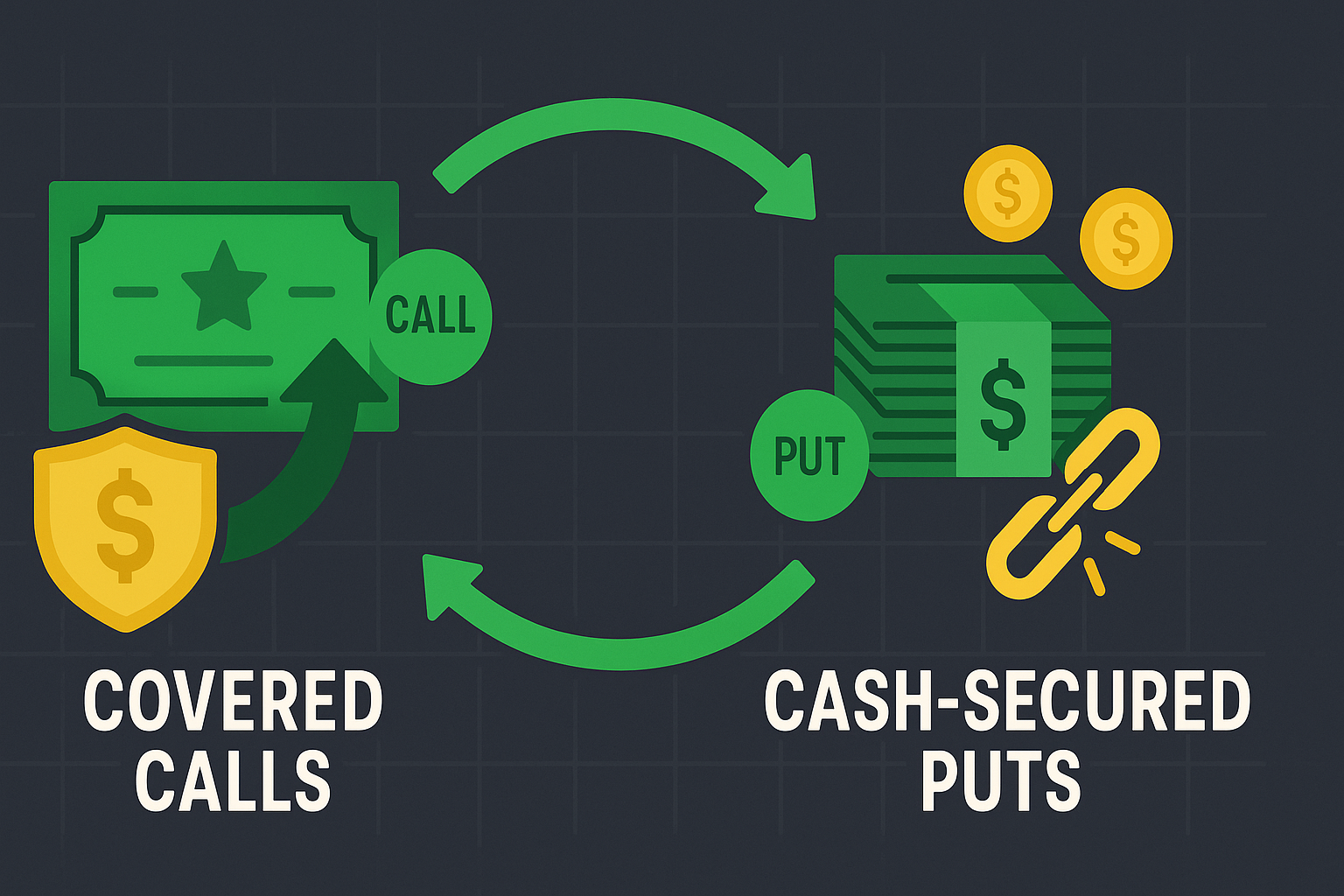
Covered calls and cash-secured puts are the two safest options strategies for value investors. Both generate income, both work on quality stocks, both respect the margin of safety. But they're not interchangeable. One works when you own shares, the other when you want to buy them.
TL;DR
- Covered calls = income on stocks you own: Generate cash flow from existing positions
- Cash-secured puts = income while waiting to buy: Get paid to set a limit order at your target price
- Both are conservative: No leverage, no naked risk, defined maximum loss
- Similar income potential: 15-30% annual yields with proper stock selection
- Use both together: Sell puts to enter, sell calls after assignment for continuous income
The Core Difference
Covered calls require you to own 100 shares (per contract) before you can sell the call. You're generating income from an existing position.
Cash-secured puts require you to have cash (strike price × 100 shares) sitting ready. You're generating income while waiting to buy shares at your target price.
Think of it this way:
- Covered calls = landlord collecting rent on property you own
- Cash-secured puts = getting paid to make a purchase offer on property you want
Both produce income. But one needs ownership first, the other needs cash first.
When to Use Each Strategy
Use covered calls when:
- You already own the stock
- Price is near or above fair value
- You're happy to sell at a profit if assigned
- You want to reduce cost basis while holding
Use cash-secured puts when:
- You want to buy the stock but it's trading above your target
- You have cash sitting idle
- You're willing to own at the strike price
- You want to get paid for limit orders
Example covered call setup:
- You own 100 shares of ABC Corp at $45
- Stock trades at $48, fair value is $60
- Sell $52 call for $200 premium
- Collect income while waiting for price appreciation
Example cash-secured put setup:
- XYZ Inc trades at $55, fair value is $70
- You want to buy at $50 or lower
- Sell $50 put for $200 premium
- Get paid $200 to wait for your entry price
The Income Math Comparison
Let's run the same $10,000 through both strategies to see how they compare.
Covered Call Math:
- Buy 200 shares at $50 = $10,000 invested
- Sell two monthly $55 calls at $150 each = $300 monthly premium
- Annual income: $3,600 (36% yield, assuming no assignments)
- If assigned at $55: make $1,000 capital gain + premiums collected
Cash-Secured Put Math:
- Reserve $10,000 cash (enough to buy 200 shares at $50)
- Sell two monthly $50 puts at $150 each = $300 monthly premium
- Annual income: $3,600 (36% yield on reserved cash)
- If assigned at $50: now own 200 shares at effective cost of $47 ($50 strike - $3 premium per share)
The income potential is nearly identical. The difference is timing and position status. Covered calls generate income after you buy. Puts generate income before you buy.
Risk Profile Comparison
Both strategies have similar risk: you're exposed to the full downside of the stock minus the premium collected.
Covered call max loss:
- Stock goes to zero, you lose your full investment minus premiums
- Example: $4,500 position (100 shares at $45), collect $600 in premiums, stock goes to $10
- Loss: $3,500 ($4,500 - $1,000 final value) offset by $600 premium = $2,900 net loss
Cash-secured put max loss:
- Stock goes to zero after assignment, you lose full investment minus premiums
- Example: $5,000 cash reserved, sell $50 put for $200, get assigned, stock goes to $10
- Loss: $4,000 ($5,000 - $1,000 final value) offset by $200 premium = $3,800 net loss
Key insight: Both strategies have substantial downside risk if the underlying company fails. That's why stock selection matters more than premium collection. Only use these strategies on wonderful companies passing your quality checklist.
Tax Treatment
This is where they diverge slightly.
Covered calls:
- Premiums collected are short-term gains when closed or expired
- If assigned, premium gets added to sale price (potentially long-term gains if held 1+ year)
- Can trigger unwanted taxable events through assignment
Cash-secured puts:
- Premiums collected are short-term gains if expired worthless
- If assigned, premium reduces your cost basis (no immediate tax event)
- Assignment creates a new holding period, so you start fresh on long-term status
For tax efficiency in a taxable account, puts have a slight edge because assignment defers the gain recognition. But the difference is minor. Use retirement accounts (IRA, Roth) when possible to avoid tax concerns entirely.
Which Strategy Pays More?
In theory, covered calls and puts at the same strike and expiration should have similar premiums (this is called "put-call parity"). In practice, puts often pay slightly more because:
Market fear bias: Investors pay more for downside protection (puts) than upside limitation (calls). Fear trades at a premium.
Dividend capture: Call sellers might accept lower premiums because they keep dividends. Put sellers don't get dividends, so they demand higher premiums.
On average, puts might pay 5-15% more premium for similar strikes and expirations. Not a huge difference, but it adds up over time.
The Wheel Strategy: Combining Both
Smart value investors use both strategies together in what's called "the wheel." Here's how it works:
Step 1 - Sell puts: You want to buy ABC Corp at $45. Sell $45 puts monthly, collecting premiums while you wait.
Step 2 - Get assigned: Stock drops to $42, you get assigned 100 shares at $45. Your effective cost: $43 (after accounting for premiums collected).
Step 3 - Sell calls: Now that you own shares, sell $50 calls monthly on the same stock.
Step 4 - Get assigned again: Stock rises to $52, shares get called away at $50. You made $700 capital gain ($50 - $43) plus all premiums from the calls.
Step 5 - Repeat: Now you have cash again, go back to selling puts.
You're generating income at every stage: while waiting to buy, while holding, and after selling. The wheel keeps spinning.
What Could Go Wrong?
Trapped by puts during crashes: You sell puts at $50, stock crashes to $30, you get assigned. Now you own shares underwater.
Mitigation: Only sell puts at prices where you genuinely want to own the stock based on intrinsic value. Use WSY app to calculate fair value before setting strikes. If fair value is $70 and you're selling $50 puts, you have a 29% margin of safety. That's enough cushion.
Missing rallies with calls: Stock gaps up 40% overnight, you miss the entire move because you sold calls.
Mitigation: Choose strikes at 80-90% of fair value to leave room for appreciation. Don't chase maximum premium by selling calls too close to current price.
Stuck in bad companies: High premiums lure you into selling options on low-quality stocks. When fundamentals deteriorate, premiums don't compensate for business decline.
Mitigation: Only use these strategies on wonderful companies. Quality first, premium second. Avoid temptation to chase yield on speculative stocks.
Cash drag with puts: Money reserved for put-selling sits idle earning nothing between trades. Opportunity cost of cash.
Mitigation: Keep reserved cash in money market funds or short-term treasuries earning 4-5% while waiting. Add that to your option premium for total return.
Next Steps: Choosing Your Strategy
- List 5 quality stocks you want to own (use WSY app to verify they're undervalued)
- For stocks you own: sell covered calls at 80-90% of fair value
- For stocks you want: sell cash-secured puts at 70-80% of fair value
- Start with one contract (100 shares) to learn mechanics before scaling up
- Track your income from both strategies over 3 months
- Consider implementing the wheel strategy to use both continuously
- Review related topics: managing covered calls and cash-secured puts basics
Covered calls and cash-secured puts are two sides of the same coin. Use puts to get in, use calls to get out, collect income the entire journey. That's how value investors turn patience into profits. Keep the riddim steady.
*Disclaimer: This content is for educational purposes only and does not constitute financial advice. Past performance does not guarantee future results. Always conduct your own research before investing.*