
Cashflow to Financial Freedom
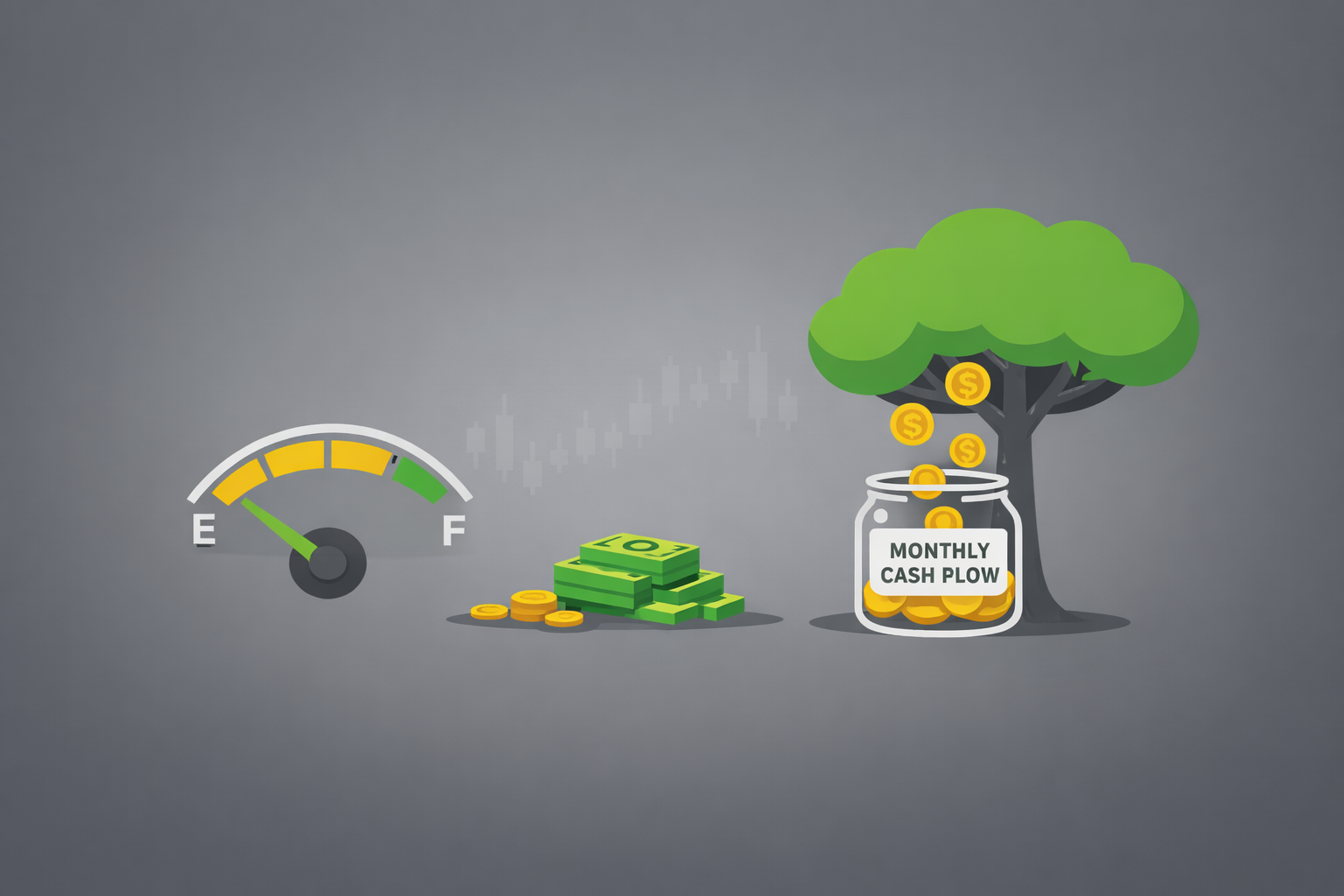
A lump sum of cash can feel like a win, but if it is not producing cash flow, it is just a candle. It lights up your life for a while, then it burns down. Freedom starts when your money stops being something you spend and starts becoming something that pays you.
TL;DR
- Budgeting helps you control spending, but it does not create income, cash flow does.
- Capital gains grow wealth over time, but they do not pay bills unless you sell shares, and eventually you run out of shares to sell.
- Inflation quietly shortens your runway when cash is sitting still and your lifestyle costs keep rising.
- Financial freedom is a monthly problem, you need a repeatable monthly cash flow plan tied to your freedom number.
- Cash flowing assets can include real estate, business partnerships, REITs, dividends, and a conservative options cashflow loop on quality underlying stocks.
- Options feel risky when used like a casino, education and defined rules are what turn them into a managed tool.
Financial Freedom Needs Cash Flow, Not Just a Bigger Pile of Money
A friend of mine got a large windfall of cash that was about 3 times (3X) his annual salary, then life hit him with the classic plot twist: he lost his job right after. His first instinct was the one most responsible people default to, stretch the dollars, budget harder, make it last. One year and some change later, he is looking up and realizing he has about a year and a half of runway left before he has to find work again. That type of countdown changes how you sleep!
That "runway" is the real lesson. A pile of cash can feel like freedom, but it is not freedom if it is shrinking every month and the plan is basically "hold on tight." Budgeting matters, it is the map. But budgeting is not the way to freedom. If the goal is financial freedom, the goal is not "how long can I survive," it is "how do I build cash flow that keeps showing up whether I have income coming in via a job or not."
This is why cash flowing assets matter. Real estate, passive business partnerships, REITs, dividends, and conservative stock options income strategies are all different ways of solving the same problem: you want money coming in on a schedule that can actually pay for life.
Inflation Turns "Make It Last" Into a Slow Leak
Even in a calm inflation environment, cash sitting still quietly loses buying power. The most recent CPI data for December 2025 showed inflation around 2.7% year over year. That sounds small until you live it for years. The same lifestyle costs more, and the meter keeps running.
So the "make it last" plan has a built-in weakness. If you are drawing down principal each month, inflation makes the drawdown larger over time, thus you can tighten the belt only so far. The real fix is not tighter budgeting forever. The fix is building a machine where your cash starts generating more cash.
Two Modes of Investing: Capital Gains vs Cash Flow
There are two completely different ways to make money in any investment. Most people only know about one. The first is the Capital Gains way and goes like this: Buy something and hope it goes up in value so you can sell it for more than you paid. Second, is the Cash Flow way to invest, You get paid NOW. Not someday. Not when the market cooperates. You build a machine that just keeps paying regularly.
Most mainstream investing conversations live in the capital gains lane. Buy something, hold it, hope it grows, sell later. That approach can build wealth and it is a great long-term game.
Here's what's wrong with the capital gains approach, You're hoping and praying. You get paid nothing while you wait. You have no idea when or if you'll make money. You're completely at the mercy of the market.
But here is the uncomfortable truth that matters for freedom: capital gains do not pay bills unless you sell the asset. If you need money every month and your "income" is only unrealized growth, you are forced to sell shares to fund your life. That can work, but it creates a nasty dependency on market timing, and it can punish you when markets are down and you still need cash. Keep doing that long enough and eventually you have nothing left to sell, and the party stops.
Cash flow investing is different. The goal is to own or control assets that produce income on a repeatable schedule, so you are less dependent on selling the asset at all or selling at the right time for you. In the cash flow lane, you are building freedom by building income streams.
That is why real estate gets so much attention. It is rent on a schedule. That is why businesses get attention. A good one can distribute cash. That is why REITs exist. They are structured around distributing income.
But stocks can play this cash flow role too, especially when you add a conservative options overlay.
The Mindset Shift: "Cash Generates Cash" Beats "Cash Gets Consumed"
My friend is not bad with money, he's actually an amazing budgeter. He is doing what people do when they feel uncertainty, protect the pile, reduce spending, stretch runway. The problem is that this mindset treats money like a candle, something you burn slowly until it is gone.
Financial freedom needs money to behave more like a fruit tree. You protect the tree, harvest the fruit, and keep the fruits growing.
That is the point of acquiring cash flowing assets. Not because growth is bad, but because growth-only investing often does not solve the "pay my life today" problem. If you want freedom, you need a plan that replaces income, not just a plan that grows a number on a screen.
Why Options Feel Risky, and Why Education Changes That
My friend is afraid of options because he has heard the word "risky," and to be fair, options can absolutely be used recklessly. He even told me, "All the smart people I know lost money trading options." The problem is that most people only see the casino version, big bets, big leverage, big blowups, and they never get introduced to the disciplined version of stock option investing where risk is defined, position size is controlled, and the goal is cash flow around quality underlying stocks, not a lottery ticket.
This does not mean we remove risk. If the underlying stock falls sharply, assignment can still happen, and owning shares can still mean drawdowns to our money. This is why education matters. Education turns vague fear into specific understanding, and specific understanding is what allows you to manage risk instead of avoiding opportunity.
The key idea is not "options are safe." The key idea is that education turns the unknown into the manageable, and once something is manageable, it stops being scary and starts being useful.
The Cash Flow Loop: Income First, While Respecting the Principal
Here is a framework we lean into, a cash flow loop built around quality stocks, where the goal is to generate consistent cash flow without turning the portfolio into a casino.
At a high level, it works like this:
You use cash-secured (selling) puts to generate income at a price you would be comfortable owning the stock, then if assigned (given the stock), you own the shares and can continue generating cash flow through covered (selling) calls.
This is not stock-picking, and it is not a promise of results. It is a structured mindset:
- Get paid for patience
- Accept ownership only at levels you can live with
- Continue generating cash while holding.
To make this fit different types of investors, there are two common rhythms:
Monthly expirations tend to fit people who want fewer decisions and a more passive cadence.
Weekly expirations tend to fit people who want more frequent decision points and do not mind being more active.
Neither is "better." The best one is the one you can follow consistently without emotional spirals.
"Quality Stocks" Are the Real Risk Control
Premium is the cash you collect when you sell options. This is where people get the whole thing wrong. They chase the highest premium, but premium is not the goal.
The real risk control is the underlying stock. If you build the cash flow loop around companies with staying power, assignment of the stock will not feel like disaster. It is supposed to feel like converting cash into ownership of something you already value.
If you build the loop around weak, hype-driven companies, assignment of the stock can turn into a long, painful hold where the cash flow does not make you whole.
That is why we keep this part high level and lean on process, not picks. With Wall St Yardie (WSY), the emphasis is value and quality first, then strategy. You want a repeatable way to find strong companies trading at reasonable prices, then decide how to generate cash around them. That is the logic behind the WSY approach and the WSY app, helping you identify and track high quality companies so you are not making decisions off vibes.
Learn Your Number, Because Freedom Is a Monthly Problem
Freedom is not abstract. Bills come monthly. So the first job is knowing what your life actually costs.
A budget does more than reduce spending. It tells you your target cash flow. That target becomes your "freedom number," the monthly amount your assets need to generate to fund your lifestyle.
Once you know that number, the whole investing conversation gets more honest. Now you can ask:
- What returns do I need?
- What risk level can I tolerate?
- What strategy cadence fits my behavior?
This also reconnects to inflation. If inflation is in the 2 to 3% range and your plan is earning less than that, you are not building freedom, you are slowly losing ground.
Small Stack vs Big Stack: Different Starting Lines, Same Mission
If you are starting small, saving and building the freedom account is still valid. If this is you then you are in the "build the engine" phase. You stack capital while learning the rules so you are not improvising later.
If you already have meaningful capital, like $100K or more, the bigger challenge is deployment of cash. The risk is not just market risk. It is the risk of sitting still while the runway shrinks, then being forced into rushed decisions when time gets short.
This is where education becomes a real asset. It helps you move from fear-based freezing to process-based action, starting small, learning the mechanics, and scaling only when you understand what you are doing. Links below help describe the process.
Closing: Freedom Is Not a Pile, It Is a System
My friend's story is a reminder that cash and a budget alone is not a plan. A plan is a system that produces income.
Capital gains can build wealth over time, but cash flow builds freedom in real time. If you want financial freedom, you need assets that pay you. Real estate, business partnerships, REITs, dividends, and conservative stock options income approaches can all be part of that ecosystem.
And if options feel risky, that is not a reason to avoid them forever. It is a reason to learn them properly. Because most fear around options is not about the tool itself, it is about the lack of understanding. Education turns the unknown into the manageable, and once something is manageable, it stops being scary and starts being useful.
Related WSY reads
- Benefits of cash-secured puts: https://www.wallstyardie.com/blog/cash-secured-puts-strategy/cash-secured-puts-benefits
- Case study: cash-secured puts on a value stock: https://www.wallstyardie.com/blog/income-generation-with-options/income-options-case-study-puts
- Finding value stocks for options strategies: https://www.wallstyardie.com/blog/finding-value-stocks-for-options-strategies
- Intrinsic value as a starting point: https://www.wallstyardie.com/blog/finding-value-stocks-for-options-strategies/finding-stocks-intrinsic-value
- Building a watchlist for value options: https://www.wallstyardie.com/blog/finding-value-stocks-for-options-strategies/finding-stocks-watchlist
- Drawdowns and capital preservation: https://www.wallstyardie.com/blog/testing-and-refining-your-value-options-strategy/testing-drawdowns
*Disclaimer: This content is for educational purposes only and does not constitute financial advice. Past performance does not guarantee future results. Always conduct your own research before investing.*