
Risks of Relying on Options Income
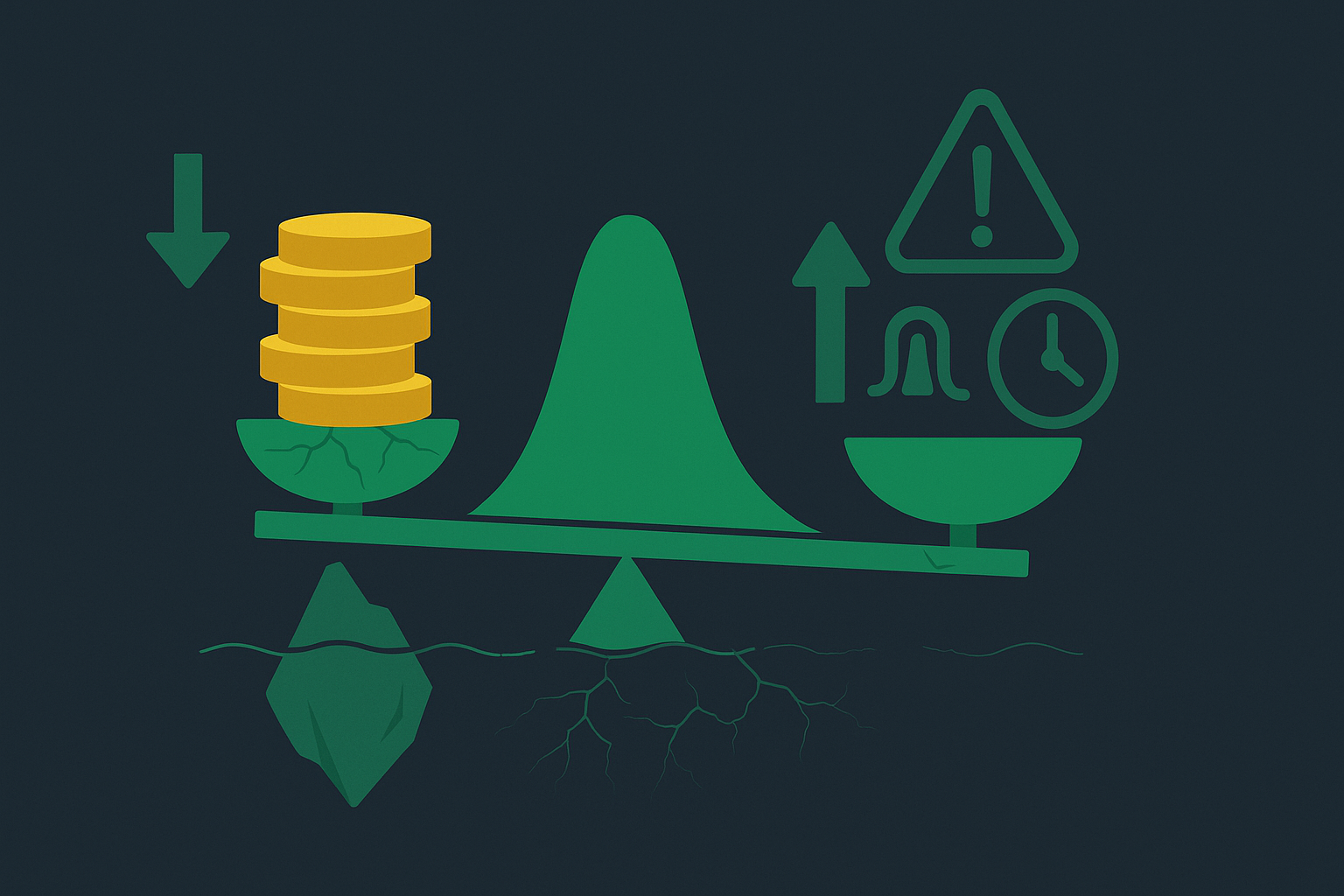
The pitch sounds perfect: collect steady income by selling options on quality stocks you'd own anyway. What could go wrong? Quite a bit, actually. Options income isn't passive, and the risks are real. Understanding them before you start is the difference between sustainable income and costly lessons.
TL;DR
- Assignment changes your portfolio unexpectedly: You might end up owning stocks at the wrong time or selling winners prematurely
- Opportunity cost is invisible but expensive: Capping upside on your best ideas compounds into significant missed gains
- Overtrading erodes returns quietly: Transaction costs, spreads, and bad decisions add up faster than you think
- Income creates false confidence: Steady premiums mask underlying position risks until markets move sharply
- Taxes complicate everything: Short-term gains, wash sales, and assignment rules can surprise you at tax time
The Assignment Risk Nobody Warns You About
When you sell options, someone else controls whether you execute. For puts, assignment means buying stock you may not want at that moment. For calls, assignment means selling stock you may want to keep.
Put assignment risk:
You sell puts because you'd love to own a stock at $80. The market drops it to $60. You're assigned at $80 and immediately underwater by $20 per share. Your "income strategy" just became a loss.
The psychological danger: you sold the put because you liked the company at $80, not because you analyzed what happens if it falls to $60. Many income sellers skip the downside analysis because assignment seemed unlikely.
Example: You sell a $90 put on a $100 stock for $2 premium. The stock falls to $70 after earnings miss. You're assigned at $90. Your cost basis is $88 ($90 strike minus $2 premium), but the stock is worth $70. That $2 income turned into an $18 loss.
Call assignment risk:
You sell calls thinking you'll happily sell at $110. The stock gaps to $140 on acquisition news. You sell at $110 (plus premium), missing $30 of upside. Your "wonderful company" was sold right before it got even more wonderful.
The psychological danger: you view the stock at the price you sold, not the price it reached. The regret compounds as you watch it climb further.
Opportunity Cost: The Hidden Drag on Returns
This is the risk income sellers most underestimate. Every covered call you sell caps your upside. Over time, those caps add up.
Consider this: You own 10 stocks. On 8 of them, covered calls expire worthless, and you keep the premium. Great. But on 2 of them, the stocks rally hard, you get assigned, and you miss substantial gains.
The math hurts:
Year 1: You collect $3,000 in premium income across your portfolio. One stock rises 40%, but your call capped you at 10%. Missed gain: $9,000. Net impact: You're $6,000 behind.
This happens more than you'd think. Winners tend to win big, and losers tend to lose modestly (until they collapse). Covered calls systematically clip your winners while letting your losers run.
The solution isn't avoiding covered calls entirely, it's being extremely selective about which positions you cap. Don't sell calls on your highest-conviction ideas with the most upside potential.
Use Wall St Yardie to identify which companies have the most room between current price and intrinsic value. Save covered calls for positions already near fair value.
Overtrading: Death by a Thousand Cuts
Options income feels active. You're making decisions, collecting premiums, adjusting positions. The activity creates an illusion of control and progress.
But every trade has friction:
Direct costs:
- Commission: $0.50-1.00 per contract
- Bid-ask spread: Often $0.05-0.15 per share
- Per-contract fees: Some brokers add additional charges
Indirect costs:
- Tax inefficiency from short-term gains
- Time spent managing instead of analyzing
- Decision fatigue leading to poor choices
Example: You trade weekly options, making 52 round trips per year on a single position. Even with "free" commissions, the spread costs you $0.10 per share each trade. On 100 shares: $10 × 52 = $520 annual friction. If your weekly premiums average $0.80, your gross income is $4,160. After friction: $3,640. You've lost 12.5% to invisible costs.
The more you trade, the more friction takes. Monthly traders face less drag than weekly traders. Quarterly traders face less than monthly.
False Confidence from Steady Income
When premium checks arrive regularly, it's easy to believe you've found a risk-free strategy. This confidence is dangerous.
The deceptive calm:
For months, you sell puts on a stock. It stays flat or rises slightly. Your puts expire worthless. You collect $200-300 per month. This feels like found money.
Then the stock drops 25% in a week. You're assigned on multiple puts. Suddenly you own way more shares than intended, all at underwater prices. One bad month erases six months of income.
The collection bias:
Income sellers remember the premiums collected. They forget (or minimize) the assignment losses. Your mental accounting shows profit even when your actual account shows loss.
Keep a real spreadsheet. Track every assignment, every stock movement, every trade. Compare your total return (income plus capital gains and losses) to simply holding the stocks without options. The truth sometimes stings.
Tax Complications Nobody Mentions
Options income creates tax headaches that can surprise you:
Short-term capital gains:
Option premiums are generally taxed as short-term gains regardless of how long you've held the underlying stock. That 1.5% monthly yield might be 0.9% after federal and state taxes.
Wash sale rules:
If you sell a stock at a loss and then sell a put on that stock within 30 days, the wash sale rule may disallow your loss. Options complicate tax-loss harvesting in ways that catch people off guard.
Assignment changes your holding period:
Being assigned on a put starts a new holding period for the acquired shares. Being assigned on a call might mean selling shares with short-term gains even if you've held them for years (depending on which shares you're assigned against).
Straddle rules:
Complex option combinations can trigger straddle tax treatment, deferring losses and changing the character of gains. Most income investors don't use strategies this complex, but be aware if you layer positions.
Consult a tax professional before building a significant options income strategy. The pre-tax yield isn't what hits your bank account.
Position Sizing Mistakes
Options income feels different from stock ownership. This leads to sizing errors:
Mistake 1: Selling too many puts
Each put commits you to buy 100 shares. Selling 5 puts on a $100 stock commits $50,000. If you're assigned on all 5, can your portfolio handle that concentration?
Many income sellers overcommit without realizing it. They see $500 in premium income and miss the $50,000 potential obligation.
Mistake 2: Selling calls on entire positions
If you own 500 shares and sell 5 calls, you've capped 100% of your upside. Consider selling calls on only 40-60% of a position, leaving some shares uncapped for big moves.
Mistake 3: Income targets drive position sizing
"I need $2,000 monthly income" shouldn't determine how many options you sell. Start with appropriate position sizes based on your portfolio, then accept whatever income that generates.
When Income Strategies Hurt Long-Term Returns
There are conditions where options income actively damages your wealth:
Strong bull markets:
In a year when the market rises 25%, covered calls might cap you at 15% plus premiums. Your 19% total return sounds fine until you realize buy-and-hold earned 25% with zero effort.
Concentrated high-conviction positions:
Selling calls on your best idea, the one you're certain will compound for decades, systematically reduces your lifetime return. Some positions shouldn't generate income. They should compound undisturbed.
Early accumulation phase:
If you're building wealth, opportunity cost hurts most. Capping upside in your 30s compounds into massive differences by your 60s. Income strategies make more sense when you're spending from a portfolio, not growing it.
Tax-advantaged accounts:
IRAs eliminate the short-term gains problem but can't recoup losses against other income. Losing money in an IRA from bad assignments is permanently gone. The stakes are different.
What Could Go Wrong?
You become psychologically attached to income: The steady premium checks feel essential. You start selling options on positions where you shouldn't, just to keep the income flowing.
Mitigation: Set income as secondary to capital appreciation. Premium is bonus income, not your primary return source.
Assignment forces poor timing: You're assigned right before a recovery. The stock drops, you get shares, it drops more, then rallies 40% after you've sold in frustration.
Mitigation: Only sell puts on companies you'd hold for 3-5 years minimum. If assigned, treat it as a long-term purchase, not a failed trade.
You underperform passive indexing: After tracking true total return for two years, you realize you'd have earned more doing nothing.
Mitigation: Track religiously. Compare to appropriate benchmarks. Be willing to admit if income strategies aren't adding value for your situation.
Complexity overwhelms discipline: Managing multiple option positions, rolling, adjusting, and tracking creates so much activity that you lose sight of the underlying business quality.
Mitigation: Limit your active income positions. Five well-managed trades beat twenty chaotic ones.
Next Steps
- Track total return, not just income: Include capital gains, losses, and opportunity cost in your performance
- Calculate your true friction costs: Add up spreads, commissions, and fees per year
- Assess position by position: Which holdings should generate income? Which should compound undisturbed?
- Review your risk tolerance honestly: Can you handle assignment at the worst possible time?
- Consult a tax advisor: Understand how income affects your specific tax situation
- Set maximum allocation: Decide what percentage of your portfolio participates in income strategies
- Maintain realistic expectations: Income strategies add 2-5% to returns, not 20%
Options income can enhance a value portfolio. But it's not magic, and it's not free. The risks are real, subtle, and compound over time.
Enter with eyes open. Track everything. Stay humble about what you don't know. That's how disciplined investors turn options income from a liability into a true edge.
*Disclaimer: This content is for educational purposes only and does not constitute financial advice. Past performance does not guarantee future results. Always conduct your own research before investing.*