
Income Generation in High Volatility
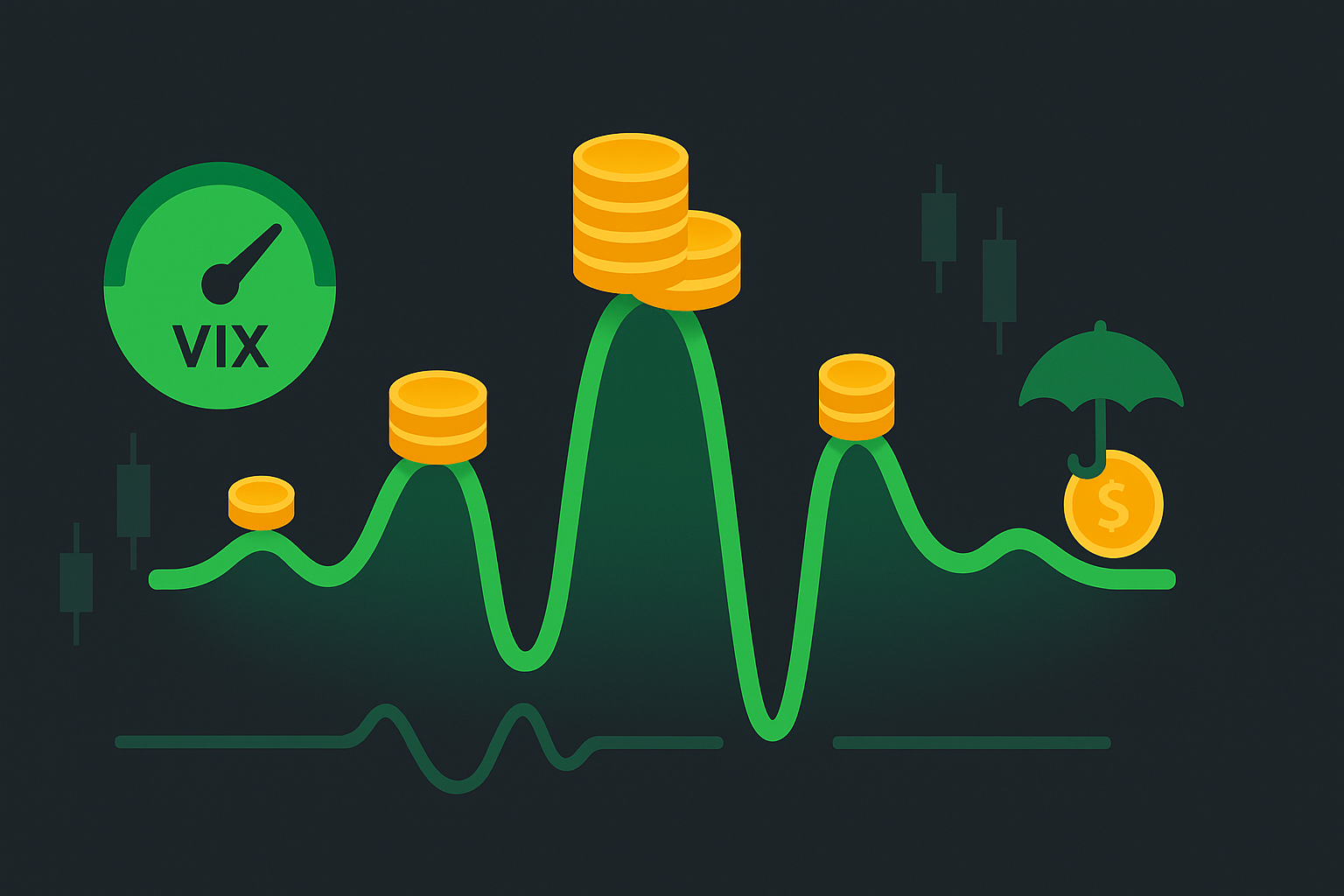
When markets panic, most investors freeze. They see red numbers and feel the urge to hide. But for income-focused value investors, fear creates a rare opportunity: the same covered calls and cash-secured puts that paid 1% last month might suddenly pay 3% or more. Volatility is the income seller's best friend, if you know how to use it.
TL;DR
- Higher implied volatility = higher premiums: Option prices rise when fear increases, creating better income opportunities
- Sell premium into spikes, not away from them: The best time to generate income is when others are scared
- Stick to quality companies: Elevated premiums on wonderful businesses are opportunities, elevated premiums on junk are traps
- Don't chase yield blindly: Just because you can earn 5% monthly doesn't mean you should take inappropriate risks
- Volatility compresses eventually: What goes up comes down, so capture elevated premiums while they last
What Implied Volatility Actually Means
Implied volatility (IV) measures how much the market expects a stock to move. It's baked into option prices, and it changes daily based on fear, uncertainty, and demand for options.
When IV is low, the market expects calm. Options are cheap because the expected move is small.
When IV is high, the market expects turbulence. Options are expensive because the expected move is large.
For option sellers, this creates a beautiful dynamic: you get paid more when uncertainty rises. The premium you collect for selling a covered call or cash-secured put reflects the market's anxiety, and anxiety pays well.
Think of it like hurricane insurance. During calm weather, premiums are low. When a storm threatens, premiums spike. As an income seller, you're the insurance company, and storms are when you make the most money.
How Volatility Affects Your Premiums
Let's compare premium income in different volatility environments using the same stock and strike:
Stock: $100, selling 30-day covered calls at $105 strike
| VIX Level | IV Environment | Approximate Premium | Monthly Yield |
|---|---|---|---|
| 12-14 | Very low | $0.80 | 0.8% |
| 15-18 | Normal | $1.40 | 1.4% |
| 20-25 | Elevated | $2.20 | 2.2% |
| 30-35 | High | $3.50 | 3.5% |
| 40+ | Panic | $5.00+ | 5.0%+ |
The same trade at the same strike generates wildly different income depending on market conditions. In a panicky market, you might earn six months of normal income in one cycle.
This is why value investors who understand options love volatility spikes. They're not trading the fear, they're collecting it as rent.
When to Increase Income Activity
Not all volatility spikes are created equal. Here's how to identify true opportunities:
Market-wide fear (best opportunity):
- VIX spikes above 25-30
- Broad indices fall 5%+ in days
- Headlines scream doom
- Quality companies fall alongside junk
This is the sweet spot. Strong businesses are suddenly paying elevated premiums because fear is indiscriminate. You're getting paid extra for risk that isn't actually elevated on wonderful companies.
Sector-specific fear (selective opportunity):
- One sector collapses while others remain calm
- IV spikes only in affected industries
- Good companies in that sector become attractive
Here, focus on the best businesses in the troubled sector. Avoid companies where the fear might be justified.
Company-specific fear (proceed with caution):
- One stock has elevated IV while peers don't
- Usually tied to earnings, lawsuits, or specific news
- Premium is high because actual risk is high
This is often a trap. If only one company has spiked IV, there's usually a real reason. Elevated premiums on potentially impaired businesses aren't opportunities, they're compensation for genuine danger.
Practical Strategies for High-Volatility Income
When volatility spikes, adjust your approach:
1. Sell puts on companies you've wanted to own
High IV creates a double opportunity: you get paid more to wait, and if you're assigned, you buy at a lower price. A stock you'd happily buy at $80 might pay $4 per share in put premium instead of the usual $1.50.
Example: During market panic, a $100 stock you value at $120 pays $4 for a $90 put. If assigned: You own a $120 stock at an $86 effective cost ($90 strike minus $4 premium). If not assigned: You earned 4.4% in one month for agreeing to buy at a discount.
Either outcome is excellent.
2. Sell covered calls further out of the money
Elevated premiums let you move strikes higher while maintaining meaningful income. Instead of selling $105 calls for $1.40, sell $110 calls for the same $1.40. You earn the same income while retaining more upside.
This is how volatility lets you have your cake and eat it: similar yields with better strike placement.
3. Extend duration for larger upfront premiums
In calm markets, 45-60 day options don't pay much more than 30-day options. In volatile markets, the term structure expands. You might collect 60% more premium for twice the duration rather than 30% more.
Longer-dated options in high IV lock in elevated premiums for extended periods. The market might calm down in two weeks, but you've secured two months of high-IV income.
4. Layer positions across multiple stocks
Volatility spikes affect most stocks simultaneously. Instead of concentrating in one position, spread your income activity across your best ideas. This diversifies the risk that any single position moves sharply against you.
Maintaining Discipline During Chaos
Volatility creates emotional pressure. Here's how to stay rational:
Don't abandon your criteria: A bad company paying high premiums is still a bad company. Stick to wonderful businesses with economic moats and strong cash flows. The premium compensates for risk, not for owning businesses you wouldn't want otherwise.
Keep position sizes normal: It's tempting to go all-in when yields look incredible. Resist. A 3% monthly yield doesn't justify doubling your exposure. Maintain the same position sizing discipline you use in calm markets.
Avoid the "quick money" trap: Some investors try to flip options quickly in volatile markets, buying and selling positions based on short-term IV movements. This is speculation, not income investing. Sell premium and let time decay work.
Remember that volatility compresses: High IV doesn't last forever. If you sell a 60-day option when IV is at 40, it might be at 20 when the option expires. This IV compression helps your trade, the option loses value faster than theta alone would predict. But don't count on extreme IV indefinitely.
Calculating Enhanced Returns
Let's compare a year of income investing in different volatility scenarios:
Scenario 1: Perpetually calm markets (VIX ~14)
- Average monthly premium: 1.0%
- Annual income: 12%
- Trading costs: 2%
- Net annual income: 10%
Scenario 2: Mostly calm with two volatility spikes
- 10 normal months at 1.0%: 10%
- 2 elevated months at 3.0%: 6%
- Annual income: 16%
- Trading costs: 2%
- Net annual income: 14%
Scenario 3: Volatile year (four significant spikes)
- 8 normal months at 1.0%: 8%
- 4 elevated months at 2.5%: 10%
- Annual income: 18%
- Trading costs: 2.5%
- Net annual income: 15.5%
Volatility isn't a threat to income investors. It's the difference between good years and great years. The key is being prepared to act when spikes occur rather than hiding from them.
Recognizing When to Step Back
Not all high-IV environments favor selling premium:
Before earnings announcements: IV is elevated because genuine uncertainty exists. The company might report disaster. Unless you're confident in the business, avoid selling around earnings.
During fundamental deterioration: If a company's business is actually failing, elevated premiums aren't compensation for temporary fear, they're warning signals. Check whether the panic is justified before selling.
When your watchlist is empty: If you can't find quality companies you'd want to own, don't reach for inferior businesses just because premiums are high. Cash is a position.
When you're already fully allocated: High IV shouldn't push you beyond your capacity. If you're at maximum position sizes, enjoy the elevated premiums on existing trades rather than adding new ones.
Use Wall St Yardie to quickly evaluate whether companies in your watchlist still meet your intrinsic value criteria during volatile periods.
What Could Go Wrong?
Stock falls further than expected: You sell puts in a panic, thinking fear is overdone. The company drops another 30%. Now you're assigned at prices well above current value.
Mitigation: Only sell puts at strikes you'd genuinely want to own at. If the stock falls to your strike, you should be happy to buy, not panicked.
Volatility stays elevated: You sell a 60-day option expecting IV to compress, but uncertainty persists. The option doesn't decay as fast as expected because fear remains.
Mitigation: Plan for the option to decay normally via theta. IV compression is bonus, not something to depend on.
You overtrade during excitement: The rush of high premiums leads to excessive activity. You sell premium on too many positions, exceeding your capacity to manage them.
Mitigation: Set a maximum number of open income positions before volatility spikes. Stick to the limit even when premiums tempt you.
Quality degrades under pressure: In panicky markets, you convince yourself that marginal companies are "good enough" because premiums are juicy.
Mitigation: Keep your watchlist updated during calm periods. When volatility spikes, trade only from that pre-approved list.
Next Steps
- Monitor VIX levels: Track the VIX and set alerts for when it exceeds 25, signaling potential opportunity
- Build your watchlist now: Identify quality companies you'd want to own before volatility spikes hit
- Calculate your normal premiums: Know what typical income looks like so you recognize when it's elevated
- Set position limits: Decide in advance how many income trades you'll have open at once
- Review strike selection: In high IV, move strikes further OTM while maintaining yield
- Practice patience: Wait for true fear, not just minor upticks in volatility
Volatility spikes are gifts for disciplined income investors. While others panic, you calmly collect elevated rent on wonderful businesses.
Keep the riddim steady when markets wobble. That's when the real money flows.
*Disclaimer: This content is for educational purposes only and does not constitute financial advice. Past performance does not guarantee future results. Always conduct your own research before investing.*