
Options Enhancement Checklist
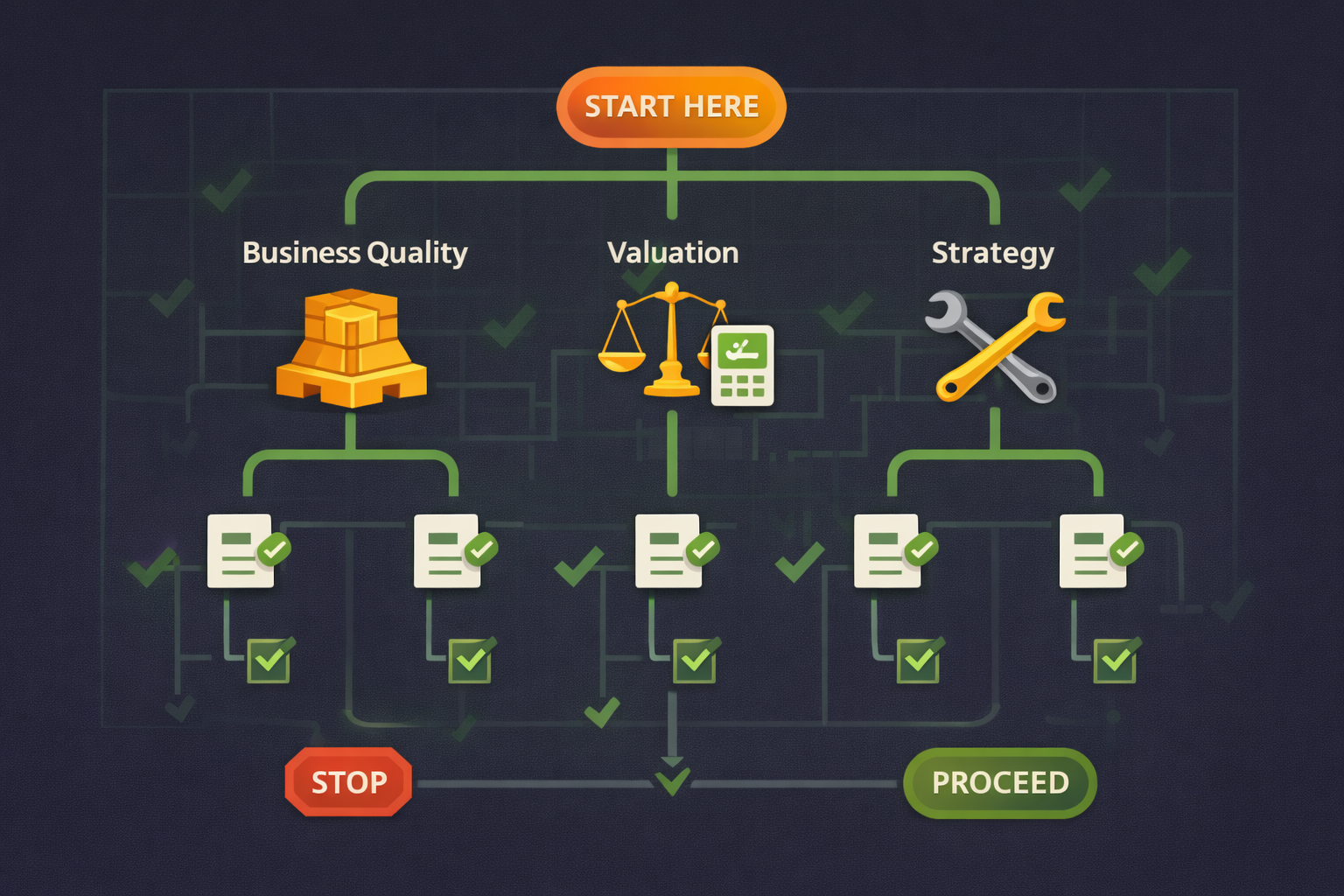
Options can enhance value investing or undermine it completely. The difference comes down to process. This checklist gives you a systematic framework to decide when, how, and why to use options in your portfolio. Follow it before every trade, and you'll avoid the mistakes that destroy returns while capturing the benefits that compound wealth over decades.
TL;DR
- Start with business quality: Never use options on companies you wouldn't own for 5+ years
- Confirm valuation first: Intrinsic value must support your strike price selection
- Match strategy to goal: Income = calls/puts, Leverage = LEAPs, Protection = protective puts
- Size positions conservatively: Keep active option strategies under 20% of total portfolio
- Use this checklist every time: No exceptions, no shortcuts, no "this one's obvious"
The Pre-Trade Master Checklist
Use this before entering any options position. Every single question must have a clear, confident answer.
Part 1: Business Quality (Non-Negotiable)
☐ Would I be happy owning this business for 5+ years?
- If no, stop here. Don't use options on it.
- If yes, proceed.
☐ Does this company have a durable competitive advantage (moat)?
- Strong brand, network effects, cost advantages, regulatory barriers, or switching costs
- If it's just "cheap" without a moat, it's probably a value trap
☐ Does management allocate capital intelligently?
- Check ROE, ROIC, history of buybacks/dividends/acquisitions
- Poor capital allocation destroys shareholder value even in good businesses
☐ Is the balance sheet strong enough to survive a recession?
- Debt-to-equity under 2.0× for most businesses
- Enough liquidity to cover 18-24 months of operations
- No near-term debt maturities that could force distressed refinancing
☐ Are earnings stable and predictable?
- Look for consistent FCF over 5+ years
- Avoid companies with lumpy, cyclical, or declining earnings
- Steady businesses generate better option premiums without hidden risk
Part 2: Valuation (Critical Foundation)
☐ Have I calculated intrinsic value using at least 2 methods?
- DCF, earnings yield, P/E vs. peers, payback time, cap rate thinking
- Different methods should converge on a similar range
- Use Wall St Yardie tools to simplify the process
☐ Is there a clear margin of safety (20-30% minimum)?
- If stock trades at $50 and you estimate fair value at $55, that's not enough
- You need room for error in your valuation assumptions
- Aim for $70 fair value when buying at $50 (29% margin)
☐ What's my target exit price?
- This determines strike price selection for covered calls
- For cash-secured puts, this determines if you're buying at a discount
- If you don't have a target, you're not ready to use options
☐ What could make my valuation wrong?
- Regulatory changes, competitive threats, technological disruption
- If these risks are high, avoid options (too much uncertainty for time-bound contracts)
Part 3: Strategy Selection
☐ What is my primary goal with this position?
- Income generation → Covered calls or cash-secured puts
- Patient entry below current price → Cash-secured puts
- Leveraged conviction → LEAPs (in-the-money)
- Downside protection → Protective puts
- No clear goal → Don't use options, just own the stock
☐ Does my chosen strategy align with my long-term thesis?
- If you believe stock will double in 2 years, selling covered calls at 10% above current price is stupid
- If you think the stock is fairly valued, selling cash-secured puts makes no sense
- Strategy must match conviction level and time horizon
☐ Am I using options to enhance or replace stock ownership?
- Enhancement = covered calls on stocks you own, puts to add to positions
- Replacement = trying to avoid stock ownership entirely, using only options
- The first works, the second fails
Part 4: Position Sizing and Risk Management
☐ What's the maximum I could lose on this trade?
- For covered calls: Downside in the stock (unlimited theoretically, but capped by strike - premium)
- For cash-secured puts: Strike price - premium (if stock goes to zero)
- For LEAPs: 100% of premium paid
- For protective puts: Premium paid
☐ Can I afford that loss without it changing my life?
- If a 50% loss would keep you up at night, position is too large
- If a 100% loss would force lifestyle changes, position is WAY too large
- Size positions so you can hold through volatility calmly
☐ What % of my portfolio is in active options strategies?
- Ideal: 10-20% in options, 80-90% in simple stock ownership
- Maximum: 30% in options, 70% in stocks
- Danger zone: 50%+ in options, you've become a trader
☐ How many different positions will I be managing?
- Manageable: 5-10 option positions total
- Challenging: 10-20 positions (requires discipline and tracking)
- Overwhelming: 20+ positions (you'll lose track and make mistakes)
Part 5: Execution Details
☐ What strike price am I choosing and why?
- For calls: Above fair value (you're willing to sell at this price)
- For puts: At or below your target entry (you want to own at this price)
- For LEAPs: In-the-money with delta 0.70-0.85 (stock-like behavior)
☐ What expiration am I choosing and why?
- Short-term (7-30 days): Maximum premium per day, but requires active management
- Medium-term (30-90 days): Balance of premium and flexibility
- Long-term (12-24 months): LEAPs only, for conviction plays
- Avoid weekly options unless you're a full-time trader
☐ What's the premium yield (monthly/annualized)?
- Reasonable for covered calls: 2-5% monthly (24-60% annualized)
- Reasonable for cash-secured puts: 2-5% monthly
- Warning zone: 10%+ monthly (usually signals hidden risk)
☐ Will I avoid earnings announcements?
- Rule: Close or roll positions 7+ days before scheduled earnings
- Earnings create binary outcomes that override your thesis
- Premium isn't worth the gap risk
☐ What's my plan if the trade goes against me?
- For calls: Roll up and out if stock rises past strike, or accept assignment
- For puts: Roll down and out if stock drops, or accept assignment and hold
- For LEAPs: Close at 50% loss or roll forward if thesis still valid
- No plan = gambling
Part 6: Tax and Administrative Considerations
☐ Am I using options in the right account type?
- Tax-advantaged (IRA/Roth): Best for active option strategies (no tax drag)
- Taxable account: Use longer-dated options (60-90 days) to reduce turnover
- 401k: Usually doesn't allow options, stick to stocks
☐ Have I considered the tax implications of assignment?
- Assignment creates a taxable event (stock purchase or sale)
- Short-term gains (< 1 year) taxed at 37% vs. 15-20% for long-term
- Factor this into expected returns
☐ Am I tracking everything in a journal or spreadsheet?
- Entry date, strike, premium, expiration, outcome, profit/loss
- Without tracking, you can't learn from mistakes or improve
- Set up tracking BEFORE the first trade, not after
Part 7: Psychological Readiness
☐ Am I emotionally prepared for assignment?
- Getting assigned shares on a put should feel like winning, not losing
- Having shares called away should feel like executing your exit plan
- If assignment creates panic, you sized wrong or chose wrong stocks
☐ Can I hold this position without checking it daily?
- Value investors check positions weekly or monthly, not hourly
- If you're obsessing over the position, it's too large or too speculative
- Options should run in the background while you focus on business fundamentals
☐ Am I using options because I believe in the strategy, or because I'm chasing returns?
- Good reason: "I want to collect income on stocks I'd hold for 10 years"
- Bad reason: "My friend made 50% last month selling options"
- Motivation determines whether you'll stick with it through downturns
☐ Do I have the patience to let this play out over months/years?
- Options have expirations, but your thesis should be multi-year
- You might sell 10-20 rounds of options on the same stock over 3 years
- Impatience leads to closing positions early and sacrificing returns
Using the Checklist: Real Examples
Example 1: Covered Call Decision
Stock: ABC Corp, currently $60, fair value $85 Idea: Sell covered call to generate income
Working through checklist:
- ☑ Business quality: Yes, strong moat, 15-year track record
- ☑ Valuation: Fair value $85, current $60 = 29% margin of safety
- ☑ Strategy matches goal: Income generation, willing to sell at $75-80
- ☑ Strike selection: $75 strike (below fair value, but profitable)
- ☑ Expiration: 60 days (monthly income, not too short)
- ☑ Premium: 3% monthly (reasonable, not suspiciously high)
- ☑ Position sizing: This is 5% of portfolio (safe)
- ☑ Tax: In Roth IRA (no tax drag)
- ☑ Psychological: Happy to sell at $75 or keep shares + premium
Decision: Proceed with trade.
Example 2: Cash-Secured Put Decision
Stock: XYZ Inc, currently $50, fair value $40 Idea: Sell $45 put to "get paid to wait"
Working through checklist:
- ☑ Business quality: Yes, decent company
- ☒ Valuation: Fair value $40, current $50 = Stock is OVERVALUED
- STOP HERE
You're selling a put at $45, but even if assigned your effective cost is $43 (after premium). That's still ABOVE the $40 fair value. You'd be buying an overvalued company.
Decision: Do not trade. Wait for stock to drop below $35 before considering puts.
Example 3: LEAP Decision
Stock: DEF Corp, currently $80, fair value $150 Idea: Buy 18-month LEAP to leverage conviction
Working through checklist:
- ☑ Business quality: Exceptional company, Warren Buffett-style compounder
- ☑ Valuation: Fair value $150, current $80 = 47% margin of safety
- ☑ Strategy matches goal: High conviction, want leverage
- ☑ Strike selection: $75 in-the-money LEAP, delta 0.78
- ☑ Premium: $1,800 per contract (18% of stock price)
- ☒ Position sizing: Planning to buy 10 contracts = $18,000 = 30% of portfolio
ISSUE: Position size too large. LEAPs should be 5-10% max.
Adjustment: Buy 3 contracts instead ($5,400 = 9% of portfolio).
Decision: Proceed with adjusted position size.
When to Skip Options Entirely
Sometimes the best decision is to NOT use options. Red flags that should stop you:
☐ You can't confidently answer every checklist question
- Don't fake it or guess
- If you're unsure, buy stock or stay in cash
☐ The company fails the quality test
- No moat, weak management, unstable earnings, bad balance sheet
- Options on bad companies don't fix the business problems
☐ Valuation is unclear or uncertain
- You can't estimate fair value within a 20% range
- Too many variables or unknowns
- Stick to businesses you deeply understand
☐ Your portfolio is already 20%+ in options
- You've hit your allocation limit
- Adding more shifts you from investor to trader
☐ You're feeling FOMO or pressure to act
- "Everyone's making money on options, I should too"
- This is emotion, not analysis
- Walk away and revisit when you're calm
Post-Trade Review Checklist
After closing a position (win or lose), review these questions:
☐ Did I follow the pre-trade checklist completely?
- If yes and you won, great—repeat the process
- If yes and you lost, what changed in the business or market?
- If no, what did you skip and why?
☐ What did I learn about this company or strategy?
- Did the business perform as expected?
- Did option pricing behave as predicted?
- Would I do this trade again?
☐ Did this trade enhance or distract from my long-term strategy?
- Enhance = generated income, improved entry, aligned with thesis
- Distract = spent too much time managing, felt like speculating
☐ What will I do differently next time?
- Concrete action items, not vague "do better"
- "Next time I'll check earnings date before selling" is useful
- "Next time I'll be smarter" is useless
What Could Go Wrong?
Checklist fatigue: You start skipping steps because "you already know the answer" or "this one's obvious." You cut corners right before a big loss.
Mitigation: Print the checklist and physically check boxes for every trade, even after 100 successful trades. Discipline compounds.
False confidence from winning streak: You follow the checklist for 20 trades, all winners. You start to think the checklist is overkill. Trade 21 you wing it and blow up.
Mitigation: The checklist's job is to prevent the one big mistake that wipes out 20 wins. Respect the process always.
Analysis paralysis: The checklist has 50 questions. You spend 3 hours analyzing a $500 position and miss better opportunities.
Mitigation: The checklist should take 10-15 minutes max after you've done fundamental research. If it takes longer, you don't understand the company well enough yet.
Gaming the checklist: You want to make a trade, so you rationalize "yes" answers to questions that should be "no."
Mitigation: Be brutally honest. If you can't answer clearly, the answer is "no" by default. Better to miss an opportunity than make a bad trade.
Ignoring the checklist after losses: You have a bad trade, blame the checklist for "not working," and abandon the process entirely.
Mitigation: The checklist prevents mistakes, it doesn't guarantee profits. Every strategy has losses. The question is: did you follow the process? If yes, accept the loss and move on. If no, fix the process gap.
Next Steps
- Print this checklist: Keep it next to your trading desk or save it as a template in your notes app
- Review last 5 option trades: Did they pass every checklist item? Where did you cut corners?
- Set allocation limits: Decide what % of portfolio you're comfortable allocating to active options (suggest: 10-20% max)
- Practice on paper: Run through the checklist for 3 hypothetical trades. Make sure you understand every question
- Study business fundamentals: Review fundamentals of value investing to strengthen your foundation
- Learn core strategies: Master covered calls and cash-secured puts before exploring advanced tactics
- Use valuation tools: Simplify your analysis with Wall St Yardie to ensure quality businesses before options
- Build a trade journal: Track every option trade using this checklist as your template
- Review quarterly: Every 3 months, assess whether you're following the checklist consistently
Remember: this checklist isn't bureaucracy, it's compound interest for decision-making. Following it religiously for years prevents the catastrophic mistakes that destroy decades of careful wealth-building. Keep the riddim steady, trust the process, and let systematic execution compound over time.
*Disclaimer: This content is for educational purposes only and does not constitute financial advice. Past performance does not guarantee future results. Always conduct your own research before investing.*