
Covered Calls vs. Dividends
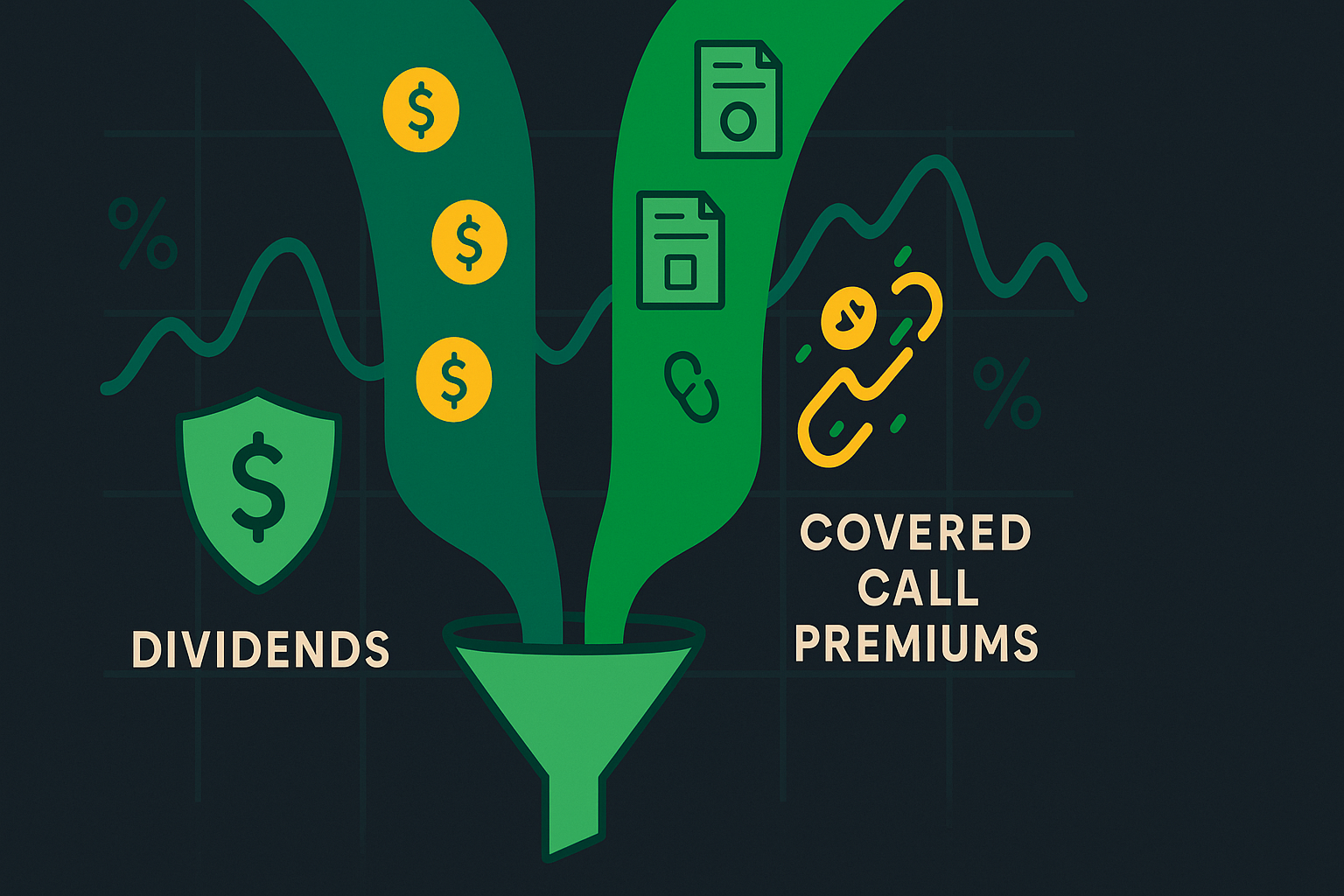
Most investors think dividends are the only reliable income from stocks. But covered call premiums can generate 2-4 times more cash flow than dividends, on the same stocks, with similar risk. The question isn't which is better, it's which fits your goals right now.
TL;DR
- Premiums beat dividends on yield: 12-24% annual from covered calls vs. 2-4% dividend yields on quality stocks
- Both reduce volatility: Income cushions price swings and lowers your effective cost basis over time
- Dividends are passive: Set it and forget it, no management required
- Covered calls need work: Active management, rolling positions, tracking assignments
- Combine both for best results: Use covered calls on high-quality dividend stocks to stack income sources
The Yield Gap
Let's start with numbers. A solid dividend stock like Johnson & Johnson yields around 3% annually. That's $300 per year on a $10,000 position. Reliable, tax-efficient (qualified dividends), and completely passive.
Now take the same $10,000 position in a quality value stock trading at $50 per share (200 shares, sold as two contracts). Sell covered calls monthly at strikes 10% out-of-the-money, collecting roughly $150 per contract ($300 total per month).
Annual math:
- Monthly premium: $300
- Annual premium: $3,600
- Effective yield: 36%
That's 12 times the dividend yield. Even if you get assigned twice during the year and sit out a month or two, you're still generating 20-30% annual income. No dividend stock comes close to that.
Why Premiums Pay More
The yield gap exists because you're providing a service: giving someone else the right to buy your shares at a specific price. You get paid for flexibility, time value, and taking on assignment risk.
Dividends, by contrast, come from company profits. Boards declare them quarterly. You can't negotiate them higher, you can't collect them more frequently, and you can't control the timing. You get what management decides to pay.
Option premiums reflect:
- Stock volatility (higher vol = higher premiums)
- Time until expiration (more time = more premium)
- Distance to strike price (farther out-of-the-money = lower premium but safer)
- Market sentiment (fearful markets spike premiums)
You're actively creating income, not passively receiving it. That's why the yield is higher, you're doing work.
The Tax Difference
This is where dividends have an edge, depending on your tax situation.
Qualified dividends: Held for 60+ days, taxed at long-term capital gains rates (0%, 15%, or 20% for most investors). That 3% dividend yield might only cost you 0.45% in taxes (15% rate).
Option premiums: Taxed as short-term capital gains at ordinary income rates if you're assigned within a year. That 36% covered call yield might cost you 8-13% in taxes (22-36% bracket). You keep 23-28% net.
So after tax, the comparison looks like this:
- Dividend: 3% yield, keep 2.55% net (15% tax rate)
- Covered calls: 36% yield, keep ~27% net (25% tax rate)
Covered calls still win by a huge margin, but taxes do narrow the gap. If you're in a high tax bracket (37%), dividends look better on a per-dollar basis. If you're using covered calls in a retirement account (IRA, 401k), taxes don't matter at all, covered calls dominate.
The Work Factor
Dividends are effortless. Stocks sit in your account, dividends hit your cash balance quarterly. No decisions, no timing, no management. You can ignore your portfolio for months.
Covered calls require attention:
- Choosing strike prices every month
- Monitoring assignments
- Rolling positions when needed
- Tracking ex-dividend dates
- Managing early assignments
- Reinvesting premiums
If you hate active management or don't have time to check your account weekly, dividends win on convenience. If you enjoy optimizing returns and don't mind spending 30 minutes per month managing options, covered calls crush dividends on yield.
Combining Both Strategies
Here's where it gets interesting: you can do both at the same time.
Buy a high-quality dividend stock like Coca-Cola, yielding 3%. Sell covered calls on it monthly, collecting another 2-3% per month (24-36% annually). Now you're stacking income sources:
- Quarterly dividends: 3% annual
- Monthly premiums: 24-36% annual
- Total yield: 27-39% on the same position
You collect dividends unless you get assigned. If assigned, you made capital gains plus all the premiums collected. Either outcome generates income.
Example:
- Buy 100 shares of KO at $60 = $6,000 investment
- Annual dividend: $180 (3%)
- Sell $65 calls monthly for $80 premium
- Annual premium (if not assigned): $960 (16%)
- Total income: $1,140 (19% yield)
If assigned at $65:
- Capital gain: $500
- Total premiums collected: $240 (3 months before assignment)
- Total profit: $740 (12.3% return in 3 months)
- Annualized return: ~50%
Either way, you crush the dividend yield alone.
When Dividends Win
Covered calls aren't always better. Dividends win in these situations:
Bull markets: When stocks surge 30-40% annually, capped gains from covered calls underperform. Dividends let you participate in unlimited upside.
Tax efficiency: If you're in a high tax bracket and using a taxable account, qualified dividend treatment beats short-term capital gains from premiums.
Simplicity: If you value time and hate active management, dividends provide income without effort.
Long-term compounding: Dividend growth stocks increase payouts over decades. A 3% yield today might be 6% on your original cost in 10 years. Covered calls can't match that long-term growth without constant reinvestment.
What Could Go Wrong?
Missing dividend payments: You get assigned right before ex-dividend date, losing the quarterly dividend you were counting on.
Mitigation: Track ex-dividend dates religiously. Close covered call positions 3-5 days before ex-dividend if the time value is low. Sometimes it's worth paying $20 to buy back the call to keep a $50 dividend.
Chasing premium over quality: High option premiums often signal high risk. Don't sacrifice business quality for yield.
Mitigation: Only use covered calls on wonderful companies you'd own for dividends anyway. Use WSY app to verify value before committing. Quality first, premium second.
Tax surprises: Frequent assignments create multiple short-term gains, pushing you into higher tax brackets.
Mitigation: Use covered calls primarily in tax-advantaged accounts (IRA, Roth IRA, 401k) where tax rates don't matter. In taxable accounts, focus on longer-dated calls (60-90 days) to reduce assignment frequency.
Over-trading: Constantly rolling positions and chasing premiums creates commission costs and widens bid-ask spread losses.
Mitigation: Choose strikes you're happy to sell at based on fair value. Accept assignment as success. Don't chase the stock higher with rolls just to keep the position.
Next Steps: Building Your Income Strategy
- Calculate fair value of dividend stocks you already own (use WSY app)
- Test covered calls on a small position (100 shares) to learn the mechanics
- Track total income over 3 months: dividends + premiums vs. dividends alone
- Set up a calendar to flag ex-dividend dates for stocks you sell calls on
- Consider using covered calls in retirement accounts to avoid tax drag
- Start with monthly calls 5-10% out-of-the-money on quality dividend stocks
- Review related strategies: cash-secured puts for entry and income generation
Dividends are great. Covered calls are better if you're willing to do the work. Combining both? That's how Toppa Top investors turn 3% yields into 20-30% income machines. Keep the riddim steady.
*Disclaimer: This content is for educational purposes only and does not constitute financial advice. Past performance does not guarantee future results. Always conduct your own research before investing.*