
Why Income Matters for Value Investors
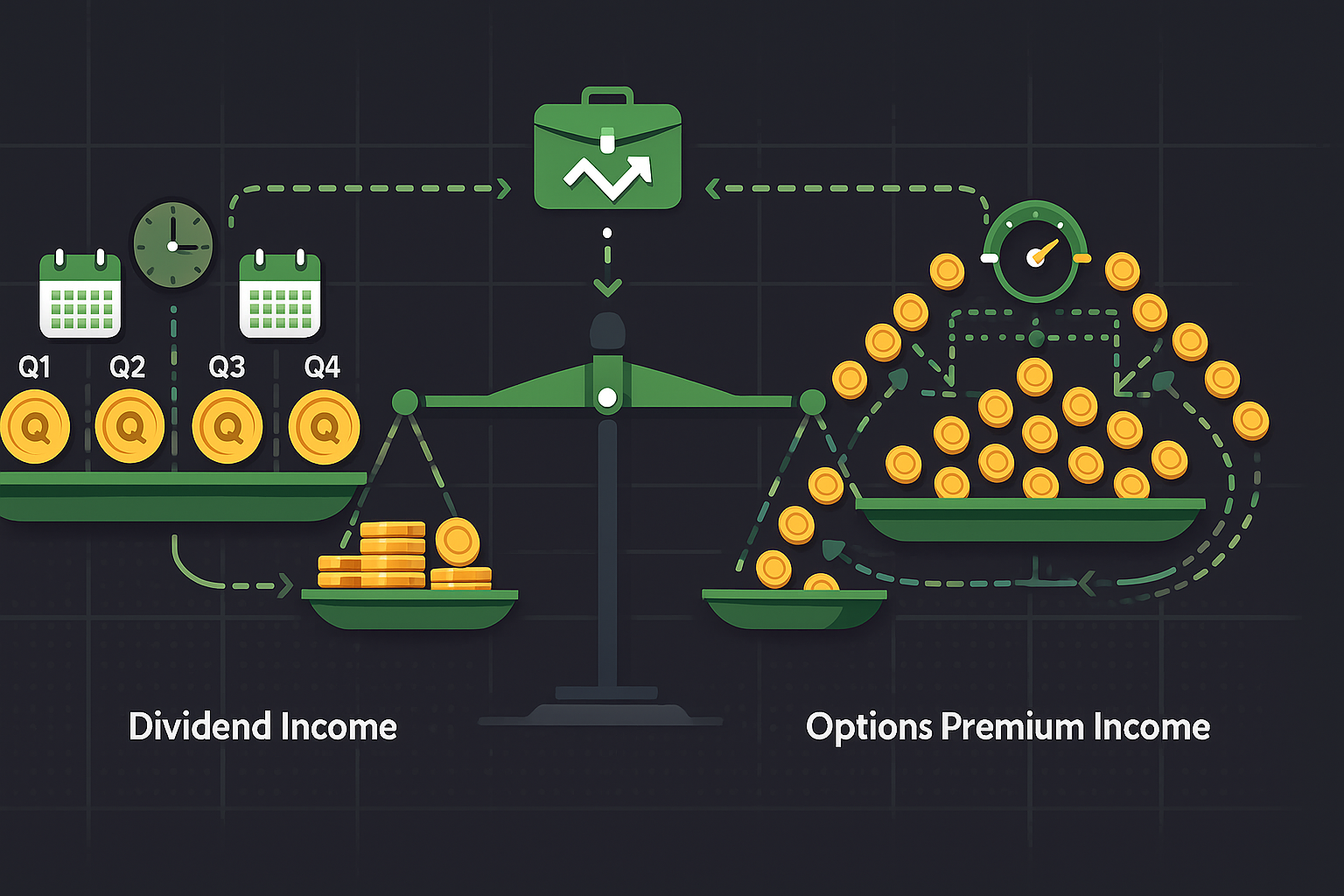
You found an undervalued stock. You bought it at a discount to fair value. Now what? Most investors just wait, sometimes for years, hoping the market will eventually recognize the value they see. But what if your positions could pay you while you wait? That's where options income changes the game for value investors.
TL;DR
- Income accelerates returns: Collecting premiums while holding undervalued stocks adds cash flow without selling shares
- Reduces effective cost basis: Every premium collected lowers your break-even price, building a bigger margin of safety
- Turns patience into profit: Instead of just waiting for price appreciation, you earn money during the holding period
- Compounds your discipline: Regular income from quality holdings reinforces your long-term strategy
- Works with your existing approach: Options income layers on top of value investing, it doesn't replace it
The Waiting Problem
Value investing works. Buying wonderful companies at fair prices (or better, at a discount) has created more millionaires than any other investment strategy. But there's a catch that nobody likes to talk about: the waiting.
You do your homework. You calculate intrinsic value. You find a company trading 30% below what it's worth. You buy shares and then... nothing happens. Maybe for months. Maybe for years.
During that time, your money sits there. Sure, you might collect a 2% dividend. But your capital is tied up, unable to compound efficiently while you wait for Mr. Market to catch up with your analysis.
This is where most value investors leave money on the table. They treat the holding period as dead time, necessary but unproductive. Premium income changes that equation entirely.
How Options Create Cash Flow
Options give you the ability to generate income from stocks you already own (or want to own) without selling them. The two core strategies are straightforward:
Covered Calls: You own 100 shares of a stock. You sell someone the right to buy those shares at a higher price by a specific date. They pay you a premium upfront. If the stock stays below that price, you keep the shares and the premium. Repeat monthly.
Cash-Secured Puts: You want to buy a stock at a lower price. You sell someone the right to sell you shares at that target price. They pay you a premium upfront. If the stock drops to your target, you buy it at the price you wanted anyway. If not, you keep the premium and try again.
In both cases, you're getting paid. The premiums are yours regardless of what happens next.
For a value investor, this is powerful. You're not speculating on short-term price movements. You're collecting rent on positions you planned to hold for years anyway.
A Real Numbers Example
Let's say you identified Johnson & Johnson (JNJ) as undervalued at $150. You calculated fair value around $180, giving you a 20% margin of safety. You bought 200 shares for $30,000.
Without options income:
- Annual dividend: roughly $4.80 per share = $960
- Dividend yield: 3.2%
- You wait for price appreciation
With covered calls:
- You sell 2 monthly calls at $160 strike (above your cost, below fair value)
- Premium collected: $2.00 per share = $400/month
- Annual premium income: $4,800 (16% yield)
- Plus the dividend: $960
- Total annual income: $5,760 (19.2% yield)
Even if JNJ stock goes nowhere for two years, you've collected $11,520 in income on a $30,000 position. Your effective cost basis drops from $150 to $92.40. That's a massive margin of safety built entirely from premium collection.
And here's the kicker: you still own the shares. If JNJ rises to fair value at $180, you benefit from that appreciation too (capped at your strike price if assigned, but you can roll the calls higher).
Why Income Matters Specifically for Value Investors
1. It Reinforces Patience
Value investing requires sitting on your hands while the market ignores your thesis. That psychological pressure causes many investors to sell too early or abandon positions before the value is realized.
Regular income changes the psychology. When you're collecting $400-500 per month from a position, you feel productive. The waiting period transforms from frustrating dormancy into active wealth-building. You're being paid to be patient.
2. It Improves Risk-Adjusted Returns
Premium income isn't free, you're giving up some upside potential. But for value investors, this trade-off makes sense. If you bought a stock at $100 with fair value at $130, selling calls at $125 still captures most of your upside while generating income.
The premium acts as a cushion. If the stock drops 10%, your premium collection might offset half that loss. If the stock goes sideways, you still earned 15-20% annually. Your worst-case scenarios improve dramatically.
3. It Accelerates Compounding
Money that sits idle doesn't compound. But premium income can be reinvested immediately, buying more shares, funding new positions, or simply building cash for opportunities.
Using the JNJ example, that $5,760 in annual income could buy 38 more shares at $150. Those additional shares generate more dividends and support more covered calls. The flywheel accelerates.
4. It Aligns with Quality Focus
Income strategies work best on high-quality, stable companies, exactly what value investors already seek. You need stocks that don't swing wildly, have predictable earnings, and won't crash 40% overnight.
This alignment means you're not changing your stock selection to accommodate options. You're adding an income layer to positions you'd own anyway.
What Could Go Wrong?
Stock rallies past your strike price: If JNJ jumps from $150 to $180 and you sold the $160 call, you capture only $10 of that $30 move (plus your premium). You miss some upside.
Mitigation: Set strikes based on fair value estimates. If $180 is fair value, selling $165-170 calls still captures most appreciation. Use Wall St Yardie to calculate fair value and set appropriate strikes. Accept that giving up extreme upside is the price of consistent income.
Premium income creates complacency: Collecting $400/month feels good. So good that you might ignore deteriorating fundamentals or hold a position longer than you should.
Mitigation: Income doesn't change your valuation discipline. If the business weakens or fair value drops, you should sell regardless of premium potential. Income is a bonus on good positions, not a reason to hold bad ones.
Stock drops significantly: You collect $2,400 in premiums over 6 months, but the stock falls from $150 to $110. Your premium income doesn't offset a $40/share loss.
Mitigation: Only use income strategies on stocks you've thoroughly analyzed and would hold through volatility anyway. The underlying business quality matters more than the premium. If you wouldn't own it without options, don't own it with them. Learn more about choosing stocks for options strategies.
Time and attention requirements: Managing covered calls requires tracking expiration dates, rolling positions, and staying engaged with each holding.
Mitigation: Start with 2-3 positions maximum. Use calendar reminders. Stick to monthly expirations rather than weekly until you're comfortable. The time investment is 15-30 minutes per position per month, reasonable for the income generated.
Tax complexity: Premium income is typically taxed as short-term capital gains, which may be less favorable than long-term gains or qualified dividends.
Mitigation: Consult a tax professional about your specific situation. Consider using income strategies in tax-advantaged accounts (IRAs) where the income isn't immediately taxable.
Next Steps
- Review your current holdings: Identify 2-3 positions where you'd be comfortable selling covered calls
- Calculate your fair value estimates: Use Wall St Yardie to determine appropriate strike prices
- Learn the mechanics: Read our guide on covered call mechanics before placing your first trade
- Start small: Sell one covered call on your most stable position and track the results for 3 months
- Track your income: Create a simple spreadsheet showing premiums collected, dividends received, and total return
- Explore cash-secured puts: If you have cash waiting for opportunities, learn how puts generate income while you wait
- Set realistic expectations: Target 12-18% annual yield from premium income, not 40%+ fantasy returns
Income changes the value investing equation. Instead of simply waiting for Mr. Market to recognize value, you're actively generating cash flow from your patience. Every month, your positions pay you. Every premium collected lowers your cost basis. Every dollar of income compounds into more shares, more dividends, more premium capacity.
This isn't about replacing your value approach. It's about enhancing it. You still do the same fundamental analysis, seek the same margin of safety, and hold the same wonderful companies. You just get paid while you wait for the value to be recognized.
That's income working for value investors, turning dead time into productive time, and patience into profit.
*Disclaimer: This content is for educational purposes only and does not constitute financial advice. Past performance does not guarantee future results. Always conduct your own research before investing.*