
Using Options Around Valuation Bands
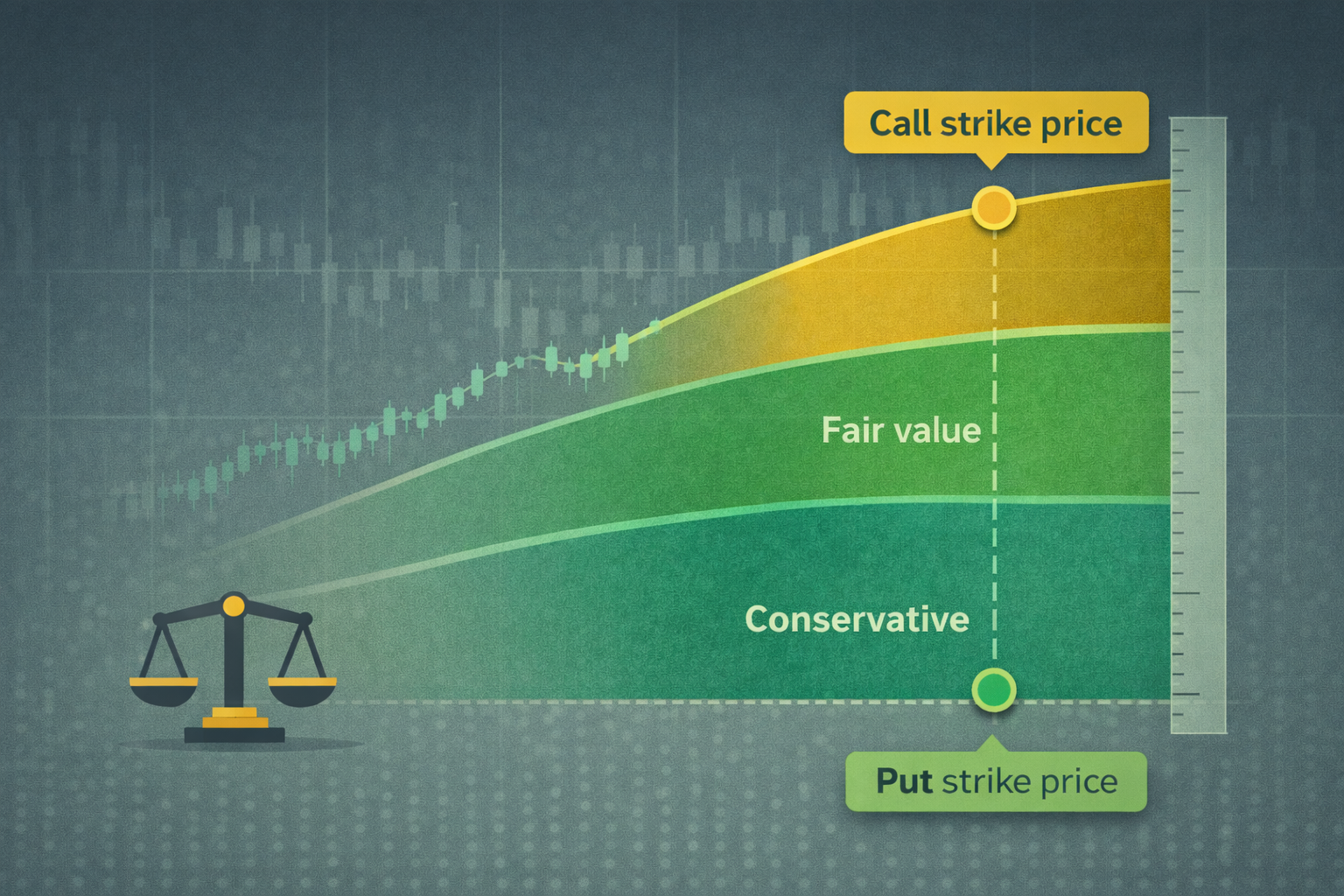
Most investors pick option strikes based on arbitrary levels—"I'll sell calls 10% above the current price" or "I'll sell puts 5% below." That's guessing, not investing. Value investors have a built-in advantage: they already calculate intrinsic value. Using valuation bands means setting strikes based on fair value, not random percentages, so every option trade reinforces your investment thesis instead of contradicting it.
TL;DR
- Define your valuation bands: Conservative, fair, and optimistic intrinsic value estimates create three reference zones
- Sell calls above fair value: Only write covered calls at strikes where you'd be happy selling the stock
- Sell puts below fair value: Write cash-secured puts at strikes where you'd gladly own more shares
- Adjust as valuations change: Update bands quarterly or when fundamentals shift, don't let old estimates guide new trades
- Avoid overlap: If a stock trades inside your fair value band, income strategies often add risk without reward
What Are Valuation Bands?
Valuation bands are simply ranges around your intrinsic value estimate. Instead of one single "fair value" number, you create three zones:
- Conservative value: The lowest reasonable estimate, assuming flat growth or minor headwinds (e.g., $90)
- Fair value: Your base case estimate using discounted cash flow, earnings yield, or cap rate thinking (e.g., $110)
- Optimistic value: Upside scenario if the business executes well (e.g., $130)
These bands guide every option decision. If a stock trades at $100, it's between conservative and fair value, so you might sell puts at $90 (conservative) to collect income while waiting for a better entry. If it jumps to $120, you might sell calls at $130 (optimistic) to capture premium if the market gets ahead of fundamentals.
The key is alignment. Your strikes should reflect where you'd actually want to transact, not where you hope the stock goes for a quick premium.
How to Build Your Valuation Bands
Start with intrinsic value. Use the models you already trust: discounted growth, cap rate, payback time, or earnings yield (cheat using Wall St Yardie to simplify the process). Once you have a base case fair value, add a conservative and optimistic scenario.
Example: "QualityCo"
- Current price: $105
- Earnings: $8 per share
- Growth estimate: 8% annually
- Your fair value (base case): $115 using a 10% discount rate
- Conservative value: $100 (assuming 5% growth)
- Optimistic value: $135 (assuming 12% growth)
Your valuation bands are now $100 (floor), $115 (fair), $135 (ceiling). These guide strikes:
- Sell puts at $95-$100: Below conservative value, you'd be thrilled to own more shares at that price
- Sell calls at $130-$140: Above optimistic value, you're comfortable exiting if the market overpays
- Hold between $100-$130: The stock is fairly valued, so covered calls cap upside unnecessarily, and puts risk overpaying
Selling Calls Above Fair Value
Covered calls work best when the stock is approaching or exceeding your optimistic value band. You're essentially saying, "If the market pays $135 for a $115 business, I'll take that deal."
Let's say "QualityCo" climbs to $125. Your optimistic value is $135. You sell a covered call at the $135 strike, collecting $4 in premium. Two outcomes:
- Stock stays below $135: You keep the shares, collect $4, and repeat next month
- Stock hits $135+: You're assigned, selling at $135 + $4 premium = $139 effective exit. You made 32% from your $105 entry ($105 → $139), and the stock was only 17% overvalued when you sold
This isn't capping gains arbitrarily, it's taking profit when the market overpays relative to business value. If you didn't have a valuation band, you might sell calls at $130 (closer to fair value) and regret it when the stock hits $150 a year later.
Selling Puts Below Fair Value
Cash-secured puts work when the stock trades near or above fair value, but you want to enter lower. You sell puts at a strike below your conservative value, getting paid to wait for a better price.
"QualityCo" is at $115 (your fair value). You want to buy it closer to $100 (conservative value). You sell a cash-secured put at the $100 strike, collecting $5 in premium. Two outcomes:
- Stock stays above $100: You keep the $5 premium and repeat, effectively earning 5% yield while waiting
- Stock drops to $100: You're assigned, buying at $100 - $5 premium = $95 effective entry. You're buying a $115 business for $95, a 21% margin of safety
This strategy fails if you sell puts at $110 (inside your fair value band). The premium might look attractive, but you're committing to buy at a price that's not truly discounted. Valuation bands prevent this mistake.
Adjusting Bands as Valuations Change
Intrinsic value isn't static. Earnings grow, margins compress, competitive moats strengthen or weaken. Update your bands quarterly or whenever a major event (earnings, management change, industry shift) changes the outlook.
Let's say "QualityCo" reports earnings and free cash flow jumped 20%. Your fair value estimate rises from $115 to $130. Your bands shift:
- Old: $100 (conservative), $115 (fair), $135 (optimistic)
- New: $115 (conservative), $130 (fair), $150 (optimistic)
If you had sold calls at $135 before the update, you'd now want to roll them up to $150 or higher. The old strike no longer aligns with your updated thesis. Without regular updates, your strikes become arbitrary again.
Avoiding the Overlap Trap
When a stock trades inside your fair value band (between conservative and optimistic), income strategies often hurt more than they help.
Example: "QualityCo" at $115, your fair value. You sell a covered call at $125 (below optimistic $135). The stock jumps to $130 in two months, and you're assigned at $125. You made money, but you sold a fairly valued business too early and missed $5 of upside ($125 → $130).
Better approach: Only sell calls when the stock exceeds optimistic value, or sell them far enough out-of-the-money that assignment is unlikely. If you want income while the stock is fairly valued, consider selling puts on other undervalued stocks instead.
Using Bands for LEAPs and Protective Puts
Valuation bands guide more than just covered calls and puts. They also help with:
- LEAPs: Buy deep-in-the-money LEAPs when the stock trades below conservative value (e.g., $90 stock, $70 strike LEAP). You're using leverage on a discounted business
- Protective puts: Buy puts at strikes near conservative value to protect downside. If fair value is $115 and conservative is $100, a $100 put provides a floor without overpaying for insurance
- Rolling decisions: If a covered call strike ($135) is now below your new optimistic value ($150), roll it up. If a put strike ($100) is now above your new conservative value ($90), close the position
Bands turn every option adjustment into a valuation-driven decision, not a panic reaction.
What Could Go Wrong?
- Anchoring to old valuations: You calculated fair value six months ago and never updated it. The business changed, but your strikes didn't, so you're selling calls at $130 when the new fair value is $150
- Overcomplicating the system: You create five bands instead of three, with sub-bands for "slightly conservative" and "moderately optimistic." More precision doesn't help if it slows decision-making
- Ignoring price action entirely: Valuation bands tell you where to transact, but if implied volatility is low, premiums might not be worth the trade. Bands guide strikes, not timing
- Using bands as predictions: Fair value is an estimate, not a guarantee. If the stock never reaches your optimistic value, don't force trades just to "use the system"
- Forgetting liquidity: A $135 strike might align with optimistic value, but if the bid-ask spread is $2 wide, you're giving up premium to illiquidity
Mitigations:
- Set a quarterly calendar reminder to update intrinsic value and bands
- Stick to three bands: conservative, fair, optimistic. If you need more detail, you're overthinking
- Combine bands with volatility analysis: high IV = better time to sell options, low IV = wait or focus on buying LEAPs
- Treat bands as guides, not mandates. If the premium is tiny, skip the trade
- Check liquidity before setting strikes. If open interest is below 100 contracts, consider a more liquid strike nearby
Next Steps
- Calculate intrinsic value for each stock in your portfolio using your preferred model
- Define conservative, fair, and optimistic value bands for each holding
- Log these bands in your position tracker (see Managing Multiple Option Positions)
- Review bands quarterly and update after major earnings or news events
- Set strikes based on bands: sell calls above optimistic, sell puts below conservative
- Avoid income strategies when stocks trade inside your fair value band
- Read Advanced Position Sizing with Options to decide how much capital to allocate per strike
*Disclaimer: This content is for educational purposes only and does not constitute financial advice. Past performance does not guarantee future results. Always conduct your own research before investing.*