
Managing Multiple Option Positions
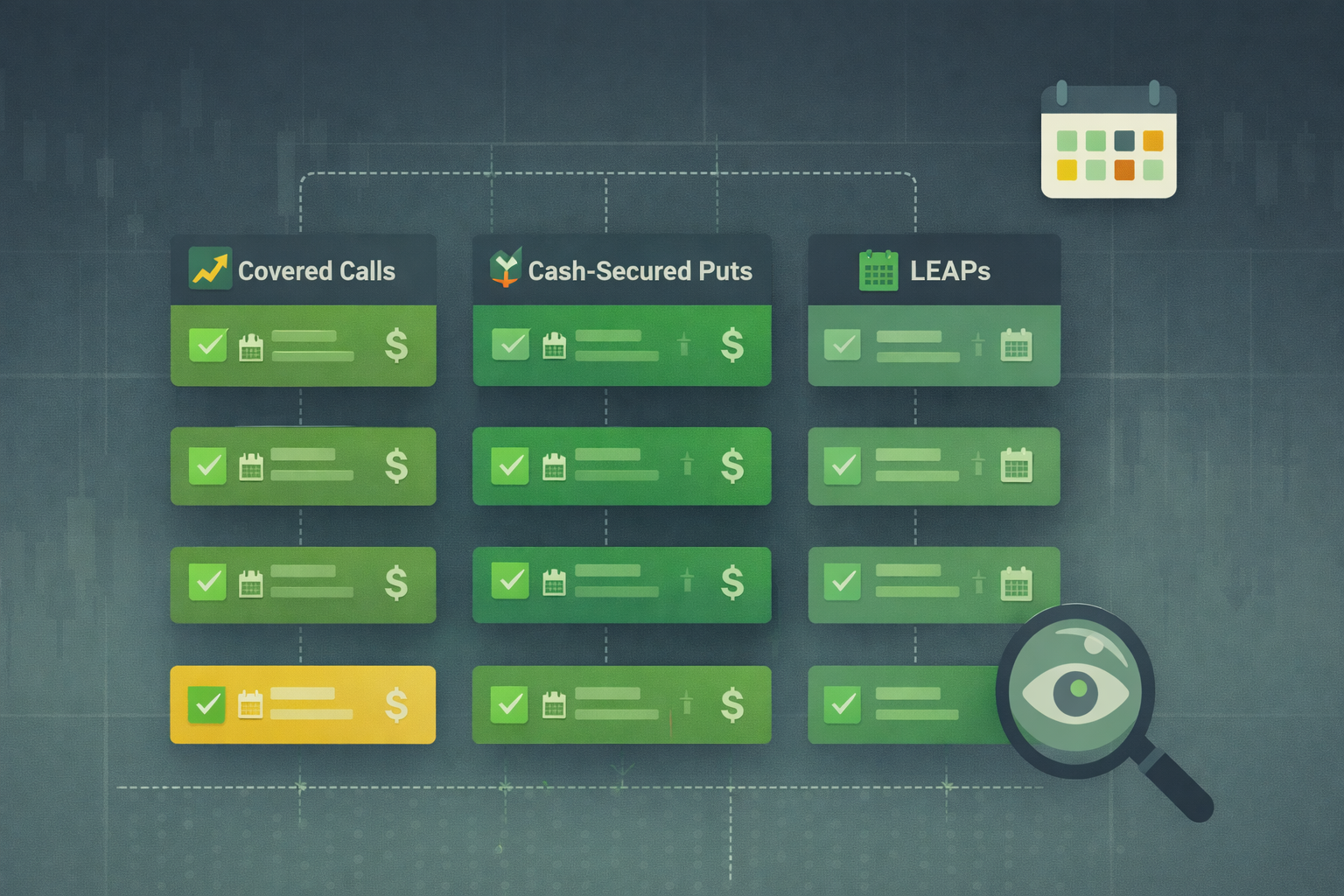
Running covered calls on three stocks, cash-secured puts on two more, and a LEAP position that needs rolling—suddenly, keeping track of expirations, strikes, and assignments feels like juggling chainsaws. Most investors start simple, but as their portfolio grows, the number of moving parts multiplies. Without a clear system, it's easy to miss an expiration, overtrade, or lose sight of your original valuation thesis.
TL;DR
- Track every position in one place: Use a spreadsheet or portfolio tool to log strikes, expirations, premiums, and original valuations
- Set calendar alerts: Never miss an expiration or earnings date that could disrupt your strategy
- Review weekly: Check if strikes still align with intrinsic value, and whether positions need rolling or closing
- Limit complexity: Don't run more strategies than you can monitor calmly, three to five active positions is often the sweet spot for most investors
- Separate speculation from conviction: Keep income strategies (covered calls, puts) on your highest-quality holdings, not speculative bets
Why Organization Matters More Than Strategy
A brilliant covered call strategy falls apart if you forget to roll it before expiration. A well-chosen cash-secured put becomes a problem if you didn't track the earnings date. The more positions you run simultaneously, the more discipline you need.
Value investors already do this with stocks, they track purchase prices, valuation updates, and catalysts. Options require the same rigor, but with tighter timelines. You're not just holding and waiting, you're managing contracts that expire, decay, and sometimes get assigned.
This isn't about becoming a full-time trader. It's about building a system so simple that checking your positions takes 10 minutes a week instead of causing stress every day.
Build a Position Tracker
Start with a spreadsheet (Google Sheets, Excel, whatever you prefer) or use a portfolio tracking tool designed for options. At minimum, track these columns:
- Stock ticker and pillar: (e.g., "QualityCo, Covered Call Income")
- Strategy: (Covered Call, Cash-Secured Put, LEAP, Protective Put)
- Strike price: The level you agreed to
- Expiration date: So you never miss a roll decision
- Premium collected or paid: Tracks your actual yield or cost
- Current intrinsic value: Your estimate of fair value, updated quarterly
- Notes: Original thesis, recent earnings, anything that changes the setup
For example, let's say you sold a covered call on "ReliableCo" trading at $100, strike $110, expiring in 30 days, premium $3. Your intrinsic value estimate is $120. You log it:
| Ticker | Strategy | Strike | Expiration | Premium | Intrinsic Value | Notes |
|---|---|---|---|---|---|---|
| ReliableCo | Covered Call | $110 | Jan 15 | $3 | $120 | Quality moat, steady earnings |
If the stock jumps to $115, you know you're at risk of assignment, but your intrinsic value says it's still undervalued at $120, so you might roll up and out for more premium. Without the tracker, you're reacting blindly.
Calendar Alerts Are Non-Negotiable
Options expire. Earnings reports drop. Ex-dividend dates arrive. Missing any of these can turn a planned trade into an unplanned mess.
Set three types of alerts:
- Expiration reminders: 7 days before expiration, decide whether to roll, close, or let it expire
- Earnings alerts: Avoid holding short options (covered calls, cash-secured puts) through earnings unless you're comfortable with the risk
- Quarterly valuation reviews: Update intrinsic value estimates so your strikes stay aligned with reality
Most brokers offer alerts. Google Calendar works. The tool doesn't matter, consistency does. If you never check alerts, they're useless.
Weekly Review: The 10-Minute Check-In
Once a week, review every position. Ask three questions:
- Is this strike still aligned with my valuation? If intrinsic value changed, does the strategy still make sense?
- Is this expiration still appropriate? Should I roll for more time or premium?
- Am I still comfortable owning this company? If the thesis broke, close the position and move on
Let's say you're running a cash-secured put on "GrowthCo" at a $90 strike, expiring in two weeks. The stock is at $95, and you collected $4 in premium. Your original intrinsic value was $110. But this week, you read the latest earnings report, and free cash flow dropped 30% due to weak demand. Your new intrinsic value is $85.
Decision: Close the put now. Take the small loss on the premium rather than getting assigned at $90 when the business is weaker than you thought. The weekly review catches this before it becomes a $5,000 mistake.
Limit Complexity to What You Can Handle
More strategies don't equal better returns. They equal more risk of mistakes. A portfolio with 10 overlapping option positions (covered calls on six stocks, puts on four, two LEAPs, a protective put) is harder to manage than a portfolio with three well-chosen strategies on high-conviction holdings.
General guideline:
- Beginners: 1-2 strategies at a time (e.g., covered calls on one stock, cash-secured puts on another)
- Intermediate: 3-5 positions across multiple strategies
- Advanced: 6-8 positions, only if you have a rock-solid tracking system
If you can't remember your strikes, expirations, and intrinsic value targets without checking a spreadsheet, you have too many positions.
Separate Income from Conviction
Run income strategies (covered calls, cash-secured puts) only on companies you truly understand and want to own long-term. Don't sell puts on a stock just because the premium is high, that's speculation dressed up as strategy.
Your highest-quality holdings should carry the bulk of your options activity. If "WonderfulCo" is a 10% position in your portfolio and you believe it's 30% undervalued, that's a perfect candidate for a covered call at a strike 20% above current price. You're happy to hold it, and you're happy to collect income while waiting for the market to recognize value.
But if "SpeculativeCo" is a 2% position you bought on a hunch, don't layer options on top. The underlying thesis is already weak, adding options just multiplies the risk of poor decisions.
Use Folders or Tags for Position Types
If your broker or tracking tool supports it, group positions by strategy type:
- Income Generation: Covered calls, cash-secured puts
- Leverage: LEAPs, poor man's covered calls
- Protection: Protective puts, portfolio hedges
This makes it easier to see your overall exposure. If 80% of your options activity is in covered calls, you know you're tilted toward income. If 60% is in LEAPs, you're tilted toward leverage. Neither is wrong, but you should know which one you're doing.
What Could Go Wrong?
- Overtrading from good intentions: You start tracking positions, feel organized, and suddenly add five more strategies because it "feels manageable." Organization doesn't eliminate the risk of complexity, it just makes it visible
- Ignoring red flags: Your tracker shows a position is underwater, but you avoid looking at it because it feels uncomfortable. Discipline means reviewing bad positions first, not last
- Tracking without action: You log everything perfectly, but never roll, close, or adjust. A tracker is useless if it doesn't inform decisions
- Forgetting the business: You get so focused on strikes and expirations that you stop updating intrinsic value estimates. Options are tools, valuation is the foundation
- Relying on memory: "I'll remember that expiration" turns into "I forgot to roll and got assigned at the wrong price." Always use a system
Mitigations:
- Add a "max positions" rule to your tracker (e.g., no more than five active option positions at once)
- Review losing positions first, not last, during your weekly check-in
- Set a quarterly "valuation refresh" reminder to update intrinsic value estimates
- Never open a position without logging it immediately
Next Steps
- Build a simple tracker with columns for ticker, strategy, strike, expiration, premium, and intrinsic value
- Set calendar alerts for every expiration date, 7 days before they arrive
- Schedule a weekly 10-minute review (Sunday evening or Friday morning work well)
- Limit yourself to 3-5 active option positions until the system feels automatic
- Review your tracking system quarterly, adjust columns or alerts as needed
- Read Advanced Position Sizing with Options to refine how much capital to allocate per strategy
- Check out Advanced Rolling Techniques for managing expirations without panic
*Disclaimer: This content is for educational purposes only and does not constitute financial advice. Past performance does not guarantee future results. Always conduct your own research before investing.*