
Synthetic Stock Positions Explained
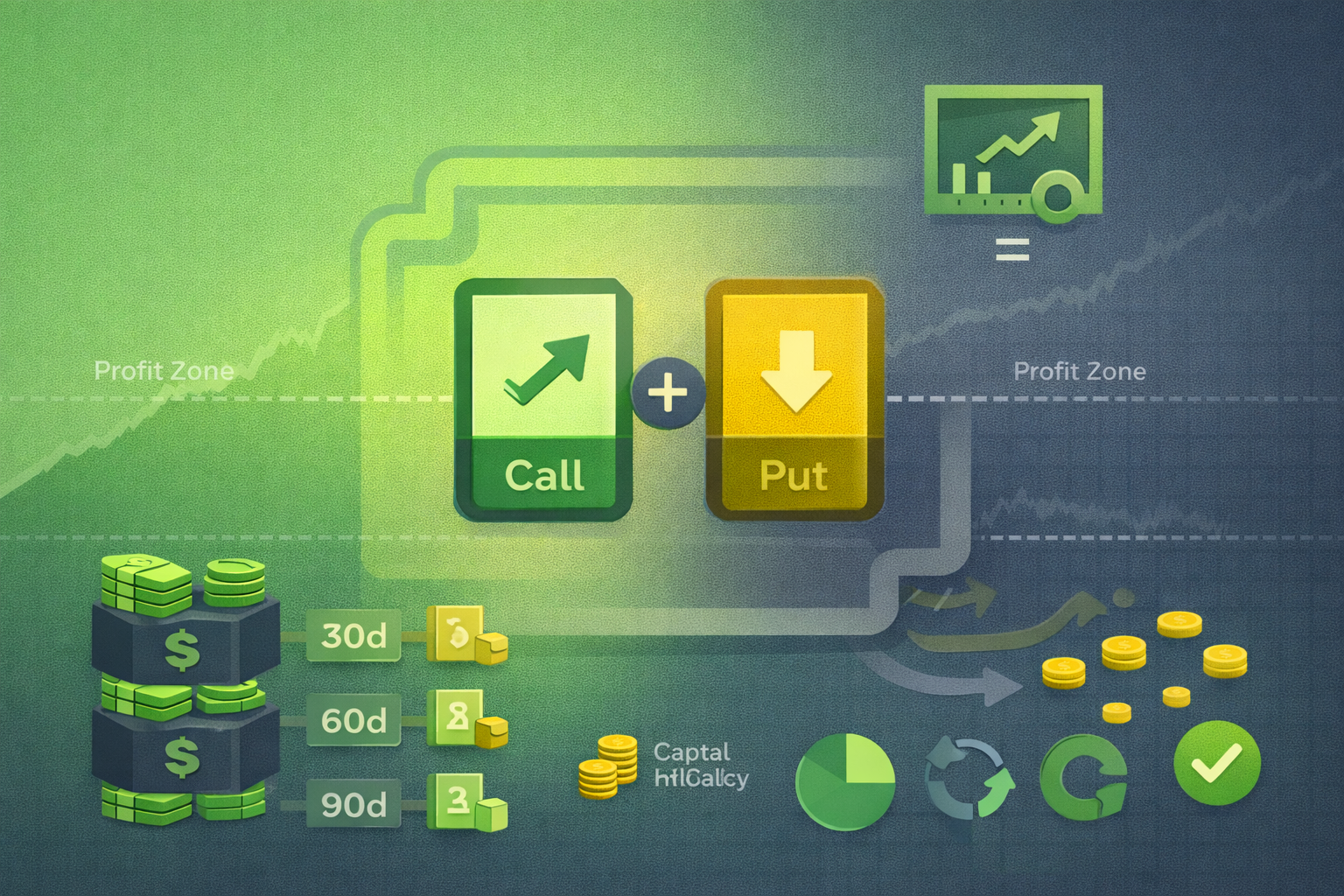
You can own stock without actually buying shares. By combining a long call and a short put at the same strike and expiration, you create a position that moves exactly like owning 100 shares, but with less capital tied up and more strategic flexibility. It's called a synthetic long stock position, and value investors use it to control exposure while preserving cash for other opportunities.
TL;DR
- Synthetic long = buy call + sell put: Both at the same strike, creates profit/loss identical to owning shares
- Lower capital requirement: Ties up option margin instead of full stock price, freeing cash for diversification
- Same risk as stock ownership: Unlimited upside, same downside as buying shares at strike price
- Strategic advantages: Lock in today's price while delaying purchase, or hold synthetic until assignment
- Not for everyone: Works best for experienced investors comfortable with put assignment and margin requirements
What Is a Synthetic Stock Position?
A synthetic long stock is created by simultaneously buying a call and selling a put at the same strike price and expiration. This combination replicates the payoff of owning 100 shares.
Here's why it works: a long call gives you unlimited upside if the stock rises, but you lose the premium if it drops. A short put obligates you to buy shares at the strike if the stock drops, but you collect premium if it rises. When you combine them, the call captures gains above the strike, the put captures losses below the strike, and the premiums mostly offset each other. The result? You're exposed to the stock's movement exactly like owning shares.
Example: QualityCo trades at $100. You want to own shares but don't want to tie up $10,000 in cash.
Setup:
- Buy 1 call at $100 strike, 60 days, $5 premium. Pay $500.
- Sell 1 put at $100 strike, 60 days, $4 premium. Collect $400.
- Net cost: $100 ($5 - $4).
Now let's see what happens at expiration.
Stock rises to $110: Your call is worth $10 per share ($1,000 value). Your put expires worthless. Profit: $1,000 - $100 net cost = $900. This is the same as buying shares at $100 and selling at $110, minus transaction costs.
Stock drops to $90: Your call expires worthless (loss of $500). Your put is assigned, you buy shares at $100 ($10,000 obligation). You now own shares at $100 while the market price is $90, a $1,000 unrealized loss. Add the $100 net cost, and you're down $1,100 total.
If you'd bought shares outright at $100, you'd also be down $1,000 at a $90 stock price. The synthetic position mirrors stock ownership almost perfectly.
Why Use Synthetics Instead of Buying Stock?
If synthetic longs behave like stock, why not just buy the stock? There are three key advantages:
Capital efficiency: Instead of tying up $10,000 per 100 shares, you commit option margin (typically $2,000-3,000 depending on broker rules). This frees up $7,000-8,000 for other trades or reserves. You can control 3-4 positions synthetically with the same capital required to buy 1 position outright.
Flexibility: With stock, you're locked in at your purchase price. With synthetics, you can roll the options to different strikes or expirations if your thesis changes. If QualityCo drops to $95, you can roll your $100 synthetic to a $95 synthetic, adjusting your entry point.
Tax timing: Synthetics don't trigger capital gains until you close the position or get assigned shares. If you're managing tax liability across multiple years, synthetics let you defer gains while maintaining exposure.
Value investors use synthetics when they want to control multiple undervalued positions without overcommitting capital. If you've identified 5 stocks trading at 20-30% discounts, you can build 5 synthetic longs for the same capital required to buy 2 stocks outright.
How Synthetics Compare to LEAPs
Synthetics sound similar to LEAPS (long-term call options), but they have key differences.
LEAPS (long call only):
- Max loss = premium paid (typically $1,500-2,500 per contract).
- If the stock drops 30%, you lose the premium but nothing more.
- You're not obligated to buy shares.
Synthetic long (call + put):
- Max loss = unlimited downside below strike, just like owning stock.
- If the stock drops 30%, you're on the hook for shares at the strike price.
- You're effectively committed to ownership at the strike.
LEAPs are for leveraging upside with limited risk. Synthetics are for replicating stock ownership with capital efficiency. If you're unsure about a stock long-term, use LEAPs. If you're committed to owning shares eventually but want flexibility in the meantime, use synthetics.
Setting Up a Synthetic Long
The best synthetic longs use at-the-money (ATM) or slightly out-of-the-money (OTM) strikes to minimize net cost.
Example: QualityCo trades at $100, fair value $130 (23% undervalued).
Option 1 (ATM):
- Buy $100 call, 90 days, $6 premium.
- Sell $100 put, 90 days, $5.50 premium.
- Net cost: $50 per contract ($0.50 per share).
Option 2 (OTM):
- Buy $105 call, 90 days, $4 premium.
- Sell $95 put, 90 days, $4 premium.
- Net cost: $0 (zero-cost synthetic).
ATM synthetic: Replicates owning shares at $100 almost perfectly. If the stock rises to $120, you gain $20 per share (minus $0.50 cost). If it drops to $85, you lose $15 per share (plus $0.50 cost).
OTM synthetic: Creates a slightly different exposure. If the stock rises to $120, your call gains $15 per share ($120 - $105 strike). If it drops to $85, your put is assigned at $95, and you own shares at $95 while market price is $85, a $10 loss.
The OTM version costs nothing upfront but gives you less upside (you start profiting at $105 instead of $100) and less downside exposure (you're assigned at $95 instead of $100). It's a trade-off: zero cost vs. perfect replication.
Most value investors prefer ATM synthetics for exact stock replication, especially when the stock is trading well below fair value. The small net cost ($50-100) is worth the precision.
Real Example: Synthetic Long on Undervalued Stock
Let's walk through a trade using "RetailCo," trading at $80, fair value $105 (24% undervalued).
Goal: Control 300 shares of RetailCo without tying up $24,000.
Setup:
- Buy 3 calls at $80 strike, 90 days, $5.50 premium each. Pay $1,650.
- Sell 3 puts at $80 strike, 90 days, $5 premium each. Collect $1,500.
- Net cost: $150 total ($50 per contract).
Capital committed: Approximately $6,000-7,500 in margin (broker-dependent) instead of $24,000 for shares.
Scenario 1: Stock rises to $95 (18% gain)
Call value: $15 per share x 300 = $4,500. Put value: $0 (expires worthless). Gross profit: $4,500 - $150 net cost = $4,350 (73% return on $6,000 margin).
If you'd bought 300 shares at $80 ($24,000), you'd gain $4,500 (18.75% return). The synthetic delivered nearly the same dollar profit with 1/4 the capital.
Scenario 2: Stock drops to $70 (12.5% loss)
Call value: $0 (expires worthless, lost $1,650). Put obligation: buy 300 shares at $80 while market price is $70. You're down $10 per share x 300 = $3,000 unrealized loss. Total loss: $3,000 + $150 net cost = $3,150.
If you'd bought 300 shares at $80, you'd be down $3,000 (12.5% loss). The synthetic mimics the loss closely.
Scenario 3: Stock stays at $80
Both options expire worthless. You lose the $150 net cost. If you'd owned shares, you'd have no gain or loss (ignoring dividends). The $150 is the cost of the synthetic structure.
Over time, if RetailCo reaches $105 fair value, your synthetic position gains $25 per share x 300 = $7,500, identical to owning shares.
Advanced Use: Converting Synthetics to Real Shares
Synthetics are temporary. Eventually, you'll either close them or convert to actual stock ownership. Here's how:
Assignment at expiration: If the stock is above your strike at expiration, the put expires worthless and your call delivers shares via exercise. You pay the strike price ($80 x 100 shares = $8,000 per contract) and own the stock.
Early assignment on puts: If the stock drops significantly (say, to $70), your put might be assigned early. You're forced to buy 100 shares at $80 while the call is still active. Now you own shares and a call, effectively a covered call position. You can hold the shares and let the call hedge your downside, or sell the call to exit.
Rolling the synthetic: If the stock stays flat or drops slightly, you can roll both legs to a later expiration or different strikes. For example, roll the $80 synthetic to a $75 synthetic (adjust your entry point lower) or extend expirations by 60-90 days.
Closing early: If the stock reaches fair value before expiration, close both legs. Sell the call for profit, buy back the put to exit the obligation. Net result: you captured the upside without ever owning shares.
This flexibility is the main advantage over stock ownership. You can adjust, extend, or exit synthetics without selling shares and triggering capital gains.
What Could Go Wrong?
Synthetics carry the same downside risk as stock ownership, plus option-specific complications:
Assignment risk: Your short put can be assigned anytime the stock is below the strike, even before expiration. If you're assigned early and don't have the capital to buy shares, you'll face margin calls. Mitigation: keep enough cash in your account to cover assignment ($8,000-10,000 per contract) or use spreads instead of naked puts.
Margin requirements: Brokers require margin for short puts, typically 20-30% of the strike price. If your account drops below maintenance levels, you face margin calls. Mitigation: don't overleverage. Limit synthetics to 30-40% of your total portfolio value.
Liquidity issues: If options have wide bid-ask spreads (e.g., $0.50-0.80), you'll lose money entering and exiting the position. Mitigation: only use synthetics on liquid stocks with tight spreads (0.05-0.15 max).
Changing fundamentals: You set up a synthetic on QualityCo at $100 assuming it's worth $130, but new data shows it's worth $90. You're stuck with a put obligation at $100 while the stock trades at $85. Mitigation: review fundamentals monthly. If the thesis breaks, close the synthetic early (even at a loss) rather than holding to assignment.
Theta decay on calls: While the put premium offsets most of the call cost, the call still loses time value if the stock stays flat. Over 90 days, a $5 call might decay to $2 even if the stock doesn't move. Mitigation: use longer expirations (90-120 days) to reduce daily theta decay.
When to Use Synthetics vs. Direct Ownership
Synthetics aren't always better than buying stock. Here's when to use each:
Use synthetics when:
- You're capital-constrained and want to control multiple positions with limited cash
- You want flexibility to adjust strikes or expirations as your thesis evolves
- You're building positions gradually and plan to convert to shares later
- The stock is moderately undervalued (15-30% below fair value) and you're comfortable with assignment risk
Buy stock directly when:
- You plan to hold for 5+ years and want to collect dividends without hassle
- The stock is deeply undervalued (40%+ below fair value) and you want immediate exposure without assignment risk
- You're uncomfortable with margin and put obligations
- You want to sell covered calls immediately (requires owning shares first)
Most value investors use a mix: direct ownership for core holdings (3-5 stocks at 20-30% of portfolio each), synthetics for secondary positions (5-10 stocks at 5-10% each). This balances simplicity with capital efficiency.
Next Steps
Synthetics are an advanced technique requiring experience with both calls and puts. Here's how to start:
- Paper trade first: Simulate synthetic longs for 3-6 months to see how they behave in different market conditions
- Start with one position: Don't layer synthetics on 5 stocks at once. Test on a single undervalued stock
- Use liquid stocks: Stick to names with option volume above 500 contracts daily and spreads under $0.15
- Track margin carefully: Use a spreadsheet to monitor committed capital, margin requirements, and net cost. Update weekly
- Review fundamentals: Read Intrinsic Value: What It Means to ensure your fair value estimates justify the synthetic exposure
Synthetic longs are tools for capital-efficient exposure, not magic shortcuts. They work best when you're committed to eventual ownership and want flexibility in the meantime. Use Wall St Yardie to identify undervalued stocks worth the commitment, then layer synthetics strategically to maximize capital efficiency. Keep the riddim steady, control your exposure, and convert to shares when the price is right.
*Disclaimer: This content is for educational purposes only and does not constitute financial advice. Past performance does not guarantee future results. Always conduct your own research before investing.*