
Step 2: Understand Value Investing
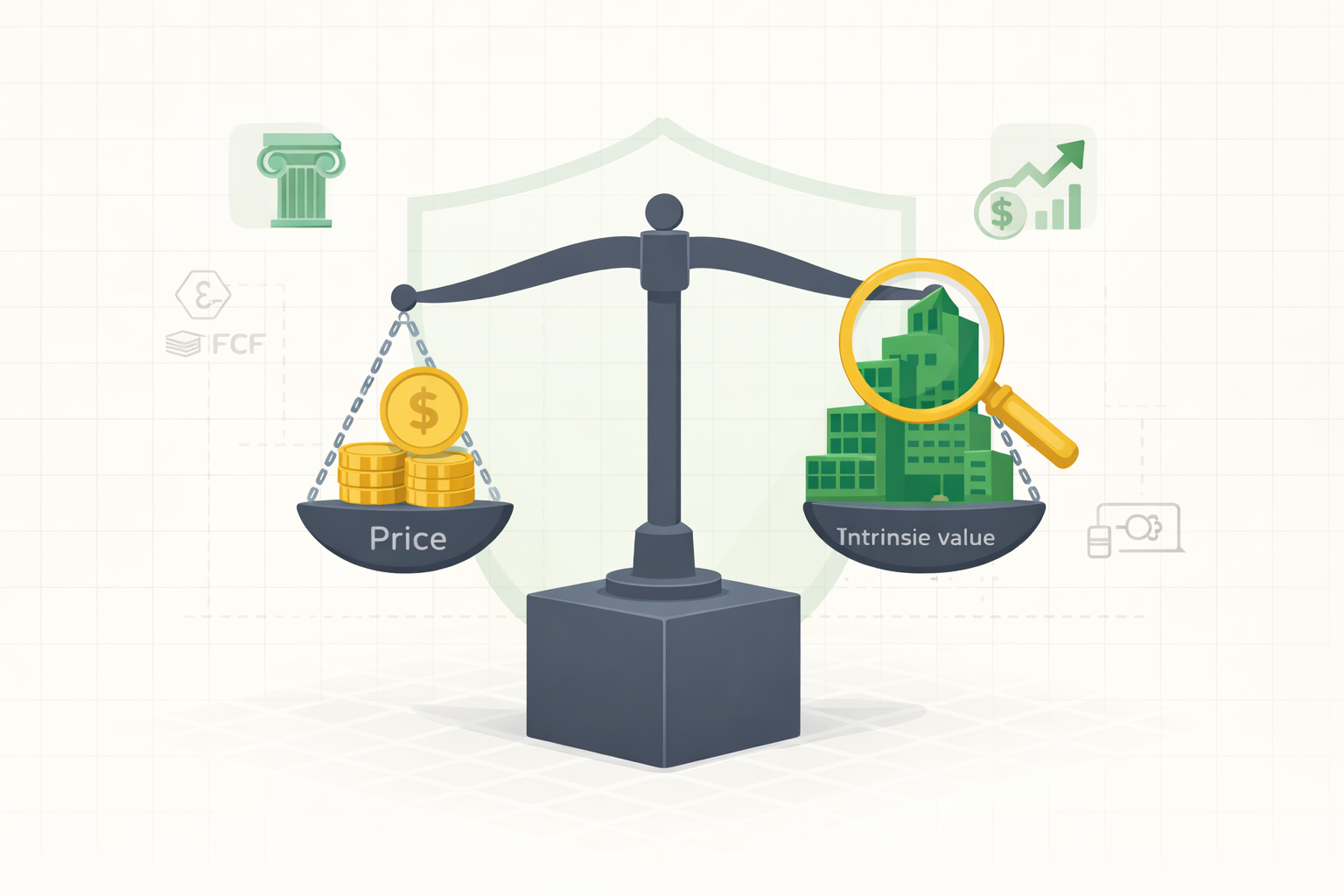
Value investing isn't about finding the cheapest stocks. It's about finding wonderful businesses trading below their true worth. This step teaches you how to calculate what a company is actually worth (intrinsic value), how to protect yourself when you're wrong (margin of safety), and how to recognize quality businesses that deserve your capital. Master these three concepts and you'll never depend on market predictions, tips, or luck again. Your investing decisions will be grounded in logic, not emotion.
TL;DR
- Intrinsic value is what a business is worth based on earnings, cash flow, and growth, not what the market says it's worth.
- Margin of safety means buying below intrinsic value to protect against mistakes and market volatility.
- Quality matters more than price, focus on companies with economic moats, strong cash flow, and predictable earnings.
- Valuation models include earnings yield, discounted cash flow, cap rate thinking, and payback time.
- Patience pays, the market eventually recognizes value, but it can take years.
What Is Intrinsic Value?
Intrinsic value is the present value of all future cash flows a business will generate. It's what a company is actually worth if you owned the entire business, not what speculators are willing to pay today.
Why this matters:
Price fluctuates based on emotion, news, and sentiment. Value is grounded in business performance: how much the company earns, how fast it grows, and how reliably it generates cash. If you can estimate intrinsic value, you can ignore market noise and focus on whether you're getting a deal.
The core question:
If you could buy this entire business for its current market price, would you? If the company earns $100 million annually, grows earnings 10% per year, and has little debt, you'd probably pay far more than $500 million. But if the market is offering it for $400 million due to temporary pessimism, that's an opportunity.
Intrinsic value gives you a number to compare against price. When price is significantly below value, you buy. When price exceeds value, you pass or sell.
How to Calculate Intrinsic Value
There's no single "correct" formula. Different models work for different businesses. The goal is to use 2-3 methods and see if they converge on a similar range. If all models suggest a company is worth $80-$100 per share, and it's trading at $60, that's a strong signal.
Earnings Yield
The inverse of the P/E ratio. If a company earns $5 per share and trades at $50, its earnings yield is 10% ($5 / $50). Compare this to bond yields or the market average. If bonds yield 4% and the market yields 6%, a 10% earnings yield suggests the stock is undervalued.
Why it works: Earnings yield treats stocks like bonds, showing the annual "return" you're getting from the company's earnings. Higher yield means better value, all else equal.
When to use: Stable, mature companies with predictable earnings (utilities, consumer staples, industrials).
Discounted Growth Model
Estimate future earnings, discount them back to today, and sum them up. If a company earns $5 per share and grows earnings 8% annually for 10 years, calculate the total discounted earnings and compare to current price.
Why it works: Growth matters. A company growing 15% annually is worth more than one growing 3%, even if they have the same current earnings.
When to use: Growth companies with visible expansion paths (tech, consumer brands, healthcare).
Simplify with Wall St Yardie: Use Wall St Yardie to run discounted growth calculations quickly without building spreadsheets.
Cap Rate Thinking
Borrowed from real estate. If a business earns $10 million annually and you demand a 10% return, you'd value it at $100 million ($10M / 0.10). Adjust the cap rate based on risk: higher risk = higher cap rate = lower valuation.
Why it works: Simple and intuitive. It forces you to think about required returns and opportunity costs.
When to use: Stable cash flow businesses with low growth (REITs, infrastructure, mature franchises).
Payback Time
How many years does it take for cumulative earnings to equal the current price? If a stock trades at $60 and earns $6 per share annually (growing 5% per year), calculate when total earnings reach $60. If it's 8-10 years, that might be fair value. Under 8 years suggests undervaluation.
Why it works: Payback time is easy to visualize and aligns with how most people think about investments (when do I get my money back?).
When to use: Any company with stable or growing earnings.
Margin of Safety: Your Insurance Policy
Even the best analysis can be wrong. You might overestimate growth, miss competitive threats, or misread management quality. The margin of safety protects you by ensuring you never pay full price.
What is it?
The gap between intrinsic value and purchase price. If you calculate a company is worth $100 per share, you don't buy at $95. You wait for $75 or $80, giving yourself a 20-25% cushion.
Why it works:
If your valuation is perfect and the stock is worth $100, you still profit buying at $75. If you're wrong and it's only worth $85, you still have a small margin. If you bought at $95 and were wrong, you lose money.
Benjamin Graham's rule: Always demand a margin of safety. It's the difference between investing and speculating.
How to apply it:
- Conservative: 30-40% margin for uncertain companies or industries you don't understand well.
- Moderate: 20-25% margin for stable, predictable businesses.
- Aggressive: 10-15% margin for wonderful companies you know intimately.
Never buy at or above intrinsic value, even if you're confident. The margin protects you from your own overconfidence and market unpredictability.
Quality: What Makes a Business Wonderful?
Not all cheap stocks are good investments. Some companies are cheap because they're dying. Quality separates value from value traps.
Economic Moats
Competitive advantages that protect profits over time. Without a moat, competitors erode margins and earnings decline.
Types of moats:
- Brand power: Coca-Cola, Nike, Apple, customers pay premium prices due to brand loyalty.
- Network effects: Visa, Facebook, the more users join, the more valuable the network becomes.
- Cost advantages: Costco, Walmart, scale allows lower prices that competitors can't match.
- Switching costs: Microsoft, Salesforce, customers stick around because switching is expensive or disruptive.
- Regulatory barriers: Utilities, telecom, regulated industries with limited competition.
Why moats matter: A company with a moat can sustain high returns on capital for decades. Without one, profits compress over time.
Predictable Earnings
Stable, growing earnings reduce risk. Companies with lumpy, volatile earnings are harder to value and more likely to surprise negatively.
What to look for:
Consistent earnings growth over 5-10 years, limited exposure to commodity prices or economic cycles, recurring revenue models (subscriptions, contracts).
Red flags:
Earnings that spike and crash, heavy dependence on one customer or product, industries in structural decline.
Strong Free Cash Flow
Earnings can be manipulated through accounting tricks. Cash flow is harder to fake. Free cash flow (FCF) shows how much cash a business actually generates after paying expenses and capital expenditures.
Why it matters: FCF funds dividends, buybacks, debt reduction, and growth investments. Companies with strong FCF have financial flexibility. Companies burning cash are fragile.
What to look for:
FCF growing alongside earnings, FCF conversion rates above 80% (meaning most earnings convert to cash), consistent cash generation across economic cycles.
Low Debt
Debt amplifies risk. In good times, leverage boosts returns. In bad times, it forces distressed asset sales or bankruptcy. Value investors prefer companies with manageable debt.
How to measure:
Debt-to-equity ratio (total debt / total equity), interest coverage ratio (earnings / interest expense). Lower is safer.
Acceptable levels:
Debt-to-equity below 0.5 for most industries, interest coverage above 5x, enough cash on hand to cover 1-2 years of debt payments.
Competent Management
Management allocates capital: reinvesting in growth, returning cash to shareholders, or making acquisitions. Good managers compound value. Bad ones destroy it.
How to evaluate:
Read annual letters, watch how capital is deployed (smart acquisitions, disciplined buybacks), check insider ownership (do executives own meaningful stock?), review long-term performance (has the business grown earnings per share consistently?).
Red flags:
Excessive executive compensation, frequent strategy shifts, dilutive stock issuance, bad acquisitions.
Putting It Together: Finding Value
Here's the process:
- Screen for quality: Start with companies that have economic moats, stable earnings, strong FCF, and low debt.
- Calculate intrinsic value: Use 2-3 models (earnings yield, discounted growth, payback time) to estimate what the business is worth.
- Compare to price: Is the stock trading below intrinsic value? By how much?
- Demand margin of safety: Only buy if price is at least 20-25% below intrinsic value.
- Monitor fundamentals: Hold as long as the business remains high quality and price stays below value.
Example:
You find "SteadyCo," a consumer staples company earning $8 per share. Earnings have grown 7% annually for 10 years. Debt is minimal. FCF is $7 per share. The stock trades at $80.Earnings yield: $8 / $80 = 10% (vs. 4% bonds, attractive).
Discounted growth: Future earnings discounted at 10% suggest value of $110-$120.
Payback time: With 7% growth, payback is ~9 years (reasonable).All models suggest intrinsic value of $110-$120. Current price is $80, giving you a 27-33% margin of safety. The business is high quality. This is a strong value opportunity.
What Could Go Wrong?
Even with solid valuation and quality analysis, mistakes happen. Here's what to watch for:
Overestimating growth: Assuming 10% growth when realistic growth is 5% inflates intrinsic value estimates.
Mitigation: Use conservative growth assumptions. It's better to underestimate and be pleasantly surprised.
Ignoring industry trends: A high-quality business in a declining industry (newspapers, traditional retail) might never recover.
Mitigation: Understand the industry's long-term outlook. Avoid structural decline stories.
Falling for value traps: Stocks that look cheap on P/E or book value but are cheap for good reasons (declining earnings, obsolete products).
Mitigation: Always check quality first. Price without quality is a trap.
Impatience: Buying a stock at $60 when intrinsic value is $100, then selling at $65 because you're bored.
Mitigation: Set a time horizon (3-5 years). Value takes time to be recognized.
Anchoring to purchase price: If you buy at $60 and it drops to $50, you might panic instead of reassessing fundamentals.
Mitigation: Focus on intrinsic value, not your entry price. If value is still $100, a drop to $50 is a buying opportunity, not a mistake.
Next Steps
Now that you understand value investing principles, it's time to practice. Here's how to move forward:
- Pick three companies in stable industries (consumer staples, utilities, industrials).
- Calculate intrinsic value for each using earnings yield, discounted growth, and payback time (use Wall St Yardie to simplify).
- Compare intrinsic value to current price. Which companies offer a 20%+ margin of safety?
- Research one company deeply: read the latest 10-K, check for economic moats, review FCF and debt levels.
- Add undervalued, high-quality companies to a watchlist. Set target entry prices with margin of safety.
- Read the next article: Step 3: Learn Options the Right Way to understand how options enhance value investing without compromising principles.
- Explore related WSY articles: Intrinsic Value: What It Means, Margin of Safety Explained, Earnings Yield as the True Measure of Value.
Value investing is logic applied to business ownership. Learn to value companies accurately, demand a margin of safety, and focus on quality. Do this consistently, and you'll build wealth regardless of market conditions. Keep the riddim steady, trust the fundamentals, and let time prove you right.
*Disclaimer: This content is for educational purposes only and does not constitute financial advice. Past performance does not guarantee future results. Always conduct your own research before investing.*