
Avoiding Earnings & News Events
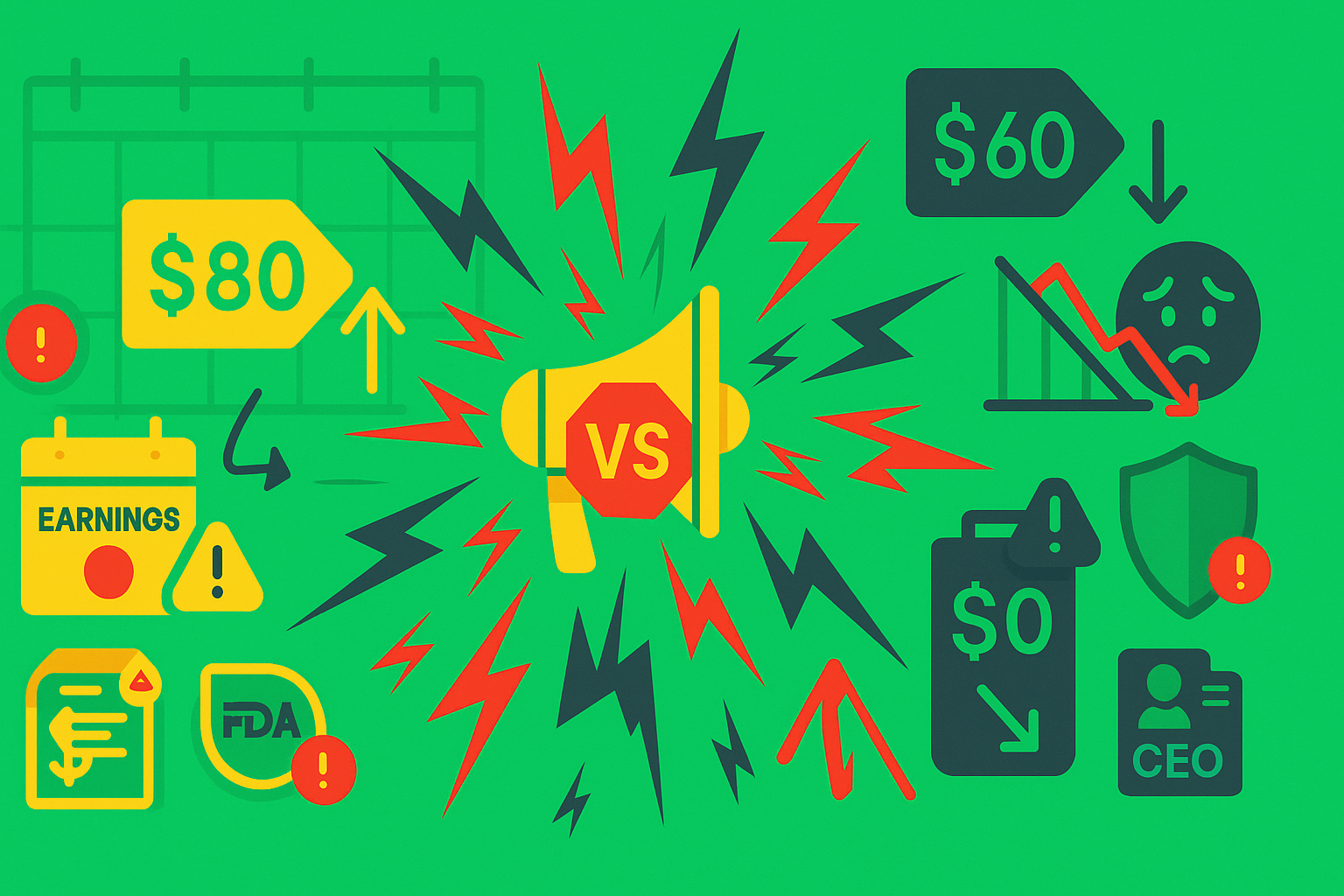
Earnings announcements and major news events are magnets for volatility and mispricing. Options traders love them. Value investors should avoid them. When you sell a put the day before earnings or hold a covered call through a product launch, you're no longer investing based on fundamentals. You're gambling on market reaction, and the house usually wins through implied volatility (IV) crush and unpredictable price swings.
TL;DR
- Earnings cause violent option price swings: IV spikes before earnings (premiums inflate), then collapses after (IV crush destroys value even if you're right about direction)
- News events add binary risk: Product recalls, FDA approvals, merger announcements create all-or-nothing outcomes that don't align with value investing's margin of safety
- Premiums before events are traps: High premiums look tempting, but they price in extreme moves. You're not getting "free money," you're taking on hidden risk
- Value investors should wait: Let earnings pass, let news settle, then trade options based on business fundamentals, not market reactions
- Exception: Only trade through events if you'd be happy with assignment: If selling a put and you're comfortable owning the stock at the strike regardless of earnings, you can hold. Otherwise, close or roll before the event
Why Earnings Announcements Are Dangerous for Options
Earnings reports are the most predictable source of volatility in stock markets. Every quarter, companies announce revenue, profit, and guidance. The market reacts, sometimes violently. A company beats expectations by 5%, and the stock jumps 15%. Another misses by 2%, and the stock drops 20%. These moves crush option values in unpredictable ways.
Implied volatility (IV) spike: In the 5-7 days before earnings, IV rises as traders price in uncertainty. A stock normally trading at 25% IV might spike to 40-50% IV before earnings. This inflates option premiums. A call that costs $3 might jump to $5 not because the stock moved, but because everyone expects a big move.
IV crush after earnings: Once the announcement happens, uncertainty vanishes. IV collapses back to normal (25%), even if the stock moved in your favor. Your $5 call might drop to $3.50 even if the stock rose 5%, because the extrinsic value (IV premium) disappeared.
Example: "SteadyCo" trades at $100 with earnings in 3 days. You buy a $105 call for $4 ($0 intrinsic + $4 extrinsic due to high IV). Earnings come out, stock jumps to $108 (great news!). Your call is now worth $4.50 ($3 intrinsic + $1.50 extrinsic after IV crush). You made $0.50 (12.5%) on an 8% stock move. Where's the rest? IV crush ate it.
Value investors don't need this complexity. You're trying to buy undervalued companies and collect premiums, not bet on quarterly reports.
The Problem with Selling Options Before Earnings
Some traders think, "I'll sell a put before earnings and collect the inflated premium." This is a mistake unless you're prepared for the consequences.
High premiums = high risk: A stock trading at $100 might offer a $95 put for $5 before earnings (5% premium in one week). That sounds like easy money. But the market is pricing in a possible 10-15% drop. If the company misses earnings and drops to $85, you're assigned at $95 and immediately down 10%. Your $5 premium doesn't cover that.
Unexpected reactions: Sometimes a company beats earnings, but guidance disappoints. Stock drops 8%. Or the company misses, but the stock rallies because expectations were worse. You can't predict market psychology. Value investing is about buying wonderful companies at discounts, not guessing short-term reactions.
Example: You sell a cash-secured put on "QualityCo" at a $90 strike for $4 premium, two days before earnings. Stock is at $95. Earnings come out: revenue up 8%, profit up 10%, but guidance lowered 3%. Stock drops to $87. You're assigned at $90, immediately underwater by $3 per share. Your $4 premium nets you $1, but you could have waited until after earnings and bought the stock at $87 with no options risk.
Better approach: Wait. Let earnings pass, let IV collapse, then sell puts or calls at fair prices based on updated business fundamentals, not event speculation.
Why Major News Events Are Worse
Earnings happen quarterly and are predictable. Major news events (FDA approvals, product recalls, lawsuits, CEO resignations, merger announcements) are unpredictable and binary. They either happen or they don't. The outcome is all-or-nothing.
Binary outcomes destroy margin of safety: Value investing is about building in a buffer. You buy at $70 when fair value is $100, so you're safe if you're 15% wrong. News events erase that buffer. A biotech stock awaiting FDA approval might trade at $50. Approval sends it to $120. Rejection sends it to $10. There's no "middle case." Options before these events are pure gambling.
Implied volatility goes insane: Before major events, IV can spike to 80-100% or higher. Premiums inflate to absurd levels. A put might cost 20% of the stock price for 30 days of protection. That's not insurance, that's a casino ticket.
Example: "BiotechCo" awaits FDA approval for a new drug. Stock trades at $40. Approval decision in 2 weeks. You sell a $35 put for $8 premium (20% yield in 2 weeks, incredible!). FDA rejects the drug. Stock drops to $12. You're assigned at $35, losing $23 per share ($15 net after premium). You just lost 43% trying to collect a "high premium."
Value investors don't bet on events they can't analyze. Stick to companies where value is clear regardless of near-term news.
The Hidden Cost of Holding Through Events
Maybe you already own a covered call or cash-secured put, and earnings or news is coming. Should you hold or close?
Holding covered calls: If you sold a call and the stock rallies on good news, you cap your upside. If the stock drops, you keep the premium but watch your equity fall. Either way, you've added event risk to what should be a steady income strategy.
Holding cash-secured puts: If the stock crashes on bad news, you're assigned at a higher price than the post-event market value. Your "discount entry" becomes an overpayment.
Mitigation: Close or roll positions 5-7 days before earnings or major events. You'll lose some premium to theta decay and closing costs, but you'll avoid the IV crush and binary risk. Then reenter after the event based on updated fundamentals.
When to hold: Only hold if you're 100% comfortable with assignment at your strike. If selling a $90 put and the stock drops to $80 post-earnings, are you happy to own it at $90? If yes, hold. If no, close before the event.
Real Numbers: Earnings Risk in Action
Let's compare two approaches to selling a put on "ValueCo" trading at $100, with earnings in 3 days.
Approach 1: Sell before earnings (risky)
- Sell 30-day put, $95 strike, for $6 premium (6% yield, inflated by IV)
- Earnings come out: revenue miss, stock drops to $90
- You're assigned at $95, immediately down $5 per share
- Net result: $6 premium - $5 loss = $1 gain (1%), but you're holding an underwater position
Approach 2: Wait until after earnings (patient)
- Wait for earnings. Stock drops to $90, IV collapses
- Sell 30-day put, $85 strike (below new price), for $3 premium
- Stock stays flat or recovers to $92. Put expires worthless
- Net result: $3 premium (3.5% yield), no assignment, no underwater position
The patient approach gives you lower income but eliminates event risk. Over time, consistent 3-4% monthly yields beat occasional 6% wins mixed with 10% losses.
When Earnings Actually Help Value Investors
There's one scenario where earnings create opportunities: after the announcement, when IV collapses and the stock overreacts.
Post-earnings dip: A company reports strong results but lowers guidance slightly. Stock drops 12%, even though fundamentals are fine. IV falls from 50% to 25%, premiums get cheap. This is your entry. Sell a put at a price 20% below fair value, or buy stock directly. The market panicked, and you got a discount.
Post-earnings premium collapse: After earnings, you can sell covered calls or puts at fair strikes without the IV inflation. Premiums are lower, but they're priced honestly. You're trading fundamentals, not event speculation.
Use earnings as a reset: Every quarter, earnings give you updated data (revenue, cash flow, margins). Wait for the announcement, analyze the new fundamentals, recalculate intrinsic value, then trade. Don't trade before you have the data.
Other News Events to Avoid
Earnings are the most common, but other events carry similar risks:
Product launches: Apple announces new iPhones, Tesla reveals new models. Stock swings 10-15% based on reception, preorders, and media hype. Avoid options around launch dates.
Regulatory decisions: FDA approvals, antitrust rulings, tariff announcements. These are binary (yes/no) and unpredictable. Wait for clarity.
CEO changes or leadership news: A beloved CEO resigns, or a new one is hired. Stock can move 20% on sentiment alone. Let the dust settle, then assess if the business fundamentals changed.
Merger announcements: Rumors of acquisitions or mergers send stocks flying. If you're holding options and the deal falls through, you're crushed. If you're selling options and the stock gaps up 40%, you miss the windfall.
Litigation or recalls: A company faces a lawsuit or product recall. Stock drops 25%. IV spikes. Avoid options until the legal outcome is clear and fundamentals can be reassessed.
What Could Go Wrong?
Even with these rules, mistakes happen:
- Forgetting to check the earnings calendar: You sell a put, forget earnings are tomorrow, and wake up to a 15% gap down. Mitigation: Always check earnings dates before entering any option trade. Most brokers highlight upcoming events.
- Chasing high premiums before events: The $8 premium looks amazing, so you ignore the risk. Mitigation: If a premium seems too good, check the earnings calendar. High yield = high risk.
- Holding through "minor" news: You think a product announcement won't matter, but the stock drops 8% anyway. Mitigation: Treat all company-specific news (earnings, guidance, launches, leadership changes) as event risk. Close or avoid.
- Selling puts on declining companies before earnings: The stock is cheap, so you sell a put. Earnings reveal deeper problems (declining margins, losing customers), and the stock crashes. Mitigation: Only sell puts on wonderful companies with strong fundamentals. Avoid turnarounds or speculative names.
- Buying options before earnings hoping to "play the pop": You buy calls expecting a beat and rally. The company beats, but the stock drops on guidance. You lose on both delta and IV crush. Mitigation: Never buy options before earnings as a value investor. If you want exposure, buy the stock.
Next Steps
- Check your current positions: If you have open options, verify there are no earnings or major news events in the next 30 days. If there are, decide now: hold or close?
- Build an earnings calendar: Use your broker's tools or sites like Earnings Whispers to track upcoming announcements for stocks you trade. Set reminders to close positions 5-7 days before events
- Practice post-earnings entries: After the next earnings announcement on a stock you follow, watch how IV collapses and price settles. Then enter your trade based on updated fundamentals
- Set a rule: "I never trade options within 7 days of earnings or major news." Write it down, make it automatic
- Read related articles: Learn Time Decay and Risk to understand how theta compounds event risk, or check Rolling Options as a Risk Tool to see how to adjust positions before events
*Disclaimer: This content is for educational purposes only and does not constitute financial advice. Past performance does not guarantee future results. Always conduct your own research before investing.*