
Rolling Options as a Risk Tool
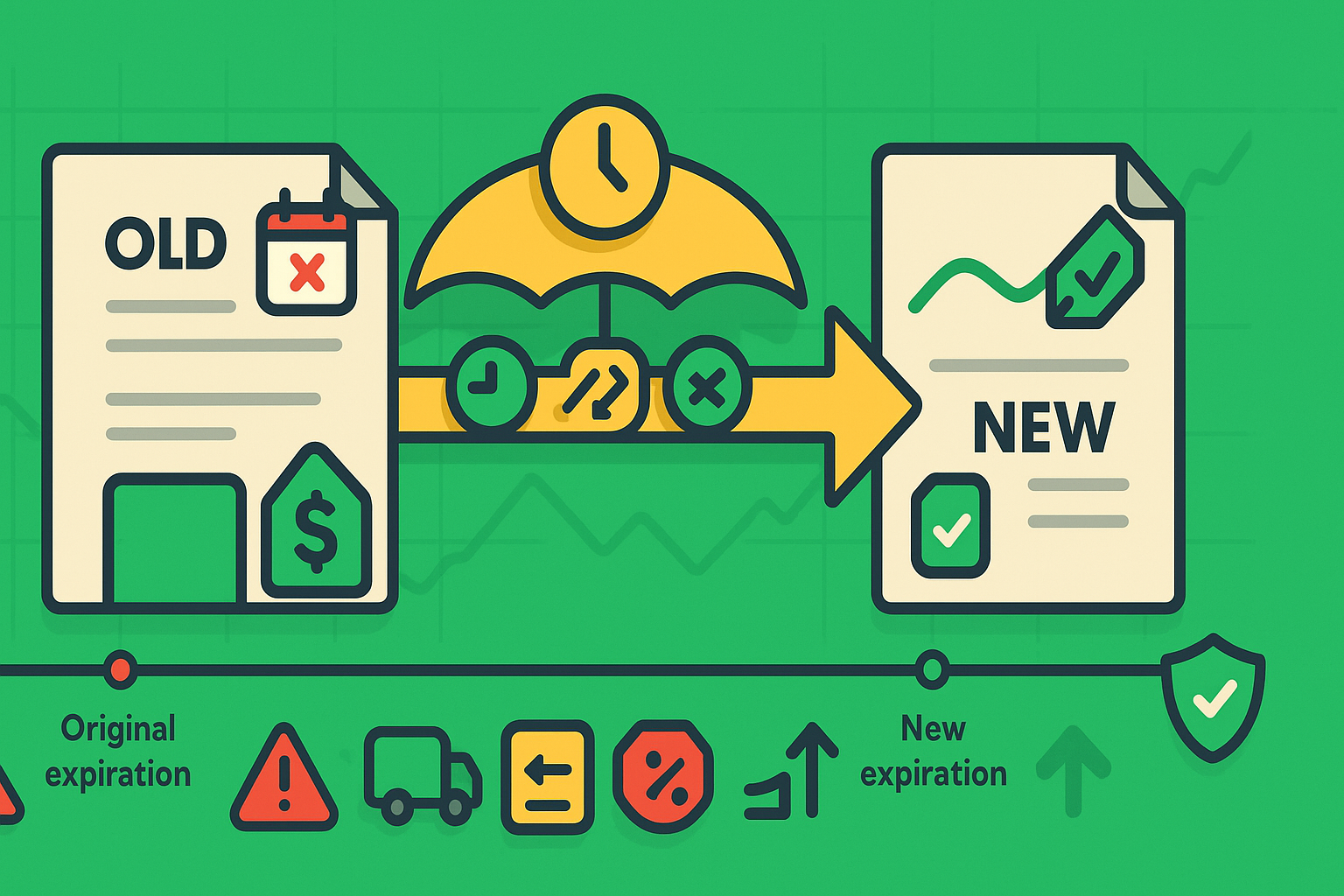
When an option trade isn't working out, you don't have to choose between taking a loss and hoping for the best. Rolling, the act of closing your current position and opening a new one with a different strike or expiration, gives you a third option: adjust the trade to match reality. It's not a magic fix, but it's a powerful tool for managing risk, extending time, and maintaining control when the stock moves against you.
TL;DR
- Rolling means closing one option and opening another: You're simultaneously exiting the current contract and entering a new one with different terms (strike, expiration, or both)
- Rolling extends time for your thesis: If the stock hasn't reached your target but fundamentals still hold, rolling out to a later expiration gives the business more time to deliver
- Rolling adjusts strikes to reduce risk: If a covered call is about to be assigned early or a put is underwater, rolling to a different strike can prevent losses or reduce exposure
- Rolling costs money (or generates credit): Depending on the direction, you might pay a debit (cost) or collect a credit (income). Always calculate the net cost before rolling
- Use rolling for specific situations: Avoid assignment when you want to keep the stock, extend LEAPS when the thesis still holds, or defend puts/calls when the move is temporary
- Don't roll bad trades indefinitely: If fundamentals have changed or your thesis is broken, take the loss and move on. Rolling doesn't fix a bad investment
What Is Rolling an Option?
Rolling is a two-step process executed as a single trade:
- Close your current option position (buy it back if you sold it, sell it if you bought it)
- Open a new option position with a different expiration date, strike price, or both
Most brokers let you execute this as one order ("roll"), so you lock in the net cost or credit without timing risk between the two legs.
Example (covered call): You sold a $105 call on "SteadyCo" trading at $100, expiring in 7 days, for $2 premium. The stock rallies to $106, and you don't want to be assigned (you'd rather keep the stock). You roll the call:
- Buy back the $105 call for $6 (cost: $6)
- Sell a new $110 call, expiring in 30 days, for $5 (credit: $5)
- Net cost: $1 debit
You paid $1 to avoid assignment, extend time, and raise the strike by $5. If the stock stays below $110, you keep it and collect the new $5 premium.
Why Roll Instead of Closing or Taking Assignment?
There are three paths when an option trade goes wrong:
- Take the loss: Close the position and walk away
- Do nothing: Let the option expire or be assigned
- Roll: Adjust the trade to a new strike/expiration
Rolling is best when:
- Your thesis still holds: The business is wonderful, you bought at a discount, but timing was off. Rolling gives the value more time to surface.
- You want to avoid assignment: You sold a call but don't want to sell your shares yet, or you sold a put but the stock is temporarily depressed.
- You can collect more premium: Rolling a put or call out in time often generates additional credit, lowering your cost basis or increasing income.
- Short-term noise is disrupting a long-term play: The stock dropped 10% on temporary bad news, but fundamentals are intact. Rolling gives you breathing room.
When not to roll:
- Fundamentals have changed (the company is declining, margins are shrinking, debt is rising)
- You're throwing good money after bad (rolling a losing LEAP on an overvalued stock)
- The cost of rolling exceeds the benefit (paying $3 to roll a position that's already down $10 doesn't help much)
Rolling Covered Calls (Avoiding Assignment)
Covered calls are a common income strategy, but sometimes the stock rallies faster than expected. You sold a $105 call, and the stock is now at $112. You're about to be assigned and lose your shares. If you still believe in the stock's long-term value, rolling lets you keep it.
Roll out and up: Close the $105 call (now worth $7, you pay $7 to buy it back). Sell a new $115 call, 30-60 days out, for $6. Net cost: $1. You paid $1 to avoid selling at $105 and raised your strike to $115. If the stock stays below $115, you keep it and the premium.
Roll out only: If you don't want to raise the strike, roll to the same strike but a later expiration. Close the $105 call for $7, sell a new $105 call 60 days out for $8. Net credit: $1. You collected income and extended time, but the stock could still be called away at $105.
When to roll covered calls:
- You're confident the stock will continue rising and don't want to cap gains at the current strike
- You'd rather keep collecting premiums than sell the shares and find a new investment
- The stock rallied due to short-term hype, and you expect it to pull back (rolling out gives you time for that)
Cost consideration: Rolling up and out often costs a small debit ($1-$3). Make sure the new premium justifies it. If the stock has already run to fair value or beyond, let it be assigned and take profits.
Rolling Cash-Secured Puts (Defending Underwater Positions)
You sold a $90 put on "QualityCo" trading at $95, collected $3 premium. The stock drops to $85 due to a temporary earnings miss. You're about to be assigned at $90, but you still believe in the company. Rolling lets you avoid assignment or lower your entry price.
Roll out and down: Close the $90 put (now worth $6, you pay $6). Sell a new $85 put, 30-60 days out, for $5. Net cost: $1. You lowered your strike from $90 to $85 (better entry price) and extended time. If the stock recovers above $85, the put expires worthless. If not, you're assigned at $85 instead of $90.
Roll out only: Close the $90 put for $6, sell a new $90 put 60 days out for $7. Net credit: $1. You collected extra premium and gave the stock more time to recover. If it stays below $90, you're still assigned at $90, but your net cost is now $89 ($90 strike - $1 original premium - $1 roll credit).
When to roll cash-secured puts:
- The stock dropped on temporary bad news (earnings miss, sector rotation), but fundamentals are strong
- You still want to own the stock, just at a better price
- Collecting additional premium improves your cost basis enough to make assignment acceptable
Warning: Don't roll puts on declining businesses. If earnings are falling, debt is rising, or the competitive position is weakening, take the assignment (if you still want the stock) or close the put and move on.
Rolling LEAPS (Extending Time on Long-Term Calls)
LEAPS are long-term calls (18-24 months) used for leverage on undervalued companies. If you bought a LEAP with 18 months left and the stock hasn't moved yet, but your thesis is intact, rolling extends your time horizon.
Roll to a later expiration: You bought a $90 LEAP on "SteadyCo" at $100, 18 months ago, for $15. The stock is still at $100, but earnings are growing and fair value is $130. The LEAP now has 6 months left and is worth $12 ($10 intrinsic + $2 extrinsic). You're losing to time decay. Roll:
- Sell the $90 LEAP for $12
- Buy a new $90 LEAP with 18 months, for $18
- Net cost: $6
You paid $6 to extend time by 12 months. Your total investment is now $21 ($15 original + $6 roll), but you have a full 18 months for the stock to reach $130.
Roll to a different strike: If the stock has appreciated but you want to capture gains while staying leveraged, roll to a higher strike. Sell the $90 LEAP (worth $20 with stock at $110), buy a $110 LEAP for $15. Net credit: $5. You locked in $10 of gains and redeployed $15 into a new leveraged position.
When to roll LEAPS:
- Fundamentals still support the original thesis (intrinsic value unchanged or improved)
- Time decay is eroding value (6-9 months left), and you need more runway
- You're willing to pay for the extension because the expected return justifies it
Cost consideration: Rolling LEAPS is expensive (often $5-$10 per contract). Only do it if the stock's intrinsic value significantly exceeds the current price. Otherwise, you're compounding losses.
Rolling to Collect More Premium (Income Optimization)
Sometimes, rolling isn't about defense. It's about generating more income. If you sold a 30-day covered call and 10 days have passed, the call is nearly worthless due to time decay. You can close it early and roll to a new 30-day call, collecting fresh premium.
Example: You sold a $105 call for $2, 30 days ago. The stock is at $102, and the call is now worth $0.40 with 5 days left. Instead of waiting for expiration, you:
- Buy back the $105 call for $0.40 (cost: $0.40)
- Sell a new $105 call, 30 days out, for $2.50 (credit: $2.50)
- Net credit: $2.10
You collected $2.10 total instead of $2 by rolling early. This strategy works best when theta decay has eaten most of the premium and you can redeploy capital into a fresh contract.
When to roll for premium collection:
- The option is nearly worthless (less than 20% of original value) with 7-14 days left
- Implied volatility is stable or rising (so new premiums are attractive)
- You'd sell the same strike again anyway, so rolling is more efficient than waiting for expiration
Risk: If the stock moves sharply, your new position could go against you faster than the old one. Only roll when you're comfortable with the new strike and expiration.
The Math of Rolling: Credits vs. Debits
Every roll has a net cost or credit. You're comparing what you pay to close the old position against what you collect (or pay) for the new one.
Net credit roll: You collect more than you spend. Example: Buy back a put for $4, sell a new put for $6. Net credit: $2. This improves your position (lowers cost basis, increases income).
Net debit roll: You spend more than you collect. Example: Buy back a call for $8, sell a new call for $6. Net debit: $2. This costs money but might save you from a worse outcome (assignment at an unfavorable price).
Break-even analysis: Before rolling, ask: "Does this improve my risk-reward?" If rolling costs $3 and saves you from selling stock at $105 (when fair value is $120), it's worth it. If rolling costs $3 and the stock is already at fair value, it's not.
Always calculate the net impact. If the roll doesn't improve your position (better strike, more time, more premium), don't do it.
What Could Go Wrong?
Rolling is a tool, not a magic fix. Misuse can compound losses:
- Rolling a bad investment repeatedly: The stock keeps falling, but you roll the put every month hoping for a recovery. Fundamentals have changed, but you refuse to accept it. Mitigation: Set a rule: if fundamentals deteriorate (earnings down, debt up, competitive position weakening), take the loss instead of rolling.
- Rolling at a net debit without justification: You pay $5 to roll, but the new position doesn't offer enough upside to justify the cost. Mitigation: Only roll if the net cost is small relative to the potential gain (e.g., pay $2 to avoid selling a stock worth $20 more).
- Rolling too frequently: You roll every week, chasing premiums or avoiding assignment. Transaction costs and bid-ask spreads eat your gains. Mitigation: Roll only when necessary (avoid assignment, extend time on a strong thesis, defend against temporary bad news).
- Ignoring implied volatility: You roll when IV is low, generating small premiums. You'd be better off waiting for IV to rise. Mitigation: Check IV before rolling. If it's at multi-month lows, consider waiting a few days for a spike (or just take the loss/assignment).
- Rolling without a plan: You roll because the position is underwater, but you haven't reassessed whether the stock is still a good investment. Mitigation: Before every roll, ask: "Would I enter this trade today if starting fresh?" If no, close the position instead.
Next Steps
- Practice with paper trades: Simulate rolling a covered call or put to see how net credits/debits work. Track the outcome over 30-60 days
- Review open positions: Check if any options are near expiration or at risk of assignment. Decide now: close, roll, or do nothing?
- Set rolling rules: Write down when you'll roll (e.g., "Roll covered calls if stock rallies 10% above strike and I want to keep it" or "Roll LEAPS with 6 months left if thesis still holds")
- Learn the Greeks: Understanding delta and theta makes rolling decisions clearer (you'll see how time and price changes affect the net cost)
- Read related articles: Check Time Decay and Risk to see why rolling early (before expiration) is often better, or read Hedging Concentrated Positions to see how rolling fits into broader risk management
*Disclaimer: This content is for educational purposes only and does not constitute financial advice. Past performance does not guarantee future results. Always conduct your own research before investing.*