
Expiration Date Selection
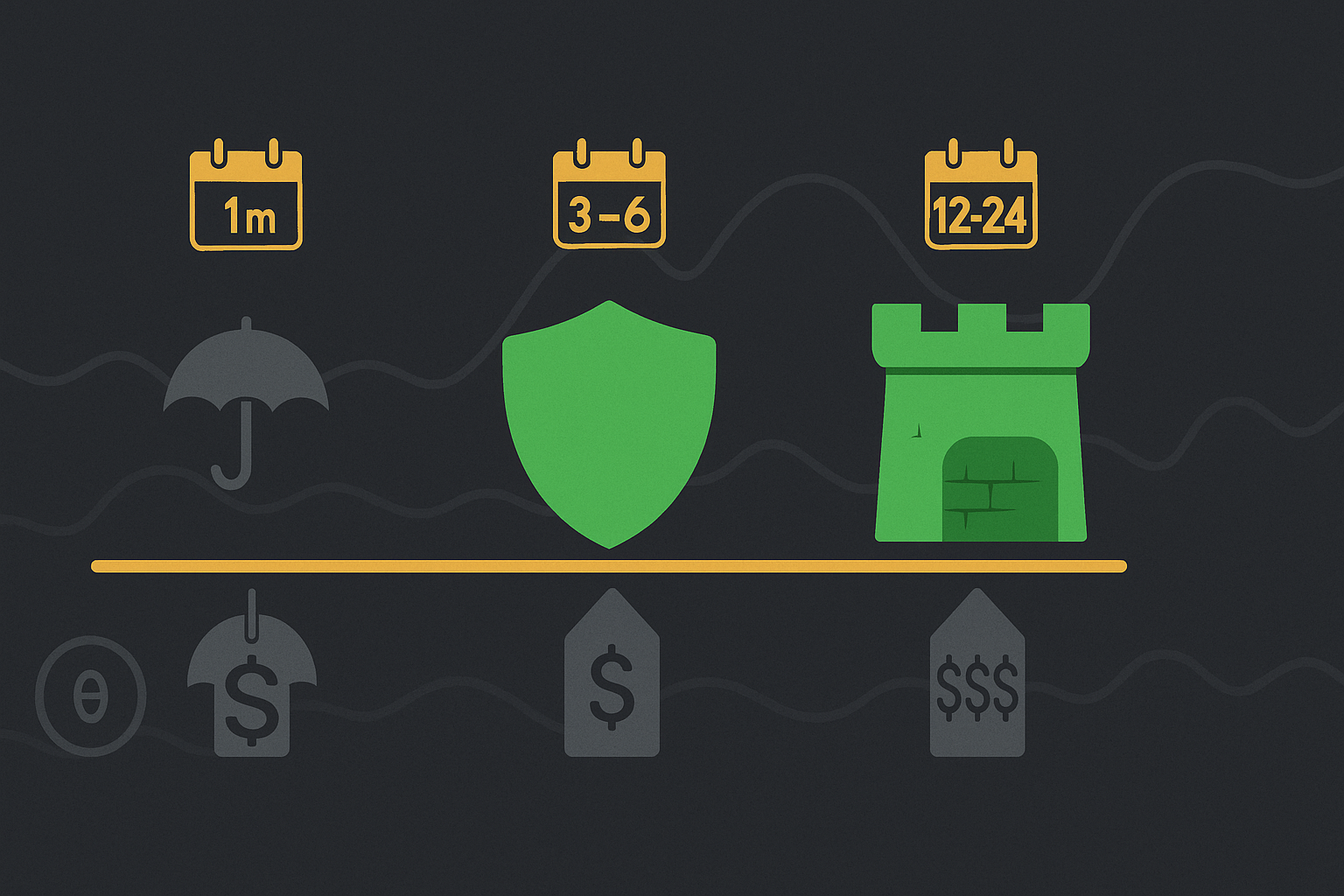
Buying a 30-day protective put is like renting an umbrella for one rainy afternoon. It's cheap, but if the storm lasts a week, you're caught unprepared. Buying a 2-year put is like owning an all-weather jacket, expensive upfront, but you're covered no matter when the bad weather hits. The expiration date you choose determines how long your protection lasts and how much you pay per month of coverage.
TL;DR
- Short-term puts (30-60 days) are cheap but risky: They cost less per contract but expire quickly, forcing you to rebuy frequently or lose protection
- Medium-term puts (90-180 days) balance cost and coverage: They give you a full quarter or two of protection at reasonable monthly cost, good for earnings seasons or temporary volatility
- Long-term puts (1-2 years) are expensive but efficient: They lock in protection for a full market cycle, reducing transaction costs and avoiding gaps in coverage
- Match expiration to your risk event: Protecting through one earnings call? Use 30-60 days. Worried about a recession? Use 12-24 months
- Theta decay accelerates near expiration: Shorter-dated puts lose value faster in the final 30 days, meaning your insurance gets expensive if you have to roll repeatedly
How Expiration Dates Affect Cost and Coverage
When you buy a protective put, you're paying for two things: intrinsic value (how much the put is already in-the-money) and time value (how much time is left for the stock to move). Time value decays as expiration approaches, and the rate of decay accelerates in the final month.
Let's say you own "StableCo" trading at $100 and want to protect against a drop below $90. Here's what different expiration dates might cost:
- 30-day put, $90 strike: $1.50 per share ($0.05 per day of protection)
- 90-day put, $90 strike: $3.00 per share ($0.033 per day of protection)
- 180-day put, $90 strike: $5.00 per share ($0.028 per day of protection)
- 1-year put, $90 strike: $8.00 per share ($0.022 per day of protection)
- 2-year put, $90 strike: $12.00 per share ($0.016 per day of protection)
Notice the pattern: longer expirations cost more in total dollars, but less per day of coverage. A 30-day put costs $0.05 per day, while a 2-year put costs only $0.016 per day. If you plan to stay protected for 12 months, buying four 90-day puts would cost $12 total ($3 x 4), the same as one 1-year put, but you'd face four separate transactions, four bid-ask spreads, and potential gaps in coverage if you forget to roll.
Short-Term Protection (30-60 Days)
When to use: You have a specific, time-limited risk event, earnings announcement, merger vote, regulatory decision, or short-term market volatility (election, Fed meeting). You don't need ongoing protection, just a safety net for the next few weeks.
Pros:
- Lowest upfront cost: A 30-day put might cost 1-2% of your position, manageable for most portfolios
- No wasted premium: If the risk passes quickly, you didn't overpay for months of unnecessary coverage
- Flexibility: You can reassess after 30 days and decide whether to renew, adjust strikes, or walk away
Cons:
- Rapid theta decay: In the final 2 weeks, time value collapses fast. If the stock hasn't moved, you're watching your insurance premium evaporate daily
- Frequent rolling required: To stay protected, you need to buy a new put every month, racking up transaction costs and bid-ask spreads
- Gap risk: If you forget to roll or miss a day, you're unprotected during the most volatile periods
Example: You own 100 shares of StableCo at $100, earnings are in 3 weeks, and you're worried about a miss. You buy a 30-day, $95 put for $2 ($200 cost). If earnings go well and the stock stays above $100, you let the put expire worthless, losing only $200. If earnings disappoint and the stock drops to $85, your put is worth $10 ($95 strike - $85 price), gaining $1,000 and offsetting most of your stock loss.
Medium-Term Protection (90-180 Days)
When to use: You want protection through a full quarter or two, covering multiple earnings announcements, uncertain macro conditions (tariff negotiations, interest rate decisions), or seasonal volatility (tax season, year-end). You're not betting on a single event, but you want a buffer for the next few months.
Pros:
- Balanced cost: More expensive than 30-day puts, but cheaper per day of coverage. A 90-day put might cost 3-4% of your position
- Covers multiple events: One put protects you through 2-3 earnings calls or several Fed meetings without needing to roll
- Slower theta decay: Time value erodes more gradually, so you're not bleeding premium as fast
Cons:
- Still requires occasional rolling: After 90-180 days, you need to decide whether to renew or let protection lapse
- Higher upfront cost than short-term: If the risk passes in 30 days, you overpaid for 60-150 days of unused coverage
- Not ideal for long-term holders: If you're a buy-and-hold investor planning to own this stock for years, 90-180 day puts are inefficient
Example: You own StableCo at $100, and you're worried about the next 6 months due to supply chain issues. You buy a 180-day, $90 put for $5 ($500 cost). Over the next 6 months, the stock fluctuates between $95 and $105, ending at $102. Your put expires worthless, but you slept soundly knowing your max loss was capped at $10 per share + $5 premium = $15 (15% total downside). If the stock had crashed to $75, your put would be worth $15, offsetting the $25 stock loss and limiting total damage to $10 + $5 = $15 per share.
Long-Term Protection (1-2 Years)
When to use: You're a long-term investor who wants continuous protection without the hassle of frequent rolling. You expect to hold the stock through a full market cycle (bull and bear phases) and want insurance against black swan events, recessions, or prolonged downturns. This is portfolio insurance, not event-driven hedging.
Pros:
- Cheapest per-day cost: A 2-year put might cost 8-12% of your position, but that's only $0.01-0.02 per day. Over 2 years, this is far cheaper than rolling 24 monthly puts
- No gaps in coverage: You're protected continuously for the entire period, no need to remember to roll or worry about missing a renewal
- Slow theta decay: Time value erodes very gradually in the first year, accelerating only in the final 6 months. You're not watching daily premium bleed
Cons:
- High upfront cost: Paying 8-12% of your position upfront hurts returns if the stock goes sideways or up. That's 4-6% annualized drag on performance
- Opportunity cost: The premium you spent could have been invested elsewhere or used for other strategies (cash-secured puts, covered calls)
- Less flexibility: You're locked into this protection for 1-2 years. If market conditions change (volatility drops, company improves), you can't easily exit without taking a loss on the put
Example: You own 1,000 shares of StableCo at $100 ($100,000 position) and want protection for the next 2 years. You buy a 2-year, $85 put for $10 per share ($10,000 cost, 10% of position). If the market crashes and StableCo drops to $50, your puts are worth $35 each ($85 strike - $50 price = $35), gaining $35,000. Your stock loss is $50,000 ($100 → $50), so your net loss is $50,000 - $35,000 + $10,000 (premium paid) = $25,000 total, or 25% of your original position. Without the put, you'd be down 50%.
Choosing Based on Your Holding Period
Short-term traders (weeks to months): Use 30-60 day puts. You're planning to sell or adjust your position soon anyway, so paying for long-term protection is wasteful. Buy just enough coverage to get through your planned holding period.
Swing traders (3-6 months): Use 90-180 day puts. You're holding through a few earnings cycles or macro events, and you want protection without frequent rolling. This balances cost and coverage.
Long-term investors (1+ years): Use 1-2 year puts if you're protecting concentrated positions or worried about a prolonged bear market. The upfront cost is high, but you avoid the transaction drag of monthly rolling. Alternatively, use 180-day puts and roll them every 120-150 days (before rapid theta decay hits) to stay protected continuously at lower per-period cost.
Timing Expiration Around Known Events
If you know a specific risk event is coming, time your expiration to cover it:
Earnings: Buy puts expiring 1-2 weeks after the earnings date. This gives you protection through the announcement and the immediate market reaction. If earnings are in 4 weeks, buy a 45-60 day put.
Macro events (Fed meetings, elections): Buy puts expiring 30-60 days after the event. Markets often take weeks to digest major news, so don't cut coverage too tight.
Concentrated position rebalancing: If you plan to sell or diversify in 6 months, buy a 180-day put. By the time it expires, you'll have exited the position anyway, so the insurance cost is exactly aligned with your holding period.
What Could Go Wrong?
Expiration selection mistakes can leave you unprotected or overpaying for insurance. Here's what to watch for:
Expiring right before a major event: You buy a 30-day put, and earnings land 2 days after expiration. You're naked when you need protection most. Mitigation: Always pad expirations by 1-2 weeks beyond known risk events.
Rolling too frequently: You buy 30-day puts every month for a year, paying 12x in transaction costs and bid-ask spreads. You end up spending 15-20% of your position on protection. Mitigation: If you plan to stay protected long-term, buy 180-day or 1-year puts upfront.
Holding long-dated puts into rapid theta decay: You bought a 1-year put, and 10 months pass with the stock staying flat. In the final 60 days, theta decay accelerates, and your put loses 50% of its remaining value. Mitigation: Roll long-dated puts 90-120 days before expiration to lock in remaining time value.
Ignoring implied volatility changes: You buy a 30-day put when IV is low ($2 cost), but when you roll 30 days later, IV has spiked and the new put costs $5. Mitigation: Use longer expirations during low IV to lock in cheaper protection.
Letting protection lapse during market stress: You had a 90-day put, it expired, and you didn't roll because the stock was up 10%. A week later, the market crashes 20%, and you're unprotected. Mitigation: Set calendar reminders to evaluate rolling 30 days before expiration, not on expiration day.
Next Steps
Ready to choose the right expiration for your protective puts? Here's your action plan:
- Identify your risk timeline: Are you protecting against a specific event (30-60 days) or ongoing market risk (1-2 years)?
- Calculate cost per day: Compare 3-4 different expirations and divide total premium by days of coverage. Pick the most efficient option for your holding period
- Check for known events: Look at the earnings calendar, Fed schedule, or company-specific catalysts. Make sure your expiration covers these dates with a buffer
- Pair with strike selection: Read about strike price selection to match expiration with the right protection level
- Set rolling reminders: If using short or medium-term puts, create calendar alerts 30 days before expiration to reassess whether to roll or let expire
- Understand the fundamentals: Review what protective puts are and when to add them
Expiration selection is about matching coverage duration to your actual holding period and risk events. Short-term puts are cheap but require active management. Long-term puts are expensive but lock in continuous protection. Neither is wrong, just different tools for different situations. Choose based on how long you plan to hold the position and how much administrative hassle you're willing to tolerate.
*Disclaimer: This content is for educational purposes only and does not constitute financial advice. Past performance does not guarantee future results. Always conduct your own research before investing.*