
Options Liquidity and Bid-Ask Spreads
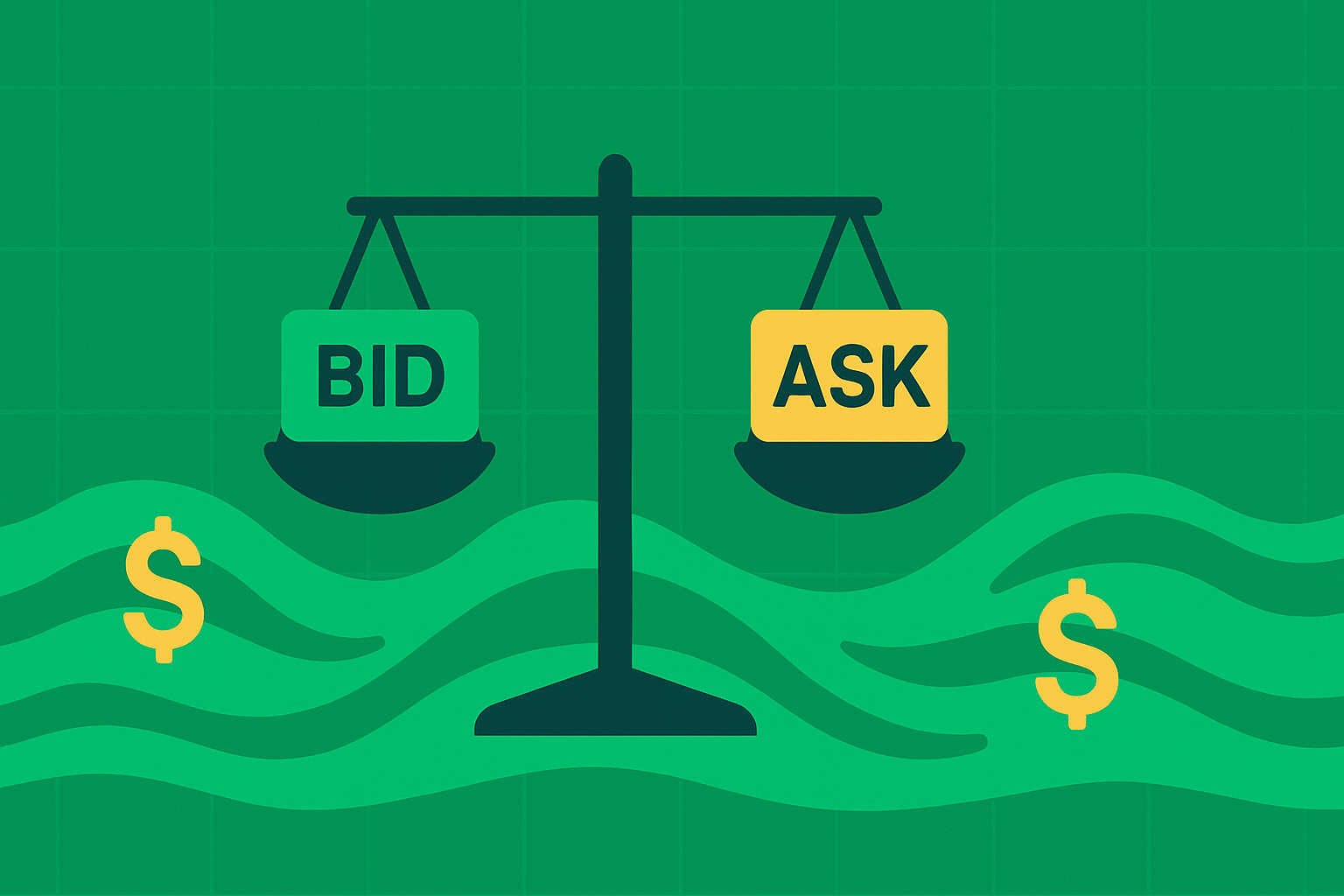
You can pick the perfect stock, nail the valuation, and still lose money on options if you ignore one thing: the bid-ask spread. It's the silent fee that eats into every options trade, and most beginners don't even notice it until their returns mysteriously disappoint. Understanding spreads is like checking for hidden fees before buying a house—small numbers that become big money over time.
TL;DR
- Bid-ask spread = the difference between buying and selling prices: Wide spreads mean you're overpaying on entry and getting shortchanged on exit
- Liquidity matters more than premium size: A $300 option with a $0.05 spread is more liquid than a $350 option with a $0.50 spread
- Stick to active stocks: High volume creates tight spreads, typically under $0.10 for quality options
- Spread cost compounds over time: On multiple trades, wide spreads can eat 5-10% of your returns annually, understand the cost of getting in and out
- Always use limit orders: Never pay the ask or accept the bid blindly, split the difference and try to pay in the middle.
What Bid-Ask Spread Actually Means
Every option has two prices quoted at any moment:
The bid: What buyers are willing to pay (what you get when you sell) The ask: What sellers are demanding (what you pay when you buy)
The spread is simply ask minus bid. If an option shows "Bid $2.80, Ask $2.95," the spread is $0.15. That $0.15 is pure friction, the cost of doing business in that option.
Think of it like buying a used car. The dealer offers you $8,000 to buy your car (the bid), but sells the same car for $9,000 (the ask). That $1,000 spread is their profit margin. In options, the spread represents the market maker's profit for providing liquidity.
Why Spreads Hurt Value Investors
Let's walk through a covered call scenario to see how spreads impact returns:
You own 100 shares of "Quality Corp" at $45 per share. You want to sell a $48 call expiring in 30 days. You check the quotes:
Bad spread example:
- Bid: $1.20
- Ask: $1.50
- Spread: $0.30 (20% spread!)
If you sell at bid, you get $120. The market immediately values that position at $150 (the ask). You just gave away $30 to enter the trade, on paper. On a $4,500 stock position, you've lost 0.67% before the stock even moves.
Good spread example:
- Bid: $1.28
- Ask: $1.32
- Spread: $0.04 (3% spread)
Sell at bid, get $128. The instant paper loss is only $4. That's $26 less cost for the same trade, a 27% improvement in net premium.
Over a year of monthly covered calls, tight spreads can mean an extra $300-500 in your pocket on a single 100-share position. Multiply that across a portfolio os any decent size and you're talking real money.
The Real Cost in Numbers
Let's compare two scenarios over 12 months, selling monthly covered calls:
Scenario A: Liquid options (tight spread)
- Monthly premium target: $150
- Average spread: $0.05
- Spread cost per trade: $5
- Annual spread cost: $60 (12 trades)
- Net annual income: $1,740
Scenario B: Illiquid options (wide spread)
- Monthly premium target: $150
- Average spread: $0.30
- Spread cost per trade: $30
- Annual spread cost: $360 (12 trades)
- Net annual income: $1,440
Same stock, same strategy, but the illiquid options brings in $300 less annually (per contract), that is a 17% reduction in income. That's the hidden tax of poor liquidity.
What Makes Options Liquid
Liquidity isn't random. Certain factors predict tight spreads:
Stock size and volume: Large-cap companies with millions of daily shares traded (think Apple, Microsoft, JPMorgan) have tight option spreads, often $0.01-0.05. Small-cap stocks with light volume can show spreads of $0.20-0.50 or wider.
Option popularity: At-the-money and near-the-money strikes see the most trading activity, creating tighter spreads. Far out-of-the-money options have wide spreads because few traders want them.
Time to expiration: Options expiring in 30-60 days typically have tighter spreads than those expiring in 6-12 months. Shorter-term options attract more traders and usually less time for price to move which removes the "unknown" factor with the short term.
Volatility events: Around earnings announcements, spreads often widen as market makers protect themselves from risk. After earnings, spreads tighten back down.
How to Spot Good Liquidity
Before placing any options trade, check these metrics:
Open interest: The total number of contracts outstanding. Look for at least 100 open contracts, preferably 500+. Low open interest (under 50) signals illiquid options.
Volume: Daily contracts traded. Higher is better. If yesterday's volume was 10 contracts and open interest is 50, that's a red flag. You want volume at least 20-50% of open interest.
Bid-ask spread percentage: Take the spread ÷ midpoint price. Under 10% is acceptable, under 5% is good, under 2% is excellent.
Example calculation:
- Bid: $2.45
- Ask: $2.55
- Midpoint: $2.50
- Spread: $0.10
- Spread %: $0.10 ÷ $2.50 = 4% (acceptable)
Practical Tactics for Tighter Spreads
Use limit orders exclusively: Never use market orders on option trades. Always set your limit price at the midpoint or slightly better. If bid is $2.40 and ask is $2.50, place a sell order at $2.45. You'll often get filled, if not go by $0.01 less and try again.
Trade during market hours: Spreads widen before open and after close. Trade between 10:00 AM and 3:30 PM Eastern for best liquidity.
Avoid expiration day chaos: The last hour before expiration can see wild spreads as traders close positions. If you're going to close early, do it a day or two before expiration.
Stick to monthly cycles: Third-Friday monthly expirations have the tightest spreads. Weekly options on less-liquid stocks often have punishing (extremely wide) spreads.
Focus on top holdings: If you're choosing between two similar undervalued stocks, pick the one with better option liquidity. The difference in income over time is material.
Liquidity and Value Stock Selection
Here's where value investing meets options reality: not all undervalued stocks have liquid options. A $15 stock with $8 fair value looks amazing, but if the option spreads are $0.40 on a $1.00 premium, you're giving away 40% of your edge.
Smart approach: build a watchlist of 20-30 undervalued large-cap and mid-cap stocks with strong option liquidity. When opportunities arise, you can act without getting hammered by spreads. Check fair value using Wall St Yardie app and confirm option liquidity before creating a position and putting up your money.
Sometimes the "good enough" undervalued stock with excellent liquidity beats the "perfect" undervalued stock with terrible options trading. You can make up a small valuation difference through better trade execution and lower spread costs.
What Could Go Wrong?
Illiquid options on small positions: That micro-cap gem might be 50% undervalued, but option spreads of $0.50 on $2.00 premiums will destroy your returns.
Mitigation: Set a minimum market cap threshold. For most value investors, sticking to stocks above $5 billion market cap ensures decent option liquidity. Use stock screeners that include liquidity filters.
Chasing premium over liquidity: A $200 premium with $0.40 spread is worse than a $180 premium with $0.05 spread, but the bigger number looks tempting.
Mitigation: Always calculate net premium after spread costs. Build a simple spreadsheet that subtracts estimated spread from quoted premiums to compare apples-to-apples. Stick to spreads that are less than 10% of the bid.
Trading around volatility events: Earnings announcements make spreads explode. You might see $0.10 spreads balloon to $0.50 the day before earnings.
Mitigation: Check earnings calendars and avoid opening positions 5-7 days before announcements. If you're already in a position, close it early or let it ride, don't try to roll into a new position during the volatility window.
Assuming big premiums mean good deals: High implied volatility creates fat premiums but also wide spreads. You might collect $5.00 instead of $2.00, but if spreads are $1.00 instead of $0.05, you're worse off.
Mitigation: Look at spread as a percentage, not absolute dollars. A $0.50 spread on a $10.00 premium (5%) is better than a $0.20 spread on a $2.00 premium (10%).
Next Steps: Spread Awareness
- Check spreads before every trade: Make it a habit to calculate spread percentage on any option you're considering
- Build a liquidity watchlist: Identify 15-20 undervalued stocks with consistently tight spreads (under 5%)
- Set spread alerts: Some platforms let you alert when spreads tighten—use this for stocks you want to trade
- Use midpoint pricing: Always place orders at the midpoint between bid and ask, adjusting slightly if not filled
- Compare similar strikes: Check multiple expirations and strikes to find the sweet spot of premium vs. spread
- Avoid illiquid strikes: Stay within 10-15% of current stock price where liquidity concentrates
Spreads are like transaction fees at a bad bank, they seem small on each trade but compound into real losses over time. The good news is that with smart stock selection and trade timing, you can reduce spread costs to near zero. Focus on liquid, actively traded options on quality value stocks, and use limit orders religiously.
Remember, you're not just picking undervalued stocks. You're choosing undervalued stocks with liquid options markets. The combination of business value plus trading efficiency is what separates consistent option income from frustrating returns. Keep the riddim steady, respect the spreads, and watch your net income climb.
*Disclaimer: This content is for educational purposes only and does not constitute financial advice. Past performance does not guarantee future results. Always conduct your own research before investing.*