
Strike Price Selection for LEAPS
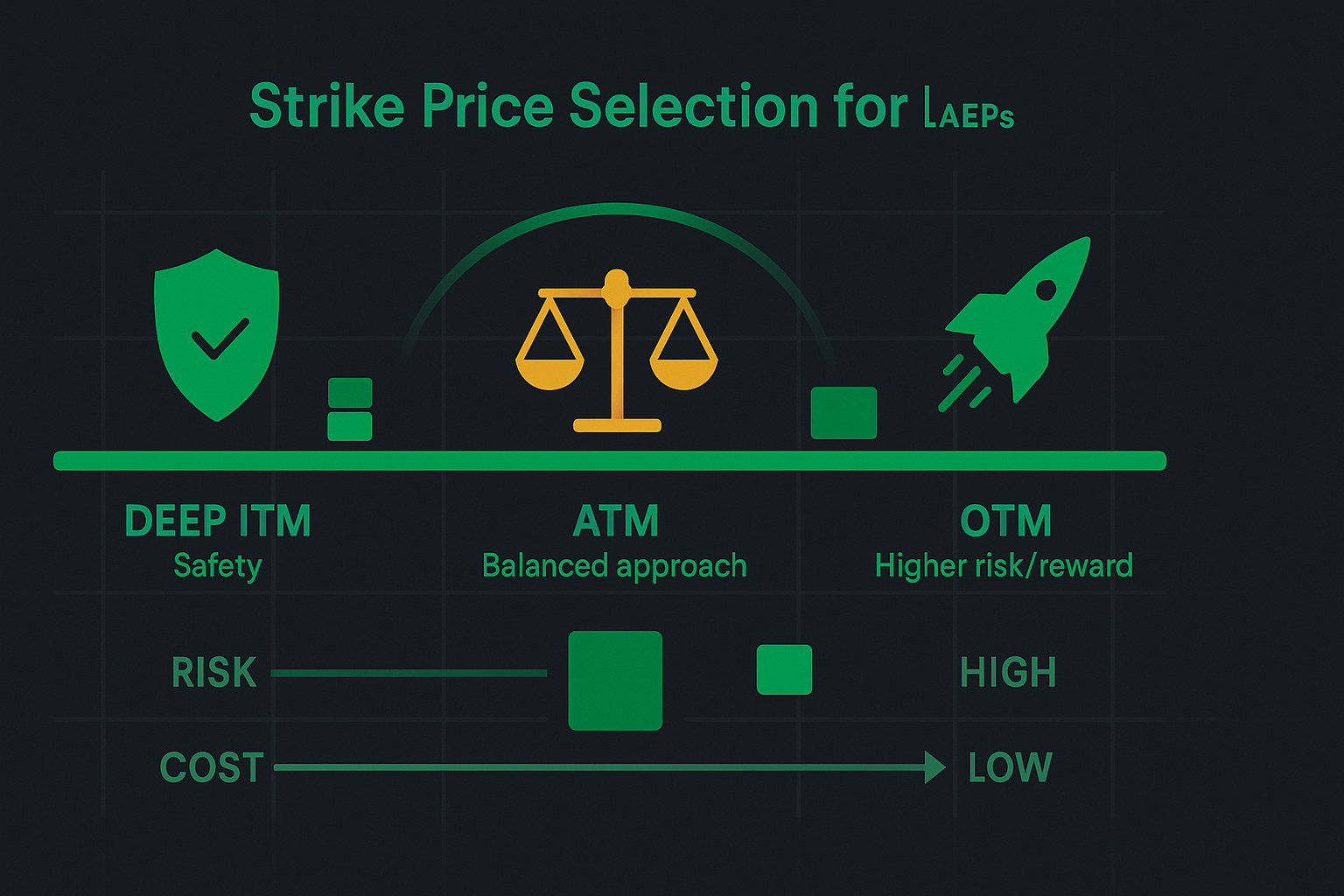
Picking the wrong strike price can turn a solid LEAPS thesis into a losing trade. Too far out-of-the-money and you're speculating on price movement, not investing on valuation. Too deep in-the-money and you pay nearly the full stock price, defeating the cost efficiency benefit. The sweet spot depends on your conviction, risk tolerance, and how much leverage you want.
TL;DR
- Deep ITM (in-the-money): Lower risk, higher cost, behaves most like stock ownership
- At-the-money (ATM): Balanced risk and reward, moderate leverage, sensitive to stock movement
- Out-of-the-money (OTM): Higher risk, lower cost, maximum leverage but requires significant price appreciation
- Value investors favor ITM: Choose strikes with at least 20-30% intrinsic value to minimize time decay
- Match conviction to strike: High conviction on timing? Go ATM. High conviction on value only? Go deep ITM
Understanding Strike Prices
The strike price is the price at which you have the right to buy the stock. If you buy a LEAPS with a $70 strike on a $100 stock, you're paying for the right to buy at $70 when the stock is already trading at $100. That $30 difference is intrinsic value.
In-the-money (ITM) means the strike is below the current stock price. The option already has real value. Deep ITM means it's significantly below, like a $60 strike on a $100 stock.
At-the-money (ATM) means the strike equals the current stock price. A $100 strike on a $100 stock. This is pure time value with no intrinsic value yet.
Out-of-the-money (OTM) means the strike is above the current stock price. A $110 strike on a $100 stock. This option has zero intrinsic value. You're paying entirely for the hope the stock rises above $110.
The deeper ITM you go, the more the LEAPS behaves like owning stock. The further OTM you go, the more it behaves like a lottery ticket.
Deep ITM: The Conservative Choice
Deep in-the-money LEAPS (strike price 20-30% below current stock price) offer the closest experience to owning stock. Most of the premium you pay is intrinsic value, not time value. This means less exposure to theta decay.
Example: Stock trades at $100. You buy a LEAPS with a $70 strike for $35. Of that $35, $30 is intrinsic value ($100 stock minus $70 strike). Only $5 is time value.
If the stock stays at $100 until expiration, you can exercise and buy shares at $70, immediately selling them for $100. You make $30 per share, minus the $35 you paid, so you lose $5 (just the time value). Compare that to an ATM or OTM option, which would expire worthless.
Deep ITM LEAPS work best when:
- You have high conviction on valuation but uncertain timing
- You want leverage without excessive risk
- You're using LEAPS as a stock substitute, not a trade
- You want minimal theta decay eating your position
The trade-off is cost. Deep ITM LEAPS are expensive, sometimes 60-80% of the stock price. You're giving up some of the capital efficiency benefit in exchange for safety.
For value investors who prioritize margin of safety, deep ITM is the natural choice.
At-the-Money: The Balanced Approach
At-the-money LEAPS (strike price equal to current stock price) offer a middle ground between cost and risk. You pay more than OTM options but less than deep ITM. You get meaningful leverage but not reckless speculation.
Example: Stock trades at $100. You buy a LEAPS with a $100 strike for $20. All $20 is time value. There's no intrinsic value yet.
If the stock rises to $130, your option is worth at least $30 (intrinsic value). Subtract the $20 you paid, and you've made $10, a 50% return. The stock only rose 30%, but your leverage amplified the gain.
If the stock stays flat at $100 until expiration, your option is worth $0. You lose 100% of your $20 investment. The stock holder lost nothing.
ATM LEAPS work best when:
- You have a clear catalyst and timeline
- You're confident the stock will appreciate meaningfully
- You want leverage without going full speculation
- You're comfortable with higher risk for higher reward
ATM strikes are more sensitive to time decay than ITM, but less than OTM. They also respond more to changes in implied volatility. If IV spikes after you buy, you gain value. If IV drops, you lose value even if the stock stays flat.
Out-of-the-Money: The Speculative Bet
Out-of-the-money LEAPS (strike price above current stock price) are the highest risk, highest reward option. You're betting the stock not only rises, but rises enough to make the contract profitable after accounting for the premium paid.
Example: Stock trades at $100. You buy a LEAPS with a $120 strike for $8. The stock must rise above $128 ($120 strike + $8 premium) by expiration just to break even.
If the stock rises to $150, your option is worth $30. Subtract the $8 premium, and you made $22, a 275% return. Massive leverage.
If the stock rises to only $115, your option expires worthless. You lose 100%. The stock went up 15%, but you lost everything because it didn't cross your strike.
OTM LEAPS are not value investing. They're speculation. You're not betting on intrinsic value, you're betting on momentum, catalysts, or market re-rating. Sometimes that works. Often it doesn't.
The only time OTM makes sense for a value investor is when:
- You have extreme conviction on a near-term catalyst (like a spin-off or earnings inflection)
- The stock is already undervalued and you expect rapid appreciation
- You're sizing the position so small that losing 100% is acceptable
Even then, it's a gamble more than an investment.
How to Choose the Right Strike
Start with your valuation model. Calculate intrinsic value using discounted cash flow, earnings yield, or payback time. Use Wall St Yardie to streamline this.
Let's say your fair value estimate is $150 for a stock trading at $100.
If you're highly confident in your valuation and timeline:
Go ATM or slightly ITM ($90-$100 strike). You'll capture most of the upside with decent leverage.
If you're confident in valuation but unsure on timing:
Go deep ITM ($70-$80 strike). You'll pay more upfront, but time decay won't kill you if the stock takes longer than expected.
If you're speculating on a binary outcome:
Go OTM ($110-$120 strike), but only if you can afford to lose 100% of the position. This is not classic value investing.
General rule: the more leverage you want, the more risk you take. Match your strike selection to your conviction level and risk tolerance.
Delta as a Guide
Delta tells you how much the option price changes for every $1 move in the stock. Deep ITM options have deltas near 1.0, meaning they move almost dollar-for-dollar with the stock. OTM options have deltas near 0.2-0.4, meaning they move less.
For value investors using LEAPS as stock substitutes, aim for deltas of 0.70 to 0.90. This gives you meaningful leverage while still tracking the stock closely.
If you're chasing higher leverage and accept more risk, deltas of 0.50 to 0.70 (ATM range) are workable.
Below 0.50 (OTM), you're speculating. Avoid unless you have a very specific, short-term catalyst.
What Could Go Wrong?
You pick OTM and the stock rises slowly:
The stock goes from $100 to $115, but your $120 strike LEAPS expires worthless. You were right on direction, wrong on magnitude.
Mitigation: Stick to ITM or ATM strikes unless you have extreme conviction on rapid appreciation.
You pick deep ITM but overpay:
You buy a $70 strike on a $100 stock, paying $38 when intrinsic value is only $30. You're paying $8 for minimal time value, which evaporates.
Mitigation: Check the bid-ask spread and time value component before buying. Don't overpay for deep ITM contracts.
You choose ATM and time works against you:
The stock stays flat for 12 months. Your ATM option loses value from theta decay even though your valuation thesis hasn't changed.
Mitigation: Add a cushion. If you think the catalyst is 12 months out, buy an 18- or 24-month LEAPS. Give yourself time to be right.
You lack conviction and pick the wrong strike:
You're unsure about timing, so you go ATM to "save money." The stock moves slowly and you lose more than you would have with a deep ITM strike.
Mitigation: Match strike to conviction. If timing is unclear, pay up for deep ITM safety.
Volatility changes hurt your position:
ATM and OTM strikes are more sensitive to volatility. If you buy when IV is high and it drops, you lose value even if the stock goes up slightly.
Mitigation: Avoid buying LEAPS during volatility spikes. Wait for calmer periods to get better pricing.
Next Steps
- Calculate intrinsic value for your target stock using DCF or earnings yield models
- Determine your confidence level: high on valuation and timing (ATM), high on valuation only (deep ITM)
- Check the delta and time value of different strikes to see cost vs. leverage trade-off
- Compare breakeven prices: strike plus premium paid. The stock must exceed this for profit
- Only go OTM if you have a clear, near-term catalyst and are willing to risk total loss
- Use Wall St Yardie to confirm valuation before committing to any strike
For more on matching expiration to your timeline, read expiration selection for LEAPS. To see the full decision framework, check the LEAPS checklist.
*Disclaimer: This content is for educational purposes only and does not constitute financial advice. Past performance does not guarantee future results. Always conduct your own research before investing.*