
Flexibility Across Market Conditions
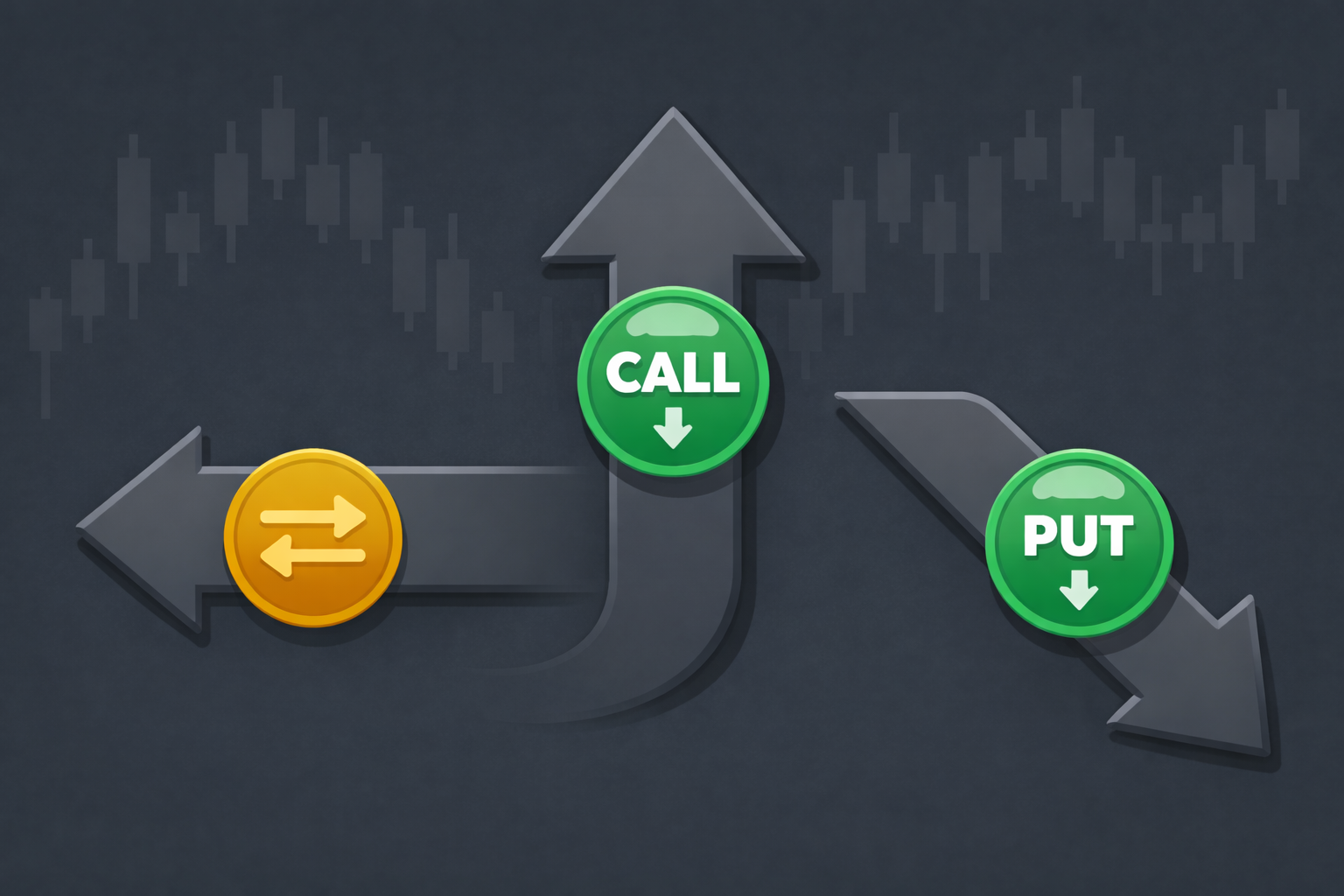
Buy-and-hold works when markets cooperate, up and to the right for years. But markets don't cooperate. They go sideways for months, drop 20% without warning, then rally 30% in weeks. Pure stock investors ride every wave, holding through pain and missing opportunities. Options let you adjust, generating income in sideways markets, protecting capital in downturns, and participating in rallies without giving up flexibility.
TL;DR
- Bull markets: Use covered calls to capture upside while collecting income, or hold LEAPs for leveraged exposure to undervalued stocks
- Bear markets: Sell cash-secured puts to buy at discounts while getting paid to wait, or use protective puts to limit losses on core holdings
- Sideways markets: Generate consistent income with covered calls and puts while stock prices go nowhere, turning dead money into cash flow
- Volatility spikes: Collect fat premiums when fear drives IV higher, then let them decay as markets calm down
- No need to predict: You don't time markets, you adapt strategies to what's happening now
The Problem with Static Strategies
Most investors follow one playbook: buy quality stocks, hold forever, reinvest dividends. This works over 30 years, but it's painful during the rough patches.
2000-2010: The S&P 500 returned 0% (the "lost decade"). Buy-and-hold investors earned dividends but no capital gains for ten years.
2008 crash: Stocks dropped 50% in 18 months. Buy-and-hold investors watched portfolios get cut in half, praying for recovery.
2015-2016: Markets went sideways for 18 months. No crashes, no rallies, just choppy action. Investors earned dividends and nothing else.
In each scenario, stock-only investors had one option: wait. Options investors had multiple plays:
- Lost decade (sideways): Sell covered calls monthly, generating 12-20% annual income while stock prices went nowhere
- 2008 crash: Sell cash-secured puts at 20-30% discounts, buying wonderful companies during panic. Or buy protective puts to limit losses
- 2015-2016 chop: Sell calls and puts on both sides, collecting premiums as stocks oscillated in a range
Options don't eliminate the need for patience, but they give you tools to generate returns when stocks don't cooperate.
Bull Market Strategies
When stocks are rising, your goal is to participate in upside while adding income. Options help you do both.
Covered Calls (income + upside):
You own "GrowthCo" at $100, and it's been climbing 2-3% per month. You believe fair value is $130, but it could take 12-18 months to get there. Sell 30-60 day covered calls at $110-$115 strikes.
If the stock reaches $115, you're assigned, making $15 per share capital gain plus $3-5 in premium (18-20% total return). If it stays below $115, you keep the premium and sell another call next month. Either way, you're earning more than buy-and-hold.
Key rule: Only sell calls above intrinsic value. If a stock is worth $130 and trading at $100, don't sell $105 calls for max income. Sell $125-130 calls for smaller premium but full upside. You're adding 2-4% income without capping yourself below fair value.
LEAPs for leverage:
During bull markets, undervalued stocks with strong fundamentals tend to catch up. Instead of buying 100 shares at $100 ($10,000), buy a 2-year LEAP call with a $90 strike for $18 per share ($1,800).
If the stock rises to $130, your LEAP is worth $40 per share ($4,000 value), a 122% gain on $1,800 invested. Buying shares would've been a 30% gain. The LEAP amplifies returns using less capital, leaving you with $8,200 to deploy elsewhere.
Risk: If the stock drops or goes sideways, the LEAP decays faster than holding shares. Only use LEAPs on high-conviction, undervalued stocks during bull markets.
Bear Market Strategies
Bear markets crush most investors emotionally and financially. Options turn crashes into opportunities.
Cash-secured puts (buy at discounts):
The market drops 15% in a month. "SolidCo," a wonderful business, falls from $100 to $85. Implied volatility spikes, and a 60-day put at the $80 strike pays $6 per share.
You sell the put, collecting $600. If the stock stays above $80, you keep the premium, a 7.5% return in 2 months while everyone else is panicking. If it drops to $75 and you're assigned at $80, your real entry is $74 ($80 minus $6 premium), 26% below the starting price.
This is "getting paid to wait" in action. Instead of rushing to buy during a crash (and possibly catching a falling knife), you let puts do the work. You either collect income or buy at better prices than most investors.
Protective puts (insurance):
If you own stocks going into a bear market and want to limit losses, buy protective puts. Let's say you own 100 shares of SolidCo at $100, and the market is getting shaky. You buy a 90-day put at the $90 strike for $4 per share ($400).
If the stock drops to $70, your put is worth $20 per share ($2,000). Your stock loss is $3,000, but the put gain is $2,000, netting a $1,000 loss plus the $400 cost of the put, total $1,400 loss instead of $3,000. You protected 53% of the downside.
Trade-off: The $400 premium is a cost. If the stock goes sideways or up, you lose the $400. This is insurance, not free money. Use it sparingly on core holdings you can't afford to see drop 30-50%.
Selling calls on bounces:
Bear markets don't go straight down. They have violent rallies (10-20% bounces over days). If you own stocks that rally back toward fair value, sell covered calls aggressively.
Example: SolidCo drops to $70, then bounces to $80. You believe fair value is $90. Sell a 30-day $85 call for $3. If it keeps rallying and gets called away at $85, you exit near fair value with extra income. If it drops again, you keep the $3 and wait for the next bounce.
Bear markets reward aggressive income strategies on high-quality stocks. Avoid speculation (don't sell puts on junk), but don't hide in cash either.
Sideways Market Strategies
Sideways markets are the worst for buy-and-hold investors. Stocks churn in a range for months, dividends trickle in, and nothing happens. Options investors love this.
Covered calls (max income):
When a stock trades in a $90-$100 range for 6 months, sell calls at $100 every 30-45 days. If the stock hits $100, you get assigned, then sell puts at $90 to buy back in. If it stays below $100, you keep collecting $2-3 per share monthly, turning a dead stock into a 24-36% annual income machine.
Cash-secured puts (build positions):
If you don't own the stock yet, sell puts at the bottom of the range. Stock oscillates between $90-$100? Sell $90 puts for $2-3 per share. If assigned, your entry is $87-88, near the low. If it stays above $90, you keep the premium and sell another put next month.
Iron condor (advanced):
In a stable range, sell a put at the low end ($90 strike) and a call at the high end ($100 strike). As long as the stock stays between $90-$100, both expire worthless and you keep both premiums. This is advanced, but it's the ultimate sideways market play.
Key insight: Sideways markets have low volatility, so premiums are smaller than during crashes. But consistency matters. Earning 2% per month for 12 months is 24% annual return, better than most bull markets.
Volatility Spike Strategies
Volatility doesn't follow market direction, it follows fear. You can have a bull market with low volatility (2017) or a sideways market with high volatility (2015-2016). When IV spikes, option premiums explode, creating short-term opportunities.
Sell puts when IV jumps:
The market drops 5% in two days, IV spikes from 20% to 40%, and put premiums double. Sell 30-60 day puts on wonderful companies at strikes 10-15% below current prices. Even if the stock goes sideways, IV will collapse back to 20-25%, and your put will lose value (good for sellers). You collected fat premium for volatility that didn't materialize.
Sell calls on owned stocks:
If you own a stock that jumps 10% in a week (IV spike from the move), sell calls at or above fair value. The high premium compensates for capping upside. When IV falls, the call loses value, and you can buy it back early or let it expire.
Avoid buying options when IV is high:
High IV makes options expensive. Don't buy protective puts or LEAPs during panic, you're overpaying. Wait for IV to drop, then buy insurance if needed.
Switching Gears Without Guessing
The beauty of options is you don't need to predict the market. You respond to what's happening:
- Market up 10% this month? Consider selling covered calls near fair value to lock in gains and income
- Market down 15%? Sell cash-secured puts on your watchlist at discount strikes
- Market choppy for 3 months? Focus on short-term covered calls and puts for consistent income
- Implied volatility at 40%? Aggressive selling of puts and calls to capture elevated premiums
- Implied volatility at 15%? Pause or scale back options, focus on stock picking
You're not timing tops and bottoms. You're using options to harvest income, reduce risk, or amplify returns based on current conditions.
What Could Go Wrong?
Over-trading by switching too often: If you change strategies every week, you'll generate commissions and taxes without improving results. Mitigation: Stick with one approach per quarter unless market conditions dramatically change (10%+ move, IV spike above 30%).
Missing big moves by being too conservative: Selling covered calls at $105 when a stock rallies to $130 means you miss $25 per share. Mitigation: Only sell calls above intrinsic value. Keep some shares uncovered to participate in upside.
Getting assigned at bad times: You sell puts during a bear market, get assigned, and the stock drops another 20%. Mitigation: Only sell puts on wonderful companies you'd hold for 5-10 years. Assignment at a discount is still a win if the business is solid.
Complexity paralysis: Trying to use every strategy in every market leads to confusion and mistakes. Mitigation: Master 2-3 strategies (covered calls, cash-secured puts, protective puts) before adding advanced tactics.
Ignoring valuation: Selling options on overvalued stocks because premiums are high is speculation, not investing. Mitigation: Always start with intrinsic value. If a stock is overvalued, don't sell puts or buy LEAPs. Sell calls or sit out.
Next Steps
- Review the last 12 months of market action and identify periods where your portfolio went sideways, use that as practice for when to deploy covered calls for income
- Build a watchlist of wonderful companies with target entry prices, so you're ready to sell cash-secured puts during the next market dip
- Read Risk Management with Options to understand how to balance income strategies with protection
- Explore Covered Calls During Market Volatility to learn how IV changes affect call selling
- Review Cash-Secured Puts During Market Volatility for strategies on selling puts when fear spikes
- Consider using the Wall St Yardie app to calculate intrinsic value and identify whether you're in a bull, bear, or sideways phase for each stock in your portfolio
*Disclaimer: This content is for educational purposes only and does not constitute financial advice. Past performance does not guarantee future results. Always conduct your own research before investing.*