Avoiding Value Traps
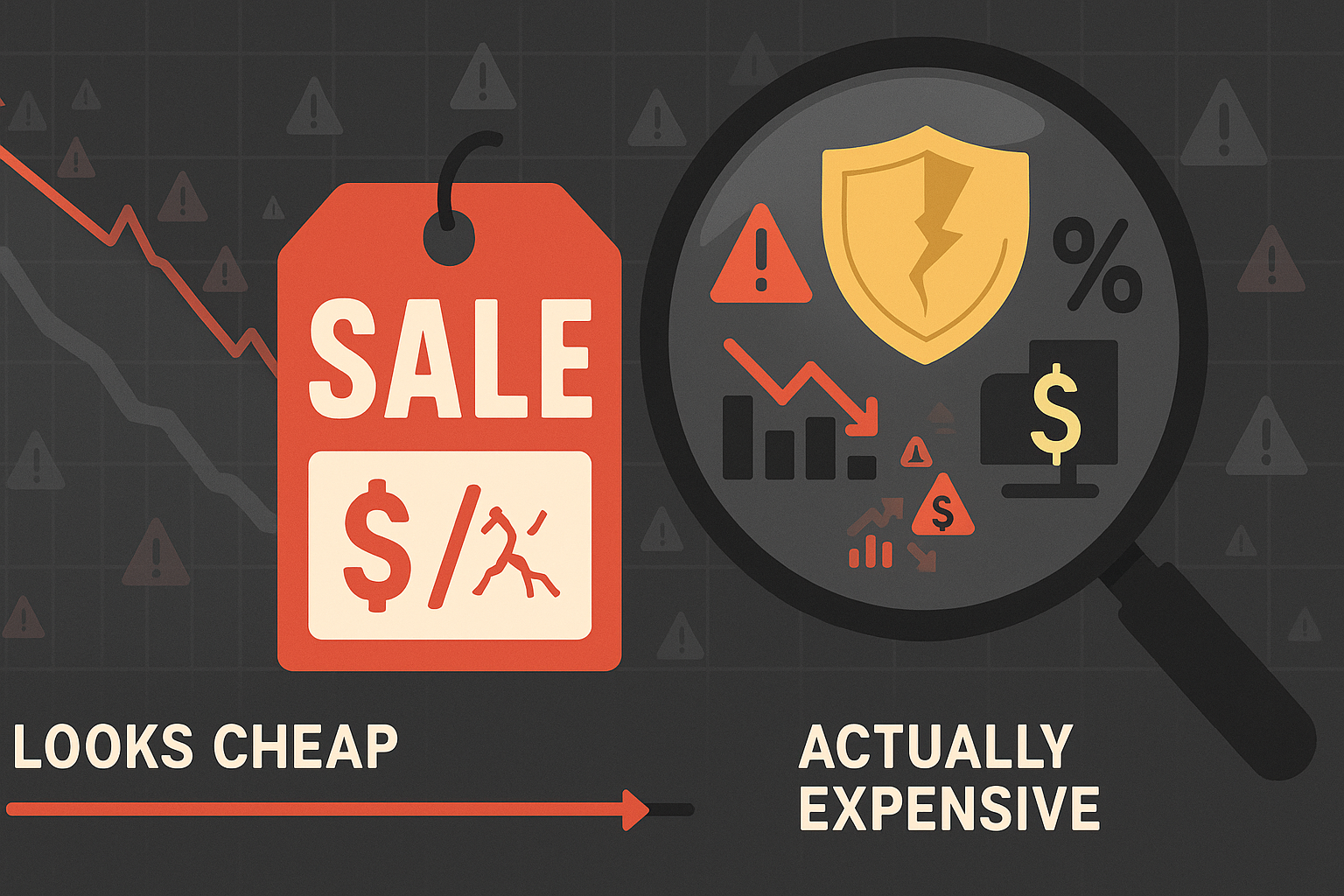
A stock drops from $80 to $20. The P/E ratio is 5. The dividend yield is 8%. Looks like a bargain, right? Not always. Sometimes cheap stocks are cheap for a reason. They're not undervalued, they're deteriorating. That's a value trap.
TL;DR
- Value traps look cheap but are actually expensive because the business is declining
- Low P/E ratios and high yields can disguise structural problems like falling sales, rising debt, or competitive threats
- Red flags include deteriorating margins, bloated balance sheets, failing business models, and poor capital allocation
- Avoid traps by focusing on free cash flow, return on invested capital, and competitive moats, not just price multiples
- Options amplify mistakes: Selling puts on value traps means you're paid to catch a falling knife
What Makes a Value Trap?
Value investing means buying quality companies at discounted prices. A value trap flips that: you buy at a discount, but the business is declining. The price might drop 40%, but intrinsic value drops 60%. You're not buying cheap, you're overpaying.
Classic signs of a value trap:
Falling revenue: Sales decline year after year. Market share is eroding. Customers are leaving. No matter how cheap the stock looks, a shrinking top line signals trouble.
Collapsing margins: The company still generates revenue, but costs are rising faster. Gross margins compress. Operating margins shrink. This often happens when competition intensifies or input costs spike without pricing power.
Rising debt: Debt levels climb while earnings stagnate or fall. The company borrows to fund operations or dividends. Refinancing risk looms. If rates rise or cash flow weakens, insolvency becomes possible.
Dividend cuts: A high yield attracts income investors, but if the payout ratio exceeds 100% (the company pays more than it earns), a cut is inevitable. Once cut, the stock often collapses further.
Broken business model: The industry is disrupting. Think newspapers in the age of the internet or video rental stores after streaming. The company's core product is obsolete, and no amount of cheap valuation changes that.
These aren't temporary issues. They're structural. The business is dying slowly, and the stock price reflects that reality, not irrational pessimism.
The Danger of Using Price Alone
Many beginners screen for stocks with low P/E ratios, high dividend yields, or low price-to-book values. These filters find cheap stocks, but they don't distinguish between undervalued and deteriorating.
A company trading at a P/E of 6 might look attractive compared to the market average of 18. But if earnings are about to halve due to lost customers, the real P/E is 12. You're not buying cheap, you're buying before the next leg down.
Similarly, an 8% dividend yield sounds amazing until you realize the company is borrowing money to pay it. Once the dividend is cut, the yield collapses to 3%, and the stock price drops another 30%.
Price-based metrics are a starting point, not an answer. You need to verify the business beneath the numbers.
Red Flag 1: Declining Free Cash Flow
Earnings can be manipulated through accounting choices. Free cash flow is harder to fake. It's the cash a company generates after paying all expenses and reinvesting in the business.
If free cash flow is falling while earnings stay flat, something's wrong. The company might be delaying payments to suppliers, cutting necessary maintenance, or inflating inventory to boost reported profits. These tricks work short-term but eventually catch up.
Look at the cash flow statement. If operating cash flow minus capital expenditures is negative or shrinking, walk away. A company that doesn't generate cash can't sustain operations, let alone grow.
Value traps often report positive earnings but negative free cash flow. They're burning through cash to keep the lights on. That's not undervalued, that's distressed.
Red Flag 2: Low Return on Invested Capital
Return on invested capital (ROIC) measures how efficiently a company uses money to generate profits. It's calculated as:
ROIC = Net Operating Profit After Tax / Invested Capital
A company with 15% ROIC generates $15 in profit for every $100 invested. That's strong. A company with 5% ROIC generates only $5. That's weak.
Value traps typically have low or falling ROIC. The business requires more and more capital to produce less and less profit. Management might invest in expansion projects that fail to generate returns. Or the core business is so weak that no amount of investment fixes it.
Compare ROIC to the company's cost of capital. If ROIC is below the cost of debt and equity (usually 8-12%), the company destroys value every time it invests. That's not a business you want to own, no matter how cheap it looks.
Red Flag 3: No Competitive Moat
Warren Buffett talks about economic moats, durable competitive advantages that protect a business from rivals. Moats include brand strength, network effects, switching costs, patents, and scale advantages.
Value traps usually lack moats. Competitors can easily undercut them on price, steal customers, or replicate products. Without a moat, the company has no pricing power. Margins shrink, and profitability evaporates.
Ask yourself: Why do customers choose this company? If the only answer is "low price," that's a red flag. Price-based competition is brutal and unsustainable.
A strong moat doesn't guarantee success, but it gives a company breathing room to adapt and survive tough times. Value traps have no such protection.
Red Flag 4: Poor Capital Allocation
Some companies generate cash but waste it. They overpay for acquisitions, invest in doomed projects, or distribute cash through buybacks at inflated prices.
Look at historical capital allocation decisions. Did past acquisitions add value or destroy it? Does management return cash to shareholders intelligently, or do they buy back stock at peaks and issue shares at lows?
Value traps often have incompetent or greedy management. They prioritize growth over profitability. They refuse to cut dividends even when unsustainable. They bet the company on risky expansions instead of shoring up the core business.
Great businesses in temporary trouble can recover. But if management consistently misallocates capital, the business will never improve, regardless of how cheap the stock gets.
Real-World Example: The Retail Trap
A regional department store chain trades at $8 per share, down from $40 five years ago. The P/E ratio is 4. The dividend yield is 12%. Looks tempting, right?
Dig deeper:
Revenue: Declining 8% annually for three years. Customers are shopping online instead of visiting stores.
Margins: Gross margin fell from 35% to 22% as the company discounts heavily to compete with e-commerce giants.
Debt: Doubled in five years as the company borrowed to fund store renovations that failed to attract traffic.
Free cash flow: Negative for two consecutive years. The company is burning cash while shrinking.
ROIC: Fell from 12% to 3%. Every dollar invested generates minimal return.
Moat: None. The company offers no unique products, no brand loyalty, and no pricing power.
This is a value trap. The stock is cheap, but the business is dying. Selling a cash-secured put at $6 might seem like a 25% margin of safety, but intrinsic value is probably closer to $2. You're not buying a bargain, you're catching a falling knife.
Contrast this with a wonderful company temporarily out of favor. Revenue grows steadily. Margins expand over time. Debt is manageable. Free cash flow is positive and growing. ROIC exceeds 15%. A strong moat protects the business.
When that stock drops 30% due to a market panic, you're buying undervalued. When the department store drops 80%, you're buying a sinking ship.
How to Avoid Value Traps
Focus on business quality first: Never compromise on fundamentals just because a stock is cheap. A mediocre business at a 50% discount is still mediocre.
Verify earnings with cash flow: Look at the cash flow statement. If free cash flow diverges from reported earnings, trust the cash.
Check ROIC trends: Rising or stable ROIC signals a healthy business. Falling ROIC signals trouble.
Assess the competitive landscape: Is the industry growing or shrinking? Are competitors gaining share? Does the company have a moat?
Read management commentary: Annual letters and earnings calls reveal how management thinks about the business. Do they acknowledge problems? Do they have a plan? Are they honest?
Stress-test assumptions: Run worst-case scenarios. If revenue drops 20%, can the company survive? If interest rates rise, can it refinance debt? If the answer is no, it's probably a trap.
Use multiple valuation models: Cheap on P/E but expensive on cash flow suggests something's wrong. Triangulate with discounted cash flow, earnings yield, and payback time. If all models say "avoid," listen.
Options and Value Traps
Options amplify mistakes. Selling a cash-secured put on a value trap means you're obligated to buy at a price above intrinsic value. Assignment traps you in a declining business.
Similarly, buying LEAPS on a value trap means you're leveraging a deteriorating asset. Time decay eats away at your premium while the stock continues dropping.
The best strategy? Avoid value traps entirely. Spend your capital and attention on quality businesses trading below fair value. Options work beautifully in those situations. They're disastrous on traps.
What Could Go Wrong?
Mistaking cyclicality for deterioration: Cyclical companies (energy, materials) see earnings drop during downturns. That's not a trap if the business model is intact. Check whether declines are industry-wide or company-specific.
Ignoring turnaround potential: Some distressed companies recover. Management changes, asset sales, or operational fixes can revive a business. But turnarounds are risky and require deep analysis. Most value investors avoid them.
Overweighting price multiples: A stock with a P/E of 3 might be cheap for a reason. Always verify with cash flow, ROIC, and moat analysis.
Falling for dividend yield traps: High yields attract income investors, but if the payout is unsustainable, the dividend will be cut. Focus on dividend coverage (free cash flow divided by dividends) instead of yield alone.
Chasing "cheap" sectors: When an entire sector collapses (coal, print media), most stocks in that sector are value traps, not bargains. Focus on individual companies with durable advantages.
Next Steps
- Audit your watchlist: Review every stock you own or are considering. Check free cash flow trends, ROIC, and competitive moat. If any show signs of deterioration, remove them immediately.
- Study historical traps: Research companies like Sears, Blockbuster, or Nokia. Understand what made them traps and how investors missed the warning signs.
- Prioritize moats: Read Understanding Economic Moats to deepen your understanding of durable competitive advantages.
- Learn ROIC analysis: Check out resources on how to calculate and interpret return on invested capital. It's one of the most reliable indicators of business quality.
- Use Wall St Yardie: The app flags stocks with declining free cash flow, negative ROIC trends, and weak balance sheets. Let it filter out traps so you focus on real opportunities.
Value traps are seductive. They promise big returns for little risk. But beneath the surface, the business is crumbling. Avoid them by focusing on quality, cash flow, and competitive strength. No amount of cheapness compensates for a broken business model. Keep the rhythm steady, and let fundamentals guide you away from traps and toward true value.
*Disclaimer: This content is for educational purposes only and does not constitute financial advice. Past performance does not guarantee future results. Always conduct your own research before investing.*