
Discounted Growth & Cap Rate Thinking
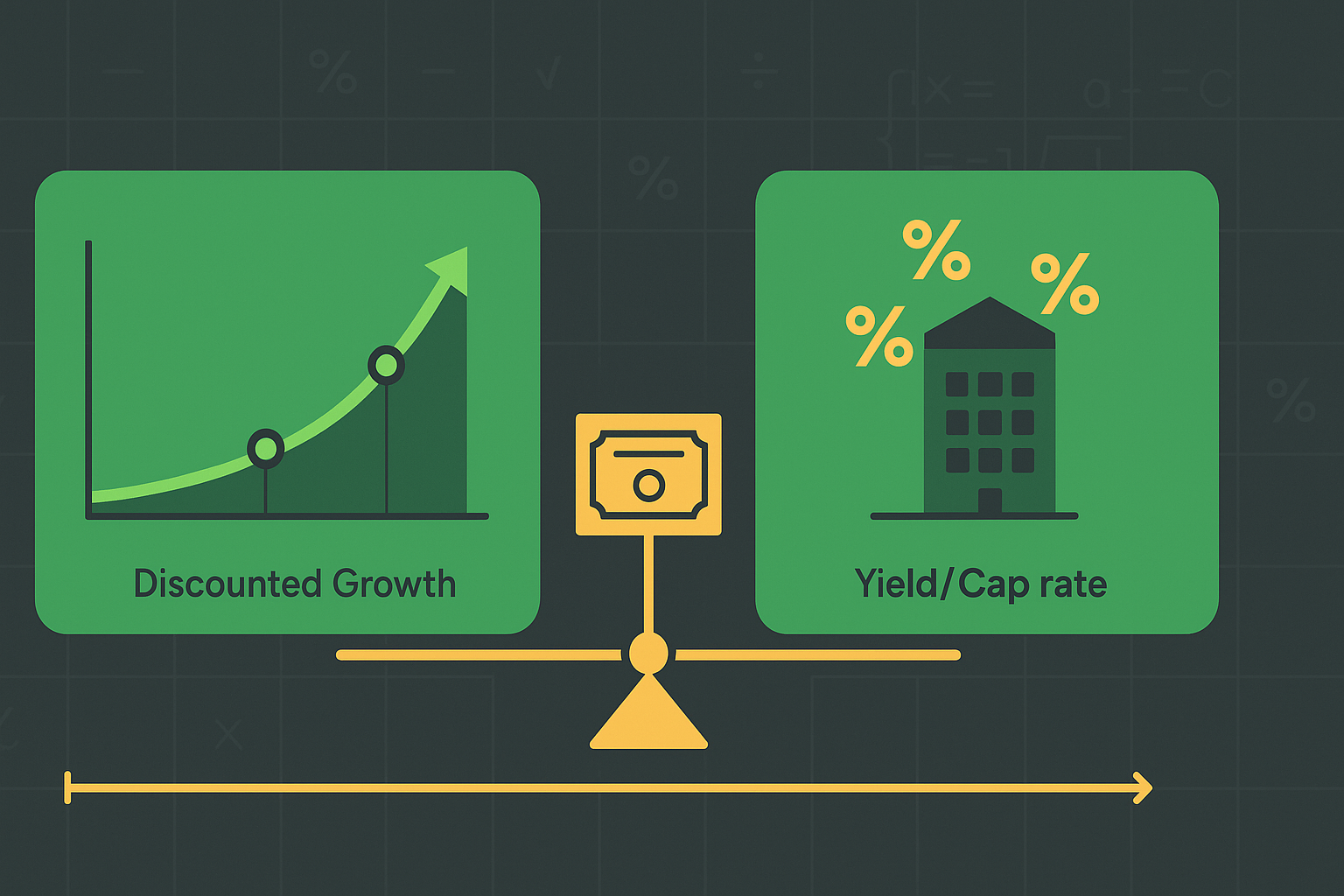
Two companies earn $5 per share. One trades at $30, the other at $70. Which is undervalued? You can't tell without a valuation model. Discounted growth and cap rate thinking cut through the noise, giving you clear numbers to compare price against worth.
TL;DR
- Discounted growth model projects future earnings and discounts them back to today's value, accounting for risk and opportunity cost
- Cap rate thinking treats stocks like real estate, focusing on the yield they produce relative to their price
- Both models complement each other: Discounted growth handles high-growth companies, cap rate suits stable, cash-generating businesses
- Margin of safety matters: Always buy at least 20-30% below calculated intrinsic value to protect against errors
- Use Wall St Yardie to simplify calculations and avoid spreadsheet errors
Why Valuation Models Matter for Options Investors
Options strategies amplify whatever happens to the underlying stock. If you sell cash-secured puts on an overvalued company, assignment sticks you with losses. If you buy LEAPS on undervalued companies, leverage multiplies gains as the stock revalues toward intrinsic worth.
That's why valuation comes first. Options are tools, not strategies. The real work is finding wonderful companies trading below their true value. Once you have that foundation, options enhance returns through income generation, leverage, or risk management.
Discounted growth and cap rate models give you concrete numbers. Instead of guessing, you calculate what a business is worth. Then you compare that to the stock price. If the gap is wide enough, you've found an opportunity.
Discounted Growth Model: Projecting Future Value
The discounted growth model starts with a simple question: What will this company earn in the future, and what's that worth today?
Here's the formula:
Intrinsic Value = Earnings × (1 + Growth Rate)^Years / (1 + Discount Rate)^Years
Let's break it down with an example.
Company: TechFlow, a software business
Current earnings: $4 per share
Expected growth rate: 12% annually
Discount rate (your required return): 10%
Time horizon: 10 years
Step 1: Project earnings in 10 years
$4 × (1.12)^10 = $4 × 3.11 = $12.44 per share
Step 2: Discount back to today
$12.44 / (1.10)^10 = $12.44 / 2.59 = $4.80 per share intrinsic value
Wait, that seems low. Here's the catch: this formula assumes the company stops growing after 10 years and you only capture the final year's earnings. In reality, you also capture all the earnings along the way.
A more complete version adds those interim earnings, but for simplicity, many investors use a perpetual growth formula instead:
Intrinsic Value = (Earnings × (1 + Growth Rate)) / (Discount Rate - Growth Rate)
For TechFlow:
($4 × 1.12) / (0.10 - 0.12) = $4.48 / (-0.02)
This formula breaks when growth exceeds the discount rate. That's intentional. It forces you to be conservative. If a company's growth rate is higher than your required return indefinitely, the valuation becomes infinite. That's unrealistic.
The takeaway: Use the discounted growth model for companies with moderate, sustainable growth (5-12%). It works best when growth is predictable and you can estimate it reasonably.
Cap Rate Thinking: Real Estate Logic for Stocks
Cap rate thinking flips the script. Instead of projecting growth, you focus on yield, the percentage return the business generates today based on its current price.
The formula is simple:
Cap Rate (Earnings Yield) = Earnings per Share / Stock Price
If a company earns $6 per share and trades at $50, the cap rate is 12% ($6 / $50). That means for every dollar you invest, the business generates 12 cents in annual earnings.
Now compare that to alternatives. A 10-year Treasury bond yields 4%. A rental property might yield 7%. This stock yields 12%. If the business is stable and well-managed, that's attractive.
But there's more. Reverse the cap rate to find intrinsic value:
Intrinsic Value = Earnings per Share / Desired Cap Rate
If you want a 10% return (your cap rate target), the stock is worth:
$6 / 0.10 = $60 per share
The stock trades at $50, so you're buying at a 17% discount to your calculated value. That's your margin of safety.
Cap rate thinking works beautifully for mature, slow-growth companies with consistent earnings. It's less useful for high-growth businesses where future earnings matter more than current yield.
When to Use Each Model
Use discounted growth when:
- The company is growing earnings consistently (8-15% annually)
- Future earnings will be significantly higher than today
- The business is in a growth phase (expanding markets, new products, increasing margins)
Use cap rate thinking when:
- The company is mature with stable, predictable earnings
- Growth is modest (0-5% annually)
- The business generates strong free cash flow and doesn't require heavy reinvestment
- You're comparing stocks to bonds or other income-producing assets
Many investors use both. Run a discounted growth model to capture future potential, then verify with cap rate thinking to ensure current yield justifies the price. If both models agree the stock is undervalued, your conviction strengthens.
Real Example: Comparing Two Stocks
Stock A: GrowthCorp
- Earnings: $3 per share
- Price: $45
- Growth rate: 10% annually
- Cap rate (earnings yield): 6.7%
Stock B: StableCo
- Earnings: $5 per share
- Price: $40
- Growth rate: 3% annually
- Cap rate (earnings yield): 12.5%
Using discounted growth (10% discount rate):
GrowthCorp: ($3 × 1.10) / (0.10 - 0.10) = undefined (growth equals discount rate, model breaks)
Let's adjust. Use a 12% discount rate:
GrowthCorp: ($3 × 1.10) / (0.12 - 0.10) = $3.30 / 0.02 = $165 intrinsic value
GrowthCorp trades at $45 with $165 intrinsic value. That's a 73% discount.
StableCo: ($5 × 1.03) / (0.12 - 0.03) = $5.15 / 0.09 = $57 intrinsic value
StableCo trades at $40 with $57 intrinsic value. That's a 30% discount.
Both are undervalued, but GrowthCorp offers more upside if the growth rate holds. However, growth is riskier. If GrowthCorp's growth slows to 5%, the intrinsic value drops dramatically.
Now apply cap rate thinking:
GrowthCorp: 6.7% yield. Acceptable if you believe growth continues, but low compared to bonds and safer stocks.
StableCo: 12.5% yield. Strong current return with modest growth on top. Less exciting, but safer.
For a cash-secured put strategy, StableCo might be better. The higher cap rate provides a cushion if growth disappoints. For a LEAPS strategy, GrowthCorp offers more leverage potential if growth accelerates.
This is how valuation models guide option strategy selection. The numbers tell you where the value lies and how much risk you're taking.
Incorporating Margin of Safety
Never buy at calculated intrinsic value. Your estimates might be wrong. Management might stumble. The economy might slow. A margin of safety protects you.
If intrinsic value is $60, don't buy at $58. Buy at $42 (30% discount) or better. That way, even if your valuation is optimistic by 20%, you're still buying below true worth.
For options strategies, margin of safety works similarly. If you sell a cash-secured put with a $50 strike, ensure the intrinsic value is at least $70-$75. That gives you room for error. If assigned, you're still buying significantly below worth.
For covered calls, set the strike at or above intrinsic value. If intrinsic value is $70 and the stock trades at $55, selling a call with a $75 strike locks in a satisfactory exit while collecting premium income.
Using Wall St Yardie to Simplify the Process
Manual calculations work, but they're error-prone. A single typo in a spreadsheet can throw off your entire analysis. That's where Wall St Yardie helps.
The app runs discounted growth, cap rate, and payback time models automatically. You input earnings, growth rate, and discount rate, and it calculates intrinsic value in seconds. It also shows you the margin of safety at the current price, so you know instantly whether a stock is undervalued.
This speeds up your process and reduces mistakes. Instead of spending 20 minutes per stock, you spend five. That lets you evaluate more opportunities and find the best risk-reward setups.
Payback Time: A Third Lens
Wall St Yardie also includes payback time, a complementary model. It answers: How many years until the company's cumulative earnings equal what you paid for the stock?
If a stock costs $50 and earns $5 per share annually, payback time is 10 years (assuming no growth). If earnings grow at 10%, payback shortens to about 7 years.
Value investors target payback times under 8 years. The faster the payback, the better the value. This model works especially well for comparing stocks within the same industry.
What Could Go Wrong?
Overestimating growth rates: Most companies don't grow at 12% forever. Be conservative. If historical growth is 12%, assume 8-10% for valuation purposes. Over-optimism leads to overpaying.
Ignoring cyclical risks: Discounted growth assumes steady earnings. Cyclical companies (autos, commodities) have lumpy earnings. Use cap rate thinking with conservative earnings estimates instead.
Using the wrong discount rate: Your discount rate reflects your required return and the stock's risk. For stable companies, 9-10% is reasonable. For riskier businesses, use 12-15%. Don't use 8% on a speculative stock.
Trusting models blindly: Models are tools, not oracles. If a model says a stock is worth $100 but the business is deteriorating, trust fundamentals over formulas. Models assume inputs are correct. Garbage in, garbage out.
Forgetting about debt: These models use earnings per share, which can be distorted by leverage. Always check the balance sheet. A company with heavy debt might report strong earnings but face refinancing risk. Adjust your estimates accordingly.
Next Steps
- Pick three stocks: Choose one growth stock, one stable company, and one cyclical business. Run both discounted growth and cap rate models on each. See which model fits best.
- Use Wall St Yardie: Input the same three stocks into the app. Compare your manual calculations to the automated results. This builds confidence and reveals any errors.
- Test different assumptions: Take one stock and run the discounted growth model with growth rates of 5%, 10%, and 15%. See how sensitive intrinsic value is to that input. This teaches you where your analysis is most vulnerable.
- Read supporting concepts: Review Margin of Safety Explained for more on protective buffers, and Earnings Yield as the True Measure of Value for deeper cap rate insights.
- Apply to option strategies: Once you've identified an undervalued stock, layer in options. Sell cash-secured puts if you want to build a position. Buy LEAPS if you want leverage. Use covered calls for income once assigned.
Valuation isn't guesswork. It's math applied to business fundamentals. Discounted growth handles future potential. Cap rate handles current yield. Together, they give you a complete picture. Run the numbers, demand a margin of safety, and let the models guide you toward undervalued opportunities. Keep the rhythm steady, and let disciplined analysis drive every decision.
*Disclaimer: This content is for educational purposes only and does not constitute financial advice. Past performance does not guarantee future results. Always conduct your own research before investing.*