
Premium Income Explained
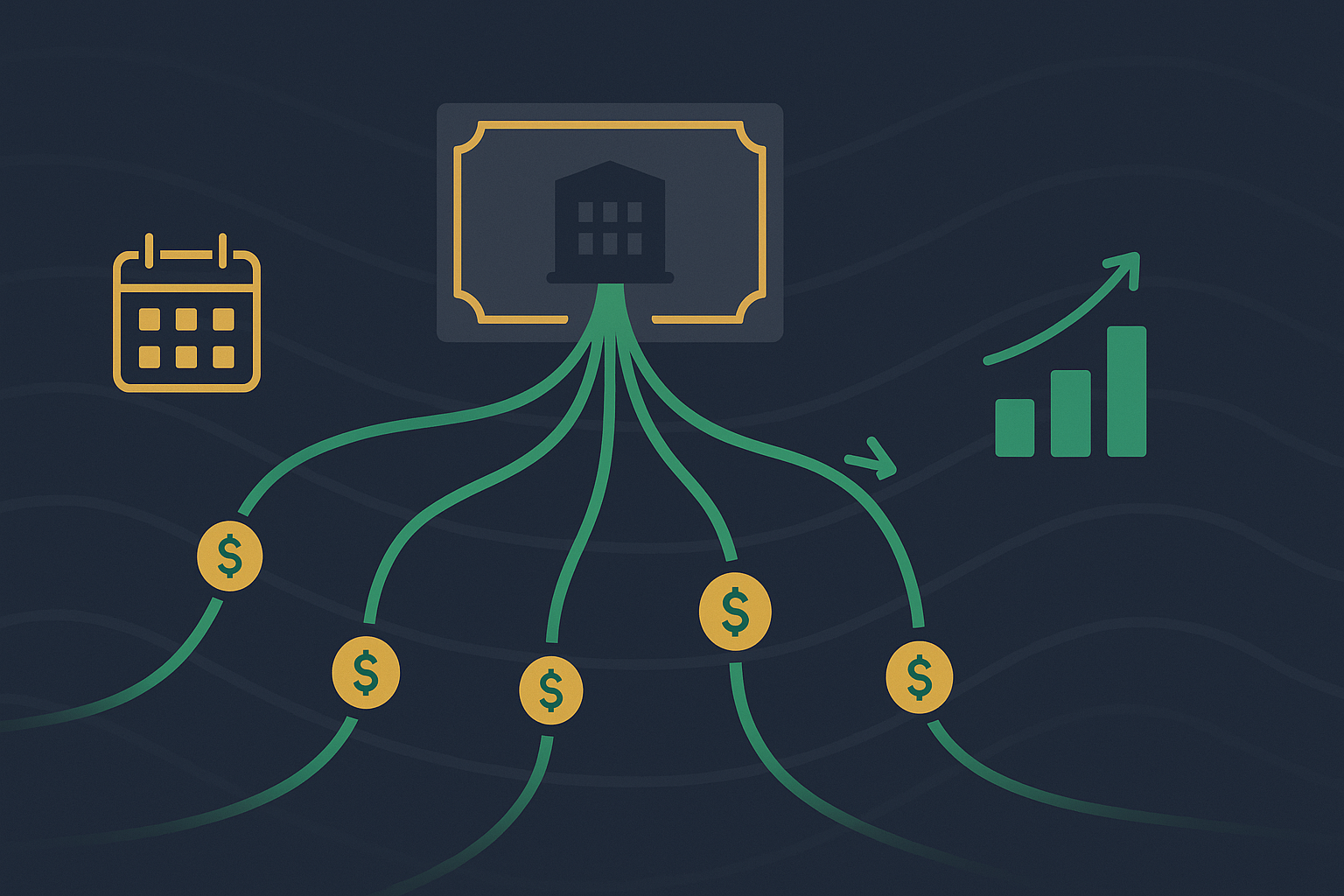
When you sell a covered call, someone pays you money immediately. That payment is called the premium, and it's yours to keep no matter what happens next. Think of it as getting paid upfront rent for agreeing to sell your stock at a specific price if the buyer wants it.
TL;DR
- Premium = your income: The amount someone pays you for the right to buy your shares at the strike price
- Paid immediately: Cash hits your account the moment the trade executes, not when the option expires
- Two components: Intrinsic value (how much the option is already worth) + extrinsic value (time and volatility premium)
- You keep it regardless: Whether option expires worthless or gets exercised, the premium is yours
- Target 2-4% monthly: On value stocks, aim for premiums that generate 24-48% annualized yield
What Premium Income Actually Is
Premium income is the cash you collect when you sell an option. It's payment for taking on an obligation, specifically, the obligation to sell your shares if the buyer exercises their right.
Think of it like car insurance. The insurance company collects your $200 monthly premium. If you have an accident, they pay out (similar to you delivering shares). If you don't have an accident, they keep the premium and no claim happens (similar to option expiring worthless). Either way, that $200 is theirs.
As the covered call seller, you're the insurance company. You collect the premium upfront, and you either deliver shares (if assigned) or keep shares and premium (if expires worthless).
The Two Parts of Premium
Every option premium has two components:
Intrinsic value: How much the option would be worth if exercised right now.
Example: Stock trades at $62, you sell a $60 call for $3.50. The intrinsic value is $2 ($62 - $60 = $2). If the buyer exercised immediately, they'd make $2 per share profit.
Extrinsic value (time value): The extra amount above intrinsic value, representing possibility the stock could move higher before expiration.
Same example: Premium is $3.50, intrinsic value is $2, so extrinsic value is $1.50. That $1.50 is pure time value, it's the buyer betting the stock might go above $63.50 by expiration.
For value investors selling covered calls, you're mostly collecting extrinsic value. You want to sell calls where the strike is above current price (out-of-the-money), so there's no intrinsic value, just pure time premium. This maximizes your income while giving the stock room to appreciate.
How Premium Income Creates Yield
Let's break down the math on "ABC Manufacturing" trading at $50 per share:
Setup:
- You own 100 shares bought at $50 ($5,000 investment)
- Fair value estimate: $65 per share
- You sell a $60 call expiring in 45 days
- Premium collected: $150 ($1.50 per share)
Income calculation:
Monthly equivalent: $150 per 45 days = ~$100 per 30 days = 2% monthly yield
Annualized: $150 × 8 (cycles per year, 45 days each) = $1,200 = 24% annual yield
This is on top of any capital appreciation (if stock goes from $50 to $60) and any dividends paid.
Compare to dividend yield:
If ABC pays 3% annual dividend ($150 per year), your total cash flow becomes:
- Dividend income: $150
- Premium income: $1,200
- Total: $1,350 (27% yield)
You've increased your cash flow by 9x just by adding covered calls.
Why Premium Income is Different from Dividends
Dividends:
- Paid quarterly (usually)
- Amount set by company board
- You have no control over timing or size
- Generally stable but can be cut
- Taxed as qualified dividends (lower rate if held long enough)
Option premiums:
- Paid instantly when you sell
- Amount varies based on strike, duration, and volatility
- You control when to collect (sell calls whenever you want)
- Can be repeated weekly, monthly, or custom cycles
- Usually taxed as short-term capital gains (higher rate)
Key advantage of premiums: Flexibility and size. You can generate 20-40% annual yield with covered calls on stocks that pay 2-3% dividends. You decide when to harvest income based on your view of the market and valuation.
Key advantage of dividends: Passive and predictable. No management required, no risk of assignment, just cash showing up quarterly.
Real Example: Premium Income Over 12 Months
Let's track "Quality Corp" over a full year:
Starting position:
- 500 shares at $40 per share ($20,000 investment)
- Fair value: $55 per share
- Annual dividend: 2.5% ($500)
Month-by-month premium collection:
January-March: Sell $50 calls (3 cycles, 30 days each)
- Premium per cycle: $200 per 100 shares × 5 contracts = $1,000
- Total: $3,000
April: Stock hits $49, sell $52 calls for $800 (lower premium, stock closer to strike)
May-July: Stock pulls back to $42, sell $48 calls for $1,200 per cycle
- Total: $3,600
August: Stock assigned at $48 (called away)
- Final premium on that cycle: $1,000
- Capital gain: ($48 - $40) × 500 = $4,000
- Stop covered call strategy (no longer own stock)
September-December: Sell $38 cash-secured puts monthly to re-enter
- Premium per cycle: $600
- Total: $2,400 (not covered calls, but continuing income strategy)
Year-end summary:
Total premiums collected: $3,000 + $800 + $3,600 + $1,000 + $2,400 = $10,800
Capital gain from sale: $4,000
Dividends collected (Jan-Aug): ~$330
Total income: $15,130 on $20,000 initial investment = 75.7% return
This is the power of premium income, it turns a good value stock into a cash flow machine. Even after being called away at $48 (below your $55 fair value estimate), you captured most upside plus massive premium income.
Factors That Affect Premium Size
1. Distance to strike (moneyness):
Closer to current price = higher premium, higher chance of assignment.
Example: Stock at $50, sell $52 calls = $2.00 premium. Sell $60 calls = $0.50 premium.
Value investors usually target strikes 10-20% above current price to balance income with upside capture.
2. Time to expiration:
Longer duration = higher premium total, but lower monthly equivalent.
Example:
- 30-day $55 call = $1.50 (1.5% monthly)
- 60-day $55 call = $2.50 (1.25% monthly)
- 90-day $55 call = $3.20 (1.07% monthly)
Most income-focused investors prefer 30-45 day cycles, it optimizes monthly yield and allows frequent adjustments.
3. Implied volatility (IV):
Higher IV = higher premium. When markets are nervous, option prices spike.
Example: Stock at $50 with 20% IV, $55 call = $1.20. Same stock with 40% IV (earnings announcement), $55 call = $2.80.
This is why avoiding earnings dates is smart, premiums look juicy but risk is elevated. Better to collect consistent $1.50 in normal times than chase $3.00 during volatile events.
4. Dividend dates:
Options trade with dividend expectations baked in. Selling calls right before ex-dividend means lower premium because buyers know they won't get the dividend.
Strategy: Sell calls after ex-dividend date when premium normalizes. Or sell before ex-div but plan to close position to capture dividend yourself.
What Could Go Wrong?
Chasing high premiums: You see a stock offering $5.00 per share premium monthly (10% yield) and jump in. Turns out it's a failing business with 80% IV because bankruptcy risk is real. Stock drops 40%, you lose $4,000 trying to make $500.
Mitigation: Choose wonderful companies first, premium second. Never sell calls on sketchy businesses just for yield. Better to make 2% monthly on Microsoft than 10% on a value trap.
Over-concentration: You allocate 80% of portfolio to covered calls trying to maximize income. One position gets assigned, another drops 20%, suddenly you're scrambling.
Mitigation: Limit covered call positions to 30-40% of portfolio. Keep core holdings separate. Income strategies should complement, not dominate, your portfolio. Study proper portfolio construction.
Assignment surprise: Stock jumps 15% overnight (acquisition news), your calls are deep in-the-money. You get assigned, miss out on huge upside.
Mitigation: Accept that assignment is part of the strategy. If you sold $60 calls and stock hits $75, you still made profit (premium + strike gain). You don't get lottery ticket upside, but that's the trade-off for consistent income.
Premium addiction: You start selling calls every week, picking strikes too close to current price, managing 10 positions simultaneously. Results? Burnout and tracking errors.
Mitigation: Start with 1-2 positions. Master the process, learn what works. Scale gradually. Monthly or 45-day cycles are easier to manage than weekly. Simplicity beats complexity for long-term wealth building.
Tax inefficiency: You generate $10,000 in premium income, taxed as short-term gains at 32% effective rate. You pay $3,200 in taxes. Dividends at 15% qualified rate would have been $1,500.
Mitigation: Consider using covered calls in tax-advantaged accounts (IRA, 401k) where income taxation doesn't matter. Or accept higher taxes as cost of higher yield, you still net more after-tax income than dividends alone.
Next Steps: Building Your Premium Income System
- Select quality stocks only: Review selection criteria and economic moats
- Calculate fair value: Use valuation models to set intelligent strike prices
- Start with one position: Master mechanics on single stock before scaling, check example walkthrough
- Set strike 10-15% OTM: Balance income with upside capture, study strike selection approach
- Choose 30-45 day durations: Optimize monthly yield with expiration selection strategy
- Track cost basis changes: Every premium collected lowers your effective cost, journal it
- Learn to manage positions: Study rolling techniques and assignment handling
- Integrate with portfolio: Explore systematic income generation frameworks
Premium income from covered calls isn't magic or gambling. It's systematically harvesting time value from options market while owning wonderful businesses. You're getting paid for patience, literally paid to wait for stocks to reach fair value.
The key is keeping valuation at the center. Every strike price should reflect your intrinsic value analysis, check it easily with WSY app. Every premium collected should feel like bonus income on top of sound investment thesis, not replacement for it.
Start small, track every cycle, learn what works for your situation. Over time, premium income can double or triple your portfolio's cash flow without taking on crazy risk. Just keep picking wonderful companies, set intelligent strikes, and let time decay work in your favor month after month. That's sustainable premium income generation, Wall St. Yardie style.
*Disclaimer: This content is for educational purposes only and does not constitute financial advice. Past performance does not guarantee future results. Always conduct your own research before investing.*