
NAV Erosion in Covered-Call ETFs: What Investors Miss
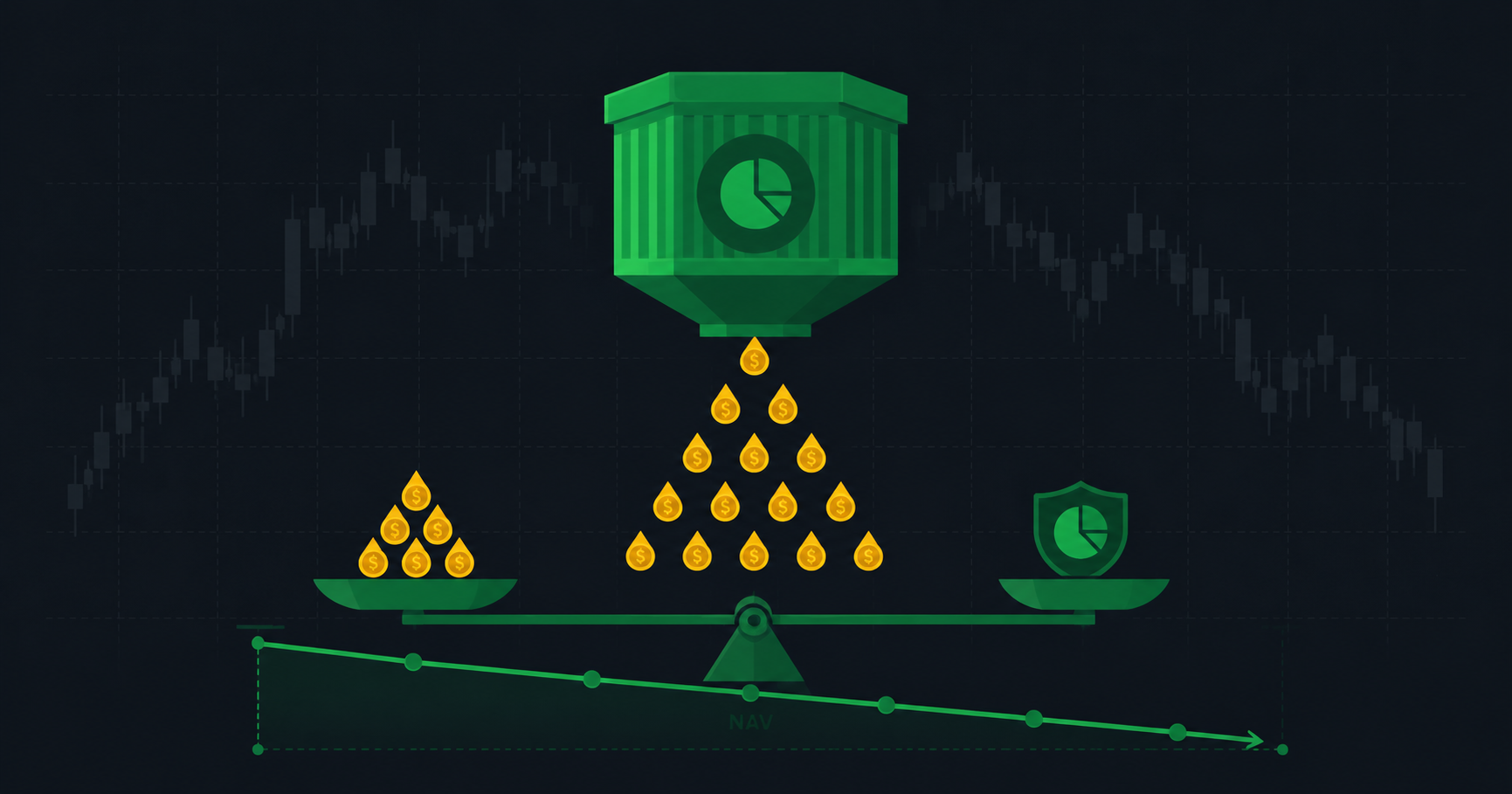
A covered-call ETF can pay you every month and still make you poorer over time. That sounds wrong, but it happens when distributions look high while net asset value, NAV, keeps drifting down. If you only track yield and ignore principal, you can mistake your own money coming back for real income.
TL;DR
- Separate yield from total return, payout size alone does not tell you if wealth is growing.
- Track NAV trend with distributions, persistent decline is a warning that principal may be eroding.
- Understand distribution sources, option premium and dividends are different from return of capital.
- In strong bull markets, overwritten upside can reduce compounding and pressure NAV over time.
- Compare covered-call ETFs against alternatives like direct stock ownership and DIY covered calls.
What NAV Erosion Actually Means
NAV is the per-share value of the ETF's holdings after liabilities. If NAV falls steadily, your ownership claim is shrinking.
Covered-call ETFs earn option premium by selling upside on holdings. That premium supports distributions, but it is not free money. In rising markets, the fund can miss part of the upside, then still pay a high distribution rate. Over long periods, that combination can leave NAV weaker than investors expected.
Think of it this way, if your house is worth less each year but you keep pulling cash out monthly, you may feel rich today while your balance sheet gets thinner.
The Distribution Illusion, A Numeric Example
Start with a hypothetical ETF at $100 NAV.
Year results:
- Portfolio gains before option cap: +12 percent
- Upside given up from call overwriting: -5 percent
- Net portfolio growth: +7 percent
- Annual distribution paid: 10 percent
If distribution exceeds sustainable net growth, principal fills the gap.
Simple math:
- Start NAV: $100
- Net growth adds: +$7
- Distribution paid: -$10
- End NAV: $97
Investor received cash, but NAV dropped 3 percent. Repeat this pattern across years and the erosion becomes meaningful.
Now compare to a year where market returns are flat and option premium is strong. NAV may hold up better. That is why context matters, covered-call structures behave differently across regimes.
Why Investors Miss It
Three common reasons:
- Headline yield dominates attention. A 9 to 12 percent yield feels attractive next to lower dividend yields.
- Price chart and cash flow are viewed separately. Investors celebrate payouts but do not combine payouts plus NAV change.
- Bull market benchmarks are not used. In strong markets, capped upside can create larger opportunity cost.
This is not saying covered-call ETFs are bad. It is saying they are tools with tradeoffs.
How to Evaluate Sustainability
Use a simple dashboard each quarter.
- Distribution rate
- NAV trend over 1, 3, and 5 years
- Total return versus a plain equity benchmark
- Distribution composition, premium, dividends, realized gains, return of capital
- Expense ratio and turnover
If distribution remains high while NAV and total return lag persistently, ask whether you are optimizing income optics instead of real wealth growth.
For a mechanics refresher, review how covered-call ETFs work.
Bull Markets Expose the Tradeoff
In strong rallies, covered calls can be assigned repeatedly. The ETF captures some gain plus premium but misses part of upside above strike levels.
That can produce a pattern where:
- Income stays consistent
- Benchmark rises much faster
- Relative underperformance compounds
- NAV struggles to keep pace
This is why a fund can look excellent for income focused investors yet disappoint growth focused investors.
If your goal is long-term compounding, evaluate whether the yield is worth the upside you are surrendering in bullish years.
When NAV Erosion May Be Acceptable
There are cases where this tradeoff can still fit:
- You prioritize current cash flow over maximum long-run growth.
- You use the fund as one sleeve, not the entire portfolio.
- You intentionally pair it with growth assets that keep compounding.
The key is intentional portfolio design, not accidental yield chasing.
What Could Go Wrong?
You treat distribution rate as return. High payout can hide weak wealth growth.
Mitigation: Always review total return and NAV path together.You ignore benchmark opportunity cost. In bull markets, capped upside can be expensive.
Mitigation: Compare 3-year and 5-year outcomes against a broad equity index.You rely on one income product for most of your portfolio. Concentration magnifies structural tradeoffs.
Mitigation: Cap position size and diversify income sources.You reinvest distributions into a declining NAV without review. Reinvestment can compound a weak structure.
Mitigation: Reunderwrite the fund periodically, do not auto-pilot forever.
Next steps
- Track payout, NAV, and total return in one spreadsheet so you can see the full picture.
- Compare your covered-call ETF against a plain equity ETF over the same period.
- Read capped upside in bull markets to understand where underperformance comes from.
- Review covered-call ETF mechanics before increasing allocation.
- Align income tools with your goal, cash flow now, or maximum compounding later.
*Disclaimer: This content is for educational purposes only and does not constitute financial advice. Past performance does not guarantee future results. Always conduct your own research before investing.*