
Selling Options on Bad Companies
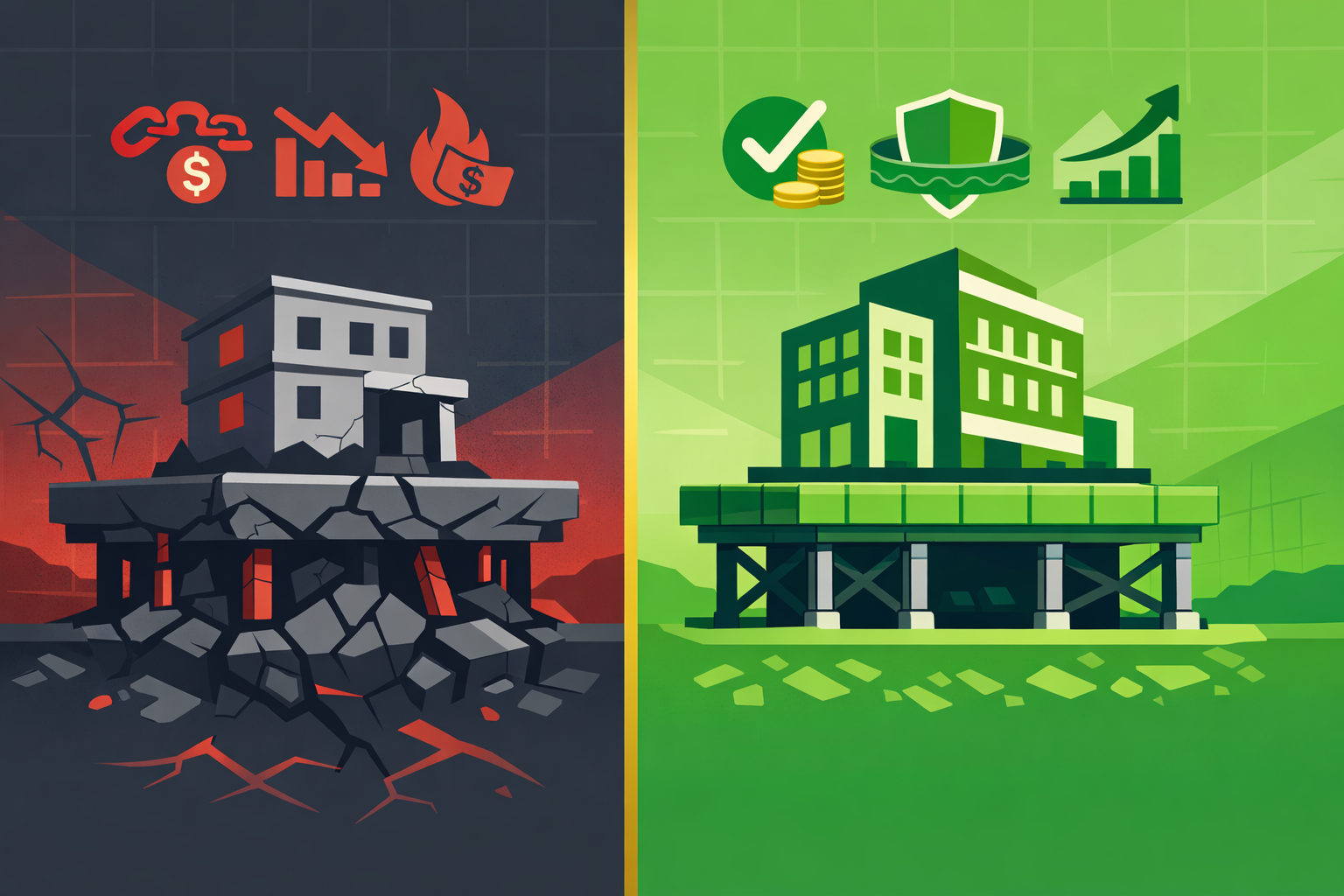
The fastest way to lose money selling options isn't picking the wrong strike or expiration. It's picking the wrong company. You can master every Greek, study option chains like a pro, and still get crushed if you're writing puts or calls on a business that's slowly falling apart.
TL;DR
- Quality matters more than premiums: A 10% yield on a declining business loses money. A 3% yield on a wonderful company compounds wealth
- Avoid value traps: Cheap stocks stay cheap (or go cheaper) for a reason. Options accelerate losses on bad businesses
- Economic moats protect your trades: Durable competitive advantages ensure the business survives market swings, earnings misses, and industry headwinds
- Check fundamentals first: Strong free cash flow, manageable debt, consistent earnings growth, these make options safer and more profitable
- Wonderful companies give you flexibility: When things go wrong, you can roll, adjust, or accept assignment without regret
Why Bad Companies Destroy Options Income
Selling options feels safe when you collect premiums every month, but if the underlying business is weak, you're not earning income, you're financing a sinking ship.
Let's say "BudgetRetail" trades at $50 and offers juicy $2 premiums on the $45 put (4% monthly income). Looks tempting, but the company is bleeding cash, losing market share to Amazon, and carrying debt 3x its equity. You sell the put, collect $200, and three months later the stock is at $35. Your put gets assigned at $45, you now own shares worth $35, a $1,000 loss that wipes out 5 months of premiums.
This is the trap: high premiums often signal high risk. The market knows something is broken, and it's pricing in the decay. Value investors don't chase yield, they chase quality businesses trading below intrinsic value.
The rule: Only sell options on companies you'd be thrilled to own at your strike price. If you wouldn't buy the stock outright at $45, don't sell the $45 put.
The Difference Between Cheap and Wonderful
A cheap stock trades at 5x earnings, low P/E, high dividend yield. A wonderful company has strong economics, predictable cash flow, pricing power, competitive moats. They're not the same.
Cheap companies often have structural problems: declining industries (newspapers, legacy retail), high debt loads (borrowing to survive), eroding margins (price wars, commodity businesses), or management issues (poor capital allocation, scandals). These stocks look attractive on valuation screens, but fundamentals keep deteriorating.
Wonderful companies trade below fair value temporarily due to market overreactions, short-term earnings misses, or sector rotation. The business itself remains strong: growing free cash flow, expanding margins, reinvesting at high rates of return. When you sell options on these companies, you're getting paid to wait for the market to wake up.
Example: "ToolMaker Inc." (wonderful company) drops from $120 to $90 after missing quarterly revenue by 2%, despite growing FCF 15% annually for a decade. The business is solid, the drop is noise. You sell a $85 put for $3, collect income, and if assigned, you buy a great company 30% below its intrinsic value of $130.
Compare that to "OldTech Corp." (cheap company) trading at $20, down from $60 three years ago. Revenue declining 10% annually, debt rising, no innovation, management burning cash. You sell a $18 put for $1.50, thinking it's "safe." Six months later, the stock is at $10, and you're holding a deteriorating asset.
The premium on the second trade was higher (7.5% vs. 3.3%), but the first trade compounds wealth while the second destroys it.
What Makes a Business "Wonderful"?
Before selling any option, ask: does this company have the traits of long-term winners?
Economic moat: Can competitors easily steal market share? Brands (Coca-Cola, Apple), network effects (Visa, Facebook), cost advantages (Costco), switching costs (enterprise software), regulatory advantages (utilities). These moats protect margins and cash flow over decades.
Free cash flow growth: Does the company consistently generate more cash than it spends on operations and capital expenditures? FCF growth funds dividends, buybacks, debt paydown, or reinvestment without diluting shareholders.
Return on invested capital (ROIC): Companies earning 15%+ ROIC compound faster than those earning 8%. High ROIC means every dollar reinvested creates more value. Low ROIC companies (retail, airlines, commodities) struggle even in good times.
Manageable debt: Debt-to-equity under 1.0 for most industries (under 0.5 for cyclical businesses). High debt amplifies downside risk during recessions. If rates rise or revenue drops, overleveraged companies cut dividends, dilute shareholders, or go bankrupt.
Predictable earnings: Steady, growing earnings reduce risk for option sellers. If you can estimate next year's earnings within 10-15%, you can price options confidently. Volatile earnings (biotech, commodities, turnarounds) introduce assignment risk at bad prices.
Pricing power: Can the company raise prices without losing customers? Pricing power protects margins during inflation and competitive pressure. Commodity businesses (steel, shipping, basic retail) have zero pricing power.
Use the Wall St Yardie app to calculate intrinsic value, free cash flow yield, and margin of safety quickly. If a stock doesn't pass these filters, don't sell options on it, no matter how high the premium.
Red Flags: Companies to Avoid for Options
Some stocks should never touch your options portfolio, even if premiums look fat:
Declining revenue over 3+ years: Shrinking businesses rarely recover. Temporary slowdowns are fine (cyclical dips, one-off events), but structural decline is permanent.
Negative free cash flow: If the company burns cash instead of generating it, how will it survive a downturn? Cash-burning businesses dilute shareholders or take on debt, both kill stock value.
Debt > 2x equity (for non-financials): High debt means any hiccup (recession, rate hikes, revenue miss) triggers distress. Option premiums on overleveraged companies are high because bankruptcy risk is real.
Industries in disruption: Newspapers, cable TV, traditional retail, fossil fuels (without transition plans). Declining industries produce declining companies, even if management is competent.
Management red flags: Excessive stock-based compensation, frequent restatements, insider selling, accounting games. If you don't trust management, you can't trust the stock.
Penny stocks and speculative names: Stocks under $10, especially biotech without revenue, mining juniors, SPACs. Liquidity is terrible, bid-ask spreads are wide, and fundamentals are usually nonexistent.
Companies with binary outcomes: One drug awaiting FDA approval, one product line, one major customer. If the catalyst fails, the stock collapses 50-80% overnight.
Rule: If you'd need to constantly monitor news, earnings calls, or analyst ratings, the company isn't stable enough for options income.
Case Study: Good Company vs. Bad Company
Let's compare two option trades to see why company quality determines outcomes.
Trade A: "SoftwareCo" (Wonderful Business)
Stock: $100, down from $115 after a mixed quarter (beat earnings, missed revenue by 1%). Business fundamentals: 25% FCF margins, 20% annual revenue growth, 60% gross margins, $2B cash, zero debt, sticky enterprise customers.
You sell a cash-secured put: $95 strike, 3-month expiration, $3 premium (3.2% return, 12.8% annualized).
Outcome 1 (stock rebounds to $110): Put expires worthless, you keep $300. Return: 3.2% in 3 months.
Outcome 2 (stock stays flat at $100): Put expires worthless, you keep $300. Return: 3.2%.
Outcome 3 (stock drops to $90): Put assigned. You buy at $95, effective cost $92 (after premium). Intrinsic value (cheat using Wall St Yardie): $125. You own a great company 26% below fair value.
Trade B: "RetailLoser" (Weak Business)
Stock: $50, down from $80 two years ago. Declining same-store sales, losing market share, margins compressing, debt 3x equity, burning $50M cash per quarter.
You sell a cash-secured put: $45 strike, 3-month expiration, $4 premium (8.9% return, 35.6% annualized, looks amazing).
Outcome 1 (stock rebounds to $55): Put expires worthless, you keep $400. Return: 8.9%. Great, but rare.
Outcome 2 (stock stays at $50): Put expires worthless, you keep $400. Still good, but unlikely.
Outcome 3 (stock drops to $35): Put assigned. You buy at $45, effective cost $41 (after premium). Stock continues falling to $30 over 6 months because fundamentals worsen. Loss: $1,100 ($4,500 - $3,000 - $400 premium).
The premium on Trade B was 2.8x higher, but the risk was 10x worse. Trade A offers lower income but higher probability of winning outcomes (keep premium OR own quality at discount). Trade B offers high income but high probability of catastrophic loss.
The lesson: Premium size is inversely correlated with business quality. Chase quality, not yield.
What Could Go Wrong?
Even disciplined investors make mistakes when evaluating company quality:
Mistaking cyclical dips for structural decline: A great industrial company drops 30% during recession. You avoid it thinking it's "bad," but it recovers 50% in two years. Learn to distinguish temporary pain from permanent damage.
Overvaluing moats: A company had a moat 10 years ago (Blockbuster had distribution, Kodak had brand), but technology or competition eroded it. Moats aren't permanent, reevaluate regularly.
Ignoring valuation: Even wonderful companies can be overvalued. Don't sell puts on a $200 stock worth $150, even if it's Apple. Wait for the right entry (margin of safety).
Being seduced by "turnaround" stories: Management promises a comeback, new products, cost cuts. Most turnarounds fail. Only bet on turnarounds if the company still has strong assets, cash, and a realistic plan.
Not diversifying across industries: Selling options on 5 wonderful retailers is still risky if retail collapses. Spread exposure across sectors.
Mitigations: Use a fundamental checklist (FCF, debt, ROIC, moat) before every trade. Diversify across 8-10 uncorrelated companies. Revisit fundamentals quarterly (simplify the process with Wall St Yardie). Avoid industries you don't understand. Keep 30-40% cash for new opportunities.
Next Steps
- Build a quality watchlist: Screen for companies with 5+ years of positive FCF growth, debt-to-equity under 1.0, and ROIC over 15%
- Eliminate bad candidates: Remove any stock in a declining industry, with negative FCF, or trading under $20
- Study 3-5 wonderful companies deeply: Read 10-Ks, listen to earnings calls, understand their competitive advantages
- Set a quality threshold: Commit to never selling options on a company you wouldn't own at your strike price
- Review existing positions: If you're holding or selling options on questionable companies, exit or hedge immediately
- Read more: Check out Characteristics of a Wonderful Company for detailed traits to look for, and Avoiding Value Traps to learn how to spot companies that look cheap but stay cheap forever
*Disclaimer: This content is for educational purposes only and does not constitute financial advice. Past performance does not guarantee future results. Always conduct your own research before investing.*