
Why LEAPs Provide Smarter Leverage
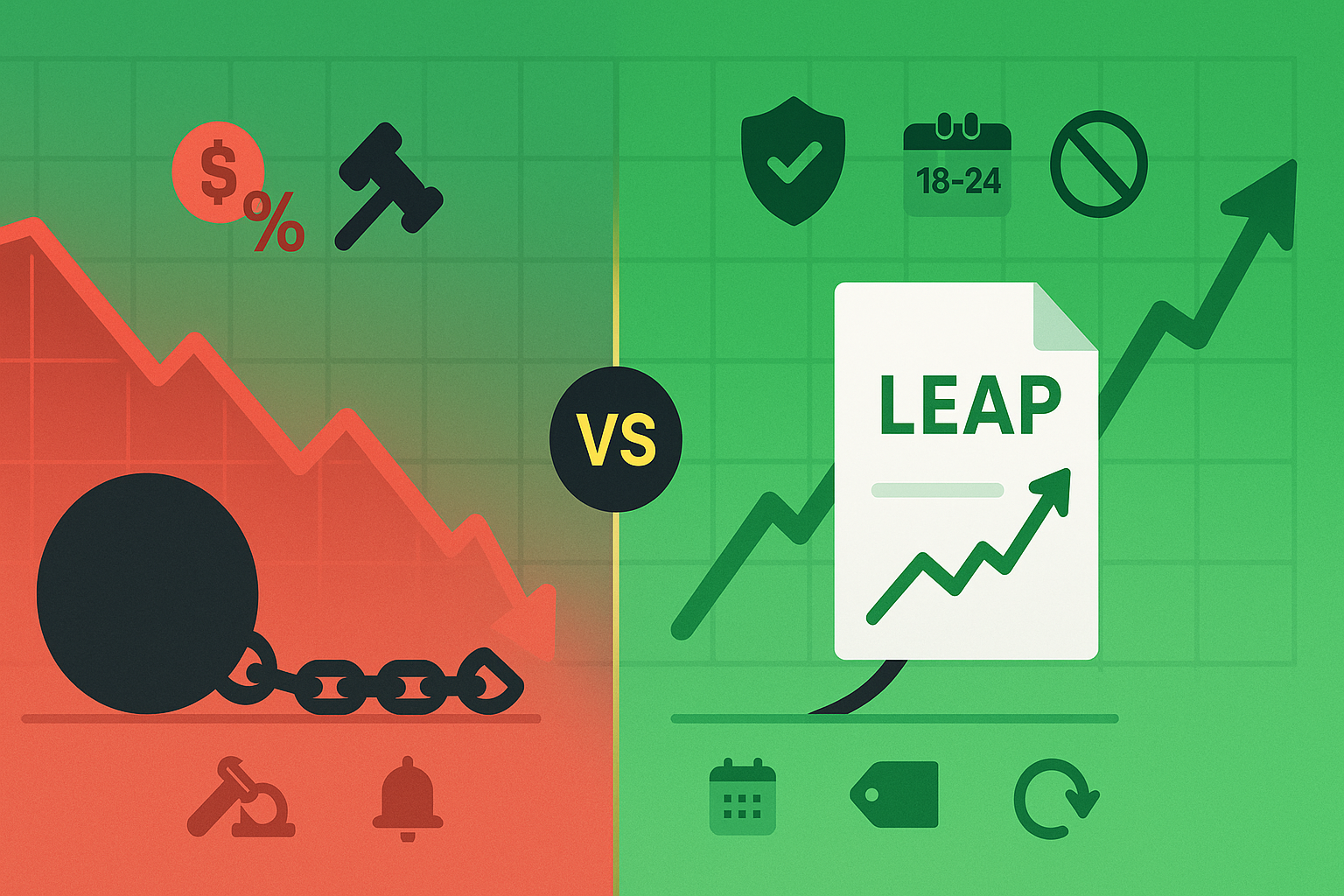
Leverage gets a bad reputation because most investors use the wrong kind. Margin debt destroys accounts during crashes, leveraged ETFs decay over time, and short-term options expire worthless. LEAPS do the opposite: they provide leverage with built-in risk controls, no forced liquidations, and time for value to compound.
TL;DR
- No margin calls: LEAPS can't force you to sell at the worst time. Your max loss is the premium paid
- Fixed downside, unlimited upside: Unlike margin debt, you know your risk upfront and can't lose more than you invest
- Time works for you: 18-24 month expirations give businesses time to deliver results, not weeks or days
- No interest payments: Margin debt costs 6-10% annually. LEAPS have no recurring costs (just time decay, which is slower)
- Flexibility: Roll, adjust, or walk away without broker intervention or debt repayment
The Problem with Margin Debt
Margin debt is the most common form of leverage, and it's also the most dangerous. Here's how it works: you borrow money from your broker to buy more stock, paying interest (typically 6-10% annually). If the stock drops too much, you face a margin call, forced to sell at the worst possible time or add cash.
Let's say you have $10,000 and use 2x margin to buy $20,000 worth of "QualityCo" at $100 per share (200 shares). If the stock drops to $75 (25% decline), your equity falls to $5,000 ($15,000 position - $10,000 loan = $5,000). Your broker issues a margin call, demanding you either add $2,500 cash or sell half your shares to reduce risk.
This is the nightmare: you're forced to sell at $75, locking in a 50% loss on your cash ($10,000 → $5,000), even though the business might be fine and the stock could recover to $120 in a year. Margin debt turns temporary volatility into permanent losses.
Interest costs: Even if the stock goes sideways, you're paying 6-10% annually on the borrowed amount. Over 2 years, that's $1,200 to $2,000 in pure cost with no upside.
How LEAPS Solve the Margin Problem
LEAPS (Long-term Equity Anticipation Securities) are call options with 18-24 months to expiration. They give you the right to buy stock at a specific price (strike) without borrowing money or paying interest. Here's why they're smarter:
No margin calls: If QualityCo drops to $75, your LEAP loses value, but you don't owe anyone money. You can hold the position, roll it to a new expiration, or walk away. No forced liquidation.
Fixed downside: You pay a premium upfront (say $15 per share, or $1,500 per contract). That's your max loss. The stock could drop to $10, and you still can't lose more than $1,500. Margin debt has no floor, you can lose everything plus owe your broker.
No interest payments: The $1,500 premium includes all costs. There's no recurring interest eating into your returns. Compare that to $1,200-$2,000 in margin interest over 2 years.
Time advantage: A 2-year LEAP gives the business time to deliver earnings growth, pay down debt, or reach fair value. Margin debt doesn't care about time, if the stock drops 20% tomorrow, you're in trouble.
Upside participation: If QualityCo rises from $100 to $140, your LEAP (with a $90 strike) goes from $15 to $50, a 233% gain. Your margin position would gain 100% ($20,000 → $28,000, minus interest). LEAPS amplify returns better than 2x margin because of their leverage ratio (delta).
LEAPS vs. Leveraged ETFs
Leveraged ETFs (like 2x or 3x daily return funds) sound great until you understand how they work. They use derivatives to amplify daily returns, but they reset every day, causing value to decay over time, especially in choppy markets.
Example: A stock drops 10%, then rises 10%. After two days, you're down 1% (not flat). A 2x leveraged ETF amplifies this decay: down 20%, up 20%, you're down 4%. Over months, this compounding decay destroys value.
LEAPS don't have this problem. They track the stock's movement over time without daily resets. If QualityCo drops 10% and then rises 10%, your LEAP's value adjusts once, not twice. The decay is from time (theta), not compounding math errors.
Cost comparison: Leveraged ETFs charge 0.75-1.5% annual fees plus internal financing costs. LEAPS have no annual fees, just the upfront premium (which includes time value). Over 2 years, a leveraged ETF could cost 3-5% of your position, while a LEAP's "cost" is baked into the initial price.
LEAPS vs. Short-Term Options
Some investors use weekly or monthly options for leverage, thinking they're cheaper. They are, but they're also riskier.
Time decay (theta): A weekly option loses 10-20% of its value per week due to time decay. A LEAP with 18 months loses 2-3% per month. The longer timeframe gives the business room to deliver.
Volatility risk: Short-term options are crushed by IV collapse after earnings. A weekly call can lose 30-50% overnight even if the stock goes up. LEAPS are less sensitive to short-term volatility spikes because they have so much time left.
Flexibility: If your thesis is right but timing is off, a LEAP gives you 18-24 months to be proven correct. A weekly option expires in 7 days, forcing you to re-enter or lose the position.
Example: You buy a weekly $105 call on QualityCo trading at $100, paying $2 per share. The stock goes sideways for a week, ending at $102. Your option expires worthless, a 100% loss. If you'd bought an 18-month $90 LEAP for $15, the same scenario would cost you maybe $0.50 in time decay (3% loss). You'd still have 17.5 months for the stock to reach $120.
Real Numbers: LEAPS vs. Margin
Let's compare a $10,000 investment in QualityCo using margin debt vs. LEAPS.
Scenario 1: Margin Debt (2x leverage)
- Position: $20,000 worth of stock (200 shares at $100)
- Loan: $10,000 at 8% annual interest
- Interest cost over 2 years: $1,600
- Stock rises to $130: Gain = $6,000 (30% stock gain × 200 shares) - $1,600 interest = $4,400 net (44% return on $10,000)
- Stock drops to $75: Margin call at $80 (broker liquidates at loss). Loss = $5,000 (your equity) + $800 interest = $5,800 (58% loss)
Scenario 2: LEAPS (6-7 contracts, $90 strike)
- Position: 6 contracts at $1,500 each ($15 per share × 100 shares), controls 600 shares worth of exposure
- Cost: $9,000 (leaving $1,000 in reserve)
- No interest or margin calls
- Stock rises to $130: LEAP value = $40 per share ($130 - $90 strike). Gain = $25 per share × 600 = $15,000 (167% return on $9,000)
- Stock drops to $75: LEAP value drops to $2-$5 per share. Loss = $9,000 - $3,000 = $6,000 (67% loss, but no forced liquidation)
Key differences:
- Upside: LEAPS win (167% vs. 44% in bull case)
- Downside: LEAPS lose more on paper (67% vs. 58%), but you avoid forced liquidation and can hold, roll, or exit on your terms
- Cost: LEAPS cost $0 in interest vs. $1,600 for margin
The Behavioral Edge
Here's the part most investors miss: LEAPS change your psychology. With margin debt, every 5% drop triggers anxiety (am I close to a margin call?). You sell early, locking in losses.
With LEAPS, you know your max loss upfront. If the stock drops 10%, you're not panicking about broker calls. You're asking, "do the fundamentals still hold?" If yes, you hold or roll. If no, you exit. This calm decision-making leads to better outcomes.
Margin debt forces action at the worst times. LEAPS let you act when it makes sense.
When LEAPS Aren't Perfect
LEAPS are smarter leverage, but they're not risk-free:
- Time decay: Even with 18-24 months, theta erodes value. If the stock doesn't move, you lose money
- Extrinsic value: You pay for time premium upfront. If the stock rallies quickly (in 3 months), you could have made more with stock ownership
- No dividends: Stock owners collect dividends. LEAP holders don't (though this is baked into pricing)
- Complexity: LEAPS require understanding strikes, expirations, Greeks, and rolling. Margin debt is simpler (just borrow and pay interest)
Rule: Use LEAPS when you're confident in the business but want leverage without margin risk. Use stock ownership when you're patient and don't need amplification.
What Could Go Wrong?
Even with smarter leverage, mistakes happen:
- Buying on overvalued stocks: LEAPS amplify downside when valuation contracts. Only use them on stocks 20-30% below intrinsic value
- Ignoring time decay: If the stock goes sideways for 18 months, you lose 30-40% of extrinsic value
- Over-leveraging: Putting 50%+ of your portfolio in LEAPS exposes you to catastrophic losses if multiple positions fail
- Wrong strikes: Out-of-the-money strikes are cheaper but riskier. Stick with in-the-money (delta 0.70-0.80) for safer leverage
- No rolling plan: If fundamentals hold but timing is off, you need to roll. No plan = watching positions expire worthless
Mitigations: Only use LEAPS on quality businesses trading below fair value, limit LEAPS exposure to 10-15% of your portfolio, choose in-the-money strikes, and set calendar reminders to review positions every 3-6 months.
Next Steps
- Compare costs: Calculate margin interest vs. LEAP premium for a stock on your watchlist (you'll see LEAPS win over 18-24 months)
- Test with paper trades: Simulate a LEAP purchase and track it against stock ownership and margin debt to see differences
- Study strike selection: Learn how delta affects leverage (higher delta = more stock-like behavior, lower theta decay)
- Review your risk tolerance: Decide how much portfolio you're comfortable allocating to leveraged positions (5-10% is safe)
- Read more: Check out The Math Behind LEAPS Leverage to see exactly how amplification works, and What Does Leverage Mean in Investing? for the foundational concepts
*Disclaimer: This content is for educational purposes only and does not constitute financial advice. Past performance does not guarantee future results. Always conduct your own research before investing.*