
What Does Leverage Mean in Investing?
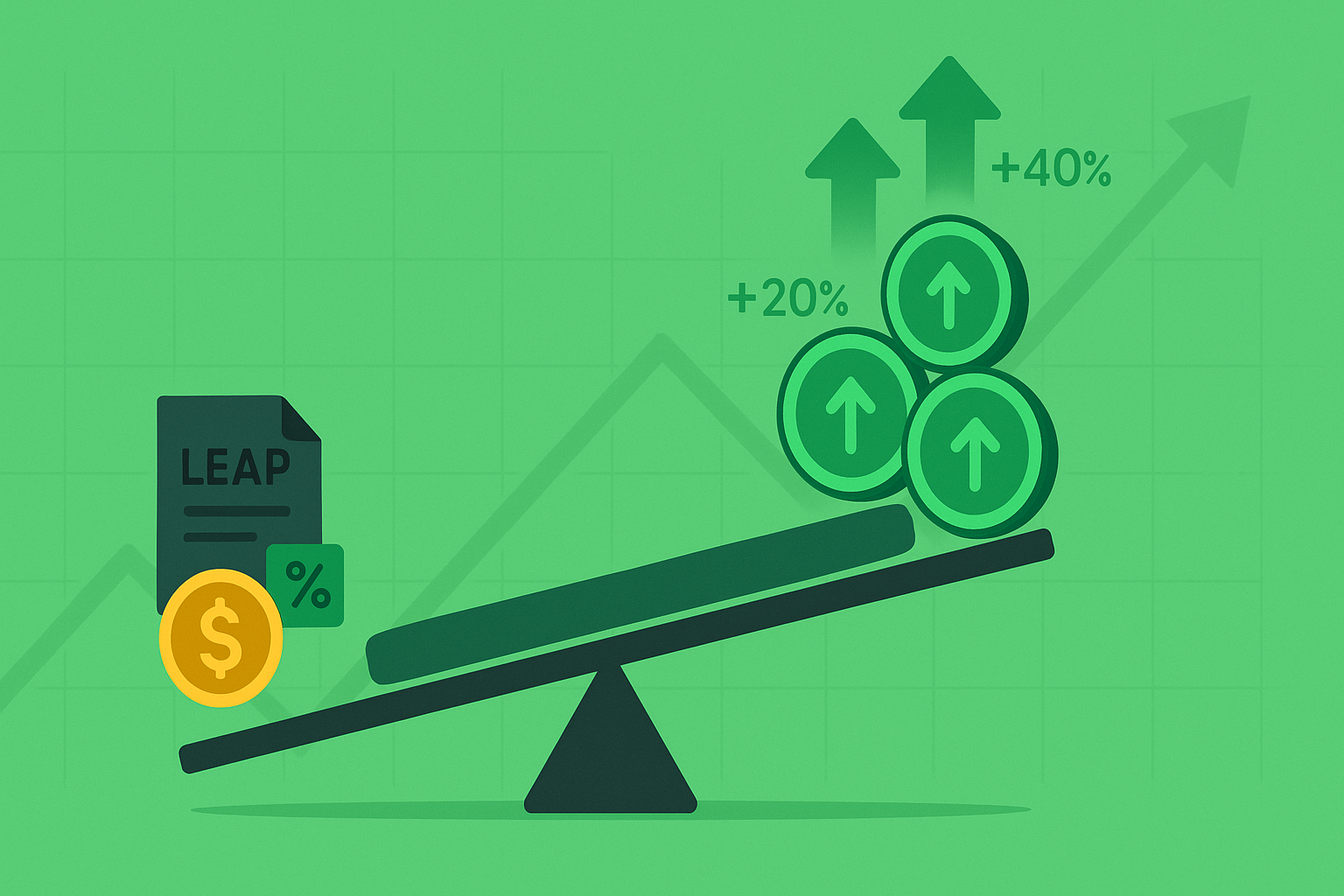
Leverage is using borrowed money or financial instruments to control more assets than your cash alone could buy. Done right, it amplifies returns. Done wrong, it amplifies losses. For value investors, the goal isn't maximum leverage, it's smart leverage applied to wonderful companies.
TL;DR
- Leverage = control more with less: Use debt, margin, or options to gain exposure to assets without paying full price upfront
- Amplifies both gains and losses: A 10% stock gain becomes a 20-30% gain with leverage, but a 10% drop can wipe you out
- Not inherently bad: Leverage is a tool. Used on undervalued, quality businesses with margin of safety, it accelerates wealth
- Value investors use it selectively: Never on speculative stocks, never with debt you can't afford, never without a backup plan
- LEAPS = smart leverage: Long-term options provide leverage without margin debt or liquidation risk
The Simple Definition
Leverage means using something you don't fully own to increase your potential returns. Think of it like a physical lever: you apply force at one end, and it amplifies the effect at the other end. In investing, that "force" is your capital, and the "amplification" comes from controlling more assets than your money alone would allow.
There are three main ways investors use leverage:
- Debt (margin): Borrow money from your broker to buy more stock
- Derivatives (options, futures): Use contracts that control large amounts of stock for a fraction of the cost
- Structured products (leveraged ETFs): Buy funds that use internal leverage to amplify returns
For value investors, options (specifically LEAPS) are the cleanest form of leverage because they avoid the dangers of margin debt while still providing amplification.
How Leverage Works in Practice
Let's say you have $10,000 and want exposure to "QualityCo," a stock trading at $100 per share.
Without leverage: You buy 100 shares for $10,000. If the stock rises to $120, you make $2,000 (20% return).
With margin debt: You borrow $10,000 from your broker and buy 200 shares. If the stock rises to $120, you make $4,000 (40% return, minus interest). But if the stock drops to $80, you lose $4,000 (40% loss, plus interest and margin call risk).
With LEAPS: You buy a $90 strike LEAP for $15 per share ($1,500 per contract = 100 shares). If the stock rises to $120, your LEAP is worth $30 per share, a $1,500 gain (100% return). You control 666 shares worth of exposure with the same $10,000 (buying 6-7 contracts).
Notice the difference: margin debt requires repayment and exposes you to liquidation risk (margin calls). LEAPS let you walk away if the trade goes bad, your max loss is the premium paid.
Why Value Investors Use Leverage Carefully
Most investors hear "leverage" and think of day traders using 10x margin to chase meme stocks. That's gambling, not investing. Value investors use leverage differently:
Leverage on undervalued companies: Only apply leverage to stocks trading 20-30% below intrinsic value. This margin of safety protects against errors.
Leverage on quality businesses: Only use leverage on companies with low debt, predictable cash flow, and economic moats. Weak businesses amplify downside faster than upside.
Position sizing limits: Never let leveraged positions exceed 10-15% of your portfolio. One bad trade shouldn't wreck your wealth.
Time horizon alignment: Use long-dated options (LEAPS) that give the business time to deliver results, not weekly or monthly contracts.
The key insight: leverage amplifies the outcome of your decisions. If you're right about the business and valuation, leverage accelerates gains. If you're wrong, it accelerates losses. That's why value investors obsess over quality and price before thinking about leverage.
The Math Behind Amplification
Let's break down how leverage changes returns.
Scenario 1: Stock rises 20%
- No leverage: $10,000 → $12,000 (20% gain)
- 2x leverage (margin): $20,000 position → $24,000 (40% gain, minus interest)
- 5x leverage (LEAPS): $10,000 in LEAPS controls $50,000 exposure → LEAP value increases 50-100% depending on strike and time to expiration
Scenario 2: Stock drops 20%
- No leverage: $10,000 → $8,000 (20% loss)
- 2x leverage (margin): $20,000 position → $16,000 (40% loss, plus interest and potential margin call)
- 5x leverage (LEAPS): LEAP value drops 50-100%, but you can walk away without owing money
Notice that LEAPS cap your downside (you can't lose more than the premium paid), while margin debt exposes you to losses beyond your initial investment.
Types of Leverage Explained
Margin debt: Borrow money from your broker to buy more stock. You pay interest (typically 6-10% annually), and if the stock drops too much, you face a margin call (forced to sell or add cash). This is the riskiest form of leverage because it can wipe out your account overnight.
Options (LEAPS): Buy long-term call options that control stock exposure for a fraction of the price. No debt, no margin calls, no interest. Your max loss is the premium paid. This is the safest leverage for value investors.
Leveraged ETFs: Buy funds that use internal derivatives to deliver 2x or 3x daily returns. These are designed for short-term trading, not long-term investing, because they decay over time due to compounding.
For value investors, LEAPS are the clear winner. They provide leverage without the existential risks of margin debt.
When Leverage Makes Sense
Leverage is not always appropriate. Here's when it works:
When the stock is deeply undervalued: If a company trades at 50% of intrinsic value, leverage can accelerate your return when the market corrects.
When fundamentals are rock-solid: Only use leverage on companies with low debt, strong free cash flow, and predictable earnings. Leverage + weak business = disaster.
When you have a long time horizon: LEAPS give you 18-24 months for the business to deliver. Short-term options (weeklies, monthlies) are speculation, not leverage.
When position size is controlled: Never let one leveraged position exceed 10% of your portfolio. Diversification + leverage = safer amplification.
What Could Go Wrong?
Leverage amplifies mistakes, here's what to avoid:
- Overleveraging: Putting 50%+ of your portfolio into leveraged positions exposes you to catastrophic losses
- Weak businesses: Leverage on speculative or high-debt companies accelerates failure
- Wrong timing: Buying LEAPS at market peaks or on overvalued stocks leads to losses even if the business is good
- Ignoring time decay: LEAPS lose value over time (theta decay). If the stock doesn't move, you lose money
- No exit plan: Entering without knowing when to take profits, roll, or cut losses leads to avoidable mistakes
Mitigations: Only use leverage on companies you'd happily own for 10+ years, limit leverage to 10-15% of your portfolio, set stop-loss rules (e.g., exit if the LEAP drops 40-50%), and always have a rolling plan if timing is off but fundamentals remain strong.
Next Steps
- Study your watchlist: Identify 2-3 companies that meet the criteria (undervalued, quality business, low debt) for potential leverage
- Calculate intrinsic value: Use the Wall St. Yardie App to determine fair value and margin of safety
- Learn LEAPS mechanics: Understand how strikes, expirations, and Greeks affect leverage (start with delta and theta)
- Practice with small positions: Start with 1-2 LEAPS contracts on a single stock to learn how leverage amplifies outcomes
- Read more: Check out Why LEAPS Provide Smarter Leverage to see why long-term options beat margin debt, and LEAPS as a Substitute for Stock to understand how to use them like stock ownership
*Disclaimer: This content is for educational purposes only and does not constitute financial advice. Past performance does not guarantee future results. Always conduct your own research before investing.*