
How Market Sentiment Influences Valuation
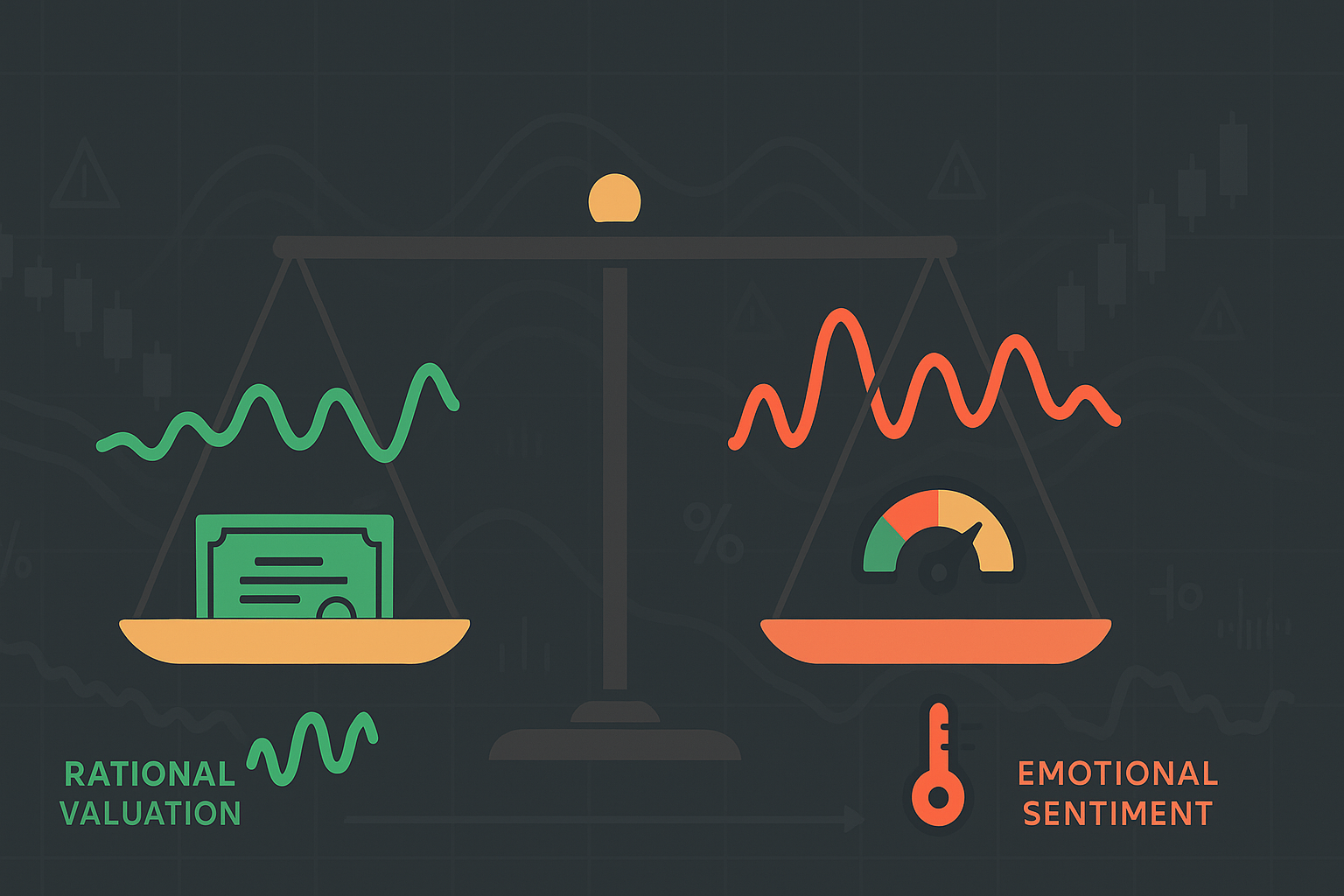
Options premiums jump when headlines scream. They collapse when confidence returns. Yet the underlying business might not have changed at all. That disconnect between emotion and fundamentals creates some of the best opportunities value investors will ever find.
TL;DR
- Market sentiment drives implied volatility, which inflates or deflates option premiums independently of a company's true value
- Fear spikes create expensive puts and cheap covered call premiums, while complacency does the opposite
- Value investors profit by selling options when sentiment is fearful and buying when it's calm
- Pricing mismatches occur when market emotion diverges from business fundamentals
- Discipline matters because sentiment always swings back toward fair value over time
When Emotion Takes the Wheel
Market sentiment is the collective mood of investors. When fear dominates, option buyers rush to protect themselves, driving up premiums. When greed takes over, premiums shrink because everyone feels safe. Neither reaction necessarily reflects what a company is actually worth.
Think of a company earning $5 per share with solid fundamentals and no debt. If the market panics over an unrelated economic worry, implied volatility might spike from 20% to 40% overnight. That same option that cost $2 yesterday now costs $4. The business didn't change. The balance sheet didn't weaken. Only the mood shifted.
This is where value investors find their edge. While traders chase momentum and fear, disciplined investors recognize that premium prices are temporarily divorced from intrinsic value. They sell high-premium options during panic and buy low-premium options during calm periods.
The Psychology Behind Pricing Mismatches
Fear is expensive. When markets drop 5% in a day, put option premiums can double or triple. Call premiums collapse because no one wants upside exposure. This creates a lopsided market where protection costs far more than potential gains, even though history shows stocks recover more often than they collapse permanently.
Consider a stock trading at $50 with an intrinsic value of $80. During a market selloff, a 30-day put with a $45 strike might cost $3. That means you're collecting $300 for agreeing to buy a $80 company at $45, an effective entry price of $42. The market is paying you handsomely for absorbing fear it can't tolerate.
Greed works in reverse. During bull runs, call premiums shrink because everyone assumes stocks only go up. Covered call writers collect pennies per contract. This is when value investors pause. Thin premiums signal complacency, and complacency is risky when selling income-generating options.
The key is recognizing that sentiment swings are temporary. A company's ability to generate cash doesn't change just because investors feel anxious or euphoric. Value investors focus on fundamentals while exploiting the premium distortions that emotion creates.
How Implied Volatility Reflects Mood, Not Value
Implied volatility is the market's expectation for how much a stock will move. It's not a prediction of direction, just magnitude. High IV means the market expects big swings. Low IV means it expects calm.
Here's the catch: IV often spikes when stocks drop and collapses when they rise. That makes premium prices reactive to mood rather than predictive of real risk. A stable, profitable company with a 10% earnings yield can see its IV double simply because the broader market sold off.
For value investors, this is gold. When IV is elevated, option sellers collect fat premiums without taking on additional business risk. The company's fundamentals haven't deteriorated, but the market is willing to pay extra for downside protection or income generation.
Let's look at the math. A stock trading at $60 with 25% IV might have a 30-day at-the-money put priced at $2. If IV jumps to 50% during a market panic, that same put might cost $4, even if the stock hasn't moved. Selling that put at $4 instead of $2 doubles your income for the same commitment. That's sentiment creating value, not the business changing.
The flip side matters too. When IV drops to historic lows, premiums shrink. A covered call that would generate $150 in normal conditions might yield only $50 in low volatility. That's when you pause or shift strategies because the market isn't compensating you fairly for tying up capital.
Recognizing Sentiment-Driven Opportunities
The best opportunities appear when sentiment diverges sharply from fundamentals. This happens most often during:
Market-wide panics: Stocks drop 10-20% on fears that have nothing to do with individual companies. A solid business with a margin of safety suddenly offers even richer premiums. Selling cash-secured puts during these windows combines intrinsic value with inflated income.
Sector rotations: When investors dump entire sectors (say, tech or energy), IV spikes across the board. Companies with strong fundamentals get caught in the selling. Their option premiums balloon even though their earnings power remains intact.
Earnings season volatility: Before earnings announcements, IV often rises as traders speculate on outcomes. If you've already analyzed a company's intrinsic value and feel confident, selling options before the announcement captures inflated premiums. Just ensure the strike price still leaves you with a margin of safety if assigned.
Post-correction complacency: After a big rally, investors forget risk exists. Premiums shrink to nothing. This is when you stop selling options or shift to buying LEAPS on undervalued companies, taking advantage of cheap time value.
The pattern repeats endlessly. Fear spikes premiums, greed deflates them, and fundamentals eventually reassert themselves. Value investors just need patience and discipline to exploit the cycle.
The Trap of Ignoring Fundamentals
Sentiment creates opportunities, but it can also destroy capital if you chase premiums without analyzing the business. A stock might offer juicy put premiums because it's genuinely risky, not just misunderstood.
Before selling any option, ask: Would I own this company at the strike price even if the premium didn't exist? If the answer is no, walk away. High premiums on shaky businesses are traps, not opportunities.
For example, a struggling retailer with declining sales might have 70% IV and $5 put premiums. Tempting, right? But if the company is actually worth $20 per share and trading at $30, that premium is compensating you for real risk, not irrational fear. Selling that put violates value principles.
Sentiment-driven opportunities only work when the underlying business is fundamentally sound and trading below intrinsic value. The premium is the bonus. The margin of safety is the foundation.
Practical Steps for Exploiting Sentiment
Start by tracking implied volatility. Tools like Wall St Yardie simplify this by showing you when a stock's IV is elevated compared to its historical range. If IV is in the top 25% of its range and the business is undervalued, you're looking at a potential opportunity.
Next, compare option premiums to earnings yield. If a company has a 12% earnings yield and you can collect an annualized 8% return from selling puts or covered calls, that's compelling. The combination of intrinsic value and high premium income stacks returns.
Timing matters but don't obsess. You can't predict exactly when sentiment will shift. Instead, sell options when premiums are rich relative to recent history. If you miss the absolute peak, that's fine. Any elevated premium improves your returns over time.
Finally, reinvest the premiums intelligently. If you collect $500 from selling puts, don't spend it. Allocate it toward your next value investment. Compounding premium income alongside intrinsic value gains is how patient investors build wealth.
What Could Go Wrong?
Chasing premiums on bad businesses: High IV doesn't mean good investment. Verify fundamentals first. A cheap-looking option on a weak company is expensive at any price.
Overestimating your risk tolerance: Elevated premiums come with elevated volatility. Stocks can drop 30% when sentiment turns negative, even if intrinsic value supports them long term. Make sure you have the cash and conviction to hold through volatility.
Ignoring time decay on long options: If you buy options when sentiment is calm (low IV), you're benefiting from cheap prices. But remember, time decay still erodes value. Only buy options on companies you believe will revalue toward intrinsic value before expiration.
Selling naked options without cash reserves: Sentiment-driven strategies work best with cash-secured puts and covered calls. Naked positions amplify risk when sentiment swings against you. Stick to defined-risk strategies.
Mistaking short-term noise for opportunity: Not every 2% market drop is a sentiment opportunity. Look for meaningful divergences, like a 15% sector selloff or a multi-day panic. Small wiggles create noise, not actionable premiums.
Next Steps
- Study historical IV: Review past IV spikes for stocks you follow. Notice how premiums reacted and how long it took for IV to normalize. This builds intuition for future opportunities.
- Track earnings yield alongside IV: Compare a stock's earnings yield to annualized option premiums. When premiums exceed half the earnings yield, you're getting compensated well for selling options.
- Learn about VIX: The CBOE Volatility Index reflects market-wide sentiment. When VIX spikes above 25-30, option premiums across the market inflate. That's prime time for value-driven option selling.
- Read related strategies: Check out Intrinsic Value vs. Extrinsic Value to understand how premiums are built, and Cash-Secured Puts for Getting Paid to Wait for a practical application.
- Paper trade sentiment swings: Use a simulator during the next market panic. Sell cash-secured puts on undervalued stocks when IV spikes. Watch how premiums decay as sentiment normalizes. This builds confidence without risking capital.
Sentiment will always swing between fear and greed. The value investor's job is to stand firm, analyze fundamentals, and exploit the premium distortions that emotion creates. When others panic, you collect income. When they relax, you wait. Keep the rhythm steady, and let sentiment work for you instead of against you.
*Disclaimer: This content is for educational purposes only and does not constitute financial advice. Past performance does not guarantee future results. Always conduct your own research before investing.*