
Case Study: Valuing an Option on a Value Stock
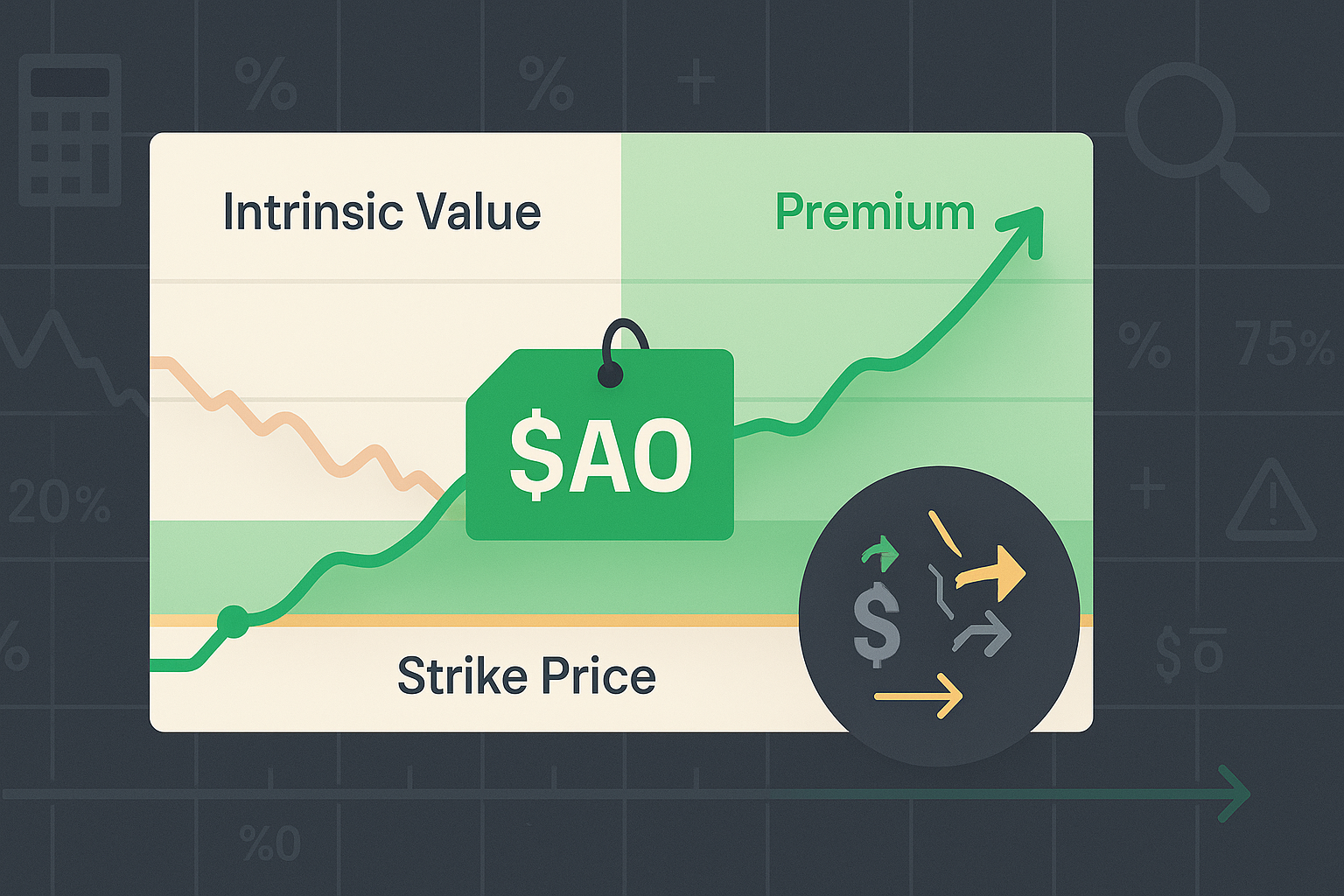
Theory makes sense on paper. Applying it to real trades is where discipline gets tested. Let's walk through a complete example: finding an undervalued stock, analyzing an option contract, and deciding whether the premium justifies the trade.
TL;DR
- Stock selection drives everything: Start with a business trading below intrinsic value with strong fundamentals
- Calculate all premium components: Break down intrinsic value, time value, and implied volatility to see if pricing is fair
- Compare annualized returns: Convert the premium into a yearly return to measure opportunity cost
- Verify margin of safety: Ensure the strike price still leaves room for error if assigned
- Document the decision: Write down your thesis so you can learn from outcomes
The Company: MicroTech Industries
MicroTech is a mid-sized software company with steady revenue growth, no debt, and consistent free cash flow generation. The company earns $6 per share annually and trades at $50 per share, giving it an earnings yield of 12% ($6 / $50).
Using a discounted growth model with a 10% growth rate and 10% discount rate, you calculate intrinsic value at $72 per share. That puts your margin of safety at 30% (($72 - $50) / $72). The business quality is solid, moat is durable (subscription software with high switching costs), and management reinvests capital intelligently.
This is the foundation. Without a quality company trading below intrinsic value, options strategies become speculation. But with this base, you can layer options to enhance returns while staying disciplined.
The Option: 45-Day Cash-Secured Put
You're considering selling a 45-day cash-secured put with a $47 strike price for a $2.50 premium. Here's the data:
- Current stock price: $50
- Strike price: $47
- Premium: $2.50
- Days to expiration: 45
- Implied volatility: 35% (70th percentile historically)
- Intrinsic value of option: $0 (stock is above strike)
- Time value of option: $2.50 (entire premium)
Now let's evaluate whether this trade aligns with value investing principles.
Step 1: Evaluate Intrinsic Value of the Option
Since the stock trades at $50 and the strike is $47, the put option has zero intrinsic value. It's out of the money. The entire $2.50 premium represents time value.
That's fine for a seller. You're collecting pure time value, which decays every day. As long as the stock stays above $47, you keep the full premium and never get assigned. Time decay works in your favor.
If the stock drops below $47 and you're assigned, you buy 100 shares at $47 per share. Your effective cost basis becomes $44.50 after subtracting the $2.50 premium ($47 - $2.50). That's 38% below intrinsic value ($72), expanding your margin of safety significantly.
Step 2: Assess Time Value Reasonableness
You're receiving $2.50 for 45 days of exposure. Is that fair compensation?
On a $47 strike, the premium represents a 5.3% return over 45 days ($2.50 / $47). Annualized, that's roughly 43% ($2.50 / $47) × (365 / 45).
Compare that to the company's 12% earnings yield. You're earning 43% annualized by selling options on a business that generates 12% in earnings. That spread suggests the market is overpaying for volatility, likely due to elevated implied volatility.
This is the opportunity. The business hasn't changed, but sentiment has driven premiums higher. You're getting compensated handsomely for accepting an obligation you'd welcome anyway: buying a $72 stock at an effective price of $44.50.
Step 3: Check Implied Volatility
The IV sits at 35%, placing it in the 70th percentile of its historical range. This means volatility is elevated but not at panic levels.
Elevated IV inflates premiums. That $2.50 premium might only be $1.50 if IV drops to its median level (say, 25%). This confirms the premium is rich relative to normal market conditions.
For an option seller, high IV is ideal. You collect inflated premiums now, and as IV normalizes, the option loses extrinsic value faster than time decay alone would suggest. This works in your favor if you want the option to expire worthless.
If IV were in the 20th percentile, the premium might be only $1.50 for the same contract. That's half the income for identical risk. Timing matters, even for patient value investors.
Step 4: Calculate Annualized Return and Opportunity Cost
Premium: $2.50 per share = $250 per contract
Capital at risk: $47 × 100 = $4,700
Return: $250 / $4,700 = 5.3% in 45 days
Annualized return: 5.3% × (365 / 45) = 43%
Now compare this to alternatives:
- Treasury bonds yield 4%
- The stock's earnings yield is 12%
- Other undervalued stocks in your watchlist might offer 15-20% earnings yields
A 43% annualized return beats all those alternatives, especially considering you're selling options on a stock you'd be thrilled to own at $44.50 per share. The opportunity cost of tying up $4,700 for 45 days is minimal when the compensation is this strong.
If the annualized return were only 10-15%, you'd need to think harder. But at 43%, the trade stacks income on top of an already compelling value opportunity.
Step 5: Factor in Assignment and Downside Protection
What happens if MicroTech drops to $42 and you get assigned?
You buy 100 shares at $47, but your effective cost is $44.50 after the premium. The stock is now worth $72 based on your intrinsic value calculation. You own a $72 stock for $44.50, a 38% margin of safety.
Even if your valuation is optimistic and the true value is only $60, you're still buying at a 26% discount. That's solid downside protection.
Now consider the worst case: your analysis is wrong, and the stock is actually worth $40. You bought at $44.50. You're underwater by $4.50 per share. But because you collected a $2.50 premium upfront, your real loss is only $2 per share versus buying the stock outright at $50 and losing $10 per share.
The premium provides a buffer. It's not insurance, but it softens mistakes. That's why value investors pair cash-secured puts with strong fundamental analysis. The margin of safety plus the premium creates a double layer of protection.
Step 6: Compare to Buying the Stock Outright
If you believe in MicroTech, why not just buy shares at $50?
You could, and that's perfectly valid. But selling the put offers advantages:
Income while waiting: If the stock stays flat or rises slightly, you collect $250 without owning shares. That's income you wouldn't receive by holding cash.
Lower effective entry price: If assigned, you buy at $44.50 instead of $50. That's a 11% better entry for the same company.
Forced discipline: The put expires in 45 days. If the stock rallies to $60 and you're not assigned, you didn't get exposure. That might sting, but it keeps you from chasing momentum. You set your entry price and let the market come to you.
The trade-off is opportunity cost. If MicroTech jumps to $65 in three weeks, you miss the gain. But that's the price of discipline. Value investors prioritize margin of safety over capturing every upside move.
Step 7: Document the Thesis
Before executing, write this down:
"MicroTech intrinsic value: $72. Current price: $50. Margin of safety: 30%. Selling 45-day put at $47 strike for $2.50 premium. Effective entry if assigned: $44.50 (38% below intrinsic value). Annualized return: 43%. IV elevated at 70th percentile, suggesting premium is rich. Comfortable owning at $44.50 based on earnings yield of 12%, no debt, and durable moat. Downside risk mitigated by margin of safety and premium buffer."
This creates accountability. If the trade works, you know why. If it fails, you can review whether your analysis was flawed or if you got unlucky. Over time, this feedback loop sharpens decision-making.
The Outcome: Three Scenarios
Scenario 1: Stock stays above $47
The put expires worthless. You keep the $250 premium. Annualized return: 43%. You didn't buy shares, but you collected income and can sell another put if conditions remain favorable.
Scenario 2: Stock drops to $44, you're assigned
You buy 100 shares at $47, effective cost $44.50. The stock now trades at $44, so you're showing a small paper loss of $0.50 per share. But intrinsic value is $72. You own a wonderful company at a 38% discount. You can now sell covered calls for additional income while waiting for the market to recognize value.
Scenario 3: Stock rallies to $60
The put expires worthless, you keep the $250 premium, but you missed the upside. This stings emotionally but isn't a mistake. You set a price you were willing to pay ($47) and stuck to it. Chasing rallies violates value discipline. You got paid to wait, and the market didn't meet your price. That's fine.
Lessons Learned
This case study reveals several principles:
Start with fundamentals: The trade only makes sense because MicroTech is undervalued. Without that foundation, selling the put is speculation.
Premiums are compensation, not strategy: The 43% annualized return is attractive, but it's secondary to the margin of safety. Never sell options on weak businesses just because premiums are fat.
IV matters: Elevated volatility inflated the premium from $1.50 to $2.50. Timing option sales when IV is high stacks the odds in your favor.
Document everything: Writing down the thesis forces clear thinking and creates a learning record.
Embrace limited upside: Selling options caps gains if the stock rockets, but it also generates income and lowers entry prices. Value investors trade unlimited upside for higher probability outcomes.
What Could Go Wrong?
Overestimating intrinsic value: If MicroTech's true value is $50, not $72, you're buying at fair value with no margin of safety. Always stress-test valuations with conservative assumptions.
Ignoring business risks: Elevated IV might reflect real risks like pending litigation, regulatory changes, or competitive threats. Don't assume every premium is mispriced. Verify fundamentals thoroughly.
Chasing premiums on multiple positions: Selling puts on five stocks at once might feel smart, but if the market drops 20%, you'll be assigned on all five. Ensure you have cash to handle multiple assignments.
Neglecting time decay on long options: This example focused on selling. If you're buying options, remember time decay works against you. The logic flips: buy when IV is low, sell when IV is high.
Forgetting transaction costs: A $250 premium minus $15 in fees is $235. On small trades, fees matter. Factor them into return calculations.
Next Steps
- Replicate this analysis: Find an undervalued stock in your watchlist. Identify an option contract and run through each valuation step. Practice makes the process second nature.
- Track your trades: Use a spreadsheet to record the stock price, intrinsic value, strike, premium, IV percentile, and outcome. Review quarterly to see patterns in what works and what doesn't.
- Compare strategies: Try this same analysis with a covered call or a LEAP. See how the valuation logic shifts based on whether you're buying or selling, short-term or long-term.
- Read foundational concepts: Review Margin of Safety Explained to deepen your understanding of downside protection, and Cash-Secured Puts for Getting Paid to Wait for more on this strategy.
- Paper trade first: Before risking real money, simulate five trades using this framework. Watch how premiums decay, IV changes, and assignments play out. Build confidence through practice.
Valuing options isn't abstract theory. It's applying logical steps to real contracts on real businesses. Start with intrinsic value, layer in premium components, calculate returns, and verify the margin of safety. Do this every time, and you'll avoid overpaying while capturing opportunities others miss. Keep the rhythm steady, and let disciplined analysis guide every decision.
*Disclaimer: This content is for educational purposes only and does not constitute financial advice. Past performance does not guarantee future results. Always conduct your own research before investing.*