
Financial Statement Analysis Tools
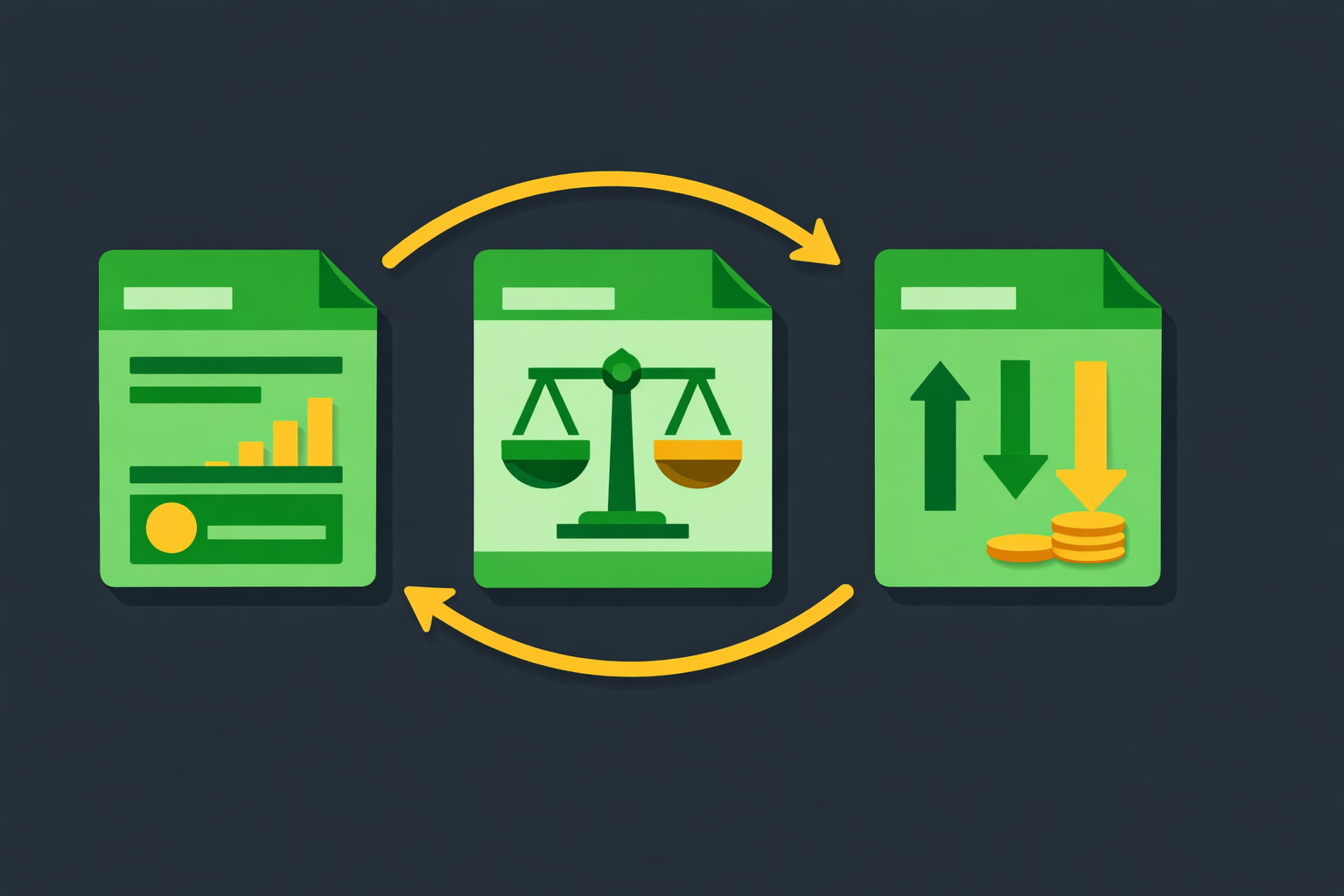
A company can claim explosive growth and market dominance, but the financial statements tell the real story. Revenue rising while cash flow bleeds. Assets growing while debt explodes. Tools that break down income statements, balance sheets, and cash flow reports turn marketing narratives into measurable truth.
TL;DR
- Three statements reveal everything: Income statement shows profitability, balance sheet shows financial health, cash flow shows real money generation
- Free tools provide full access: SEC EDGAR, company investor relations sites, and financial databases offer complete statements at no cost
- Focus on trends, not snapshots: Single-year numbers lie, five-year trends expose patterns and reveal quality
- Cash flow beats earnings: Net income can be manipulated, but cash generation is harder to fake
- Ratios simplify comparison: Margins, returns, and leverage ratios let you compare companies across industries and time periods
Why Financial Statements Matter More Than Headlines
Management tells you what they want you to hear. Press releases highlight successes and bury problems. Analyst reports often parrot company guidance without critical analysis. Financial statements, by contrast, are required disclosures audited and filed with regulators. They contain the numbers that determine whether a business creates or destroys value.
Value investing starts with understanding what a company actually earns, owns, and owes. Without reading financial statements, you're investing based on stories, not facts. A company might tout "record sales," but if margins collapsed due to rising costs, profitability declined despite revenue growth. Another might boast "asset expansion," but if assets were purchased with excessive debt, financial risk increased rather than decreased.
Consider two companies both reporting $50 million in net income:
Company A:
- Revenue: $500 million
- Operating margin: 10%
- Free cash flow: $45 million (90% of net income)
- Total debt: $100 million
- Shareholder equity: $300 million
Company B:
- Revenue: $250 million
- Operating margin: 20%
- Free cash flow: $10 million (20% of net income)
- Total debt: $400 million
- Shareholder equity: $150 million
Same net income, radically different businesses. Company A is efficient, cash-generative, and conservatively leveraged. Company B has better margins but questionable cash generation and risky debt levels. Financial statements expose these differences that headlines and earnings reports obscure.
For deeper understanding of financial health metrics, see our guide on debt and leverage ratios.
The Three Core Financial Statements
Understanding what each statement reveals and how they connect gives you a complete picture of business performance and financial strength.
Income Statement (Profit & Loss)
What it shows: How much the company earned or lost over a period (quarter or year).
Key lines to analyze:
- Revenue (top line): Total sales before any expenses
- Cost of goods sold (COGS): Direct costs of producing products or services
- Gross profit: Revenue minus COGS (shows pricing power and production efficiency)
- Operating expenses: Selling, general, administrative costs (SG&A), R&D
- Operating income (EBIT): Earnings before interest and taxes (core business profitability)
- Net income (bottom line): Profit after all expenses, taxes, and interest
What to look for:
- Rising revenue with stable or improving margins (top and bottom line growing together)
- Operating income growing faster than revenue (operating leverage)
- Consistent profitability over 3-5 years (not volatile or erratic)
Red flags:
- Revenue growth but shrinking margins (pricing pressure, rising costs)
- Net income positive but operating income negative (one-time gains hiding poor operations)
- Large "other income" or "extraordinary items" (non-recurring, unsustainable)
Learn more about profitability measures in our article on earnings power and cash flow.
Balance Sheet (Financial Position)
What it shows: What the company owns (assets) and owes (liabilities) at a specific point in time. The difference is shareholder equity (net worth).
Key sections to analyze:
Assets:
- Current assets: Cash, inventory, receivables (convertible to cash within a year)
- Long-term assets: Property, equipment, intangibles, goodwill
- Total assets: Everything the company owns
Liabilities:
- Current liabilities: Payables, short-term debt (due within a year)
- Long-term liabilities: Bonds, long-term debt, pensions
- Total liabilities: Everything the company owes
Equity:
- Shareholder equity: Assets minus liabilities (what's left for owners)
- Retained earnings: Cumulative profits reinvested in the business
What to look for:
- Strong current ratio (current assets ÷ current liabilities above 1.5)
- Low debt-to-equity (total debt ÷ equity under 1.0 for most industries)
- Growing equity over time (business building net worth, not eroding it)
Red flags:
- Current ratio below 1.0 (can't cover short-term obligations)
- Excessive goodwill or intangibles (often from overpriced acquisitions)
- Declining equity while debt increases (leverage rising, net worth falling)
For understanding balance sheet strength, see our guide on financial statement basics.
Cash Flow Statement (Real Money Movement)
What it shows: Where cash came from and where it went during a period. Divided into three sections:
Operating cash flow (OCF):
- Cash generated from core business operations
- Most important section: shows if the business actually produces cash
- Should be positive and growing
Investing cash flow:
- Cash spent on assets (capex), acquisitions, or investments
- Typically negative (companies investing in growth)
- Compare capex to depreciation to assess maintenance vs. growth spending
Financing cash flow:
- Cash from issuing/repaying debt, issuing/buying back stock, paying dividends
- Shows how the company raises and returns capital
What to look for:
- Operating cash flow consistently positive and growing
- Free cash flow (OCF minus capex) positive and ideally growing
- OCF greater than net income (cash earnings exceed accounting earnings)
Red flags:
- Negative operating cash flow despite positive net income (earnings not real)
- Free cash flow negative for multiple years (business consumes cash, doesn't generate it)
- Rising capex as percentage of revenue (diminishing returns on investment)
Understanding cash generation is critical, as covered in our article on free cash flow analysis.
Best Tools for Analyzing Financial Statements
You don't need expensive subscriptions or specialized software to access and analyze financial statements. Free tools provide complete data for all publicly traded companies.
SEC EDGAR (sec.gov/edgar)
What it is: Official U.S. government database of all public company filings.
Why it's essential:
- Primary source, no data errors from third parties
- Complete 10-Ks (annual reports) and 10-Qs (quarterly reports)
- Footnotes and MD&A (management discussion) reveal details missing from summaries
How to use it:
- Search company name or ticker
- View "10-K" for annual financials or "10-Q" for quarterly
- Navigate to "Financial Statements" section
- Download or view HTML directly in browser
Pro tip: Read the MD&A section for management's explanation of changes in results. Check footnotes for accounting policies, debt details, and contingencies. These sections reveal risks and one-time items that affect interpretation.
Company Investor Relations Sites
What they are: Each public company maintains an IR page with financial documents, presentations, and earnings transcripts.
Why they're useful:
- Same data as EDGAR but often formatted more clearly
- Earnings presentations with charts and explanations
- Historical financials in Excel format (easier for trend analysis)
How to find them:
- Google: "[Company name] investor relations"
- Usually company.com/investors or ir.company.com
What to review:
- Latest earnings presentation (quarterly results summary)
- Annual report (full 10-K with visuals and narrative)
- Press releases (major announcements and explanations)
Financial Databases (Free)
Yahoo Finance (finance.yahoo.com):
- Pre-formatted income statement, balance sheet, cash flow for every stock
- Annual and quarterly views
- Download to Excel for custom analysis
- Ratios and metrics calculated automatically
Finviz (finviz.com):
- Snapshot view with key financials and ratios
- Visualizes margins, returns, and growth in one screen
- Links to full statements on Yahoo Finance or EDGAR
Google Finance / Seeking Alpha:
- Similar to Yahoo Finance with clean layouts
- Community analysis and commentary (take with skepticism)
Pro tip: Use Yahoo Finance or Finviz for quick overviews and screening, then verify key numbers directly on EDGAR or company IR sites before making decisions. Data aggregators occasionally have errors or reporting lags.
Spreadsheet Analysis (Excel or Google Sheets)
Why build your own models:
- Customize metrics relevant to your strategy
- Track trends over 5-10 years to spot patterns
- Calculate ratios and margins not shown on websites
- Compare multiple companies side-by-side
Essential columns for your spreadsheet:
- Year/Quarter
- Revenue, gross profit, operating income, net income
- Operating margin, net margin
- Operating cash flow, capex, free cash flow
- Total assets, total liabilities, equity
- Debt-to-equity, current ratio, ROE
Template structure:
| Year | Rev | OpInc | NetInc | OpMargin | FCF | Debt/Eq | ROE |
|------|-----|-------|--------|----------|-----|---------|-----|
| 2020 | ... |   ... |    ... |      ... | ... |     ... | ... |
| 2021 | ... |   ... |    ... |      ... | ... |     ... | ... |
Over time, your spreadsheet becomes a personal database revealing which metrics predict stock performance and which companies consistently compound value. This historical record is your edge.
How to Analyze Statements Like a Value Investor
Reading financial statements isn't about memorizing every line item. It's about asking the right questions and spotting patterns that reveal quality and risk.
Step-by-step analysis process:
1. Start with the income statement (profitability):
- Is revenue growing steadily (5-10%+ annually)?
- Are margins stable or improving?
- Is net income growing at least as fast as revenue?
- Any unusual one-time items inflating or deflating results?
2. Move to cash flow (real earnings):
- Is operating cash flow positive and growing?
- Does operating cash flow exceed net income (cash > accounting profit)?
- Is free cash flow positive after capex?
- Is the company generating cash or consuming it?
3. Check the balance sheet (financial strength):
- What's the debt-to-equity ratio? (Under 1.0 is conservative)
- Can current assets cover current liabilities? (Current ratio > 1.5)
- Is equity growing over time?
- Any large goodwill or intangible assets from acquisitions?
4. Calculate key ratios (for comparison):
- Operating margin: Operating income ÷ Revenue
- Net margin: Net income ÷ Revenue
- ROE: Net income ÷ Shareholder equity
- Debt-to-equity: Total debt ÷ Shareholder equity
- Free cash flow conversion: Free cash flow ÷ Net income
5. Compare to peers and history:
- How do margins compare to competitors?
- Is ROE above industry average?
- Are trends improving, stable, or declining?
For a comprehensive valuation framework incorporating these metrics, see our article on putting it all together.
Real Example: Analyzing a Retail Company
Let's walk through a simplified analysis using publicly available data.
RetailCo (hypothetical, using realistic numbers):
Income Statement (last 3 years):
| Year | Revenue | Operating Income | Net Income | Operating Margin |
|---|---|---|---|---|
| 2021 | $2,000M | $180M | $120M | 9.0% |
| 2022 | $2,200M | $198M | $132M | 9.0% |
| 2023 | $2,400M | $216M | $144M | 9.0% |
Observation: Steady revenue growth (10% annually), stable margins, net income growing with revenue. Consistent profitability.
Cash Flow Statement (2023):
- Operating cash flow: $160M
- Capex: $50M
- Free cash flow: $110M
Observation: FCF $110M vs net income $144M = 76% conversion. Positive, though some earnings tied up in working capital or non-cash items. Still solid cash generation.
Balance Sheet (2023):
- Total assets: $1,200M
- Total debt: $300M
- Shareholder equity: $600M
- Debt-to-equity: 0.5
Observation: Conservative leverage, strong equity base. Current ratio (not shown) should be checked, but debt level is manageable.
Calculated ratios:
- ROE: $144M ÷ $600M = 24% (excellent)
- Net margin: $144M ÷ $2,400M = 6% (decent for retail)
- FCF yield: $110M ÷ market cap (if market cap $2,000M) = 5.5%
Conclusion: Profitable, cash-generative, conservatively leveraged, growing steadily. This is a quality business worth further research. Next steps: check economic moat, assess valuation using intrinsic value tools, and determine if current price offers margin of safety.
What Could Go Wrong?
Trusting net income without checking cash flow: Companies can manipulate earnings through aggressive revenue recognition, understating expenses, or one-time gains. Net income might show profit while cash flow bleeds.
Mitigation: Always compare net income to operating cash flow. If OCF is consistently lower than net income, or worse, negative while income is positive, dig deeper. Real businesses generate cash, not just accounting profits. Prefer companies where OCF exceeds net income over time.
Ignoring footnotes and one-time items: A company might report strong net income, but footnotes reveal $50 million came from selling a division (non-recurring). Normalized earnings are much lower than reported.
Mitigation: Read footnotes and MD&A sections in 10-Ks and 10-Qs. Look for "non-GAAP adjustments," "restructuring charges," or "asset sales." Adjust your analysis to remove one-time items and focus on sustainable, recurring earnings. Check our guide on avoiding value traps.
Comparing incompatible industries: A software company with 30% operating margin looks great, but comparing it to a grocery chain with 3% margin is misleading. Capital intensity, business models, and competitive dynamics differ radically.
Mitigation: Always benchmark within industries. Compare retailers to retailers, software to software. Use sector medians from screeners or databases as context. Absolute numbers mean little without industry-relative perspective.
Relying on stale or incorrect data: Free aggregators sometimes lag by quarters or contain data entry errors. Acting on wrong numbers leads to bad decisions.
Mitigation: Verify key numbers directly from EDGAR or company IR sites before committing capital. Use aggregators for screening and quick looks, but confirm critical metrics (debt, cash, earnings) from primary sources. Cross-check across two platforms if uncertain.
Next Steps
- Pick 3 companies you own or are researching and find their latest 10-K on SEC EDGAR
- For each company, pull the income statement, balance sheet, and cash flow statement
- Create a simple spreadsheet tracking revenue, net income, free cash flow, debt, and equity for the past 5 years
- Calculate operating margin, net margin, ROE, and debt-to-equity for each year
- Identify trends: Are margins improving or declining? Is cash flow growing or shrinking? Is debt rising or falling?
- Compare your companies to 2-3 industry peers using the same metrics
- Use Wall St Yardie to simplify intrinsic value calculations incorporating your statement analysis
- Read the MD&A section of the latest 10-K for one company to see how management explains results
Remember: Financial statements are the foundation of value investing. No amount of screening, valuation modeling, or options strategy can compensate for poor fundamentals. Master reading and interpreting these three statements, income, balance sheet, cash flow, and you'll never again mistake hype for value. Tools make analysis faster and more systematic, but understanding what the numbers mean is the irreplaceable skill that separates successful investors from speculators.
*Disclaimer: This content is for educational purposes only and does not constitute financial advice. Past performance does not guarantee future results. Always conduct your own research before investing.*