
Step 6: Build a Watchlist
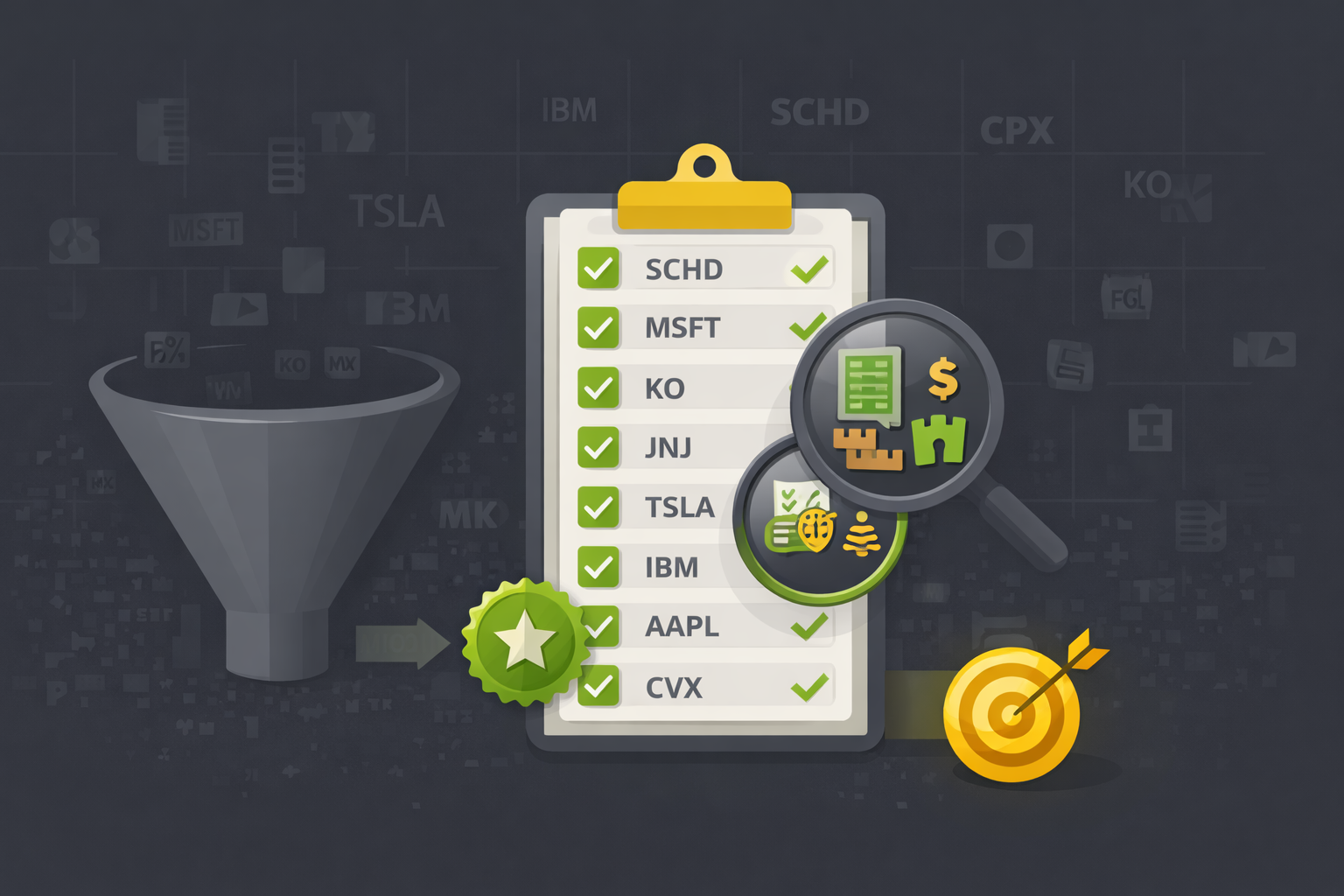
You can't sell a cash-secured put or covered call on just any stock. You need a curated list of high-quality, undervalued businesses you'd be proud to own for years. This is your watchlist: 10-20 companies you've researched, valued, and decided meet your standards. Building it takes time, but once you have it, trading becomes simpler. You're not scrambling to find opportunities, you're waiting patiently for your pre-approved list to reach your target prices. This step teaches you how to build that list the right way.
TL;DR
- Quality over quantity: Aim for 10-20 companies, not 100. Deep knowledge beats shallow coverage.
- Use screeners to filter, not decide: Screeners find candidates, but you must analyze fundamentals yourself.
- Focus on economic moats: Prioritize companies with durable competitive advantages that protect profits.
- Calculate intrinsic value for each: Use earnings yield, discounted growth, or cap rate thinking to estimate fair value.
- Update quarterly: Review watchlist after earnings, remove deteriorating businesses, add new opportunities.
Why a Watchlist Matters
Without a watchlist, you're reactive. Markets drop 10%, you panic-search for "cheap stocks," and buy whatever looks oversold. Or you see someone on Twitter hyping a stock and chase it without research.
With a watchlist, you're proactive. You've already done the work: identified quality businesses, calculated intrinsic value, and set target entry prices. When markets drop and your stock hits your price, you act confidently. No FOMO, no guesswork, just execution.
The psychological benefit:
Watchlists eliminate decision fatigue. Instead of analyzing 5,000+ public companies, you focus on your 15 pre-vetted picks. This keeps you patient, disciplined, and prevents "shiny object syndrome."
Step 1: Define Your Watchlist Criteria
Before adding companies, set clear standards. This prevents emotional additions ("I like Apple, so I'll add it") and ensures consistency.
Minimum Financial Standards
These are non-negotiables. Every company on your watchlist must meet these thresholds:
1. Positive free cash flow for at least 3 years
Free cash flow (FCF) = operating cash flow minus capital expenditures. Companies with consistent FCF can invest in growth, pay dividends, or buy back shares without taking on debt.
Why it matters:
Negative FCF businesses burn cash and often dilute shareholders. You want cash generators, not cash burners.
How to check:
Look at the cash flow statement in the 10-K (annual report). Calculate FCF = Operating Cash Flow - CapEx. Verify it's positive for the last 3-5 years.
2. Debt-to-equity ratio below 1.0 (or industry-appropriate)
Lower debt means less financial risk. If a recession hits, low-debt companies survive; high-debt companies struggle or go bankrupt.
Why it matters:
You might hold these stocks for years. You don't want leverage blowing up your portfolio.
How to check:
Balance sheet: Total Debt ÷ Total Equity. Aim for < 0.5 for most industries. Utilities and REITs can go higher (1.0-1.5) due to their capital-intensive nature.
3. Consistent earnings growth (or stable earnings for mature companies)
Growth companies should show 5-10%+ annual earnings growth. Mature companies (utilities, consumer staples) should show stable earnings even if growth is flat.
Why it matters:
Earnings drive long-term stock prices. Erratic earnings suggest management issues, competitive threats, or cyclical problems.
How to check:
Income statement: Net Income over the last 5 years. Look for upward trends or stability, not wild swings.
4. Market cap above $1 billion (optional but recommended)
Larger companies have more liquidity, better options markets, and lower bankruptcy risk. Small caps (< $1B) can work, but they're riskier.
Why it matters:
Options on small caps often have wide bid-ask spreads and low open interest, making premiums less attractive. Stick to mid-large caps initially.
Qualitative Standards (Harder to Measure, Just as Important)
1. Economic moat (competitive advantage)
Can competitors easily replicate this business? If yes, skip it. Look for moats like brand power (Coca-Cola), network effects (Visa), cost advantages (Costco), or switching costs (Microsoft).
Why it matters:
Moats protect profits. Without them, competitors steal market share and margins compress.
How to check:
Read the 10-K "Business" section. Ask: Why do customers choose this company over rivals? What would it cost a competitor to replicate this?
2. Understandable business model
If you can't explain what the company does in 2-3 sentences, skip it. Complex businesses hide risks.
Why it matters:
You might own this stock for years. You need to understand how it makes money and what could go wrong.
Example:
"Costco runs membership-based warehouses selling bulk goods at low margins, earning most profit from membership fees." Clear, simple.
3. Management quality (track record of capital allocation)
Look for CEOs who reinvest wisely, avoid stupid acquisitions, and return cash to shareholders when appropriate.
Why it matters:
Bad management destroys value. Good management compounds it.
How to check:
Read shareholder letters, check insider buying/selling, and review past acquisitions (did they overpay or create value?).
Step 2: Use Screeners to Find Candidates
Stock screeners filter thousands of companies based on your criteria. They won't do the analysis for you, but they'll narrow the field.
Recommended Free Screeners
- Yahoo Finance Screener: Basic but functional. Filter by P/E, market cap, sector.
- Finviz: More advanced. Add criteria like debt-to-equity, ROE, and dividend yield.
- Your broker's screener: Most brokers (Fidelity, Schwab, Interactive Brokers) have built-in tools.
Sample Screener Settings for Value + Options
Run this screen to find initial candidates:
- Market cap: > $1 billion
- P/E ratio: < 20 (cheaper than market average, typically 18-25)
- Debt-to-equity: < 1.0
- Return on equity (ROE): > 10% (profitable, efficient use of capital)
- 5-year earnings growth: Positive (or stable for mature companies)
- Options available: Yes (some screeners let you filter by this)
Expected results:
This should return 50-200 companies. Your job is to manually review them.
Manual Review: Narrowing to 10-20 Stocks
Don't add all 50 to your watchlist. Pick the 10-20 you understand best and trust most.
For each candidate:
- Read the latest 10-K (annual report, focus on "Business" and "Risk Factors" sections).
- Calculate intrinsic value using earnings yield, discounted growth, or Wall St Yardie's models (https://app.wallstyardie.com makes this easy).
- Check recent earnings calls (transcripts available on company investor relations sites or Seeking Alpha).
- Identify the moat: What protects this business from competition?
- Set a target entry price: Based on intrinsic value with 20-30% margin of safety.
Example:
SteadyCo has intrinsic value of $80 per share. You want a 25% margin of safety. Your target entry price: $60. Add it to your watchlist with this note: "Enter at $60 or below."
Step 3: Organize Your Watchlist
A watchlist isn't just a list of stock tickers. It's a decision-making tool. Organize it with enough detail to act confidently when opportunities arise.
Recommended Columns
Create a spreadsheet (Google Sheets, Excel, or Notion) with these columns:
| Ticker | Company Name | Sector | Current Price | Intrinsic Value | Target Entry | Margin of Safety | Moat | Last Reviewed |
|---|---|---|---|---|---|---|---|---|
| AAPL | Apple Inc | Technology | $180 | $200 | $150 | 25% | Brand, ecosystem | 2026-01-01 |
| COST | Costco | Consumer | $550 | $600 | $480 | 20% | Membership, scale | 2026-01-01 |
Why each column matters:
- Target Entry: Your buy signal. When the stock hits this price, you act (sell a put or buy shares).
- Margin of Safety: Shows how much room for error you've built in.
- Moat: Reminds you why this company is defensible.
- Last Reviewed: Forces quarterly updates. If you haven't reviewed in 6 months, remove it or re-analyze.
Priority Tiers (Optional)
Rank stocks by conviction:
- Tier 1 (High Conviction): Top 5 stocks. You'd buy immediately if they hit target price.
- Tier 2 (Moderate Conviction): Next 5-10 stocks. You like them but want to see more before committing.
- Tier 3 (Monitoring): 5-10 stocks you're researching. Not ready to act yet.
This helps you allocate capital when multiple opportunities arise. Focus on Tier 1 first.
Step 4: Set Alerts and Monitor (Without Obsessing)
Watchlists fail if you check them hourly. They succeed when you set alerts and wait patiently.
Price Alerts
Use your broker's alert system or apps like Yahoo Finance to notify you when a stock hits your target entry price.
Example:
SteadyCo target entry: $60. Current price: $75. Set an alert for $62 (slightly above target to give you warning). When it triggers, review fundamentals and decide whether to act.
Earnings Calendar Alerts
Track when companies report earnings. Review the watchlist company within 1-2 days of earnings to update your intrinsic value estimate.
Why:
Earnings reports change valuations. If SteadyCo's earnings drop 20%, your $80 intrinsic value might fall to $65. Adjust your target entry accordingly.
Quarterly Review Cadence
Every 3 months, spend 1-2 hours reviewing your entire watchlist:
- Remove deteriorating businesses: If fundamentals weakened (moat eroding, debt rising, earnings declining), delete from watchlist.
- Add new candidates: As you learn about industries, add 1-2 new high-quality companies.
- Recalculate intrinsic value: Update estimates based on recent earnings, guidance, and market conditions.
- Adjust target prices: If valuations changed, adjust your entry prices.
Don't:
Check daily. That's not patience, that's anxiety. Set alerts, trust your research, and wait.
Step 5: Validate Your Watchlist (Self-Audit)
Before finalizing your watchlist, run this self-audit:
For each stock, ask:
- Have I read the latest 10-K and understand the business model?
- Can I explain the economic moat in one sentence?
- Have I calculated intrinsic value using at least one model?
- Is my target entry price at least 20% below intrinsic value?
- Would I be comfortable owning 100 shares at my target price, even if it dropped another 20%?
- Is this company's sector represented no more than 2-3 times on my list (diversification check)?
If you answer "no" to any question, either do more research or remove the stock.
Common Watchlist Mistakes
Mistake 1: Too Many Stocks (50+)
You can't deeply research 50 companies. You end up with shallow knowledge and make poor decisions.
Fix: Limit to 10-20. Quality over quantity.
Mistake 2: Chasing Hot Stocks
You add stocks because they're trending on Twitter or in the news, not because you've analyzed them.
Fix: Only add stocks you've personally researched for at least 2-3 hours.
Mistake 3: No Target Prices
You add stocks without defining entry prices, leading to guesswork when opportunities arise.
Fix: Every stock must have a target entry price based on intrinsic value and margin of safety.
Mistake 4: Never Updating
You built a watchlist in January and never revisit it. By December, half the companies have deteriorated, but you don't realize it.
Fix: Quarterly reviews. Set a calendar reminder.
Mistake 5: Ignoring Options Liquidity
You add small-cap stocks with no options volume, making it impossible to run covered calls or puts.
Fix: Check options chains. Look for open interest > 100 on near-the-money strikes. If liquidity is weak, remove from list.
What Could Go Wrong?
- Analysis paralysis: You spend 6 months researching and never finish your watchlist, missing opportunities.
- Adding stocks you don't understand: You include complex businesses (biotech, mining) because they look cheap, then panic when they drop.
- No diversification: You add 10 tech stocks and nothing else, concentrating risk.
- Forgetting to review: Your watchlist becomes stale, and you act on outdated valuations.
- Over-reliance on screeners: You trust the screener results without manual research, adding low-quality companies.
To avoid these, set a deadline (2-4 weeks to complete your initial watchlist), focus on businesses you genuinely understand, and commit to quarterly reviews.
Next Steps
- Define your watchlist criteria (write down your minimum financial and qualitative standards).
- Run a stock screener using the sample settings above (or customize based on your focus).
- Manually review 10-20 candidates. Read their 10-Ks and calculate intrinsic value (cheat using Wall St Yardie at https://app.wallstyardie.com).
- Create a watchlist spreadsheet with all recommended columns.
- Set price alerts for your top 5 Tier 1 stocks.
- Schedule a quarterly calendar reminder to review and update your watchlist.
- Move to Step 7: Start with Paper Trading to practice executing trades on your watchlist without risking real capital.
*Disclaimer: This content is for educational purposes only and does not constitute financial advice. Past performance does not guarantee future results. Always conduct your own research before investing.*