
Step 18: Transition to Intermediate Level
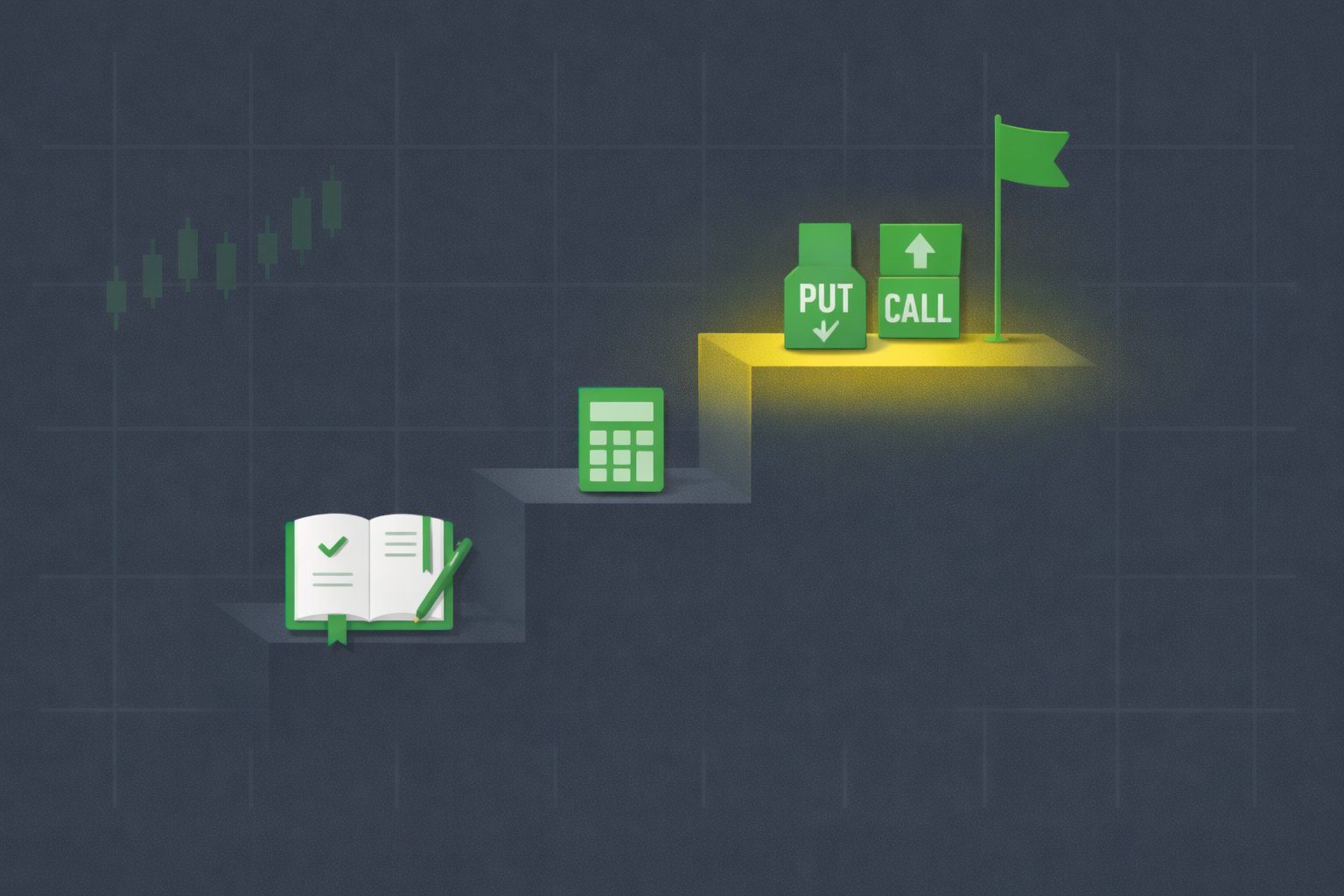
You have a watchlist, a journal, and a few months of trades. Step 18 lifts you from beginner to steady intermediate by widening your toolkit carefully: larger but still measured size, layered strategies, and clearer performance metrics. The goal is not more excitement—it is repeatability with slightly more complexity.
TL;DR
- Raise size slowly: increase contract count only after 20–30 calm, journaled trades
- Layer strategies with intent: pair CSP entries with covered calls exits; add protective puts only for concentration
- Track risk-adjusted metrics (win rate, average credit, max drawdown) instead of only premium totals
- Run small experiments, one variable at a time, and review results monthly
- Keep core rules: valuation first, margin of safety intact, cash buffer protected
Define what “intermediate” means
- Consistency: A streak of journaled trades that follow your plan, not your feelings.
- Measured size: Moving from 1% to 2–3% per position after you’ve proven discipline.
- Strategy stacking: Combining CSPs for entry and covered calls for exit on the same ticker, guided by valuation.
- Risk literacy: Comfort with Greeks at a high level—delta for direction, theta for time, vega for volatility—without chasing complexity.
Before stacking strategies, revisit the mechanics in /blog/cash-secured-puts-strategy/cash-secured-puts-getting-paid-to-wait and the covered call guide at /blog/covered-call-strategy/covered-calls-strike-price-selection. They remain your foundation.
A structured step-up plan
- Performance review: Calculate win rate, average premium per trade, and largest drawdown over the last 90 days.
- Incremental sizing: If rules were followed, raise max position size from 1% to 2% for the next 10 trades. If discipline slips, revert.
- Strategy pairing: Choose one quality company, sell a CSP near your buy zone, and prewrite the covered call you’ll sell if assigned.
- Risk practice: For a concentrated holding, test a single protective put to learn how hedges feel without overcommitting.
- Monthly retro: Grade yourself on process (followed plan?), risk (stayed within size?), and mindset (journaled?).
Numeric example: stepping up with control
Portfolio: $120,000. Previous max trade size: 1% ($1,200). After a quarter of disciplined execution, you raise the limit to 2% ($2,400).
- CSP leg: Sell one $45 put for $2.00 on a stock you value at $60, collateral $4,500. That is 3.75%—too high. You drop to one $40 strike instead at $1.10, collateral $4,000, or 3.3%. Still above plan, so you instead sell a $42.50 strike with $1.50 premium and keep size to one contract, $4,250 collateral or 3.5%. To stay within 2%, you decide to wait or choose a smaller-price ticker. Discipline wins.
- Assignment plan: If assigned 100 shares at $42.50, you will sell a $50 covered call for $1.80, aiming to exit near your fair value with added income.
- Hedge test: On a $15,000 concentrated holding, you buy a single three-month protective put for $250 to learn how hedges affect P&L.
The upgrade is measured: more intentional strategy pairing, not reckless leverage.
Metrics that matter at this stage
- Process adherence rate: Percent of trades that followed your written plan.
- Return per unit risk: Premium collected divided by collateral or capital at risk.
- Max drawdown: Largest peak-to-trough drop; keep it in single digits.
- Time-in-trade: Shorter average durations reduce gap risk if your plan calls for it.
These metrics beat raw premium totals because they reveal whether your process scales.
Build an intermediate dashboard
- Weekly scorecard: Track five numbers: win rate, average credit, average collateral, max drawdown, and percent of trades that followed the plan. Keep it to one page.
- Playbook library: Save one-page summaries for each strategy you use—CSPs, covered calls, protective puts. Note your preferred DTE, strike distance, and exit rules.
- Scenario drills: Once a month, run through “what if” cases: IV spike, market gap down, sudden assignment. Write the move you would make at each stage.
- Upgrade rule: Only add a new tactic (like diagonals) after two months of clean execution with current tools and after reading its playbook three times.
Intermediate investors succeed by removing friction. A small dashboard keeps you from chasing shiny new trades when the basics already work.
Take ten minutes each Sunday to update the dashboard. The habit cements process over pride and makes Monday decisions calmer.
What could go wrong?
- Size creep: Raising size too quickly after a lucky streak. Mitigation: require 20–30 documented trades between size bumps.
- Strategy overload: Adding diagonals, calendars, and spreads all at once. Mitigation: one new tactic at a time with tiny size.
- Ignoring drawdowns: Growing exposure while equity curve is falling. Mitigation: pause new trades until drawdown recovers to a preset level.
- Data blindness: Not measuring anything. Mitigation: build a simple spreadsheet for win rate, average credit, and max loss per trade.
Next steps
- Review your last 90 days of trades and record win rate, average credit, and drawdown
- Set the next position-size ceiling (e.g., 2%) and the rule for when to revert to 1%
- Pick one ticker to pair CSP entry with a planned covered call exit
- Test a single protective put on your most concentrated position
- Schedule a monthly retro to decide if you are ready for the next small size increase
*Disclaimer: This content is for educational purposes only and does not constitute financial advice. Past performance does not guarantee future results. Always conduct your own research before investing.*