
Step 14: Build a Portfolio
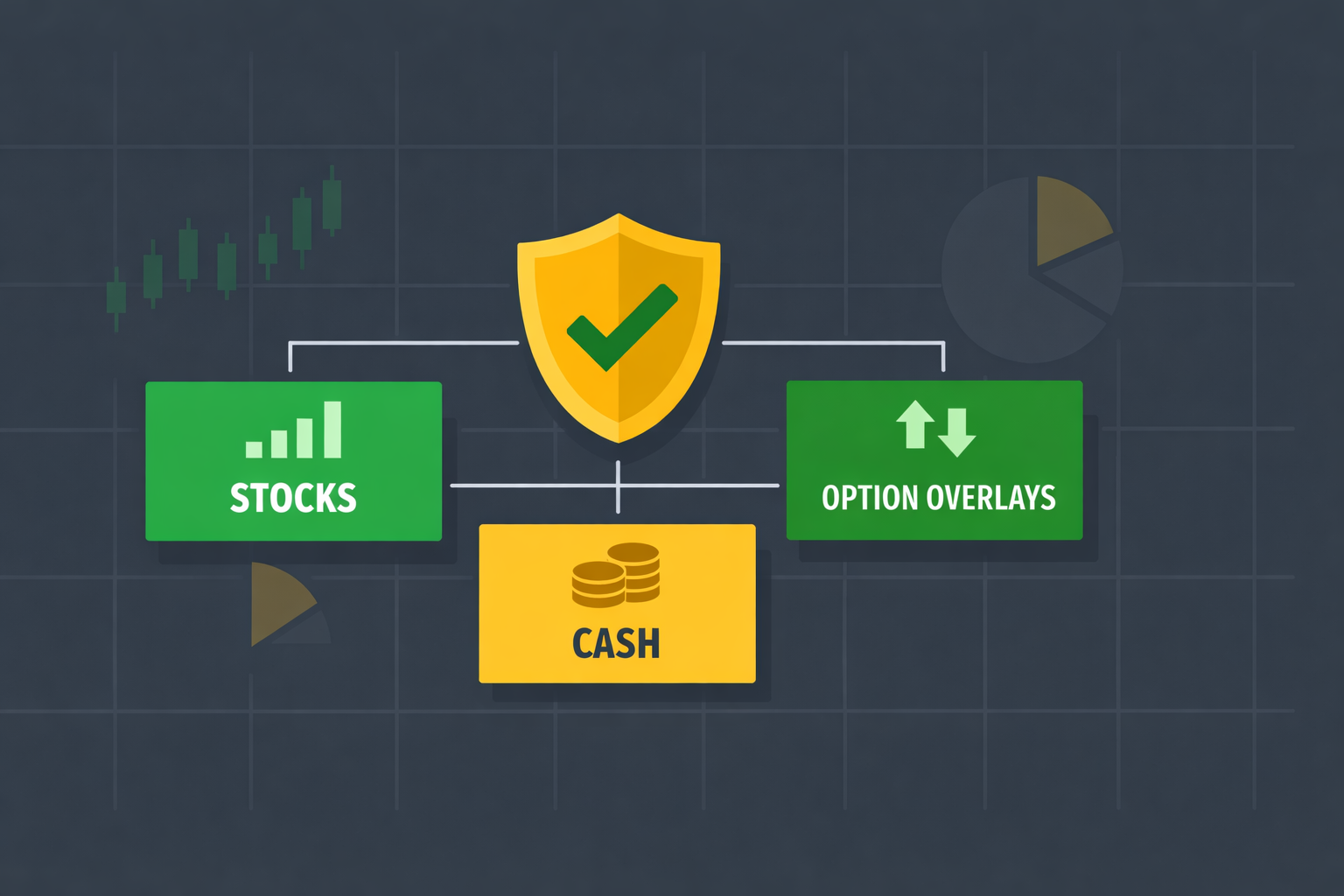
Random trades can make money by luck, but a loose portfolio burns confidence. Step 14 turns your skills into a structure: a core of wonderful businesses, cash for patience, and option overlays that follow your valuation work instead of driving it. When the structure is clear, every contract has a job and you sleep easier.
TL;DR
- Anchor the portfolio to intrinsic value first, then layer options as supporting moves
- Split capital into clear buckets: core stocks, cash for patience, and option overlays sized by risk
- Use position-size rules (1–5% per stock, smaller for options) to avoid concentration accidents
- Rebalance on a schedule, not on emotion; trim winners that drift above fair value
- Keep a written playbook that links every position to a thesis, price target, and exit rule
Why structure matters before size
Valuation skills need a container. Without it, income trades creep bigger, cash disappears, and one earnings surprise skews the whole account. A structured portfolio creates:
- Role clarity: Core stocks compound business quality, cash pays for patience, options add income or protection.
- Decision speed: When price moves, you already know whether to roll, trim, or add because the rules are written.
- Behavior guardrails: Structure absorbs emotion. If a stock jumps 20% above your Wall St Yardie fair value, your plan says to trim or sell calls, not to hope.
Build a simple core–satellite map
Set capital buckets
Start with three buckets and adjust percentages to your risk tolerance:
- Core equity (50–70%): Wonderful companies trading at or below intrinsic value with a margin of safety.
- Cash reserve (15–30%): Dry powder for drawdowns and for selling cash-secured puts when prices drop.
- Option overlays (10–25%): Covered calls on owned shares, cash-secured puts on watchlist names, and occasional protective puts for concentrated positions.
Write position-size rules
- Core stock size: 1–5% of portfolio per name, depending on conviction and balance sheet strength.
- CSP size: One contract per 1–2% of total capital, only when the strike sits near your fair value minus margin of safety.
- Covered calls: One contract per 100 shares, only above your valuation-based exit.
- Protective puts: Small, time-bound insurance for concentrated holdings.
Tie every decision to valuation
Calculate fair value with the Wall St Yardie app when possible—cheat using the Wall St Yardie app for fast, consistent intrinsic value math. Strikes and exits should reference that number, not today’s price.
A round-number example
Assume $100,000 portfolio value:
- $60,000 in five core stocks at 12% each, all trading 20% below your fair value targets.
- $20,000 in cash as a patience buffer.
- $20,000 earmarked for option overlays.
You sell two cash-secured puts on a watchlist stock at a $45 strike when your fair value is $55. Each contract ties up $4,500, or 4.5% of capital. You also write covered calls on 200 shares of a core holding at a strike 15% above your fair value exit, collecting $400 in premium. If assigned, you realize a disciplined exit; if not, you keep income that lowers cost basis. The buckets stay intact and nothing breaches your sizing rules.
Integrate income and defense without overlap
- Income first, defense second: Covered calls and CSPs should never consume the cash you need for protective puts or new entries.
- Match duration to intent: 30–45 DTE for steady income, longer-dated calls only if you are willing to exit the shares.
- Rotate attention: One week focus on income rolls, another on risk review. This prevents overtrading a single lever.
For more detail on strike discipline, revisit the earlier step on income overlays: /blog/step-by-step-beginner-blueprint/blueprint-step-12-income. Pair that with sizing rules from /blog/portfolio-construction/portfolio-options-position-sizing to keep every contract in bounds.
Rebalance on purpose, not emotion
- Quarterly checkups: Compare each holding to its fair value; trim above-target names or add calls to harvest gains.
- Cash refills: After a string of income trades, move a portion of premiums back into the cash bucket.
- Drift control: If any position crosses 15% of the portfolio, reduce it unless your thesis has strengthened and risk is controlled.
What could go wrong?
- Overconcentration sneaks in: A winning stock grows to 20% and options magnify exposure. Mitigation: hard cap single-position weight and roll calls higher to trim exposure.
- Cash gets drained by premiums: Spending premiums eliminates your patience buffer. Mitigation: earmark at least half of collected premiums to replenish cash.
- Too many contracts at once: Managing five rolls at earnings time raises error risk. Mitigation: stagger expirations and keep an active list of upcoming events.
- Valuation drift: Market excitement tempts you to raise fair value without evidence. Mitigation: keep the original thesis and valuation note in your journal; update only after new fundamentals, not price.
Next steps
- Map your current holdings into core, cash, and overlay buckets
- Set written size limits for stocks, CSPs, covered calls, and protective puts
- Calculate fair values with Wall St Yardie and align strikes to those targets
- Schedule a quarterly rebalance review on your calendar
- Update your journal so every position lists its role, target, and exit plan
*Disclaimer: This content is for educational purposes only and does not constitute financial advice. Past performance does not guarantee future results. Always conduct your own research before investing.*