
Historical Use of Protective Puts
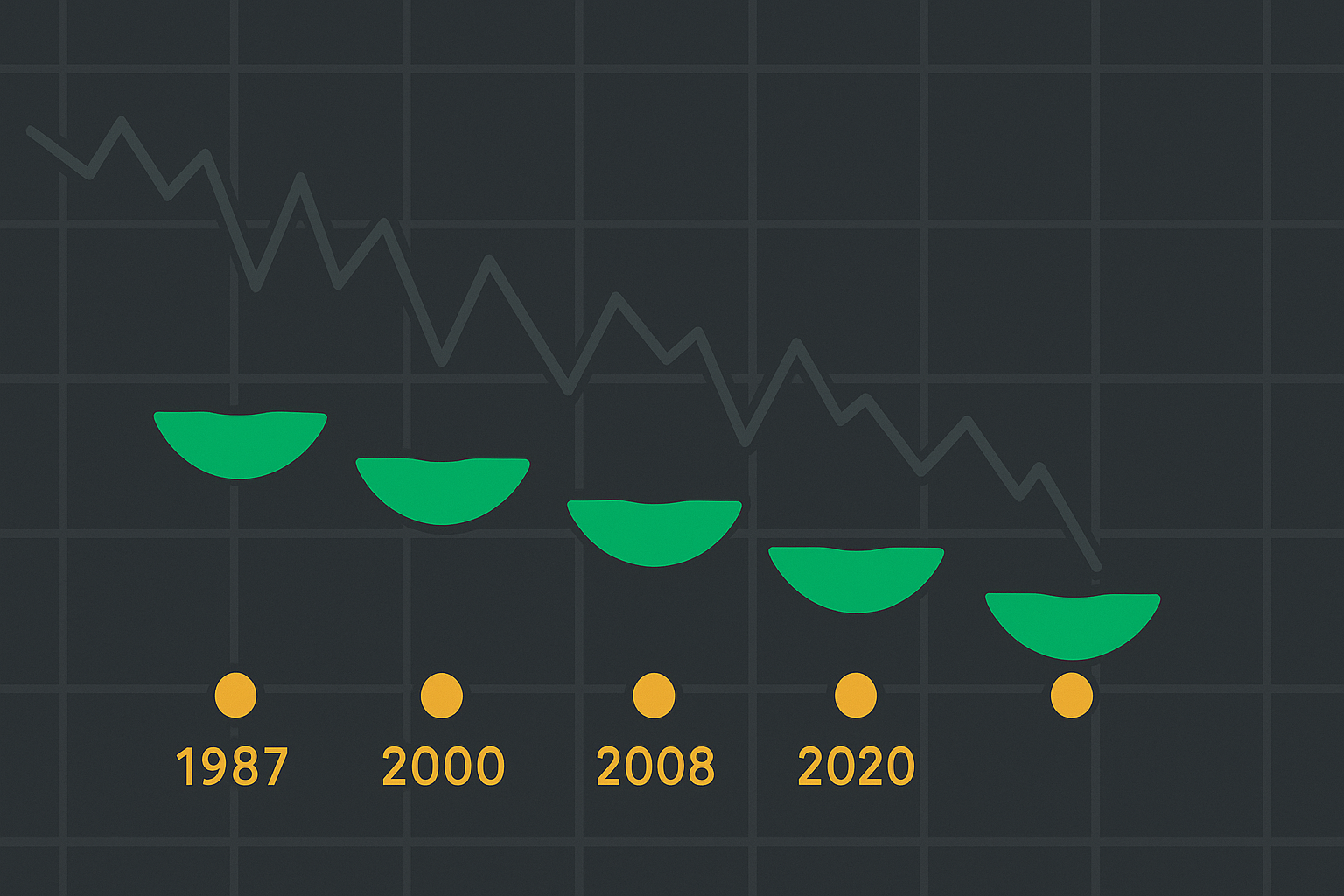
The best lessons in investing come from history. Protective puts have been around since the 1970s, but their real value became crystal clear during three major downturns: the 2000-2002 tech crash, the 2008 financial crisis, and the March 2020 COVID crash. Investors who used puts intelligently limited losses, preserved capital, and had cash to buy bargains when panic peaked. Those who didn't either rode portfolios down 40-60% or panic-sold at the bottom.
TL;DR
- 1987 crash: portfolio insurance (put-based hedging) collapsed due to poor execution, but individual protective puts worked as designed
- 2000-2002 tech crash: puts protected value investors who held quality stocks while speculative names collapsed
- 2008 financial crisis: puts on financials and indexes saved portfolios, especially those with concentrated positions
- March 2020 COVID crash: short-term puts captured 30% drops in 3 weeks, preventing permanent losses for hedged investors
- Key lesson: puts work best when volatility spikes before the crash, not after, timing and cost matter
1987: The Flash Crash and Portfolio Insurance
October 19, 1987, the Dow dropped 22% in a single day, the largest one-day percentage decline in history. The crash exposed a flawed strategy called "portfolio insurance," where institutions used dynamic hedging (selling index futures to replicate puts) instead of buying actual protective puts.
What went wrong: Portfolio insurance relied on liquidity, the ability to sell futures contracts as the market dropped. When everyone tried to sell at once, liquidity vanished, and the strategy collapsed. Institutions that thought they were protected lost billions.
What worked: Individual investors who bought actual protective puts on their stock positions were protected. If you owned 100 shares of a blue-chip stock at $50 with a $45 put, your max loss was $5 per share, not the $11 the market lost. When the dust settled, hedged investors still owned their shares and captured the recovery.
Lesson: Real puts work. Synthetic hedges (like dynamic rebalancing) fail during liquidity crunches. Buy actual insurance, not replicas.
2000-2002: The Tech Crash
The dot-com bubble burst in March 2000. Over the next two and a half years, the NASDAQ fell 78% from peak to trough. Speculative tech stocks went to zero, while value stocks (industrials, financials, consumer staples) held up better but still dropped 20-40%.
Who used protective puts effectively:
- Value investors with concentrated positions in quality companies bought puts during late 1999 and early 2000 when implied volatility was still moderate
- Put premiums were 2-4% of stock value for 6-month contracts, expensive but not absurd
- When the crash came, these puts capped losses at 10-15% while unhedged portfolios dropped 30-50%
Example: An investor holds 500 shares of "IndustrialCo" at $80 in January 2000. They buy 6-month puts with a $75 strike for $4 per share ($2,000 total). By July 2000, the stock drops to $60. The puts are worth $15 ($75 strike minus $60 stock = $15 intrinsic value). The investor sells the puts for $7,500, offsetting most of the $10,000 stock loss. Net loss: $4,500 instead of $10,000.
Lesson: Protective puts don't eliminate losses, they limit them. That preserved capital let hedged investors buy quality stocks at deep discounts in 2001-2002, setting up strong returns when the market recovered.
2008: The Financial Crisis
The 2008 crisis was different. It wasn't a bubble pop, it was a systemic collapse. From October 2007 to March 2009, the S&P 500 fell 57%. Financials dropped 80%, and even high-quality companies lost 40-60%.
Who won with protective puts:
- Investors who bought puts on financial stocks in mid-2007 (when Bear Stearns first stumbled) locked in protection before premiums skyrocketed
- Index puts on SPY or IWM hedged entire portfolios, especially useful for investors holding 15-20 stocks with no single hedge target
- Put buyers who rolled their positions (extending expiration dates) stayed protected through the entire 18-month crash
Example: An investor holds $100,000 in a diversified portfolio in August 2007. Nervous about credit risks, they buy 12-month SPY puts (S&P 500 ETF) with a strike 10% below current prices, costing $5,000. By October 2008, the S&P has dropped 40%. The puts are worth $30,000. The investor's portfolio lost $40,000 in stock value but gained $25,000 from puts (original $5,000 cost, now worth $30,000). Net loss: $20,000 instead of $40,000.
Lesson: Index puts work beautifully for broad market crashes. They're cheaper than hedging every individual stock and capture systemic risk better than diversification alone.
March 2020: The COVID Crash
This was the fastest crash in history. The S&P 500 dropped 34% in 23 days (February 19 to March 23, 2020). No one saw it coming, but investors who maintained rolling put positions or bought puts during the early volatility spike (late February) protected themselves.
Who won:
- Investors who bought short-term puts (30-60 days) in late February when the virus news started hitting markets
- Put premiums spiked as implied volatility exploded, but early buyers got protection before costs went insane
- Those with puts on concentrated positions (especially travel, energy, financials) saved massive losses
Example: An investor holds 200 shares of "AirlineCo" at $50 in early February 2020. They buy 90-day puts with a $45 strike for $2 per share ($400 total). By mid-March, the stock crashes to $20. The puts are worth $25 ($45 strike minus $20 stock). The investor sells the puts for $5,000, offsetting most of the $6,000 stock loss. They either hold the stock (believing in long-term recovery) or sell and reinvest elsewhere.
What didn't work: Investors who waited until mid-March to buy puts paid 5-10x more for protection. By then, implied volatility had spiked to historic highs, making puts prohibitively expensive. The lesson: hedge before the crash, not during it.
Patterns Across All Crashes
1. Puts work when bought early: Premiums are lowest when markets feel safe. By the time panic sets in, puts are expensive and less effective.
2. Short-term puts capture fast crashes: 2020 proved that 60-90 day puts work well for sudden drops. Long-term puts (6-12 months) work better for slow, grinding declines like 2008.
3. Index puts beat individual stock puts for broad crashes: When the whole market falls, hedging the S&P 500 is cheaper and more efficient than hedging 10-20 individual stocks.
4. Protective puts preserve capital for recovery opportunities: The real value isn't avoiding losses, it's having cash and shares intact to buy bargains when the market bottoms.
What Could Go Wrong?
- Buying puts too late: waiting until the crash starts means paying 3-5x more for protection, reducing net savings
- Under-hedging: buying puts for only 50% of your position means losses still hurt, hedge the full position or skip it
- Rolling puts indefinitely: extending protection month after month drains returns. Use puts for specific threats, not permanent insurance
- Ignoring recovery timing: puts expire. If the market rebounds before your protection ends, you lose the premium and miss gains
- Over-relying on historical patterns: each crash is unique. 2020 was fast, 2008 was slow, 2000 was sector-specific. Adjust your put strategy to current risks
Next Steps
- Study past crashes to understand how protective puts would have performed in your portfolio
- Identify which major downturns match your current market concerns (sector crash, broad decline, flash crash)
- Learn to time protective puts by watching implied volatility
- Understand when NOT to use protective puts to avoid wasting capital
- Review the protective put checklist before placing your next hedge
*Disclaimer: This content is for educational purposes only and does not constitute financial advice. Past performance does not guarantee future results. Always conduct your own research before investing.*