
Balancing Stocks, Cash, and Options
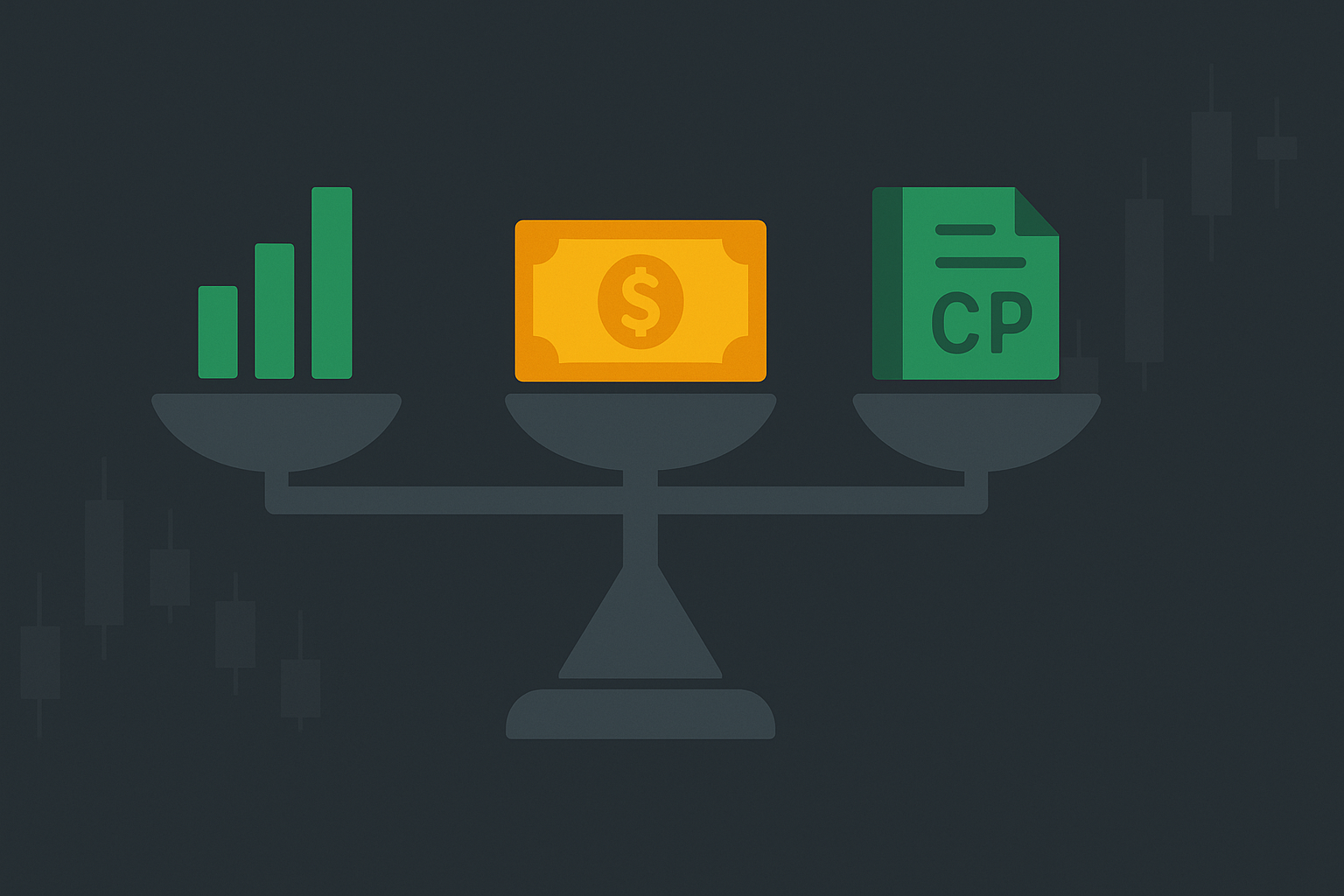
A portfolio with 100% stocks leaves no room to act when opportunities appear. A portfolio with too much cash earns nothing. A portfolio loaded with options trades becomes speculation. The right balance between stocks, cash, and options determines whether you compound wealth steadily or bounce between overexposure and missed chances.
TL;DR
- Stocks are the foundation: 60-80% equity ownership in wonderful businesses provides long-term compounding
- Cash is opportunity: 10-20% reserves let you buy during crashes and avoid forced selling
- Options are leverage and income: 10-30% in strategies (covered calls, puts, LEAPs) boost returns without replacing equity
- Rebalance with discipline: Adjust allocation based on valuation, not emotion
- No perfect formula: Your balance depends on age, goals, risk tolerance, and market conditions
Why Balance Matters
Imagine two investors. The first puts 100% of her portfolio into undervalued stocks. When the market crashes 30%, she has no cash to buy at better prices. She's fully invested at the wrong time. The second investor holds 50% cash, waiting for the "perfect" entry. Markets rally 50%, and he misses the entire move. Both failed because of poor allocation.
Balance isn't about perfection, it's about flexibility. You need enough stocks to capture long-term growth, enough cash to act when fear spikes, and enough options exposure to generate income or amplify high-conviction ideas. The right mix depends on your situation, but the principle is universal: diversify across asset types, not just stocks.
The Three-Part Allocation Framework
Stocks (60-80%): The Core
This is where wealth compounds. Stocks represent ownership in real businesses, businesses that grow earnings, generate cash flow, and increase intrinsic value over time. Your stock allocation should focus on wonderful companies trading below fair value.
Why 60-80%? This range provides meaningful equity exposure without leaving you trapped. If you hold 90% stocks and need liquidity during a crash, you're forced to sell at terrible prices. If you hold 40% stocks, you're underexposed and miss compounding.
What qualifies as "stocks" here:
- Long-term equity positions in undervalued companies (buy and hold for years)
- Stocks you'd be happy owning even if the market closed for a decade
- Companies with economic moats, steady earnings, and strong balance sheets
What doesn't qualify:
- Short-term trades or speculative bets
- Companies you're only holding to collect option premiums (that's satellite, not core)
- Overvalued stocks you're hoping to flip for quick gains
Example: You have $100,000. You allocate $70,000 (70%) to a portfolio of 12-15 high-quality value stocks. You buy shares in companies with earnings yields above 10%, low debt, and predictable cash flows. You hold these for 5-10 years, adding during dips and letting compounding do the work.
Cash (10-20%): The Safety Valve
Cash doesn't earn much, but it buys optionality. When markets crash, cash lets you act while others panic. When a wonderful company hits an air pocket, cash lets you load up. When life throws a curveball, cash prevents forced selling of winners.
Why 10-20%? Too little cash (5%) leaves no margin for error. Too much cash (40%) drags returns and makes you a market timer. 10-20% gives flexibility without sacrificing growth.
What qualifies as "cash":
- Money market funds, Treasury bills, or high-yield savings accounts
- Dry powder waiting for opportunities, not money "parked" because you're scared
- Reserves to cover 6-12 months of living expenses if this is retirement money
When to use cash:
- Market selloffs where valuations improve dramatically (20-30% drops)
- Individual stocks you've been watching hit attractive entry points
- Selling cash-secured puts to enter positions at discounts
Example: You keep $15,000 (15%) in cash. During a 25% market correction, you deploy $5,000 buying more shares of core holdings at lower prices. You sell $5,000 worth of cash-secured puts on companies you want to own, collecting premium while waiting for assignment. You keep $5,000 in reserve for deeper opportunities.
Options (10-30%): The Amplifier
Options enhance returns, but they're not the portfolio. This allocation includes covered calls on existing stock, cash-secured puts to enter new positions, LEAPs for leveraged upside, and protective puts for downside insurance. The exact mix depends on strategy, but total option exposure should never dominate equity.
Why 10-30%? Options add flexibility and income, but they expire. If 50% of your portfolio is tied to option contracts, you're speculating, not investing. Keep options as a strategic overlay, not the main event.
What qualifies as "options":
- Premiums collected from covered calls and cash-secured puts (income strategies)
- Capital allocated to LEAPS contracts (leverage on high-conviction ideas)
- Cost of protective puts (insurance on concentrated positions)
What doesn't qualify:
- Short-term speculative trades (weekly options, naked calls/puts)
- Strategies you don't understand or can't explain simply
- Options on companies you wouldn't own as stock
Example: You allocate $15,000 (15%) to options. You sell $5,000 in covered calls on stocks that have appreciated near your fair value estimate, collecting 6-8% annualized premium. You sell $5,000 in cash-secured puts on a company you want to own at $80 per share (current price: $90), earning premium while waiting. You buy $5,000 in LEAPS contracts on a high-conviction stock trading at 60% of intrinsic value, controlling 300 shares with less capital.
How to Rebalance
Markets move, valuations shift, and your allocation drifts. Rebalancing keeps the portfolio aligned with your philosophy.
When to rebalance:
- Quarterly review: Check if your allocation has drifted more than 5-10% from targets. If stocks are now 85% instead of 70%, trim and add to cash or options.
- After major moves: If the market rallies 40% in a year, your stock allocation is likely too high. Take some profits, build cash reserves, or sell covered calls to generate income.
- When valuations shift: If 80% of your stocks are now trading above intrinsic value, reduce equity exposure, increase cash, and wait for better entries.
How to rebalance:
- Don't sell winners to chase losers: If a stock appreciates because the business is performing well, let it run. Trim only if valuation becomes extreme.
- Use options to rebalance: Sell covered calls on appreciated stocks to reduce exposure without triggering capital gains. Sell cash-secured puts to deploy cash without buying outright.
- Add to underweight areas with new capital: If you're saving monthly, allocate new money to the asset class that's below target (cash, stocks, or options).
Example: Your portfolio started at 70% stocks, 15% cash, 15% options. After a bull run, it's now 80% stocks, 10% cash, 10% options. You sell covered calls on your most appreciated stocks, collecting premium and capping upside. You don't buy more stocks. You let cash build back to 15% over the next few months through fresh savings and option premiums.
Adjusting for Life Stage and Goals
Your allocation isn't static, it evolves as your situation changes.
Young investors (20s-40s): Focus on growth. Allocate 75-80% to stocks, 10-15% to cash, 10-15% to options (mostly LEAPs for leverage). You have time to recover from volatility and can afford to be aggressive.
Mid-career investors (40s-50s): Balance growth and income. Allocate 65-75% to stocks, 15-20% to cash, 15-20% to options (covered calls and puts for income). You're building wealth but need to protect what you've accumulated.
Pre-retirement and retirees (60+): Prioritize income and capital preservation. Allocate 60-70% to stocks (high-quality, dividend-paying), 20-25% to cash (liquidity for living expenses), 10-15% to options (covered calls for income, protective puts for insurance). You can't afford a 50% drawdown without recovery time.
What Could Go Wrong?
Even with a plan, allocation mistakes happen. Here's what to avoid:
Over-allocating to options: Chasing premium income feels good until market volatility spikes and all your short puts get assigned at once. Suddenly 40% of your portfolio is in stocks you bought at the wrong price.
Mitigation: Cap option exposure at 30%. Spread strategies across multiple positions and timeframes.
Letting cash sit idle too long: Cash reserves are for opportunistic buying, not market timing. If you've been 100% cash for two years "waiting for a crash," you've lost compounding.
Mitigation: Deploy cash gradually through cash-secured puts or dollar-cost averaging. Don't wait for perfection.
Chasing performance by shifting allocations: When covered calls work great, you increase option exposure to 50%. When stocks rally, you push to 90% equity. This is chasing past returns, not planning future ones.
Mitigation: Rebalance based on valuation and goals, not recent performance. Stick to your target ranges.
Forgetting taxes and liquidity: Frequent rebalancing triggers capital gains. Over-allocating to illiquid options (long-dated LEAPS, low-volume contracts) locks up capital.
Mitigation: Rebalance in tax-advantaged accounts when possible. Keep most options in liquid, high-volume names.
Ignoring opportunity cost: Holding 30% cash "just in case" for five years costs you compounding. Every allocation decision has trade-offs.
Mitigation: Match cash levels to market valuation. In cheap markets, drop to 10% cash. In expensive markets, raise to 20%. Let valuation guide allocation.
Next Steps
- Calculate your current allocation: Add up equity, cash, and option exposure. Compare to your target
- Set target ranges: Define your ideal 60-80% stocks, 10-20% cash, 10-30% options based on age and goals
- Read Portfolio Construction Checklist: Build a system for maintaining balance
- Explore The Role of Income Strategies: Learn how covered calls and puts fit into allocation
- Study Using Cash as Strategic Dry Powder: Maximize the value of cash reserves
Balance isn't about rigidity, it's about having a plan and sticking to it when emotion screams otherwise. Build the structure first, then let compounding do the heavy lifting.
*Disclaimer: This content is for educational purposes only and does not constitute financial advice. Past performance does not guarantee future results. Always conduct your own research before investing.*