
The Greeks Made Simple
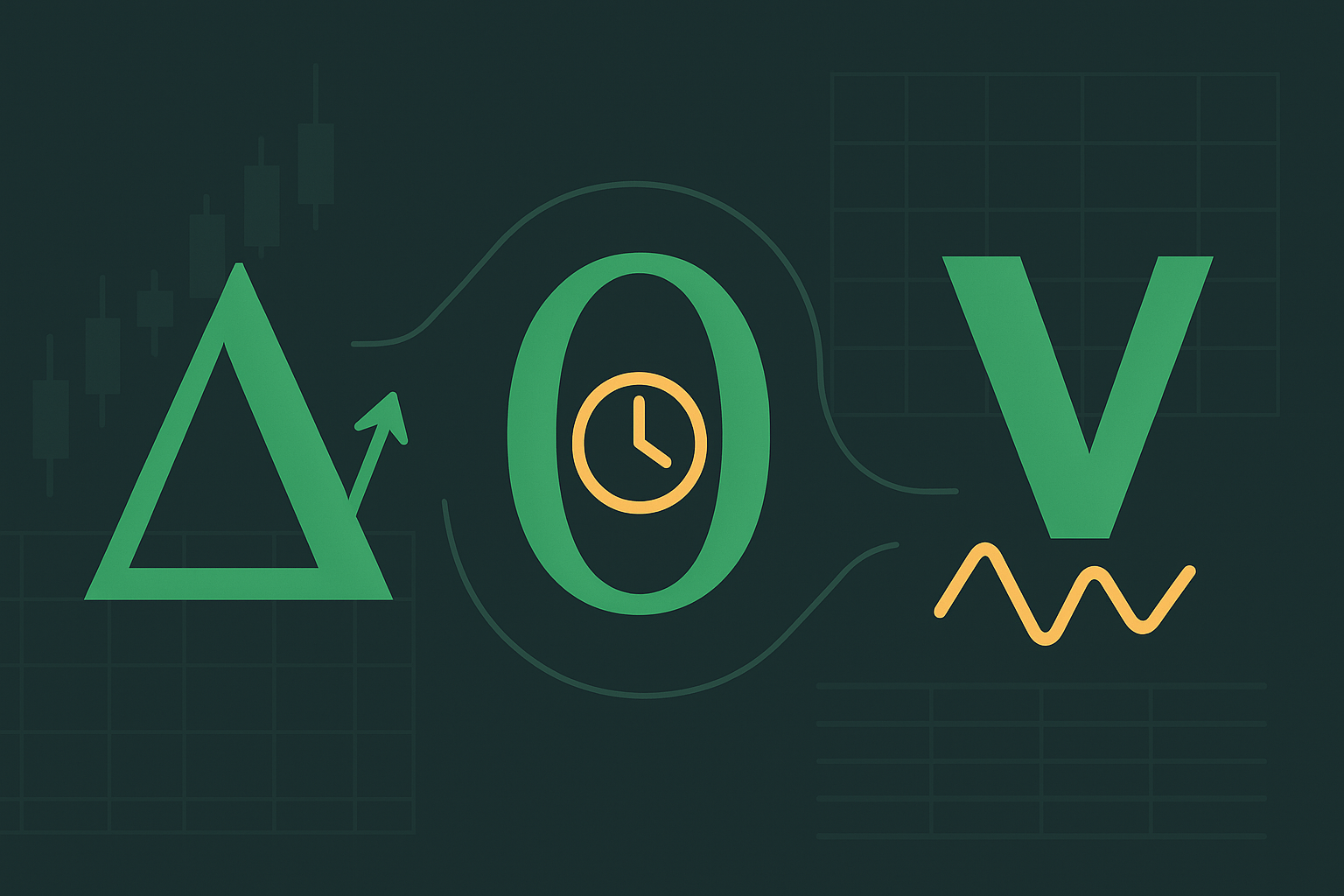
The Greeks sound like ancient mythology, but they're actually the most practical tools for understanding how your options will behave. Think of them as your option's vital signs—they tell you exactly how sensitive your position is to changes in stock price, time, and volatility. Master these three core Greeks (delta, theta, vega) and you'll never be surprised by how your options perform again.
TL;DR
- Delta tells you speed: How much your option price moves when the stock moves $1—it's your profit/loss accelerator
- Theta shows time decay: How much value your option loses each day, even if the stock stays flat—time is not your friend (when buying options)
- Vega reveals volatility sensitivity: How much your option gains or loses when market expectations change—the fear and greed meter
- Higher deltas = more stock-like behavior: Options with 70+ delta (0.7) move almost like owning shares, but with less money at risk
- Combine all three for smart decisions: Use Greeks together to understand total risk and choose the right strikes and expirations
Delta: Your Profit Accelerator
Delta measures how much your option price changes when the underlying stock moves $1. It ranges from 0 to 1 for calls (0 to -1 for puts) and acts like a speedometer for your position.
A call option with 0.5 delta means if the stock goes up $1, your option gains roughly $0.50. But delta isn't constant—it changes as the stock price moves. Options closer to being in-the-money have higher deltas, while far out-of-the-money options have deltas near zero.
For value investors, delta is crucial for position sizing. If you want $1,000 of Apple exposure but don't want to pay $180,000 for 1,000 shares, you can buy calls with 50 delta (0.5). You'd need roughly 20 contracts (2,000 shares worth of delta ÷ 100 shares per contract ÷ 0.5 delta per contract) to get similar price movement.
Deep in-the-money calls often have deltas above 0.8 (80 Delta), meaning they move almost like owning the stock but require much less money. This is perfect for value investors who want leverage on undervalued companies without tying up their entire portfolio.
Theta: The Silent Wealth Destroyer
Theta measures time decay—how much value your option loses each day, regardless of what the stock does. Unlike delta, theta is always working against you when you buy options, and it accelerates as expiration approaches.
An option with -0.05 theta loses about $5 per contract per day ($0.05 × 100 shares). This might seem small, but it adds up fast. Over 30 days, that's $150 in decay, and the rate increases dramatically in the final weeks.
Here's the key insight for value investors: Theta explains why buying options one month before earnings often fails. Even if you're right about the company's direction, time decay can eat most of your profits. The stock needs to move significantly just to overcome theta.
Options with 60-90 days to expiration typically offer the best balance of time value and reasonable theta decay. Going longer reduces daily theta but increases the premium cost, as you are buying more time. Going shorter (less time to expiration) and theta decay accelerates rapidly.
Vega: The Volatility Wild Card
Vega measures how much your option price changes when implied volatility moves 1%. This is where many investors get blindsided because vega can overwhelm both delta and theta during market stress, typically a big drop.
When markets get nervous, implied volatility spikes and all options become more expensive. When markets calm down, volatility drops and option values collapse—even if the stock doesn't move. An option with 0.15 vega gains $15 per contract if implied volatility increases by 1 percentage point.
Value investors need to understand vega timing. Buying options before earnings, FDA approvals, or other binary events means paying high vega premiums. The volatility often collapses immediately after the event, regardless of the outcome. You can be right about direction and still lose money due to vega crush.
The smart approach is buying options when volatility is low (cheaper vega) and selling when it's high. This aligns perfectly with value investing—buy when others are complacent, sell when they're fearful.
A Real-World Greek Example
Let's say Microsoft is trading at $350, and you're bullish on their AI prospects. You're comparing two call options:
Option A: $360 strike, 30 days out
- Delta: 0.35
- Theta: -0.08
- Vega: 0.12
- Premium: $4.50
Option B: $350 strike, 90 days out
- Delta: 0.55
- Theta: -0.04
- Vega: 0.20
- Premium: $12.00
If Microsoft rises to $360 in two weeks:
- Option A gains about $3.50 from delta ($10 move × 0.35) but loses $1.12 from theta (14 days × -0.08)
- Option B gains about $5.50 from delta but only loses $0.56 from theta
However, if implied volatility drops 2 points after good earnings:
- Option A loses $0.24 from vega (2 × 0.12)
- Option B loses $0.40 from vega (2 × 0.20)
This shows why longer-dated options often perform better despite higher premiums—they give your thesis time to play out while limiting theta damage.
Using Greeks Together: The Complete Picture
Smart options trading requires balancing all three Greeks based on your outlook and timeframe:
High conviction, shorter timeframe: Choose higher delta options, 60 Delta (0.6 or higher) to maximize directional exposure while accepting higher theta risk.
Moderate conviction, longer timeframe: Balance delta and theta with 60-90 day options around 0.4-0.6 delta or longer if this is a company you truly love and is under valued.
Volatile events approaching: Be cautious of high vega options unless you're specifically playing volatility expansion.
Many platforms show Greeks in real-time, so you can see exactly how your position will behave under different scenarios before you trade.
What Could Go Wrong?
Focusing only on delta: New traders often ignore theta and vega, then wonder why profitable stock moves don't translate to option profits.
Mitigation: Always check all three Greeks before entering any position. Factor in time decay and volatility changes in your profit calculations.
Greek values change constantly: The Greeks themselves move as the stock price changes, so your initial calculations may not hold.
Mitigation: Monitor your positions regularly and understand that Greeks are dynamic. Use position-sizing to manage the uncertainty.
Volatility timing mistakes: Buying expensive options before events or selling cheap options during calm periods.
Mitigation: Learn to identify high and low volatility environments. Consider avoiding trades when implied volatility is at extremes unless that's specifically your strategy.
Overcomplicating with too many variables: Analysis paralysis from trying to predict every Greek movement perfectly.
Mitigation: Start simple. Focus on delta for directional trades, theta for timing, and vega for event-driven positions. Advanced strategies come later.
Next Steps: Your Greeks Mastery Plan
- Learn to read Greeks on your platform: Most brokers display delta, theta, vega alongside option prices—familiarize yourself with the option chain layout
- Paper trade with Greek awareness: Practice tracking how actual Greek changes match your expectations over time
- Study basic option fundamentals: Ensure you understand underlying option mechanics before diving deeper into Greeks
- Understand implied volatility: Learn to identify high and low volatility environments for better vega timing
- Practice Greek-based position sizing: Use delta to calculate equivalent stock exposure and position appropriately
- Monitor real positions: Track how your actual returns break down between delta, theta, and vega components
- Explore covered call strategies: See how Greeks work when you're selling options instead of buying
- Master timing decisions: Learn when longer or shorter expirations make sense based on your thesis timeline
The Greeks transform options from gambling instruments into precision tools. They tell you exactly what risks you're taking and how to position appropriately. Like any skill, mastering Greeks takes practice, but the payoff is huge—you'll finally understand why your options behave the way they do.
Remember, the goal isn't to predict every Greek movement perfectly. It's to understand your risks upfront and position size accordingly. When you know a position has high theta, you won't panic if it loses value on flat days. When you understand delta, you'll size positions to get the exposure you actually want.
Keep the riddim steady and start incorporating Greeks into every options decision. Your future self will thank you when you're no longer surprised by option behavior that seems random but actually follows very predictable mathematical rules.
*Disclaimer: This content is for educational purposes only and does not constitute financial advice. Past performance does not guarantee future results. Always conduct your own research before investing.*