
Cash-Secured Puts as an Income Strategy
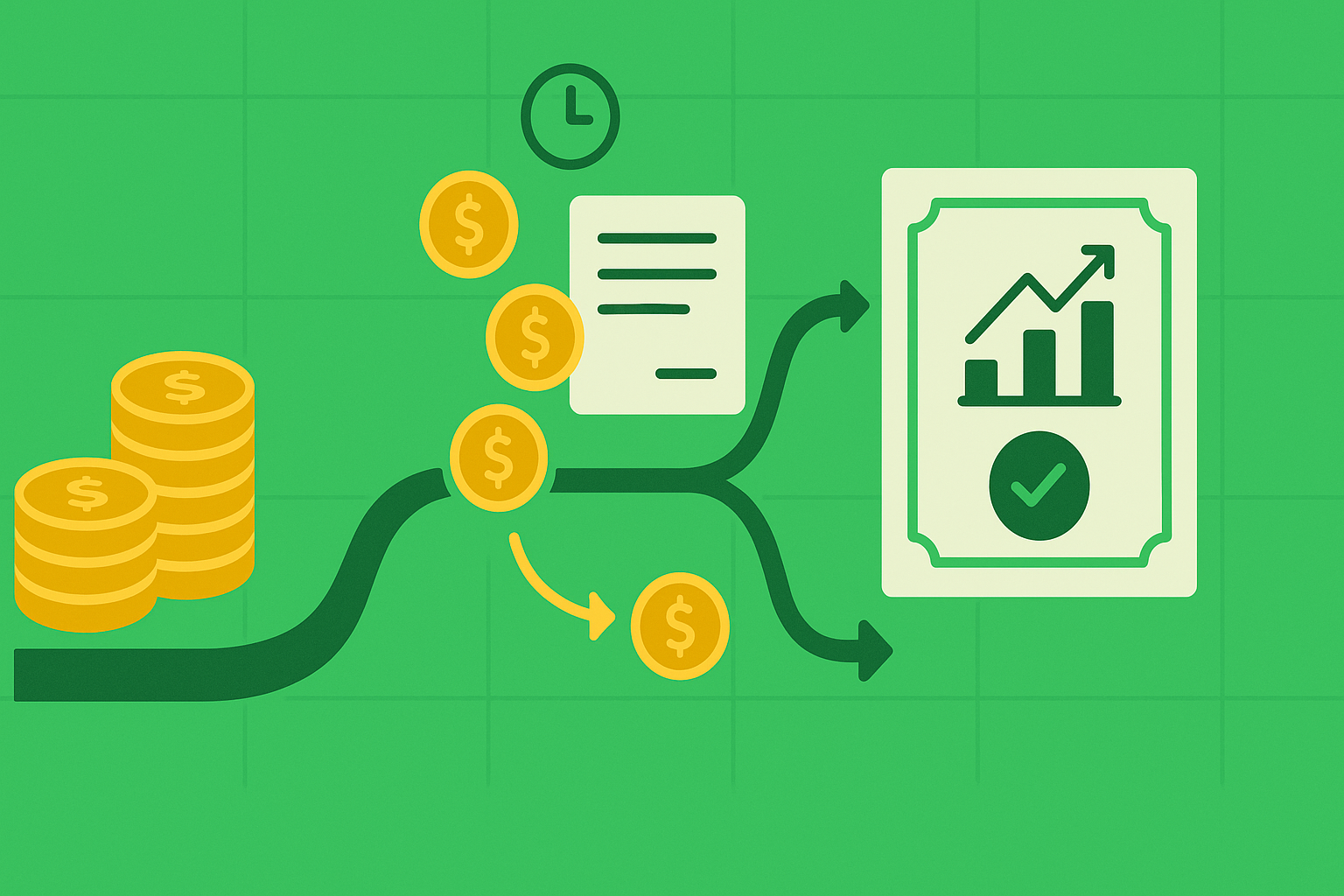
Most investors place a limit order and wait, hoping the stock drops to their target price. They might wait weeks, months, or forever while their cash earns nothing. But what if someone paid you to wait? That's exactly what cash-secured puts offer: income from cash that would otherwise sit idle.
TL;DR
- Get paid to wait: Collect premium income while your cash waits for buying opportunities
- Buy at your price: If assigned, you purchase the stock at your predetermined target price
- Double win potential: Either keep the premium (if stock stays above strike) or buy quality stocks at a discount
- Works with value analysis: Set strike prices based on your fair value calculations for built-in margin of safety
- Turns idle cash into working capital: Cash reserves become income generators instead of dead weight
The Idle Cash Problem
Value investors often keep cash on the sidelines waiting for the right opportunity. Maybe the market is overheated and nothing looks attractive. Maybe you're waiting for a specific company to drop to your target price. Either way, that cash sits in a money market earning 4-5% while you wait.
There's nothing wrong with patience. Holding cash until opportunities appear is a core value investing discipline. But there's a difference between patient cash and lazy cash.
Patient cash is ready to deploy at the right price. Lazy cash just sits there doing nothing extra. Cash-secured puts transform lazy cash into patient cash that earns premium income while waiting for your target prices.
How Cash-Secured Puts Generate Income
Here's the basic mechanics: You have $15,000 in cash. You want to buy 100 shares of a company trading at $160, but only if it drops to $150 (your calculated fair value with a margin of safety).
Instead of placing a limit order at $150 and waiting, you sell a put option at the $150 strike. Someone pays you $300 (the premium) for the right to sell you 100 shares at $150 by the expiration date.
Scenario 1: Stock stays above $150. The option expires worthless. You keep the $300 premium and still have your $15,000 in cash. You can sell another put next month.
Scenario 2: Stock drops below $150. You're assigned and buy 100 shares at $150. But you already collected $300, so your effective cost is $147 per share, even better than your target price.
Either outcome works. You're not gambling on direction. You're getting paid to commit to buying a stock you wanted anyway at a price you already determined was attractive.
A Complete Income Example
Let's walk through a full year of put selling on Microsoft (MSFT):
Starting situation:
- MSFT trades at $400
- Your fair value estimate: $380 (using Wall St Yardie)
- Your target buy price: $350 (10% margin of safety below fair value)
- Cash available: $35,000
Monthly put selling: You sell one monthly put at $350 strike each month. Average premium: $3.50 per share ($350 per contract).
Year 1 results (MSFT stays between $380-420):
- Puts sold: 12 contracts
- Total premium collected: $4,200
- Cash still available: $35,000
- Annual yield on cash: 12%
You earned 12% on cash that would have earned 4-5% in a money market. And you were ready to buy MSFT at $350 the entire time. If it had dropped to your price, you'd own a wonderful company at a great price plus all the premium collected up to that point.
Year 2 results (MSFT drops to $340 in month 6):
- Puts sold months 1-5: 5 contracts = $1,750 premium
- Month 6: Assigned at $350 strike
- Effective purchase price: $350 - $1,750/100 = $332.50
- You now own 100 shares at $332.50 (17% below fair value)
Even better. You collected income while waiting, then bought at an even lower effective price than your target. The premium income subsidized your entry, creating an even wider margin of safety.
Why This Works for Value Investors
1. It matches your existing discipline
You already identify companies you'd love to own at the right price. You already calculate fair value and determine entry points. Put selling just adds an income layer to that process.
If you'd buy a stock at $50, you should be happy to sell a $50 put and get paid while waiting. The worst case is you buy the stock you wanted at the price you wanted. That's not a risk, that's the plan.
2. It enforces price discipline
When you sell a put at $50, you've committed to that price. You can't panic and chase the stock higher if it rallies. You can't lower your standards when FOMO kicks in.
The put contract locks in your discipline. Either you get your price or you get paid for waiting. Both outcomes align with value investing principles.
3. It improves your entry price
Every premium collected reduces your effective purchase price. If you sell three monthly puts at $50 before being assigned, collecting $1.50 total, your effective price is $48.50, a 3% improvement on an already attractive entry.
Over time, this premium subsidy adds up. Aggressive put sellers might reduce their cost basis by 8-12% before ever owning shares.
4. It keeps you engaged without overtrading
Waiting for opportunities can feel passive. Put selling gives you something productive to do: evaluate strikes, collect premiums, track positions. You stay engaged with your watchlist without the temptation to chase mediocre opportunities.
Strike Price Selection for Income
Your strike price determines the balance between income and probability of assignment. Here's a framework:
Conservative approach (lower income, lower assignment risk):
- Strike price: 10-15% below current price
- Premium yield: 4-8% annualized
- Assignment probability: 15-25%
- Best for: Stocks you'd happily own but aren't eager to buy immediately
Moderate approach (balanced):
- Strike price: 5-10% below current price
- Premium yield: 8-15% annualized
- Assignment probability: 25-40%
- Best for: Stocks at fair value where you'd welcome a dip
Aggressive approach (higher income, higher assignment risk):
- Strike price: 2-5% below current price (or at-the-money)
- Premium yield: 15-25% annualized
- Assignment probability: 40-60%
- Best for: Stocks you actively want to own and would buy today at current prices
For income-focused value investors, the moderate approach usually makes sense. You're getting meaningful premium income while still requiring the stock to drop before you're assigned. Learn more about strike price selection.
Expiration Selection for Income
Shorter expirations generate more income per day (faster time decay) but require more management. Longer expirations are less work but tie up capital longer.
Weekly options:
- Highest annualized yield potential
- Most management work
- Best for: Active traders with time to monitor positions
Monthly options (30-45 days):
- Good balance of yield and efficiency
- Moderate management
- Best for: Most value investors seeking consistent income
Longer-dated options (60-90 days):
- Lower annualized yield
- Less management
- Best for: Busy investors or those seeking specific entry points
The sweet spot for most income-focused investors is 30-45 days to expiration. You capture meaningful time decay, have enough time for the trade to work, and only manage positions once a month.
What Could Go Wrong?
Stock crashes below your strike: You sell a $100 put, collect $3, and the stock drops to $70. You're assigned at $100, losing $27 per share (minus the $3 premium) for a net loss of $24 per share.
Mitigation: Only sell puts on companies you've thoroughly analyzed and would genuinely want to own through volatility. If you wouldn't hold the stock if it dropped 30%, don't sell puts on it. The underlying business quality matters more than the premium. See our guide on choosing the right stocks for puts.
Opportunity cost: Your $35,000 is locked as collateral for a put contract. While it's tied up, you can't deploy it elsewhere if a better opportunity appears.
Mitigation: Don't commit all your cash to put contracts. Keep 30-50% truly liquid for unexpected opportunities. Diversify across 3-5 different put positions rather than concentrating in one.
Missing the rally: The stock you wanted to buy rallies from $160 to $200 while you're selling $150 puts that never get assigned. You collected premium but missed the big move.
Mitigation: Accept that this is the trade-off. You're optimizing for entry price and income, not capturing every move. If you have high conviction that a stock will rally soon, buy shares directly instead of selling puts. Put selling is for patient accumulation, not momentum plays.
Assignment at the wrong time: You get assigned right before earnings, and the stock drops further on bad results. Now you own shares with an immediate loss.
Mitigation: Avoid selling puts that expire immediately after earnings announcements. Check the earnings calendar before selecting expiration dates. Close or roll positions before known volatility events. Read more about when not to sell puts.
Premium shrinks in low volatility: When markets are calm, put premiums drop. Your income strategy yields 6% instead of 12%.
Mitigation: Low volatility is actually good for value investors, it means less risk of dramatic drops. Accept lower premiums as the cost of stability. Focus on higher-quality companies that maintain reasonable volatility.
Next Steps
- Identify 3-5 companies you'd love to own at lower prices: These become your put-selling candidates
- Calculate your target entry prices: Use Wall St Yardie for fair value, then apply your margin of safety
- Check option liquidity: Ensure the stocks have active options markets with tight bid-ask spreads
- Start with one position: Sell one monthly put on your highest-conviction candidate
- Track your results: Record premium collected, strike price, expiration, and outcome
- Review and repeat: After expiration, evaluate results and decide whether to sell another put
- Build your system: Create a calendar for managing expirations and rolling positions
- Learn the deeper mechanics: Read our detailed guide on cash-secured put mechanics
Cash-secured puts transform the waiting game. Instead of idle cash earning money market rates while you hope for opportunities, your capital works continuously, generating income month after month.
You're still a value investor. You still demand quality companies at fair prices. You still maintain discipline about what you'll pay. The difference is you're getting paid for that discipline instead of just exercising it quietly.
Think of put selling as a toll booth on the road to stock ownership. Anyone who wants to sell you shares at your target price has to pay the toll first. Whether they cross or not, you collect the fee. That's income working for value investors.
*Disclaimer: This content is for educational purposes only and does not constitute financial advice. Past performance does not guarantee future results. Always conduct your own research before investing.*