
Reducing Market Timing Risk
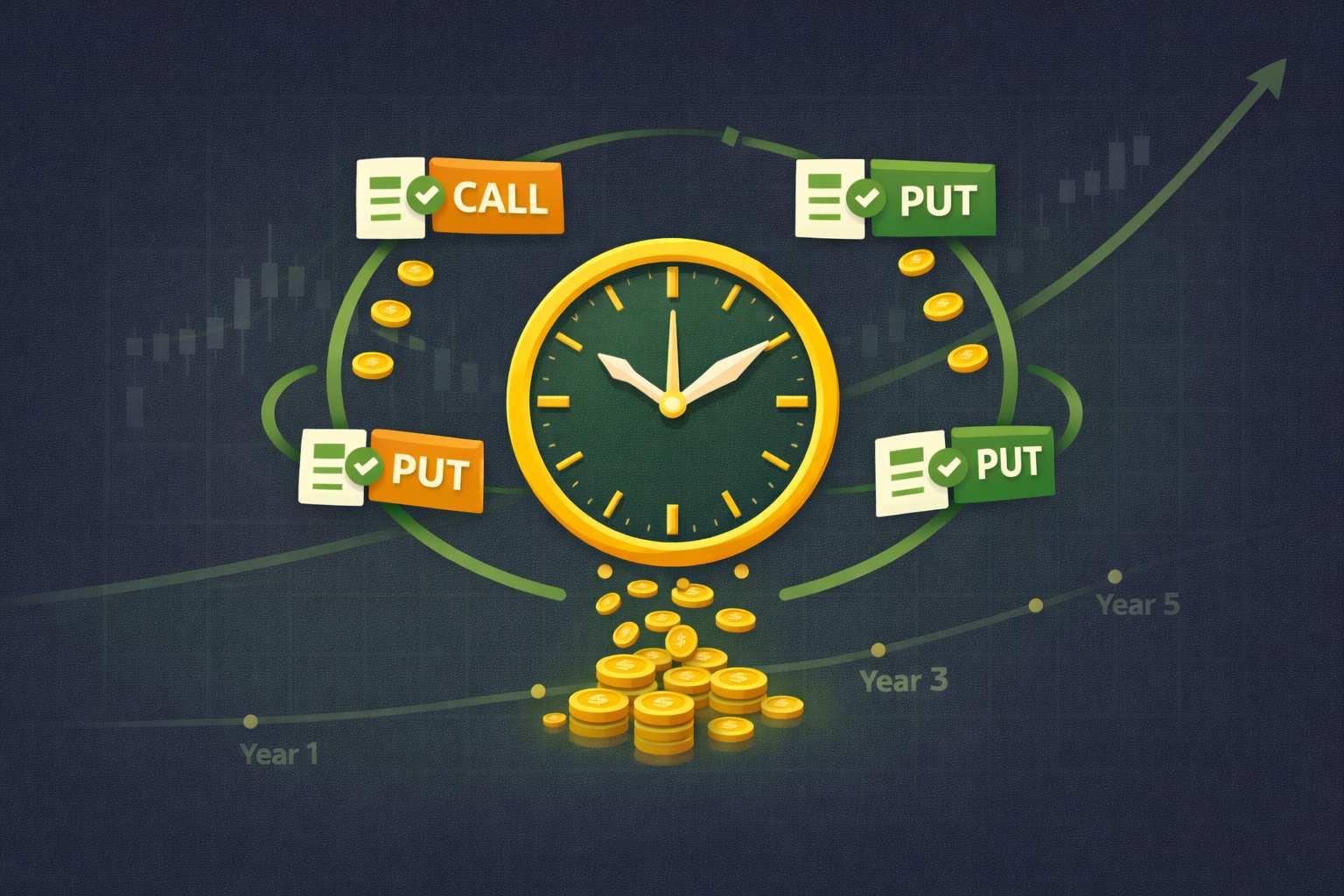
Market timing is a trap that destroys returns for most investors. You buy at what feels like a perfect moment, only to watch the stock drop 20%. Or you wait for the "right time" to enter and miss a 50% run. Value investors avoid this by focusing on business quality and intrinsic value, but options add another layer of protection against timing mistakes.
TL;DR
- Dollar-cost average with premiums: Sell cash-secured puts monthly to build positions gradually, removing the pressure to time entries perfectly
- Generate income while waiting: Collect option premiums even when stocks trade sideways, turning dead time into profitable time
- Reduce entry risk with puts: Get paid to set limit orders, lowering your effective cost basis regardless of when you're assigned
- Extend holding periods with calls: Covered calls let you hold quality stocks longer by reducing cost basis, making short-term volatility less painful
- Time becomes an asset: Long-dated LEAPs give businesses 18-24 months to prove your thesis correct, removing the need for perfect entry timing
The Problem with Market Timing
Most investors believe they can identify the "right time" to buy or sell. They wait for dips, try to catch bottoms, or panic-sell during crashes. Academic research shows this approach consistently underperforms simple buy-and-hold strategies.
Here's why timing fails: you need to be right twice, when you buy AND when you sell. Get either decision wrong and you trail the market. Even professional fund managers with teams of analysts and instant access to information can't consistently time markets.
The typical cycle looks like this:
- Stock drops 15% and you think "I'll wait for it to drop more"
- Stock recovers 20% and you think "I'll wait for the next pullback"
- Stock rises another 30% and you finally buy near a temporary peak
- Stock corrects 10% and you panic sell
- Stock resumes its uptrend without you
This isn't stupidity, it's human psychology. Our brains are wired to avoid losses and chase momentum, making timing decisions emotionally charged and consistently wrong.
How Options Change the Timing Equation
Options don't eliminate timing risk, they redistribute it across multiple decisions over time. Instead of one big decision ("buy 100 shares today"), you make smaller, incremental decisions that reduce the impact of any single mistake.
Cash-Secured Puts: Get Paid to Wait
Let's say you want to own QualityCo but it's trading at $50, slightly above your target of $45. Instead of placing a limit order and waiting (earning nothing), you sell a $45 put expiring in 30 days for $150 premium.
Three outcomes are possible:
Outcome 1: Stock stays above $45 You keep the $150 premium and can sell another put. You've earned 3.3% yield on the cash you set aside ($150 on $4,500) in 30 days. If you repeat this monthly, that's a 40% annualized return while waiting for your entry price.
Outcome 2: Stock drops to $45 and you're assigned You buy at $45 but your effective cost is $43.50 after the premium ($45 - $1.50 = $43.50). You got paid to buy at your target price, and you're entering 13% below the original $50 level.
Outcome 3: Stock drops to $40 before expiration Your put is in the money. You can either accept assignment at $45 (still better than buying at $50), roll the put lower to capture more premium, or close it at a small loss and reassess your thesis.
Notice what just happened: you removed the pressure to time the entry perfectly. You got paid to set your target price, and if the stock never reaches it, you still profited from the premium.
Covered Calls: Lower Your Cost Basis Over Time
If you already own shares, covered calls work the opposite way. They reduce your effective cost basis through premium collection, making your timing of the original purchase less critical.
Example: You bought 100 shares of ABC Corp at $60, thinking it was undervalued. The stock drops to $55 and you're frustrated. Instead of selling at a loss or just holding and hoping, you sell a $62 covered call for $200 premium.
Now your effective cost is $58 ($60 - $2). If the stock rises to $62, you exit at $62 but your real gain is $4 per share (from $58 to $62), not the $2 loss you feared. If the stock stays flat, you collected $200 and can sell another call, further reducing your basis.
Over 6 months, selling calls might reduce your cost from $60 to $54. Suddenly your "bad timing" at $60 becomes less painful because premiums lowered your breakeven point.
LEAPs: Giving Your Thesis Time to Work
Long-dated options (LEAPs) eliminate short-term timing stress entirely. A 2-year call option gives the business 24 months to deliver earnings growth, hit fair value, or get acquired. You're not betting on next quarter, you're investing in the long-term story.
Example: DEF Inc trades at $80 with intrinsic value of $130. You believe it will reach fair value within 2 years, but you're not sure when the catalyst will hit. Instead of buying shares and sweating every quarterly report, you buy a 24-month LEAP call at $75 strike for $1,500.
If the stock takes 18 months to reach $120, you still profit massively ($45 intrinsic value per share × 100 = $4,500 gain on $1,500 invested). If it happens in 6 months, you profit even more. And if your timing is completely wrong and it takes 3 years, you can roll the LEAP forward, extending your timeline.
The LEAP converts timing risk into thesis risk: either the business is undervalued (and time proves it), or it's not (and you lose the premium). You no longer need to predict when the market will recognize the value, just that it eventually will.
The Math of Time Working For You
Let's compare two scenarios using real numbers:
Scenario A: Traditional Stock Purchase (Timing-Dependent)
- You buy 200 shares of XYZ at $50 = $10,000 invested
- Stock immediately drops to $40 (you timed it poorly)
- You're down $2,000 (20% loss)
- You hold for 2 years and stock reaches $70
- Final gain: $4,000 (40% total return over 2 years)
Scenario B: Options Approach (Time-Agnostic)
- Stock at $50, you sell 2 cash-secured puts at $45 strike for $300 total
- Stock drops to $40 before expiration
- You're assigned at $45, but effective cost is $42 ($45 - $3 premium = $42)
- You now own 200 shares at $42 average vs. $50 in Scenario A
- You immediately sell covered calls at $48 for $400 total premium
- Over 2 years, you collect $2,000 in option premiums
- Stock reaches $70
- Your gain: ($70 - $42) × 200 = $5,600 from shares + $2,000 from premiums = $7,600 total (76% return)
Same stock, same timeframe. The options approach nearly doubled your return because you removed timing pressure and collected income throughout the holding period.
Behavioral Benefits: Staying Calm During Volatility
Here's the part most investors miss: options change your psychology around timing.
When you buy stock, every price movement feels significant. A 5% drop triggers anxiety ("Did I time this wrong?"). A 10% gain creates greed ("Should I sell now?"). You're constantly second-guessing your entry and exit timing.
When you're selling puts or calls, volatility becomes your friend. High volatility = higher premiums. A 5% drop? Great, sell more puts at better strikes. A 10% spike? Excellent, roll your calls higher for more premium.
You stop obsessing over daily prices and start thinking in probability ranges. "Will this quality business trade between $40 and $60 over the next 12 months?" is easier to predict than "Will it hit $52 in the next 30 days?"
This psychological shift is invaluable. You make fewer emotional decisions, trade less frequently, and focus on business fundamentals rather than chart patterns.
When Time Alone Isn't Enough
Options reduce timing risk, but they don't eliminate the need for analysis. Time only works in your favor if you've picked quality businesses trading below intrinsic value.
Selling puts on a declining company doesn't make you money, it just gets you assigned shares you shouldn't own. Holding LEAPs on an overvalued stock means time decay erodes value faster than the business grows.
The formula is simple: Options + Quality Businesses + Patience = Timing Risk Reduced.
Without quality businesses, options are just expensive gambles. Without patience, you'll close positions early and miss the compounding. But combine all three, and you've built a system where time becomes your ally instead of your enemy.
For reference, check out Wall St Yardie's valuation tools at https://app.wallstyardie.com to simplify identifying quality businesses trading below fair value.
What Could Go Wrong?
Overconfidence in timing: Selling options doesn't mean you can ignore timing completely. Selling puts right before earnings or major news events can lead to massive losses when stocks gap down.
Mitigation: Avoid selling options within 7 days of scheduled earnings or known catalysts. Let the event pass, then sell options when volatility settles.
Patience failure: You sell a put, collect $200 premium, then close it early for $50 profit because you're impatient. You've sacrificed 75% of the potential return for instant gratification.
Mitigation: Set rules for early closes (e.g., only close if profit reaches 80% of maximum within 50% of the time). Journal every early close to spot patterns.
Premium chasing: High premiums often signal hidden risk. Selling $5 puts on a stock that might drop to $3 isn't smart timing, it's catching a falling knife.
Mitigation: Only sell options on companies you've thoroughly valued and would happily own. Business quality trumps premium size.
Ignoring opportunity cost: You sell puts on XYZ at $40, but it immediately rallies to $60 and never looks back. You collected $200 premium but missed a $2,000 gain.
Mitigation: Accept that opportunity cost is part of the strategy. You can't capture every move. Focus on consistent returns over chasing maximum gains.
Over-leveraging with LEAPs: You buy 10 LEAP contracts thinking "time is on my side," then watch them all expire worthless because your thesis was wrong or timing was way off.
Mitigation: Limit LEAPs to 5-10% of portfolio max. Use them only on highest-conviction ideas with clear catalysts within the option's timeframe.
Next Steps
- Identify 3-5 quality companies you'd like to own but are waiting for better prices. These become candidates for cash-secured puts
- Review existing holdings to see which ones could benefit from covered call income to reduce cost basis
- Paper trade put selling for 2-3 months to understand how premium collection works without timing pressure
- Calculate effective costs: Track how premiums change your entry and exit prices compared to simple stock purchases
- Study cash-secured puts strategy to master patient capital deployment
- Learn about LEAPs for extending time horizons on high-conviction ideas
- Build a timing-agnostic checklist: Define when you'll sell options based on valuation, not price predictions
- Review quarterly performance: Measure how options reduced your timing errors compared to direct stock purchases
Remember: perfect timing is impossible, but consistent execution over time compounds. Options let you profit during the waiting periods, turning patience into premium income. Keep the riddim steady, focus on business quality, and let time do the heavy lifting.
*Disclaimer: This content is for educational purposes only and does not constitute financial advice. Past performance does not guarantee future results. Always conduct your own research before investing.*