
Managing Time Decay in LEAPs
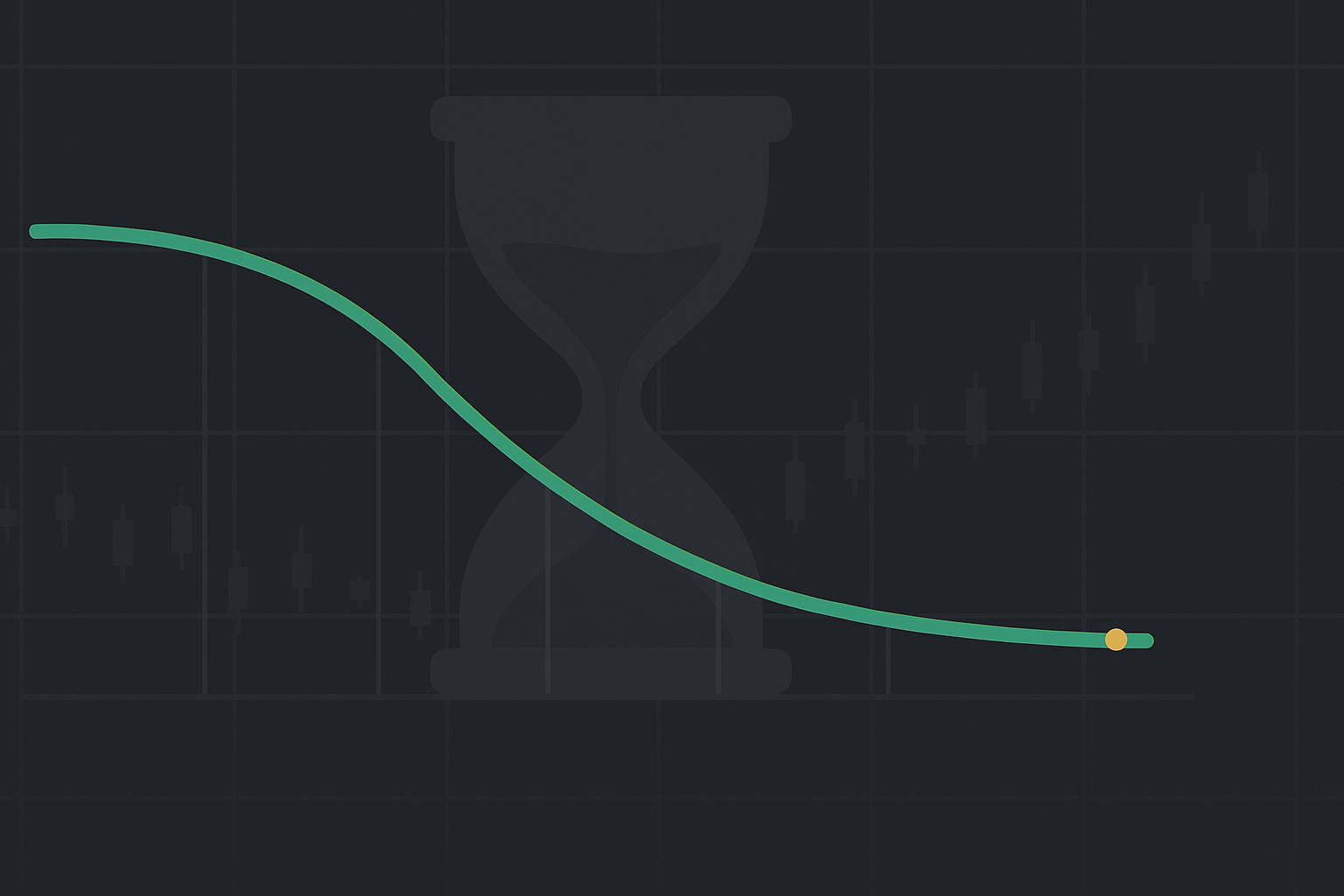
Time decay is the option trader's silent cost, slowly eating premiums as expiration approaches. Short-term options bleed value fast, losing 30-50% of their premium in the final month. LEAPs decay differently, eroding gradually over 18-24 months, giving value investors room to let intrinsic value compound before theta accelerates.
TL;DR
- Theta is non-linear: LEAPs lose value slowly at first (months 18-12), then faster as expiration nears (final 6 months)
- Long time horizons work for you: 18-24 months gives businesses time to deliver earnings growth and reach fair value
- Monitor 6-9 months out: When your LEAP has 6 months left, theta accelerates sharply, time to roll or close
- Deep ITM slows decay: In-the-money LEAPs decay slower than at-the-money because most value is intrinsic, not time
- Theta costs less than margin: Even with decay, LEAPs cost less than 6-10% annual margin interest
What is Time Decay (Theta)?
Time decay, measured by theta, is the dollar amount an option loses each day as it approaches expiration. Think of it like ice melting, the closer you get to the deadline, the faster it disappears.
For a short-term option (30-45 days), theta might be $0.10-$0.20 per day. That's $3-$6 per month, or 5-10% of the option's value. Over 30 days, a $5 option could decay to $3 just from time, even if the stock doesn't move.
LEAPs work differently. A 2-year LEAP with a $15 premium might decay $0.02-$0.05 per day in the first year, that's $7-$18 over six months, or 5-12% of the premium. The decay is spread out, giving you time to be right about the stock's valuation.
Why LEAPs Decay Slowly at First
Theta isn't a straight line, it's a curve. Long-dated options lose value gradually at first because time value is spread across many months. The market assumes the stock has plenty of time to move, so the option retains most of its premium.
Let's say you buy a 24-month LEAP on "GrowthCo" at a $90 strike when the stock is $100. You pay $18 per share ($1,800 per contract). In the first 6 months, the LEAP might lose $2-$3 from time decay, assuming the stock stays flat. That's 11-17% decay over half a year, manageable compared to short-term options that would lose 50%+ in the same period.
By month 12, you've lost another $3-$4, total decay around $6-$7. You're still holding $11-$12 of value, and the stock has had a full year to reach your fair value target (say $120).
When Theta Accelerates (The Final 6 Months)
Once a LEAP drops below 6-9 months to expiration, theta accelerates sharply. The option is transitioning from a long-term bet to a short-term trade, and the market prices that risk.
In months 18-24, your LEAP might lose $5-$7 from time decay if the stock hasn't moved. That's 40-50% of the remaining premium evaporating in 6 months. This is the danger zone for value investors, you're paying for time but not getting much in return.
Key rule: Don't let LEAPs expire. When you hit 6-9 months remaining, evaluate the position. Is the stock near fair value? Close or roll to a new 18-24 month contract. Is it still undervalued? Roll to extend your time horizon and reset theta.
Managing Theta with Strike Selection
The strike price you choose dramatically affects theta. Deep in-the-money (ITM) LEAPs decay slower because most of their value is intrinsic, not time. At-the-money (ATM) or out-of-the-money (OTM) LEAPs decay faster because they're mostly time value.
Example: GrowthCo trades at $100.
- $70 strike LEAP (deep ITM): Costs $35. Intrinsic value is $30, time value is $5. Theta might be $0.03/day. You're paying $5 for 2 years of time, about 14% of the premium.
- $100 strike LEAP (ATM): Costs $18. All time value, no intrinsic. Theta might be $0.05/day. You're paying $18 for 2 years of time, 100% of the premium.
The deep ITM LEAP decays slower because only $5 (14%) is at risk from time. The ATM LEAP decays faster because the entire $18 (100%) is time value. For value investors, deep ITM LEAPs are safer, you're buying mostly intrinsic value with a small time premium.
Rolling LEAPs to Reset Theta
Rolling is the art of closing an expiring LEAP and opening a new one with more time. It's like refinancing a loan, you extend the deadline to avoid accelerated decay.
Let's say you bought a 24-month LEAP on GrowthCo at $90 for $18. After 18 months, the stock is at $110, and your LEAP is worth $22 ($20 intrinsic + $2 time). But you only have 6 months left, theta is about to spike.
Roll strategy: Sell the $90 LEAP for $22. Buy a new 24-month LEAP at $95 for $21. You've locked in $1 of profit, reset your theta curve, and extended your position for another 2 years. The new LEAP starts decaying slowly again, giving you time for the stock to reach $130.
Rolling costs transaction fees (usually $1-$2 per contract), but it's cheaper than letting theta crush your position in the final months.
Comparing Theta to Margin Interest
Even with time decay, LEAPs cost less than margin debt. Let's compare:
Margin debt: Borrow $10,000 at 8% annually. Over 2 years, you pay $1,600 in interest, no upfront cost but recurring drain on returns.
LEAP: Buy 1 LEAP for $1,500 (controls $10,000 worth of stock). Over 2 years, you lose $1,500 to theta if the stock stays flat, all upfront, no recurring cost.
Margin interest is guaranteed, you pay 8% every year regardless of stock performance. LEAP theta is offset by gains if the stock appreciates. If GrowthCo rises from $100 to $120 (20% gain), your LEAP might double in value ($1,500 → $3,000), completely covering theta and delivering a 100% return.
Margin debt would deliver a 40% return ($10,000 → $12,000, minus $1,600 interest = $400 profit on $10,000 = 4% annually, 8% over 2 years, but you started with $10,000 cash, so 20% total return minus 16% interest = net 4% gain). Wait, let me recalculate: $10,000 grows to $12,000, minus $1,600 interest = $10,400 net. That's a 4% total return over 2 years, or 2% annually. LEAPs win.
What Could Go Wrong?
Stock stays flat or declines: If GrowthCo stays at $100 for 2 years, your LEAP decays to near zero. You lose $1,500 (100% of premium). Margin debt would cost $1,600 in interest, similar loss but with no upside potential.
Misjudged fair value: If your intrinsic value estimate was wrong (GrowthCo is worth $95, not $120), the stock won't reach your target, and theta eats your premium. Always use conservative valuations, cheat with Wall St Yardie to confirm fair value before buying LEAPs.
Volatile market crushes implied volatility (IV): If IV spikes when you buy (premiums high) and crashes later (premiums low), your LEAP loses value from both theta and IV contraction. Buy LEAPs when IV is normal or low, not during panic.
Forgot to monitor expiration: Letting a LEAP decay past 6 months without rolling is like ignoring a melting ice cream cone. By month 3-6, theta is devastating. Set calendar reminders at 9 months to review positions.
Over-leveraged position: Buying too many LEAPs amplifies theta risk. If you allocate 50% of capital to LEAPs and they all decay, you've lost half your portfolio. Keep LEAPs to 10-20% of total capital, treat them as leverage, not core holdings.
Next Steps
- Set expiration alerts: Add calendar reminders at 12, 9, and 6 months before LEAP expiration to review positions
- Use deep ITM strikes: Reduce theta risk by buying LEAPs with 70-80% intrinsic value, not pure time value
- Plan to roll early: Don't wait until month 3-6, roll at 6-9 months to avoid accelerated decay
- Compare theta to margin: Calculate the cost of borrowing versus LEAP premium to confirm LEAPs are cheaper
- Read Using LEAPs in Concentrated Bets for strategies on managing theta in high-conviction positions
- See Rolling LEAPs for Long-Term Holding for detailed tactics on extending positions without loss
- Visit The Poor Man's Covered Call to learn how to offset theta by selling short-term calls against LEAPs
*Disclaimer: This content is for educational purposes only and does not constitute financial advice. Past performance does not guarantee future results. Always conduct your own research before investing.*