
Position Sizing with LEAPs
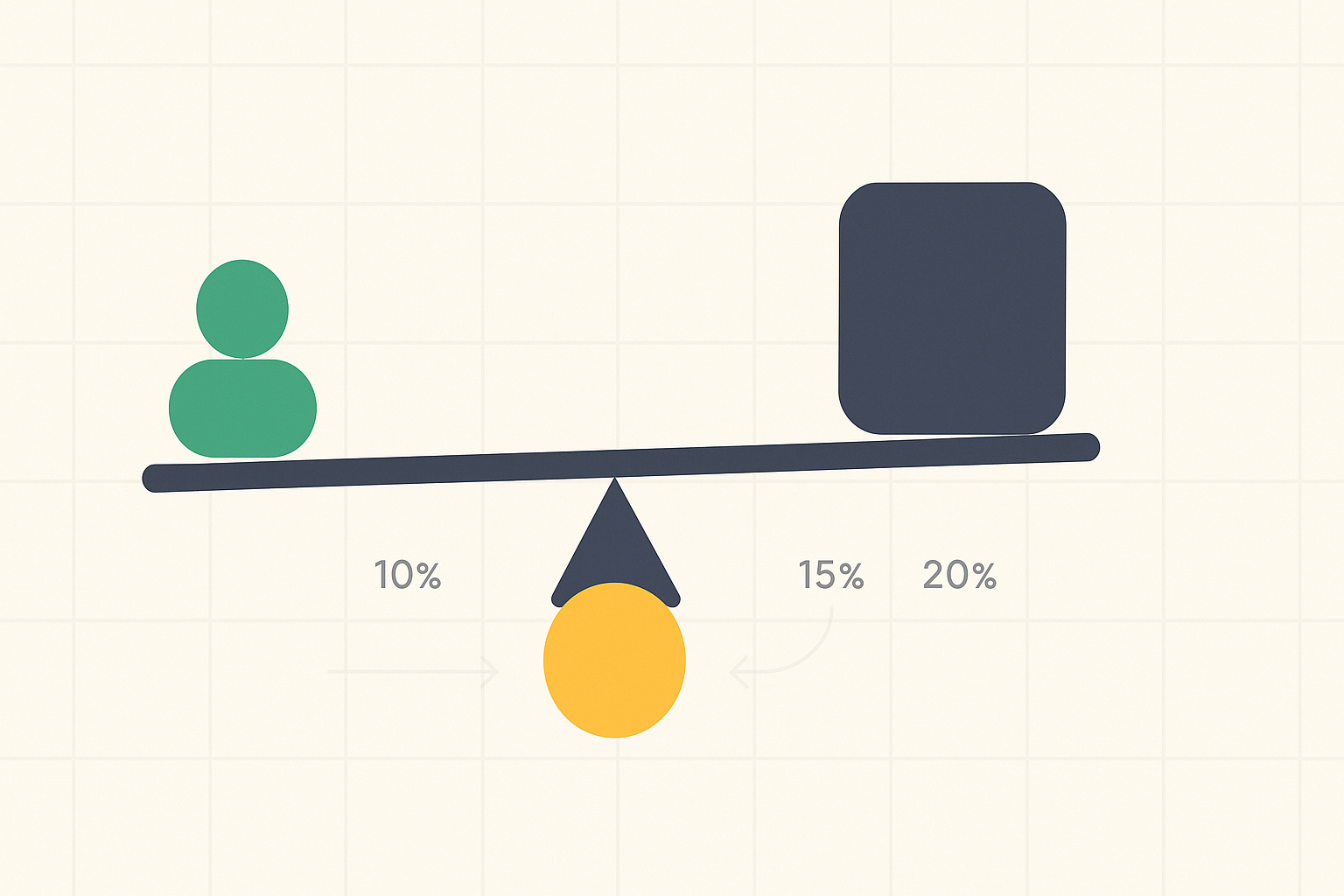
Leverage makes small mistakes catastrophic and smart decisions incredibly profitable. The difference isn't just what you buy, it's how much you buy. Position sizing determines whether LEAPs amplify your wealth or wipe out your portfolio. Most investors fail not because they pick bad stocks, but because they size positions recklessly. Here's how to use LEAPs without gambling your future.
TL;DR
- 10-20% max allocation: LEAPs should never exceed 10-20% of your total portfolio, even on high-conviction ideas
- 1-3 positions maximum: Concentrate on your best 1-3 LEAP ideas, not 10-15 positions that dilute focus
- 50-70% stock core: Keep the majority of your portfolio in stock ownership for stability and income
- 10-20% cash reserve: Always hold dry powder for opportunities, corrections, or rolling contracts
- Risk per position = 2-5% of portfolio: Never let a single LEAP loss exceed 2-5% of your total net worth
The Kelly Criterion Doesn't Apply (And Why That's Good)
Some traders use the Kelly Criterion to size positions based on probability of success and expected return. It works for blackjack and sports betting, but it's dangerous for LEAPs because:
- You can't calculate exact probabilities: No one knows if a stock will hit intrinsic value in 18 months
- Kelly assumes infinite trials: You don't get infinite chances, each LEAP has one outcome (profit or loss)
- Kelly ignores time decay: The formula doesn't account for theta eating your premium every day
Instead, value investors use a simpler rule: size for survival first, growth second. The goal is to stay in the game long enough for your edge (valuation analysis) to compound over decades.
The 10-20% LEAP Allocation Rule
No matter how confident you are, LEAPs should never dominate your portfolio. Here's the framework:
Conservative (10% in LEAPs):
- 70% stock ownership (long-term holdings)
- 10% LEAPs (1-2 high-conviction ideas)
- 20% cash (dry powder)
Moderate (15% in LEAPs):
- 65% stock ownership
- 15% LEAPs (2-3 positions)
- 20% cash
Aggressive (20% in LEAPs):
- 60% stock ownership
- 20% LEAPs (3-4 positions)
- 20% cash
Why the cap at 20%? Because LEAPs can go to zero. If you put 50% of your portfolio into LEAPs and half of them expire worthless, you just lost 25% of your net worth. No amount of gains on the winners makes up for that kind of setback, especially if you need to withdraw money during a downturn.
Position Sizing per LEAP Trade
Within your LEAP allocation, size each position based on conviction and risk.
High-conviction idea (5-10% of LEAP allocation):
- All three valuation models agree (discounted growth, cap rate, payback time)
- Stock trading 30-40% below intrinsic value
- Strong business fundamentals (low debt, predictable cash flow, economic moat)
- Clear catalyst within 12-18 months (earnings recovery, activist campaign, industry tailwind)
Example: $10,000 portfolio → 15% LEAP allocation = $1,500 → high-conviction trade = $750-1,500 (1-2 contracts)
Medium-conviction idea (2-5% of LEAP allocation):
- Two valuation models agree, one is neutral
- Stock trading 20-30% below intrinsic value
- Good fundamentals but some uncertainty (cyclical industry, management changes, recent earnings miss)
- Catalyst is less certain or further out
Example: $10,000 portfolio → 15% LEAP allocation = $1,500 → medium-conviction trade = $300-750 (1 contract)
Low-conviction idea (skip it):
- Only one model says undervalued, or none do
- Stock trading <20% below intrinsic value
- Weak fundamentals (high debt, declining margins, competitive threats)
- No clear catalyst
Rule: Don't buy LEAPs on low-conviction ideas, no matter how "cheap" the premium looks. Leverage on bad ideas accelerates losses.
The 2-5% Risk Rule
This is the most important rule for survival. For every LEAP you buy, calculate the maximum loss (the premium paid) as a percentage of your total portfolio.
Formula:
- Risk per LEAP = Premium Paid ÷ Total Portfolio Value
Example:
- Total portfolio: $50,000
- LEAP premium: $1,500 (1 contract)
- Risk: $1,500 ÷ $50,000 = 3%
If the LEAP expires worthless, you lose 3% of your portfolio. That's survivable. Do it 4 times in a row (unlikely if your valuation process is sound), and you're down 12%. Painful, but not portfolio-ending.
Now compare to reckless sizing:
Bad Example:
- Total portfolio: $50,000
- LEAP premium: $10,000 (6-7 contracts on one stock)
- Risk: $10,000 ÷ $50,000 = 20%
If this LEAP fails, you just lost 20% of your net worth in one trade. Do it twice, and you're down 36%. Recovery from that kind of hole takes years, even with great stock picks.
Rule: Never let a single LEAP position risk more than 5% of your portfolio. For most investors, 2-3% is safer.
Concentration vs. Diversification in LEAPs
LEAPs favor concentration, not diversification. Here's why:
The case for concentration:
- High-conviction ideas are rare. If you find 10 "LEAP-worthy" stocks, you're probably lowering your standards
- Leverage amplifies mistakes. Spreading 20% of your portfolio across 10 LEAPs (2% each) means 10 opportunities to be wrong
- Monitoring 10 LEAPs is exhausting. You need to track earnings, roll contracts, adjust strikes, which dilutes focus
The case against over-diversification:
- If you own 10 LEAPs and 7 expire worthless, the 3 winners need to 3-4x just to break even
- LEAPs aren't stocks. Stock diversification reduces volatility because companies don't all fail at once. LEAPs all face the same enemy (time decay), so diversification doesn't protect you the same way
Best practice: Limit yourself to 1-3 LEAP positions at a time. If you can't find 3 stocks that meet all your valuation criteria, hold cash and wait.
Example Portfolio Construction
Let's build a realistic portfolio using these rules.
Starting capital: $50,000
Allocation:
- Stock core (65%): $32,500 in 5-8 long-term holdings (mix of dividend payers and growth compounders)
- LEAPs (15%): $7,500 across 2 high-conviction ideas
- Cash (20%): $10,000 in dry powder
LEAP Position 1 (high conviction):
- Stock: QualityCo (trading at $100, intrinsic value $140)
- Strike: $90
- Premium: $15 per share
- Contracts: 3 ($4,500 total)
- Risk: $4,500 ÷ $50,000 = 9% of portfolio
LEAP Position 2 (medium conviction):
- Stock: ValueCo (trading at $80, intrinsic value $110)
- Strike: $75
- Premium: $10 per share
- Contracts: 3 ($3,000 total)
- Risk: $3,000 ÷ $50,000 = 6% of portfolio
Total LEAP exposure: $7,500 (15% of portfolio) Total risk if both fail: 15% (survivable, though painful)
Scenario 1: Both LEAPs succeed (stock reaches intrinsic value in 18 months):
- QualityCo LEAP gains $25 per share ($140 stock - $90 strike - $15 premium) × 300 shares = $7,500 gain (167% return on premium)
- ValueCo LEAP gains $20 per share ($110 stock - $75 strike - $10 premium) × 300 shares = $6,000 gain (200% return on premium)
- Total portfolio gain: $13,500 on $7,500 invested = 27% gain on total portfolio in 18 months
Scenario 2: One succeeds, one fails:
- QualityCo LEAP gains $7,500
- ValueCo LEAP expires worthless, lose $3,000
- Net gain: $4,500 (9% gain on total portfolio)
Scenario 3: Both fail:
- Lose $7,500 (15% portfolio hit)
- Stock core and cash remain intact ($42,500)
- Learn from mistakes, rebuild with remaining capital
Adjusting Position Size Over Time
As your portfolio grows, your LEAP allocation can grow in absolute dollars, but the percentage should stay constant.
Year 1: $50,000 portfolio
- 15% LEAP allocation = $7,500
Year 5: $150,000 portfolio (assuming 20% annual returns)
- 15% LEAP allocation = $22,500
You're now deploying 3x the capital into LEAPs, but it's still only 15% of your portfolio. This is how you scale leverage safely over time.
Key insight: As capital grows, you can add more LEAP positions (4-5 instead of 2-3) or increase contract size on existing positions, but the risk per position should stay at 2-5% of total portfolio.
What Could Go Wrong?
Position sizing mistakes are the #1 killer of LEAP strategies:
- Overleveraging: Putting 30-50% of your portfolio into LEAPs exposes you to catastrophic losses if timing is wrong
- Too many positions: Spreading LEAPs across 8-10 stocks dilutes conviction and makes monitoring impossible
- No cash reserve: Going "all-in" on LEAPs leaves no dry powder for better opportunities or rolling contracts
- Ignoring correlation: Buying 3 LEAPs on banks, all move together, so you don't have true diversification
- Chasing losers: Doubling down on a failing LEAP position to "average down" compounds mistakes instead of cutting losses
Mitigations: Stick to the 10-20% total LEAP allocation rule, limit yourself to 1-3 high-conviction positions, always keep 10-20% cash, avoid concentrated sector exposure in LEAPs, and set a stop-loss rule (e.g., exit if LEAP loses 50% of value unless fundamentals remain strong).
Next Steps
- Audit your current portfolio: Calculate what % is in stocks, LEAPs, and cash. If LEAPs exceed 20%, rebalance
- Calculate risk per position: For every LEAP you own or are considering, divide premium by total portfolio value. If it's >5%, reduce size
- Limit positions: If you own 5+ LEAPs, identify your top 2-3 highest-conviction ideas and close the rest
- Build a cash cushion: If you're <10% cash, sell a few positions to create dry powder
- Read more: Check out Maintaining Margin of Safety with LEAPs to ensure you're preserving downside protection, and The Math Behind LEAPs Leverage to understand how position size affects amplification
*Disclaimer: This content is for educational purposes only and does not constitute financial advice. Past performance does not guarantee future results. Always conduct your own research before investing.*