
Using Options to Reduce Cost Basis
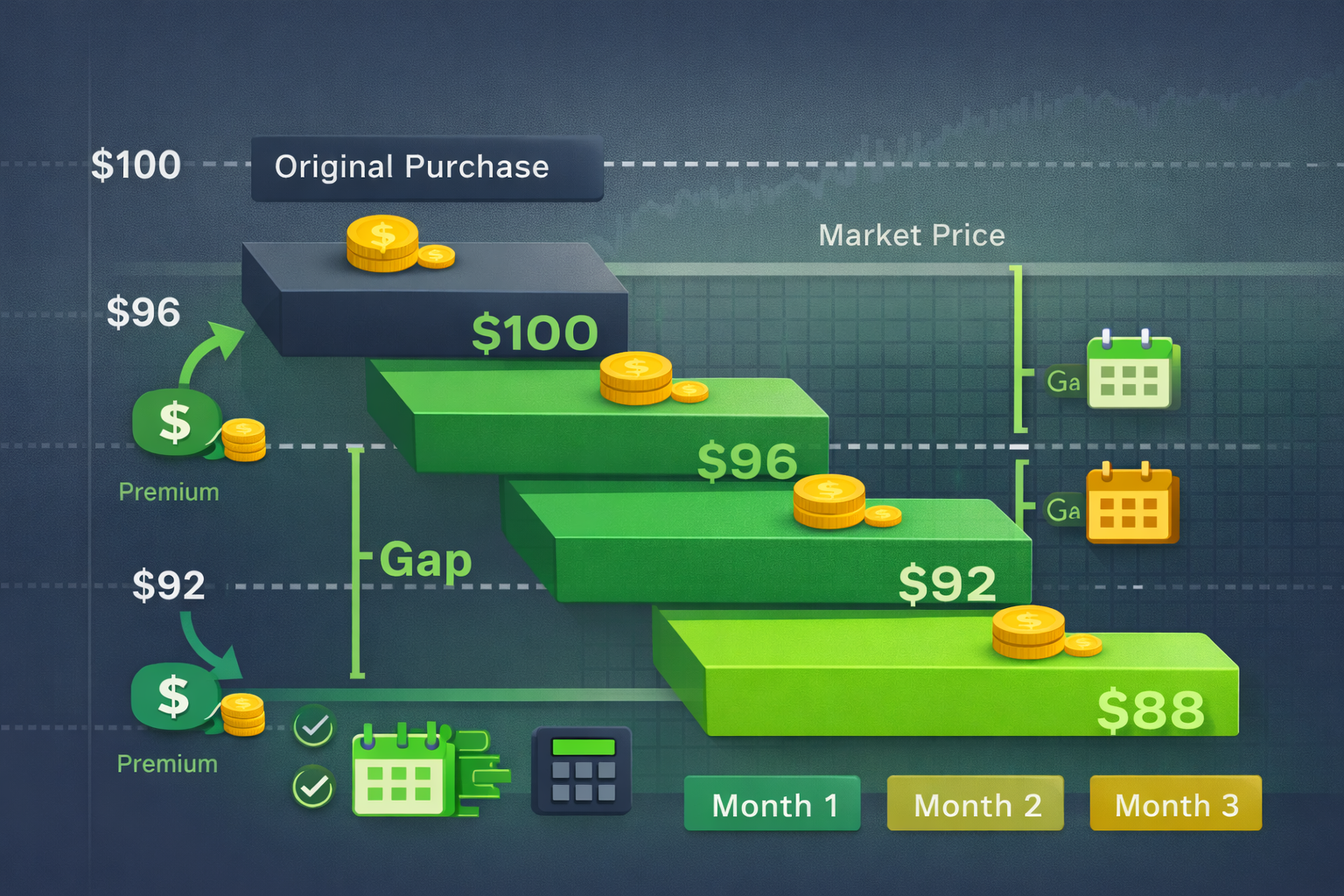
Every dollar you collect in option premiums reduces your cost basis, turning a mediocre entry price into a great one. Buy shares at $100, sell calls for $3, sell puts for $4, and suddenly you're in at $93 net. Do this systematically across months and years, and you can own wonderful companies at prices 15-30% below your original purchase, even if the stock never drops.
TL;DR
- Every premium collected lowers cost basis: $1 in premium = $1 off your effective purchase price
- Covered calls reduce basis immediately: Sell calls on owned shares, premiums drop your net cost
- Puts lower basis before purchase: Sell puts, collect premium, get assigned at strike, net cost is strike minus premium
- Compound reductions: Layer calls and puts over time, each contract chips away at cost basis
- Track meticulously: Use spreadsheets to log every premium, maintain accurate net cost per share
The Core Concept: Premiums Are Discounts
When you collect an option premium, you're being paid to make a commitment. Sell a covered call, you commit to sell shares at the strike if the stock rises. Sell a cash-secured put, you commit to buy shares at the strike if the stock drops. In exchange, you get cash upfront.
That cash isn't profit until you close the position. It's a reduction in your cost basis. If you buy shares at $100 and immediately sell a call for $2, your net cost is $98 per share. If you sell puts for $3, get assigned at $95, your net cost is $92. Every premium stacks, lowering your effective entry price.
Value investors use this systematically. Instead of trying to time perfect entry points (impossible), they enter near fair value and then reduce their cost basis over months with premium income. Eventually, their effective purchase price is 20-30% below current market price, creating a huge margin of safety.
Think of it like buying a car. You negotiate the price from $30,000 to $28,000 (7% discount). But then the dealer offers you $1,000 cash back if you agree to service the car there for two years. Your net cost is now $27,000 (10% discount). Option premiums work the same way: every premium collected is cash back that lowers your net cost.
Strategy 1: Covered Calls to Lower Basis on Owned Shares
If you already own shares, selling covered calls is the simplest way to reduce cost basis.
Example: You bought 100 shares of QualityCo at $100. The stock trades sideways for months at $98-102. You're frustrated because you're not making money, but you believe it's worth $120 long-term.
Month 1: Sell 1 call at $105 strike, 30 days, $2 premium. Collect $200. Your cost basis drops from $100 to $98 per share.
Month 2: Call expires worthless (stock at $101), keep $200. Sell another call at $105, collect $200. Cost basis drops to $96.
Month 3: Call expires worthless (stock at $103), keep $200. Sell another call at $105, collect $200. Cost basis drops to $94.
After three months, you own shares at $94 net cost while the market price is $103. You're up $9 per share (9.6% gain) even though the stock barely moved. If the stock eventually reaches $120 fair value, your gain is $26 per share (27.7% return) instead of $20 (20% return).
This compounds powerfully over time. If you hold QualityCo for two years and sell calls monthly at $2 average premium, you collect $4,800 total (24 months x $200). Your $100 cost basis becomes $52. Even if the stock stays flat at $100, you've made $48 per share (48% gain) just from premiums.
When to use: On stocks you plan to hold long-term that are trading near or slightly below fair value. The premiums slowly accumulate, turning patience into profit.
Strategy 2: Puts to Lower Basis Before Purchase
If you don't own shares yet but want to build a position, sell puts to collect premiums before assignment. This lowers your effective purchase price below the strike.
Example: QualityCo trades at $100, fair value $120. You'd happily own shares at $95, but you want to lower your cost even more.
Setup: Sell 1 put at $95 strike, 60 days, $4 premium. Collect $400.
Outcome 1 (stock stays above $95): Put expires worthless, you keep $400. You didn't buy shares, but you earned 4.2% on the $9,500 committed capital in 60 days (about 25% annualized). Repeat with a new put.
Outcome 2 (stock drops to $88): Put is assigned, you buy 100 shares at $95. Net cost: $91 per share ($95 - $4 premium). Current price: $88. You're down $3 per share on paper, but you're still 24% below your $120 fair value target. Now you can sell covered calls to lower basis further.
By selling puts first, you entered at $91 instead of $100, a 9% discount before even considering future call premiums. If you'd bought shares at $100 outright, you'd be down $12 per share ($88 price) instead of $3.
When to use: When building new positions in undervalued stocks. Selling puts generates income while you wait, and lowers your net cost if assigned.
Strategy 3: Wheel Strategy (Continuous Basis Reduction)
The wheel strategy combines puts and calls to lower cost basis continuously, whether you own shares or not.
Step 1 (no shares yet): Sell cash-secured put at $95, collect $4 premium.
Step 2 (assigned shares at $95): Net cost = $91. Sell covered call at $105, collect $3 premium. Cost basis drops to $88.
Step 3 (call expires worthless): Keep shares, sell another call at $105, collect $3 premium. Cost basis drops to $85.
Step 4 (shares called away at $105): You sold shares at $105 with an $85 cost basis. Profit = $20 per share (23.5% gain). Now go back to Step 1, sell a new put, and repeat.
Each cycle lowers your cost basis by $7-10 per share. Over multiple cycles, you're buying and selling the same stock repeatedly at improving prices. The first cycle might net 20% profit, the second cycle 25%, the third cycle 30%, because your cost basis keeps dropping.
Real numbers over one year:
Cycle 1: Sell put at $95 ($4 premium), assigned at $91 net. Sell calls for $3 each (4 months), basis drops to $79. Shares called at $105. Profit: $26 per share (33% gain).
Cycle 2: Sell put at $100 ($5 premium), assigned at $95 net. Sell calls for $3 each (3 months), basis drops to $86. Shares called at $110. Profit: $24 per share (28% gain).
Total: $50 per share profit in one year from the same stock, entirely from premium collection and basis reduction.
Strategy 4: Stacking Premiums Across Multiple Contracts
Instead of one put or one call, layer multiple contracts at different strikes to accelerate basis reduction.
Example: You own 300 shares of QualityCo at $100 average cost.
Month 1:
- Sell 3 calls at $105, $107, $110 strikes, collect $2, $1.50, $1 premiums = $450 total.
- Cost basis drops from $100 to $98.50 per share.
Month 2:
- All calls expire worthless, keep $450. Sell 3 new calls at similar strikes, collect $450 again.
- Cost basis drops to $97 per share.
By selling multiple strikes, you increase total premium collected while diversifying assignment risk. If the stock jumps to $108, only the $105 call is assigned (100 shares sold), you keep the other 200 shares to continue wheeling.
When to use: On larger positions (200+ shares) where you can afford to have some shares called away while retaining others.
Tracking Cost Basis Accurately
Lowering cost basis only works if you track it properly. Brokers don't automatically adjust for option premiums, you must calculate net cost manually.
Formula: Net cost per share = (original purchase price - total premiums collected) / number of shares owned
Example:
- Bought 100 shares at $100 = $10,000 cost.
- Sold 4 calls over 4 months, collected $800 total.
- Net cost = ($10,000 - $800) / 100 = $92 per share.
If you sell shares today at $98, your broker shows a $200 loss ($9,800 - $10,000). But your actual cost is $9,200, so you made $600 profit. Always track premiums separately to know your true cost basis.
Use a spreadsheet with columns: Date, Action (buy/sell call/put), Strike, Premium, Shares Owned, Net Cost Basis. Update it every time you trade options. This prevents mistakes when calculating taxes and realized gains.
Real Example: Two-Year Basis Reduction
Let's walk through a multi-year example using "RetailCo," purchased at $80 per share.
Year 1:
- Q1: Sell 4 monthly calls at $85, collect $2 each = $800. Basis drops to $72.
- Q2: Stock rises to $88, shares called away at $85. Realized gain: $13 per share ($85 - $72). Profit: $1,300.
- Q3: Sell put at $80, collect $4, assigned at $80. Net cost: $76. Sell 3 calls at $85, collect $6 total. Basis drops to $70.
- Q4: Sell 3 calls at $85, collect $6 total. Basis drops to $64.
Year 2:
- Q1: Stock rises to $90, shares called at $85. Realized gain: $21 per share ($85 - $64). Profit: $2,100.
- Q2: Sell put at $82, collect $5, assigned at $82. Net cost: $77. Sell 3 calls at $87, collect $6 total. Basis drops to $71.
- Q3-Q4: Continue wheeling, collect $12 more in premiums. Basis drops to $59.
End of Year 2: You've cycled through RetailCo three times, collected $3,800 in total premiums, and your current cost basis is $59 per share on a stock trading at $85. Even if you hold here, you're up $26 per share (44% gain) from a $59 cost basis.
This is the power of systematic basis reduction. You didn't need the stock to double, you built profit through patience and premium collection.
What Could Go Wrong?
Lowering cost basis with premiums isn't risk-free. Here are the pitfalls:
Shares called away during a rally: You sell calls at $105, stock jumps to $130, shares called at $105. You miss $25 per share in upside. Mitigation: only sell calls on stocks near fair value. If a stock is still 40% undervalued, hold without calls or use very high strikes ($120+).
Assignment during crashes: You sell puts at $95, stock drops to $60, you're assigned at $95. Your cost basis is $91 after premium, but the stock is at $60. You're down $31 per share. Mitigation: only sell puts on quality businesses with strong fundamentals. If earnings collapse or debt spikes, stop selling puts immediately.
Death by a thousand calls: You sell so many calls that shares are constantly called away, preventing you from holding during major rallies. Mitigation: sell calls on only 50-70% of your position, keep 30-50% uncovered to capture big moves.
Tax complications: Every option expiration and assignment is a taxable event. Frequent wheeling creates dozens of transactions to track. Mitigation: keep detailed records, use tax software that handles options, or limit wheeling to IRAs (tax-deferred accounts).
Changing fundamentals: You're lowering basis on QualityCo assuming it's worth $120, but new data shows it's worth $80. You keep selling calls and collecting premiums, but the stock is overvalued. Mitigation: review valuation quarterly. If fair value drops below current price, stop selling puts and exit covered calls early.
Next Steps
Lowering cost basis with options requires discipline and tracking. Here's how to start:
- Pick one stock to wheel: Choose a high-quality business trading at 15-25% below fair value. Commit to wheeling it for 6-12 months
- Track every premium: Create a spreadsheet with Date, Strike, Premium, Net Cost Basis columns. Update it after every trade
- Start with covered calls: If you already own shares, sell 1-2 calls monthly for 3 months to see how basis reduction feels in practice
- Add puts gradually: Once comfortable with calls, start selling 1 put per month on stocks you want to own
- Review fundamentals monthly: Read Checklist for Evaluating a Value Stock to ensure your stocks still deserve the strategy
Lowering cost basis turns time into money. Every month you hold a stock, you can collect $200-400 in premiums, chipping away at your entry price. Use Wall St Yardie to identify undervalued stocks worth the commitment, then systematically reduce your basis with calls and puts. Keep the riddim steady, stack those premiums, and watch your cost basis melt away.
*Disclaimer: This content is for educational purposes only and does not constitute financial advice. Past performance does not guarantee future results. Always conduct your own research before investing.*